I remember that just a few years ago (in 2000), Amsterdam aborted a pilot program for public bicycles, because they all got stolen or vandalised [1]. Since 2006 a new nationwide scheme is being operated by the country's largest train company and it's doing great.
I currently live in London and the Barclays Cycle Hire scheme, operated by the TFL, is pretty successful. Successful enough to recently get expanded to cover a greater area [2]. It's not just popular with tourists, but also with people who use it to commute to work. I rarely see a bicycle vandalised and you have to be an idiot to steal one.
Some differences that I think make the London bicycles successful, whereas other plans failed:
1. To hire a bike, you need to either rent one on the spot, or become a member. In both cases, you are using a credit or debit card, knowing that you will be charged if the bike gets stolen or vandalised on your watch. They are also linked to your name.
2. Hiring a bike gets progressively expensive as you keep it longer, so you are likely to return it to a docking point sooner rather than later.
3. The bikes are ugly, heavy and instantly recognisable. Not something you'd like to keep home.
4. The bikes are built like tanks. I don't think it's easy to remove things like bicycle seats etc. at all.
5. The scheme only costs slightly over £50 a year. That is how much I pay in maintenance of my own bike.
6. Even if you buy a bike in London, you cannot always park it at your home or workplace. Renting allows you to bike and just park it in a docking station in the city.
The London bike plan also has plenty of problems (no available docking points, AARGH!), but overall it seems to work pretty well. I wouldn't discount the concept altogether.
[1] http://nl.wikipedia.org/wiki/Witte_fiets
[2] http://www.tfl.gov.uk/corporate/media/newscentre/metro/18137...
I agree that there is room for creativity here. There are so many things to try. For instance, I noticed that ViaCycle seems to be piloting on college campuses. Might it be possible to put docking stations _inside_ of academic buildings, requiring a college ID swipe to get in, and possibly being within viewing distance of a building attendant?
There are quite a few cycle hire alleycats around the world. The London ones are fun.
One of my friends rode the Dunwich Dynamo on a cycle hire bike. 200km overnight on a bike that you couldn't service or fix a puncture on... pretty brave.
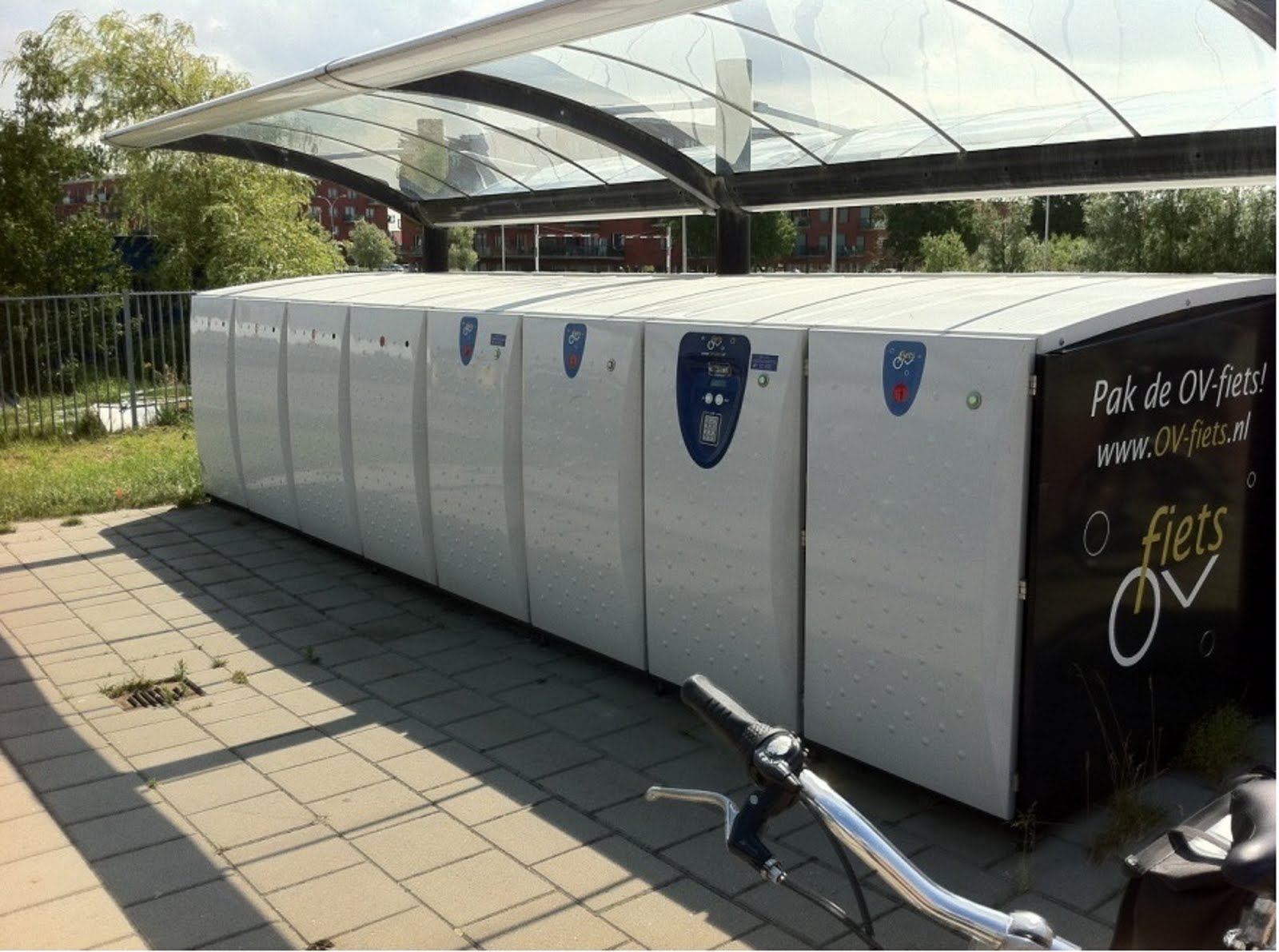
By the way, stashing bikes behind locked doors is actually what the "OV-fiets" plan in The Netherlands is doing (they are more like lockers, really: http://3.bp.blogspot.com/-PeUfIZbrzY4/Ti8hHZCsLyI/AAAAAAAAAE...), and it works quite well. As a bonus, you can also rent those lockers for your own bike.
http://www.bromptondock.co.uk/
Then you get one of the best folding bikes, perfectly good for general use too.
They have plans for long-term hires too so you can use a bike daily and guarantee it is there for your commute. In the UK these Brompton Docks are mostly located at rail stations so that you have a bike waiting for you at the end.
It's a stretch to say "This will never work!" when something already is working, and avoiding the specific issues complained about.
http://blogs.montrealgazette.com/2012/03/16/bixi-raising-mon...
"In total, the Montreal operation will bring in $7.4 million. Bixi will spend $7.3 million on operations, marketing, administration and research and development."
That's for 2012. Projections aren't results, but things don't sound too far off. What are you basing your statement on?
http://ruk.ca/content/how-use-copenhagen-city-bikes/
It's a free system, because the 20 kroner coin that is used to unlock the bike is released when the bike is returned. These bikes have 20-inch wheel, which are non-pneumatic. Single-gear with a coaster brake. And weigh about 50 pounds. Also built like tanks. As a tourist, it increased my enjoyment of the city by a factor of 10.
Your article on Velib is from 2009, and while they did have a lot of theft early on, it was due to a design flaw. They've since fixed the problem and recently celebrated their 100 millionth ride. Also, theft hasn't been a problem at all in the US:
http://www.streetsblog.org/2010/11/29/theft-and-vandalism-ju...
A $1K bike may seem expensive, but they have a lot of differences from your local $100 Walmart cruiser. Our bikes are meant to last for years while being used 24/7 and withstanding any weather. They're also hardened against theft.
The financials are good as well. DC breaks even on operations, while Denver has made a sizable profit:
http://www.commuterpageblog.com/2012/02/capital-bikeshare-st...
Their main issue is high capital cost, which viaCycle solves. We can do a large city programs or let organizations install bikes on a grass-roots level, so you don't need to splash out $5+M to have reliable transportation.
Essentially, I pay my membership fee so that someone else bears the risk of owning a bike in a city filled with vandals and thieves. It's a good deal.
Or do you use these bikes going between destinations which have these bike stations so you don't expose yourself to any risk of leaving unattended?
viaCycle's system allows riders to secure their bicycle between stations, so you're not forced to ride from to specific points until you're ready to check it back into the system. Enforcing a penalty for bikes that get stolen helps reinforce proper locking of the bicycle.
Cars are subsidized via road building/maintenance, after all, and it's likely to cost less to maintain a few bikes than it does to maintain roads/parking for the cars that would displace them.
Imagine if there were no transportation subsidies and road maintenance were privatized. A nightmare. It seems entirely reasonable that forms of transportation that can help bring tax revenues to a city are subsidized, and therefore entirely reasonable to create a start-up based in part on those subsidies.
Isn't HN usually full of people saying you have to figure out what customers will pay for (meaning, what customers will pay more for than it costs you to provide)? Bike-sharing is not one of those things. End-user customers will not pay you more than it costs to provide.
A lot of successful start-ups don't sell to consumers at all. And kazevedo comments that they are in fact structured as a B2B start-up. [1]
For example, DC's capital bikeshare comes from Federal grants that covered the setup costs, while Velib in Paris is entirely operated by JCD, an advertising agency that operates the system in exchange for advertising rights.
Take Velib. Last time I checked, JCD had revenue of $54 million, with an operating expense of roughly $35 million on Velib. The theft and vandalism complaints were regrettably exaggerated when the City and JCD were re-negotiating their contract last year. That they need subsidies to exist is patently false.
Financial aspects of US systems are also healthy as pointed out by other commenters.
On a related note, the subsidies to other modes, mainly rail and roads, are several orders of magnitude higher.
Here's a picture of them
http://www.bikehype.com.br/wp-content/uploads/2012/02/alugue...

and a supporting article
http://www.smartplanet.com/blog/global-observer/take-two-for...
Denver's bike share is a blessing, especially for visitors who don't have a rental car.
I'm in Montreal, and there aren't many bikes with missing parts. There are deflated tired, but that's about it.
It's not profitable domestically yet, but that seems more due to mismanagement than an underlying flaw.
Having a bike locked up at my apartment doesn't do me much good after walking downtown with friends. For $65, I can get an annual membership to the Minneapolis bike share program (Nice Ride MN, a Bixi system) and have bikes just waiting for me all over the city. It's awesome.
So instead of a $100 headache, you now have a $1500 headache.
You do avoid maintenance costs, of course. Which are $0/year for many bicyclists.
How does zipcar handle car theft?
  - I don't have to worry about my own (rather nice) bike getting stolen
  - I don't have to lug around a lock+chain for short trips.
  - I'm not stuck with my bike if I use another means for the return trip
    (e.g., going to a bar, then cabbing home or hitching a ride)
When I first moved here I was amazed by the number of people that use the program. I'm quite curious about the actual municipal cost, though-- especially as a before/after comparison. Also would be interested in other effects. For instance, did it decrease parking woes? Increase public transportation usage? Cause more traffic accidents?
Sign up for CaBi - if for no other reason than it helps prevent you arriving at your destination looking like a sweathog from the walk from the metro.
The end-user price points are just examples of what's feasible if you buy their products.
I own several bicycles, but if I don't ride one to work, I can't ride one home. Due to my schedule, I often don't ride to work in the morning, but I would gladly ride home. A bike sharing program solves that problem. $20 a month? Well worth it.
I hate the idea of promoting cycling (roads are for cars, not bikes), but there's nothing about what ViaCycle is doing that suggests it is doomed to failure.
I live in a city with a bike-sharing system. It's deeply unprofitable and exists only at the sufferance of the city government. There are a number of flaws. Number 1 is that people who ride bikes don't rent them, they own them. For $100 anyone can purchase a bicycle that will last indefinitely and be available 24/7/365. Number 2 is that people vandalize the shit out of bicycles. Seats will be stolen, tires slashed, bicycles thrown in the river, cables cut. You're free to go after this sort of bicycle since it has no owner - no one is going to come storming out of a nearby store and kick your ass. Crackheads will steal a bicycle seat and try to sell it for $5 to get a hit of crack - I have watched them do it. We live in a world where people are routinely electrocuted trying to steal copper from live power wires and blown up stealing gasoline from pipelines. Those bikes might as well have a sign on them saying "steal me". If even ONE of the components can be removed and sold for a few dollars...
http://www.theglobeandmail.com/news/world/pariss-pedal-power...
http://www.cbc.ca/news/canada/montreal/story/2009/06/26/mont...
Combining high cost of bicycles, ongoing cost to repair/replace/corral wayward bicycles, and low cost of the alternative (owning a bicycle), there is just no chance that this can be a successful business. You will recall people talking about the future of electricity, as being "too cheap to meter". Well, electricity never made it that far, but time on a bicycle did. Bicycle-time is too cheap to meter.
(There may be some future for the company selling to cities or other large entities which intend to subsidize all the costs associated, but it can never be successful as a stand-alone business.)