> But fusion often use it's pending development as an argument against fission - a technology we already have and desperately need to adopt now.
If it helps, CEA is also doing a ton of R&D on fission (and batteries, among others). But there, the real issues are mostly political.
Unless you can do a science fiction thing of turning off the sun, and harvesting the hydrogen in it to power local reactors in earth orbit to provide the energy (light) we need without letting the vast majority escape our solar system unused. Otherwise that big fusion reactor in the sky provides all the energy we need.
Energy storage is far from a solved problem. Tesla produces ~40 gigawatts of storage capacity an entire year. California alone consumes ~800 gigawatts of power in a day. Even if Tesla dedicated every bit of lithium it had to building storage capacity for just one state, and demand didn't increase, it would realistically still take over a decade to keeping the lights on purely with renewables for a 24 hour period. At which point the first battery packs would be nearing the end of their service life.
One of those hopefully-you-don't-need-it concerns but it is starting to become a more pressing with the uptick in wars and unrest that seems to be going on.
On a 1:500 year time horizon we know there are threats that dim the sun (possibly quite a bit shorter now that nuclear weapons are on the table and we seem to be incapable of dealing with that threat productively - the number of actors with nukes is growing). Planning for that isn't anti-renewable, it is just cautious.
And nobody was talking about K-Pg events. You'll notice the years quoted were all after the Roman Empire was founded.
Aggressive predictions have us generating ~6-10TWh of batteries by 2030 meaning we’re going to still need about another 3-6 years to actually satisfy demand (ignoring complexity of hooking up the batteries). On top of that, the batteries require rare earth metals that companies are gearing up to satisfy by strip mining the ocean floor for those polymetallic nodules, operations which have a very real risk of completely destroying deep ocean life. It seems to me like it’s slow and ecologically potentially more destructive than even global warming. Is it really wise to be betting on batteries at this scale vs tried and true nuclear fission which doesn’t carry any of these risks?
What people forget is batteries are a manufactured good, which follows Wright's Law. Manufactured goods (like energy storage, TVs, lightbulbs) obey different economic principles to scarce goods (like land, services, or goods with scarce inputs), and they have effectively unlimited supply. The supply is strictly set by demand.
Aggressive predictions of ~6-10TWh/year of batteries in 2030 are more predictions of demand, not so much predictions of supply. If market demand in 2030 is 30TWh/year, then that's what the market will produce. But don't blame manufacturers for the fact that demand in 2030 will only be 6-10TWh/year! And don't confuse this for a sector's inability to increase supply!
The response when seeing a "6-10TWh/year" prediction should be "how can we incentivize demand so that this number is 30TWh/year instead".
Lithium ion is preferred for vehicles because it's lighter, but again we are talking about stationary storage, so the extra weight of sodium ion isn't a problem.
The technology is solved, and the materials needed to make it abundant. It's all about demand. If the demand is there, the industrial capacity will follow. But right now, the market is only demanding about 3TWh/year of storage, and so that's how much industry is producing.
It takes a lot of time for new battery technologies to scale and disrupt existing ones and entrenched players have an incentive to continue competing. Sodium ion, iron air etc might replace lithium ion on the 30 year time scale but lithium ion will continue to drive down costs and up its capacity to try to compete and it has significantly more revenue to fund this by being the only player in the market. So it’s not clear when alternative batteries will start to replace lithium ion, but at scale it’s unlikely to be a quick process. And please don’t pretend like it’s all a demand side problem. It takes time to build out new factories from manufacturing all the equipment needed to acquiring and training employees. There’s plenty of demand for cheap batteries and the ability to manufacture simply isn’t there either and it’s being brought online. Oh and that capacity being added? It’s all lithium ion and requires a long pay off for that investment. Lithium ion is going to be potential a significant ecological debt worse than fossil fuels if the ocean floor strip mining gets going.
And it is all a demand side problem. If the world wanted to buy 10 or 20 TWh a year at current market prices, that's how much would be produced. But the world doesn't want to do that and hence that much isn't produced. This is Econ 101 for goods with non scarce inputs. It doesn't take ten years to scale up production for commodity goods.
As for scarcity, inputs to lithium ion ARE scarce which negates your entire model. Pretending they aren't is where you're making a mistake. Lithium, cobalt & nickle are relatively scarce and the mines for that have to scale up to meet demand as well. You've also got a workforce to train to do the work which takes time & is also input-constrained. That's why there's massive NEW lithium mines being opened in the US & elsewhere to extract existing reserves to meet the growth in lithium ion batteries. If the world thought that sodium ion or ion air was an immediate future, you wouldn't see these massive large-scale investments into lithium. Lilthium-ion batteries is going to be a large and growing market for decades which brings me back to the strip mining of the ocean floor that's coming to support that.
Whright's law by the way isn't also an inevitable effect that goes on forever. At some point your exponential plateau's and you no longer see such exponential decrease in pricing. That's why processors aren't getting cheaper and compute isn't scaling up quite in the same way as in the early days. There's only so efficient you can make something.
Most states currently only care about installing solar and wind -- not storage -- because they are still majority fossil fuels, and at the current moment it makes no sense to install storage if you still have fossil fuel to dislodge. The only exception is really California, who are installing storage, but their bottleneck is not the market's ability to deliver enough supply.
There are also many storage options beyond lithium ion if you only spent a moment to look.
Maybe fusion will be an alternative someday but for now it's just a fantasy. We need to act based on what's proven to work today.
Fission as a solution is something that is popular on social media, for reasons that are utterly mystifying to me. The arguments are invariably a few words that reach sweeping conclusions with no actual data backing it up, and lots of data contradicting it that the individual appears oblivious to.
Current supply of storage matches current demand. Supply is low only because demand is low. However, as demand increases, supply will continue to match demand, and moreover the price will actually decrease because of the fact that the learning curve is a function of production volume.
This has been a steady empirical phenomenon for 30+ years, and it's predicted by basic economics principles. It's not going to change now!
This is true for all battery types, but especially for sodium ion and iron air, which are constituted of abundant materials. Sodium ion in particular has very similar behavior and cost to lithium ion.
This confusion you're having is you seem to be conflating manufactured goods (like batteries) with scarce goods like land or services, whereby there's a fixed supply that can't be increased and where Wright's Law doesn't apply. This is not correct.
Storage is more like televisions or light bulbs, where you can basically make as much of it as you want, and the price will keep declining as more is made. And supply will always be there for demand, whatever the level of demand happens to be (in this case, a lot).
Converting every passenger car and light truck in the US to a BEV would involve enough batteries to store something like two days of the average grid output, which is more than would be needed for a cost optimal wind/solar/battery/hydrogen system for a 100% renewable grid.
Assuming the power stored in these vehicles can be reclaimed by the grid anytime they want?
It's an argument I like to use. When someone claims "we can't use X because of reason Y, we have to do Z instead" I look to see if Z also is hit by objection Y.
Another example of this is "renewables require too much material that we can't recycle", at which point I observe that the quantity of materials produced by society as a whole greatly exceeds what renewables would involve, even if the society is powered by nuclear. The US produces 600 megatons of construction and demolition waste a year, for example. Renewable waste would just be a minor blip on this existing waste stream. So, either recycling this waste isn't actually needed, or a putative sustainable nuclear-powered society has discovered how to recycle it, so just toss the renewable waste (which is almost entirely things like steel, aluminum, and glass) into that same recycling infrastructure.
Steel mills run when power is cheap. They historically have run at night (and only minimum power during the day) because cheap power is available at night. Of course there are lots of different steel mills, older ones can't shut down - but modern ones don't run 24x7, they run when power is cheap. Even the old 24x7 ones did their yearly maintenance in December - when power demand is highest (Christmas lights).
Wind and solar are easially predicted a few days in advance with high accuracy, and thus the mills change their shifts/output to follow the cheap power. If it is cloudy/no wind they will send their employees home (with pay) or do maintenance for that week while waiting on more cheaper energy. It takes a tremendous amount of energy to melt iron and so they manage this carefully because it makes them money. They can't deal with months of no production, but they can manage a week here and there.
If this isn't about ceasing carbon emissions then none of this is necessary. Fire up the coal plants!
(1) the emissions of a 98% renewable + 2% natural gas grid that comes online in 6 years, assuming fossil fuels for t between [t, t+6 years].
(2) the emissions of a 100% fission grid that comes online in 16 years, assuming fossil fuels for t between [t, t+16 years].
If you insist on ignoring the temporal nature of cumulative emissions, then sure, you can arrive at a convenient but false conclusion. But any honest analysis will consider the emissions in that [t+6 year, t+16 year] interval.
(... it would also consider things like social licensing risks leading to early plant closures like what's happening in Germany, or the fact that nuclear will likely be paired with natural gas too because demand itself is variable, and overbuilding nuclear is expensive.)
Start both with the same (current) % for renewables and (1) have some realistic ramp-up of renewables to reach 98%, and (2) keep the renewables more modestly rising in the fission version, while fading-out fossils in favor of fission
You should also account the carbon foodprint of grid-level energy storage (yes, it will be needed, even with the natural gas plans), vs the foodprint for fission plants (undoubtedly quite bad).
Renewables are by their nature much more distributed in space, which makes them much harder to enclose and control in the way required to reproduce the current structure, especially as they are mainly being built by challengers who aren't really interested of forming monopolies with the fossil industry.
Which is why we aren't building record-setting amounts of natural gas infrastructure, oh wait...
https://headwaterseconomics.org/wp-content/uploads/HE_electr...
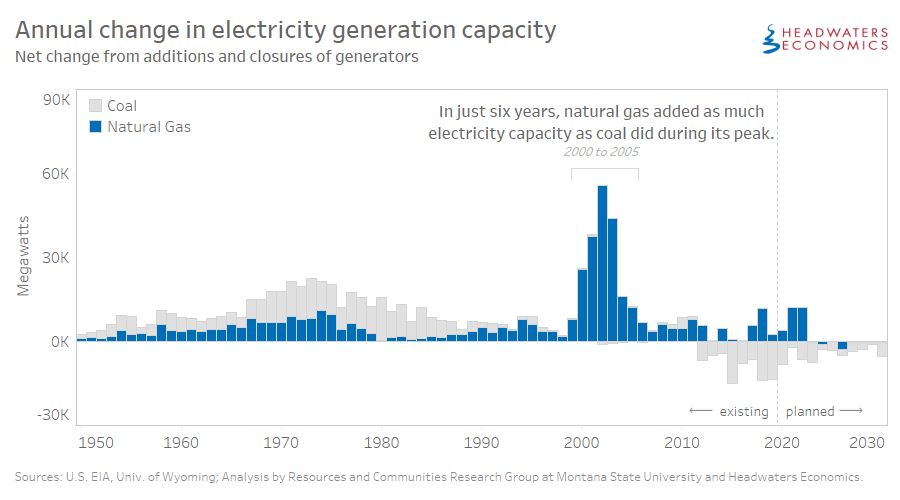
It's not. If it was the world wouldn't be using 140k TWh of fossil-fuel-produced energy[1], and would be using a lot more than 9k TWh of renewable energy[2]
[1] https://ourworldindata.org/grapher/global-fossil-fuel-consum... [2] https://ourworldindata.org/grapher/modern-renewable-energy-c...
Don't mistake skepticism for hate. I will be the first one to applaud a commercial fusion reactor. But fusion proponents often use it's pending development as an argument against fission - a technology we already have and desperately need to adopt now.