I think we need to think about management in a graded way, with different areas having different mandates and different policies, with different restrictions on usage, and all working together in a way that repairs what we have damaged, and working together with policies for land that isn't government-managed.
However, we have to be prepared to stand up for restrictions that a lot of people aren't happy with. A lot of people aren't happy that we don't log and mine natural parks. If we give in to the "common sense" of people like that, on the reasoning that "nothing is truly wild," we'll lose the rest of what we have, and very quickly. The moment you use a word like "recreation" in connection with a federally-managed piece of land, people are going to assume it's for partying and drunk-operating noisy vehicles. And they're going to call you elitist and out-of-touch for pushing back. We absolutely need to fight those battles, even without a blind and absolute belief in "wilderness."
Even "leave no trace" outdoor practices leave some trace. Multiply that by the number of visitors and the impact is obvious.
We need more places like that, especially since we're becoming more urbanized, and kids are growing up without access to less-developed areas. Granted, there are a lot of unique places like Sequoia and Zion that can't be replicated, but every landscape has its own charms.
- No motorized vehicles
- No permanent buildings - this even means bathrooms and bear boxes many places. Stephen Mather Wilderness (North Cascades National Park) is currently doing surveys asking about if they should install more of them or add more bathrooms.
- Limited trail signage
- No "trammeling" which essentially means: don't mess with natural processes.
These Wilderness Areas are very different from Federal Recreation Areas, yet you can still "recreate" in a Wilderness area seeking solitude and nature.
https://www.fs.usda.gov/Internet/FSE_DOCUMENTS/stelprdb52701...
Carrying long guns is legal on all BLM land. Discharging them may be restricted in some areas, though.
(There might be a counterargument to this; I have not found it in the article)
When an area is designated as a Wilderness, that requires a certain style of management that might or might not be appropriate for the area and is very hard to change. More flexible management options are often a good thing, and there are lots of options for managing federal lands (NRAs, NCAs, etc) that don’t come with the strict rules of a Wilderness but are still pretty limited in what they allow.
Non-Wilderness designations do mean having to place more trust in the people on the ground and the agencies involved. You might or might not think that’s appropriate. But what OC and the article both say is that we have to make those decisions with the mindset that “no management” isn’t the default or best option, and often people hear the word “wilderness” and assume that it is.
I'd love it if things were mostly left up to local decision makers. Some trails aren't appropriate for bikes and that's fine, Wilderness area or no. Some trails within Wilderness areas would be no problem at all for bikes.
And tactically, maybe environmentalists would gain some allies if they weren't trying to push cyclists out.
Nothing like listening to few hours of planes on approach to SeaTac to spoil the whole “untrammeled by man” thing.
(Not that I have a good solution to this problem. Air traffic noise abatement involves a ton of tradeoffs)
It's very clear that Wilderness areas are not meant for commercial exploitation. I believe a few of them have grandfathered in grazing rights, perhaps to get them over the line politically, but that's about the extent of it and I would not expect that to change.
Pardon my french, but fuck no. I think "Wilderness" is a perfectly appropriate designation for the intended use of these lands-to keep man-made impact on them as little as possible. The fact that it's not "historically accurate" doesn't diminish the value of the label in its intended use.
I'm sure it's geo-dependent, but I wonder if there's a wider media narrative driving the association.
Nobody really cares about the four wheelers flying around on BLM land in the middle of the desert, but if the only "wilderness" near you is mostly ATV trails, it's not a fun place to hike. Those are often called "recreation areas" to distinguish them from places where no vehicles are allowed.
Some American Indians loathe the patronizing idea that they were/are nobles in-tune with nature. They may not have exploited nature with mechanized efficiency, but at least some tribes took what they needed when they needed without the hippie vision of harmonious balance and they engaged in violence and war when it made sense to do so —kind of like other groups of humans elsewhere.
There’s a theory the current state of the Amazon is the product of heavy cultivation. Hence its high quantity of edible plants. I’m not sure the degree of acceptance that theory has though.
Also, I did not realize the Wilderness designation had anything to do with indigenous Americans. Is that a thing?
Grazing animals can prevent grassland from reforesting by eating the tree shoots, but they can't knock down mature trees. There is some evidence paleoindians would burn down forests to expand grasslands. https://en.wikipedia.org/wiki/Great_bison_belt
Thus, in some parts of the US, you can stand on a hill, look out at miles of apparently untouched land without a single permanent structure, but is as artificial and manmande as a golf course, crafted from thousands of years of invisible labor.
Hem, not. This is not how it works. A very old, well cared apple tree can produce 800 Kg of apples a year. You can't breed a cow just using the grass growing in the same surface. It needs more space. A lot of animals eat leaves, twigs, fruits, and flowers of trees. The thicker the "layer alive" that can sustain animals the better. Trees are like the fat of the land. Rocky areas are like the skeleton of the land. Grasslands left unregulated enter very fast into a tragedy of the commons spiral by being invaded by cattle, sheeps and goats turning into rocky areas.
Ceteris paribus, normal trees will always outcompete fruit trees because they don't have to waste any energy on fruit, and use that instead on trunk height, putting fruit trees in their shade and, eventually, starving them to death.
You can, of course, maintain an orchard of fruit trees, manually removing competitor species, but then we're talking about stationary farming, a technology that Plains Indians did not have ten thousand years ago.
Not. Not always. This is a too simplistic point of view.
Is like asking "how many penguins can be seen in this photo of the sahara?" If the conclusion is that penguins can't compete with camels, is a deceptive one.
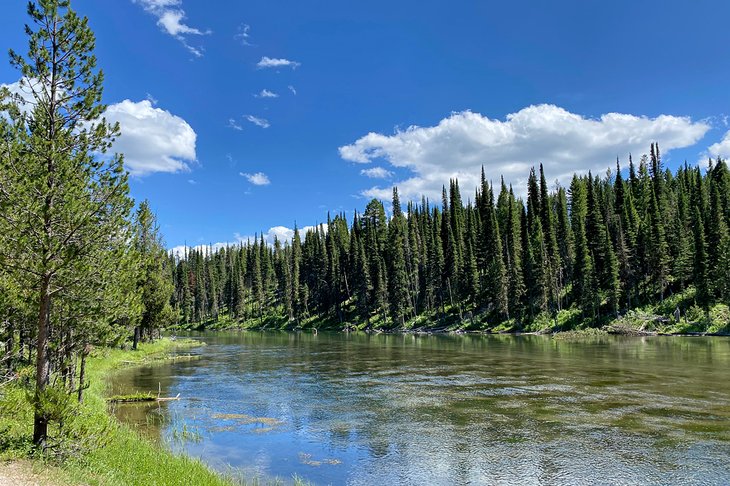
This forest is a conifer forest. Put the same conifer in a place suitable for growing walnuts, figs, or hazelnuts and we will see who kills who.
But, the author is fundamentally correct about the relationship between humans and natural areas. The untrammeled nature of officially designated wilderness areas is a myth. The degree of trammeling of course varies by area and over time, but it's there no matter where you look. To the extent that we continue to put stock in this concept of "untrammeled by man", we do a disservice to the history and continued existence of indigenous Americans. Also, we needlessly hamstring our own management actions which compound into real threats on the very thing the act set out to protect. Increasingly I think to myself "no more wilderness" and advocate for proposed wilderness study areas to have a management designation more closely aligned with their intended use: National Recreation Areas.