I don't think it's unreasonable to assume this could reduce their total audio-sourced bandwidth consumption by a considerable amount while maintaining/improving reliability and perceived "quality".
Looking at wireshark review of whatsapp on an active call there was around 380 UDP packets sent from source to recipient during a 1 minute call, and a handful of TCP packets to whatsapp's servers. That would yield a transmission overhead of about 2.2kbps.
quick edit to clarify why this is: you can see starting ptime (audio size per packet) set to 20ms here, but maxptime set to 150ms, which the clients can/will use opportunistically to reduce the number of packets being sent taking into consideration the latency between parties and bandwidth available.
(image): https://www.twilio.com/content/dam/twilio-com/global/en/blog...
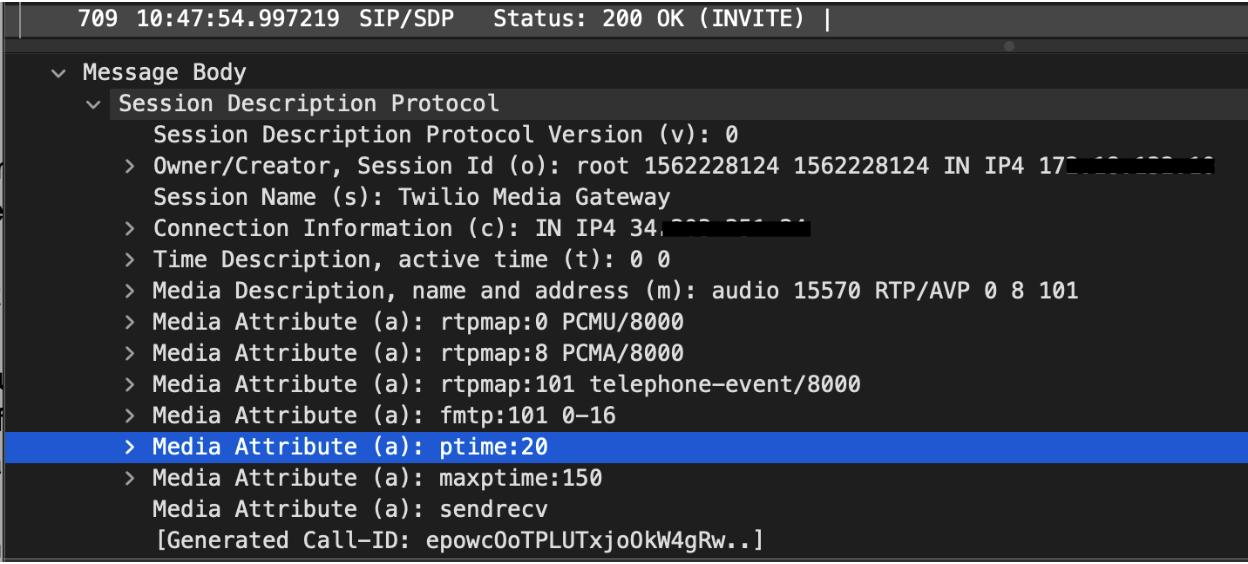
> 380 UDP packets sent from source to recipient during a 1 minute call, and a handful of TCP packets to whatsapp's servers. That would yield a transmission overhead of about 2.2kbps.
That sounds like way too many packets! 380 packets per second, at 40 bytes of overhead per packet, would be almost 120 kbps.
My calculation only assumes just 50, and that’s already at a quite high packet rate.
> you can rely on protocols that have less error correction
You could, but there's no way to get a regular smartphone IP stack running over Wi-Fi or mobile data to actually expose that capability to you. Even just getting the OS's UDP stack (to say nothing of middleboxes) to ignore UDP checksums and let you use those extra four bytes for data can be tricky.
Non-IP protocols, or even just IP or UDP header compression, are completely out of reach for an OTT application. (Networks might transparently do it; I'm pretty sure they'd still charge based on the gross data rate though, and as soon as the traffic leaves their core network, it'll be back to regular RTP over UDP over IP).
What they could do (and I suspect they might already be doing) is to compress RTP headers (or use something other than RTP) and/or pick even lower packet rates.
> I don't think it's unreasonable to assume this could reduce their total audio-sourced bandwidth consumption by a considerable amount while maintaining/improving reliability and perceived "quality".
I definitely don't agree on the latter assertion – packet loss resilience is a huge deal for perceived quality! I'm just a bit more pessimistic on the former, unless they do the other optimizations mentioned above.
If you have 50ms of latency between parties, and you are sending 150ms segments, you'll have a perceived latency of ~200ms which is tolerable for voice conversations.
One other note is that this is ONLY for live voice communication like calling where two parties need to hear and respond within a resonable delay - for downloading of audio messages or audio on videos, including one-way livestreams for example, this ptime is irrelevant and you're not encapsulating with SRTP - that is just for voip-like live audio.
There is a reality in what OP posted which is that there is diminishing returns in actual gains as you get lower in the bitrate, but modern voice implementations in apps like whatsapp are using dynamic ptime and are very smart about adapting the voice stream to account for latency, packet loss and bandwidth.
That would definitely increase the utility of low bitrate codecs by a lot, at the expense of some latency (which is probably ok, if the alternative is not having the call at all).
During longer monologues, decrease packet rates; for interruptions, send a few early samples of the interrupter to notify the speaker, and at the same time make the (former) speaker's stack flush its cache to allow "acknowledgement" of the interruption through silence.
In other words, modulate the packet rate in proportion to the instantaneous interactivity of a dialogue, which allows spending the "overhead budget" where it matters most.
Edit to add: Meta can also afford to add a bit more sampling delay, because they've got very wide distribution of forwarding servers (they can do forwarding in their content appliances embedded in many ISPs), which reduces network delay vs competing services that have limited ability to host forwarding around the globe. Peer to peer doesn't always work and isn't always lower delay than going through a nearby forwarding server.
You pay that price back when the packets are dropped. We use a lot of advanced codec managers for broadcast, and while they do combining like this, they also offer the ability to repeat frames within subsequent packets. So you may get a packet with frames [1,2,3] then a packet with frames [2,3,4].
The best codecs actively monitor the connection and adjust all these parameters in real time for you.
Pointedly - if you had a 75ms of one-way latency (150ms RTT) between two parties, and you used a 150ms audio segment length (ptime) you'd be getting close to the 250ms generally accepted max audio delay for smooth two-way communication. the recipient is hearing your first millisecond of audio 226ms later at best. If any packet does get lost, the recipient would lose 150ms of your message vs 20ms.
Modern voice apps and voip use dynamic ptime (usually via "maxptime" which specifies the highest/worst case) in their protocol for this reason - it allows the clients to optimize for all combinations of high/low bandwidth, high/low latency and high/low packet loss in realtime - as network conditions can often change during the course of a call especially while driving around or roaming between wifi and cellular.
In addition to that, early VoIP applications mostly used uncompressed G.711 audio, both for interoperability with circuit switched networks and because efficient voice compression codecs weren't yet available royalty-free.
G.711 is 64 kbps, so 12 kbps of overhead are less than 25% – not much point in cutting that down to, say, 10% at the expense of doubling effective latency in a LAN use case.
Yup pretty much. Doubling it for round-trip, 200 ms is a fifth of a second which is definitely noticeable in conversation.
40 ms is a twenty-fifth of a second, or approximately a single frame of a motion picture. That's not going to be noticeable in conversation all.
Of course both of these are on top of other sources of latencies, too.
Speed of sounds is roughly 343 meters per second. Which means translates we can sense the delay difference of about 4-8 meters or so.
Which 100% corresponds with what you are saying. 20 meters is a 58ms-ish delay.
A 200ms is about 70 meters. Which would be like having conversation between people using one of those accidental sound projection features that sometimes happens with large open buildings like sports stadiums.
people talk in a cadence of around 100-200 words per minute. I guess we could say that is 300-600 syllables per minute. So that is about 200-100ms per syllable.
It all kinda lines up.
"We have already fully launched MLow to all Instagram and Messenger calls and are actively rolling it out on WhatsApp—and we’ve already seen incredible improvement in user engagement driven by better audio quality."
What makes you think that they have somehow just been misleading themselves the whole time?
You are right that OPUS already hits the ball for most audio applications. 20kbps is pretty good, and 30 kbps is almost perfect.
Meta has tons of Indian and South Asian users with insanely poor network. It's already using 60ms/120ms packets (16.6/8.3 packet rate) for those people, but still, some calls are still bad.
What this new codec does is to further make the call accessible by bringing down the bitrate, which seems to help their DAU.
Nitpick: measuring packet rate on your device doesn't usually work. I think meta (as well as most other voip providers) is using DTX, so when user doesn't talk, packet rate is 2/sec.
To keep latency low in real-time communications, the packet rate needs to be relatively high, and at some point the overhead of UDP, IP, and lower layers starts dominating over the actual payload.
As an example, consider (S)RTP (over UDP and IP): RTP adds at least 12 bytes of overhead (let's ignore the SRTP authentication tag for now); UDP adds 8 byte, and IPv4 adds 20, for a total of 40. At at typical packet rate of 50 per second (for a serialization delay of 1/50 = 20ms), that's 16 kbps of overhead alone!
It might still be acceptable to reduce the packet rate to 25 per second, which would cut this in half for an overhead of 8 kbps, but the overhead would still be dominating the total transmission rate.
Where codecs like this can really shine, though, is circuit-switched communication (some satphones use bitrates of around 2 kbps, which currently sound awful!), or protocol-aware VoIP systems that can employ header compression such as that used by LTE and 5G in IMS (most of the 40 bytes per frame are extremely predictable).