That part has always bugged me. The Lucifer is always depicted from the Bible's point of view. There are no Gospels Of Hell that give Satan's viewpoint.
And the Bible insists that only its words are true. You must not trust anything else (sorry, too lazy to find the verses right now).
For me, this sounds exactly like every propaganda outlet (and I read a lot of "Pravda" for historical research).
Just for contrast, imagine a Lucifer-character that said: "Yeah, we didn't part on good terms, and I dispute a lot of what's said about me... But I've learned to accept things I can't change and I invite you to watch and judge me by my works."
— Wait, are you guys ... vampires?
— There are many hurtful stereotypes. May we come in?
Satan, as a figure was created (and described) by Christians. So it can't be anything but what it says on the tin.
It's not a real person whose biography they could have lied about - it's a creation they made of words, and those particular words define him.
You could reject their whole teachings and universe, but you can't really say "but what if Satan is actually good?", while accepting he exists. If he was good he just wouldn't be Satan. So it makes as little sense as asking "what if Moby Dick was really a rabbit?" - when Moby Dick only existed as a literary whale Melville conjured.
Similarly, as much as Satan is anything, and is useful for anything, it's for embodying the specific character he was described to be with the specific backstory.
You could write an alternate Satan (like the gnostic gospels do or Milton does), but that's fan-fiction then. The rabbit version of Moby Dick, not the "true" Moby Dick.
Yes, but Christianity is a fan-fiction of the Jewish bible. In the same way, the Quran is a fan-fiction of the former ones.
And the Jewish bible is full of fan-fictions of previous stories, like Gilgamesh.
A lot of Christians would object to that quite strenuously, and quite a few Muslims would stone you if you say these words in a wrong country.
That's why it's important to highlight the inconsistencies in the very logic of the religion.
Does it matter for what we're discussing?
I strongly disagree. Important towards what end? And if that end is getting people to be less religious, I think this is one of the least effective ways to make that point. Trying to dissuade a religious person in the basis of the logical inconsistencies in their religion is the le atheist approach, and seems to be most compelling to the agnostic and atheist crowds.
https://en.wikipedia.org/wiki/Mastema
https://en.wikipedia.org/wiki/Book_of_Jubilees
Mastema being yet another variation on embodiments of Yetzer hara, cause made real of the inclination of man to do evil.
To which I respond: "Silflay hraka, u embleer rah!"
(the hopping in the aboriginal ceremonies reminded me of the very avian caucasian dances: https://www.youtube.com/watch?v=vJ6FzIgKWl0 ; compare https://www.youtube.com/watch?v=eJHCaahJ4pY&t=52s )
Here you can see the children of the Crocodile Islands group use the music of caucasian islanders for their muse: https://www.youtube.com/watch?v=O-MucVWo-Pw
Lagniappe: https://www.youtube.com/watch?v=myKF9mxAJ70
[EDIT: and gu marryuna dhu marryuna may not exactly be a hyperlink, but it does serve as a songline.
TIL "Cockatoo" is a place, in the Top End]
Luritja: https://youtu.be/JjDlbCfybbE?t=27
and, of course, there's English as the modern lingua Pidgin: https://www.youtube.com/watch?v=gw-AgvUEVm4
* https://mgnsw.org.au/wp-content/uploads/2019/01/map_col_high...
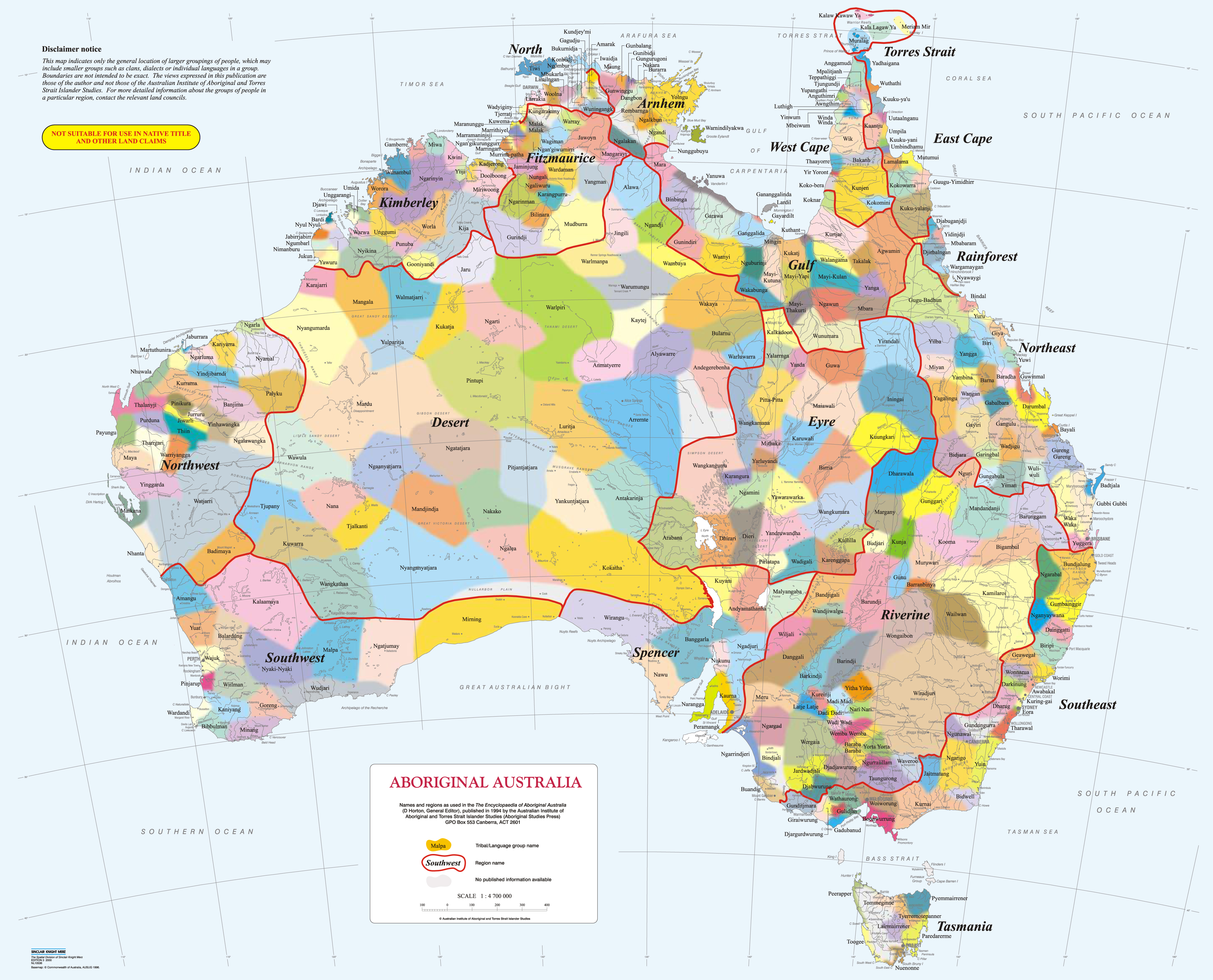
Are you from Australia, or just a WWW fan of music from here?
When I was into The Expanse's Lang Belta (a creole), I was following BBC Pidgin: https://www.bbc.com/pidgin to get some feel for the possible antecedents. (UK:"Most read" = Pidgin:"De one we dem de read well well") Just to complicate things, what gets called "Hawai'ian Pidgin" is actually a creole as well, eg: https://www.youtube.com/watch?v=R15IQAVT7Rg (Is the use of "Aunty" parallel between this and Oz cultures?)
I'm just a fan. Thanks very much for the pointers into a new set of cultures* for me; up until now I've been enjoying cultural appropriations (consider the platypus!) in the other direction, eg polka acca dacca: https://www.youtube.com/watch?v=n_gtGfAail4 (and songlines I only discovered today while trying to figure out what the Oz equivalent of the https://en.wikipedia.org/wiki/Inuksuk might be)
* so far these mobs have been using a basketball court as an impromptu community centre/dance floor, which I guess they share even with very highly produced numbers, like "Baby One More Time"? As basketball had yet to be invented, earlier germans contented themselves with dancing around lime trees: https://de.wikipedia.org/wiki/Tanzlinde
Indigenous Hip Hop Projects have a youtube channel with community made videos from all over the country, eg: https://www.youtube.com/watch?v=GmKxmxk6Gas , https://www.youtube.com/watch?v=tFIOC078g6E - many in English | mixed, some in local languages. There are also channels such as https://www.youtube.com/@SkinnyfishTV/videos et al.
polka acca dacca covers songs by scots | brits adrift in the colony but the cultural appropriation doesn't stop there! (There are AccaDacca covers from across the globe) Yolŋu bands have covered AC|DC's Jailbreak https://www.youtube.com/watch?v=gaaxbNX-wg8 with a throw to aboriginal deaths in custody and another to the first indigenous language song that charted in AU: https://www.youtube.com/watch?v=ubxZsfyEwWY .. George live was something else: https://www.youtube.com/watch?v=U3RAPV7p-nc
Satan is initially described with his methods in Genesis, a Jewish work. Evil people often use the same ones today, esp in advertising and politics. Analysis of his methods below:
https://bible.org/seriespage/lesson-8-how-temptation-works-g...
Later, Satan is in Job and Zechariah 3. He's accusing people hoping that they get taken down. By Genesis, we don't need to know anything more about Satan other than to avoid or resist him. By Job and Zechariah, we know he's a consistent, mortal enemy of humanity across many generations. God's Word reveals more later but not much. Why not?
God's Word is about His relationship with and redemption of man through Jesus Christ. The books all combine into one story about how God saves us from ourselves for Himself by His grace and Christ's death. With that writing focus, he barely mentions most things in nature (eg angels). Same for most of the sciences. Why would God dig deep into a subordinate enemy in a book meant to glorify God?
The other angle is, once forgiven by Christ, God's Word is training for righteousness. We're to focus on loving and imitating Christ, and loving and serving each other. Much of what's in the Word supports those goals in different ways. Reading about lying angels that hate us wouldn't help at all. If we bump into them, invoking Jesus' name is all it takes to deal with them. He'll finish them off later.
I don't particularly believe that either Satan or Prometheus existed as literal beings at any point, but I do find the idea of their stories being different perspectives of the same tale fascinating.
Contrast these concepts with that of the prodigal son—an adherent who strays and then returns to the flock is more valued than one that never left. Why? Is it possible that in revealing these other aspects of humanity our "connection to god" could be made stronger?
Another thought that occurred to me is that life in the garden would have been painfully dull. If there is no pain, no striving, what does it mean to find pleasure in something? Similar to playing a video game with god-mode cheats enabled, it quickly becomes boring after the power fantasies are played out.
  When Adam delved and Eve span,
Who was then the Gentleman?To the best of my limited understanding, very little is said of Satan, at all, in either the OT or the NT. What little is said, doesn't actually plainly state that the Serpent from the Garden of Eden is Satan, or that this is the same entity as Lucifer (or any other angel, fallen or otherwise).
Satan, as in the Christian Devil, is very much a thing of the Judeo-Christian mythology, the stuff that didn't make it into any of the books. Not much written down about it (think of what it might mean to be caught with such books?), just stories passed down orally, maybe in whispers.
> And the Bible insists that only its words are true. You must not trust anything else
I'm an atheist myself, but this seems like a particularly asinine interpretation of anything you might find in the Christian Bible.
I think you're all missing a conundrum that has some similarities to those we find in computer science. If you have two or more invisible, incorporeal entities, one or more of which may lie and be the impostor of the other, how can you determine who is who? What if some or all have multiple names? Can you even determine if there are multiple entities, perhaps you are mistaken and there's only one? For instance, when Mormons or Muslims say they worship the same deity as Christians, why should their opinion be taken at face value (regardless of whether you are a believer or atheist)?
x=y ≡ (∀z. z≤x ≡ z≤y)
(or at least isomorphic to H, if one allows one's deities to merely be preordered instead of partially ordered. However, in this setting one would be unable to distinguish even a single religion's deity from Her identical twin Latonya, which probably leads to greater theological problems than it solves...)
In Greek theology, all "deities" are effectively "up" and normal humans have very little way of telling which entity is "really" in charge. To much information disparity. Zeus, Hera? Hephaestus? Has it already done the entire Titans storyline again with Zeus, and humans don't even know?
Below some resolution, the lines on the chip are indistinguishable from a pixel. [1] Most creatures need significant advancement to comprehend anything other than "glowing texture."
[1] https://www.researchgate.net/publication/312346271/figure/fi...

Ancient Mythology theorists suggest it has been done, with the advent of the "Age of Pisces", and humans have bumper stickers to attest to it. Could it be true?
https://news.ycombinator.com/item?id=38761574
> normal humans have very little way of telling which entity is "really" in charge
The rivalries (enacted with human and demigod pawns) in the Iliad suggest that even the Olympians didn't know they had a King and instead acted as an (infighting and infidelitous?) autonomous collective.
"You can't expect to wield supreme executive power, just 'cause you got your dad to chunder all your siblings!"
(note that a tradition of apothanatophagy has been carried over from the Olympian age into the Galilean)
But I don't mean this as a criticism of Lewis who I adore. I'll have to read his Preface, since I'm sure they'll deepen my understanding.
I recommend it even to the non-religious since many of the human errors/temptations it discusses can still be understood through an agnostic lens. For example, one doesn't have to believe whispering devils are involved in order to believe in in/out-group thinking, inferiority complexes, procrastination, etc.
But it's not quite the same with Screwtape, he represents a demon (fallen angel), who is sort of tip-toeing around ideas that, if he were to stumble even an inch closer, he might decide that he is actually among the "bad guys", and reform. He belongs to a tyrannical and diabolical organization that recognizes the dangers of such tip-toeing. It's been many years since I read it, but doesn't his protege end up turning him in to their secret police?
This is a counter-reversal of what he suggests Milton does with his poem.
I know Screwtape is concerned with not spooking the mortal target with unnecessary moral quandaries:
> You will say that these are very small sins; and doubtless, like all young tempters, you are anxious to be able to report spectacular wickedness. But do remember, the only thing that matters is the extent to which you separate the man from the Enemy. It does not matter how small the sins are provided that their cumulative effect is to edge the man away from the Light and out into the Nothing. Murder is no better than cards if cards can do the trick. Indeed the safest road to Hell is the gradual one-the gentle slope, soft underfoot, without sudden turnings, without milestones, without signposts.
However I never got the impression Screwtape was afraid of some kind of... moral whiplash on his own account. Rather, I think he was more concerned with accidentally running afoul of the Lowerarchy's official dogma. I infer that it--like The Party in 1984--is a self-perpetuating system where no participant can do anything except oppress and predate on one another. (Hellish, indeed.)
> I hope, my dear boy, you have not shown my letters to anyone. Not that it matters of course. Anyone would see that the appearance of heresy into which I have fallen is purely accidental. By the way, I hope you understood, too, that some apparently uncomplimentary references to Slubgob were purely jocular. I really have the highest respect for him. And, of course, some things I said about not shielding you from the authorities were not seriously meant. You can trust me to look after your interests. But do keep everything under lock and key.
“The mind is its own place and, in itself can make a heaven of hell or a hell of heaven.” That satanic line alone should be cause for reflection. How often human beings shack themselves up in their delusions where they feel they can reign, because pride looks upon service with disgust, screaming "Non serviam!"
Of course, cut off from the truth, we are cut off from being, and thus condemn ourselves to insanity, to rot in the noxious vapors and mirages of our decaying souls. And it is here, through this void, that we embrace the demonic and prepare ourselves for enslavement to the demonic.
I guess almost all (including Hindus, Buddhists, etc.; what about Taoists or Confucians?) would agree, with the exception of christian and muslim believers in predestination?
    100 000 protestants believing in double predestination
  1 700 000 sunni muslims
So ~1/5 of the world believes "you don't make your own heaven and hell", and the remaining ~4/5 believes in agency, whether connected to an afterlife or not.
(as far as the conflict between omniscience and free will goes, that page says that the prophet [pbuh] counselled: don't delve too greedily and too deep)
  > And they searched his grief
  > But could only find his prison
  > And they searched his prison
  > But could only see themselves in chains
> To admire Satan, then, is to give one's vote not only for a world of misery, but also for a world of lies and propaganda, of wishful thinking, of incessant autobiography. Yet the choice is possible. Hardly a day passes without some slight movement towards it in each one of us. That is what makes Paradise Lost so serious a poem. The thing is possible, and the exposure of it is resented. Where Paradise Lost is not loved, it is deeply hated. As Keats said more rightly than he knew, 'there is death' in Milton.
> We have all skirted the Satanic island closely enough to have motives for wishing to evade the full impact of the poem. For, I repeat, the thing is possible ; and after a certain point it is prized. Sir Willoughby may be unhappy, but he wants to go on being Sir Willoughby. Satan wants to go on being Satan. That is the real meaning of his choice 'Better to reign in Hell, than serve in Heav'n.' Some, to the very end, will think this a fine thing to say ; others will think that it fails to be roaring farce only because it spells agony. On the level of literary criticism the matter cannot be argued further. Each to his taste.
[0] https://en.wikipedia.org/wiki/A_Preface_to_Paradise_Lost