Glass/plastic/contaminated cardboard and others are all required to go into the trash.
Which makes no sense, glass is infinitely recyclable, yet it is not, it is instead brought to the local dump.
Now here's the kicker, I was talking the to the trash collection people around the winter break (tip your trash collection folks well, and they will make all kinds of stuff disappear) and they mentioned to me that because there is no demand for cardboard/metal recycling while they load it into two different trucks, they end up at the exact same dump.
This was confirmed not too much later when I went with my contractor to the dump to get rid of a ton of construction material, where I saw two dump trucks right next to each other, one filled with trash and one with recyclables.
So very little actually gets recycled in the United States. Most of it ends up in giant piles, buried...
It's reusable, sure. Glass milk bottles you return to be washed and refilled are great.
Glass recycling though makes little sense in many areas of the world. You are basically trucking sand around. Just far less efficiently. Glass takes about 40% less energy to melt than sand does, so you need to have a relatively efficient recycling supply chain to make up for that.
I haven't looked into it for over a decade, but the RoEI on that was exceedingly negative for my locality when I did.
Energy is not the only metric. We need metrics to roughly quantify ecological destruction due to mining, and account for those in our calculations.
Assume the bottles don't have to be super clear.
Mine even stops, gets out, and puts my bins away. Only for my neighbor and me, because we take care of him at the holidays.
Many recycling centers in the US use single stream recycling where the waste is separated into separate streams at the recycling plant. I'm sure this only works well for glass and metal items but I don't see any reason that it eventually wouldn't get better.
Here in Japan we are sorting and packaging our trash all at home and putting it out to be collected individually.
There is
- cardboard (to be cut flat and bundled with string)
- unlaminated and clean paper (to be bundled with string or collected in a paper bag)
- PET (clean, no bottle cap, label removed)
- Milk cartons above 1l (cut open, flattened and tied up with string)
- glass
- cans
- aluminum
- other plastics (if clean)
- other metals
Of the top of my head ;)
What’s left over is classified as Burnable or non-Burnable and collected separately.
Collection happens at central points shared by a few houses. So if you fuck it up, your neighbors will know.
Collection happens through individual small trucks and the guy check the items and sort them directly into larger bins. If you made a mistake they will label it and leave it behind.
I spend about an hour sorting trash each week. Given the opportunity cost, I really consider what to buy, order online etc.
That gets to the clear difference between Japanese culture and US culture.
Americans will sort their trash, but they won't spend that much time sorting their trash.
Japanese culture has an immense amount of civic pride and responsibility that isn't present in the US.
>Collection happens through individual small trucks and the guy check the items and sort them directly into larger bins. If you made a mistake they will label it and leave it behind.
Part of it is the fact that neighbors police each other. Culturally we tend to reject when others are intruding in our business. Note the disdain for HOA and busybodies.
Having that culture might be a good thing in respect to recycling but it is also a brake to other societal change as it is a consecutive force.
It used to be that people smoked everywhere, 10 years ago certain districts started prohibiting smoking in the street and relegated smokers to certain corners, today this corners have been replaced by closed containers with air conditioning and filtration systems.
It sometimes feels magical…
Putting so many hours into recycling... well it depends on how much that actually accomplishes. Because that is a huge amount of labor.
  - 86% of plastics are "recycled", of which 56% is "thermally recycled", the rest 25% is only quoted as "chemical recycling and material recycling combined" in most PR materials, which I think is enough indication that it's not going back into bottles.[1][2]
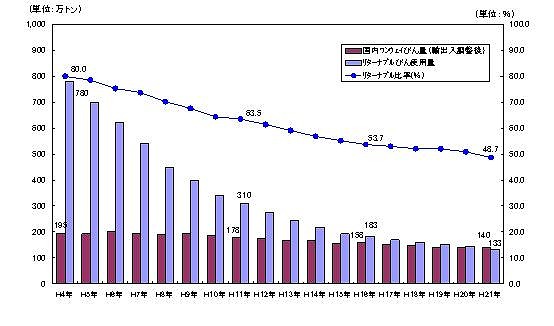
  - I was wrong about glasses: 70% of glass bottle source materials comes from recycled materials[3], and use of reusable bottles have declined over the years and converging into 50%[4](by numbers of bottles?).
 - Papers and milk cartons[5] are fine as had always been; I think those were recycled to toilet papers.
0: https://www-cycle.nies.go.jp/magazine/kenkyu/202008.html
1: https://www.sustainability-hub.jp/column/learn/about-chemica...
2: https://www.wbsj.org/activity/conservation/law/plastic-pollu...
3: https://www.glass-3r.jp/data/
> Collection happens through individual small trucks and the guy check the items and sort them directly into larger bins. If you made a mistake they will label it and leave it behind.
See, that's the key. In my area, we have compost, recycling and trash bins for each home. What you put in it is up to your moral compass. Nobody is checking or seeing what you put in there. If there was some peer pressure around that, things would change rather quickly, I'd imagine. Though I can't see such a system emerging in the states. People like to do their own thing, individually, and not be bothered with it.
The trash men check our bins in Seattle (although not very thoroughly). We can be fined for throwing compostable material in the trash (has never happened to me) and your recycling can be rejected for throwing away non-recyclables (has happened to me when someone dumped their trash in my recycling bin.)
Here in Germany, the only additional breakdown is that "glass" is separated into brown glass, green glass, and white (or clear) glass. Usually thought as beer / wine / other.
Yep, its all our fault.
Regulations that greatly limit the total number of packaging types may be of help here.
The ideal solution is surely that the waste management industry figures out how to deal efficiently with two streams of waste, one perishable and the other not.
In normal economy, the key to success is specialization. Instead of training each worker on each task, we divide work into chunks, and have t different workers specialize in different work. This increases efficiency tremendously.
However, since most of recycling is based on positive emotions, shaming, and wishful thinking, and not sound economic principles, it shouldn’t be surprising that instead of centralizing sorting work to make it more efficient, we demand that society wastes a lot of collective time, to offload the cost sorting onto regular people (with great inefficiency), and to shame them into getting a feeling of stake in the whole process.
Imagine what would the rest of the economy look like if it used similar model. You’d go to grocery store and waste time picking through produce to find fresh, undamaged fruits and vegetables, because the store can’t bothered to pre-sort it. You would manually add additives after filling up your car, because the gas stations only sell regular gas and can’t be bothered to premix and offer the premium. You’d go to a restaurant, and your waiter would tell you what ingredients you need to bring to get the meal cooked (by the waiter himself).
People shouldn’t need to sort recyclables by category,
Picking damaged fruit from undamaged fruit or mixing a low-entropy fuel with a low-entropy additive to make a high entropy product is cheap.
Sorting through trash is much more expensive because the entropy in a trash stream is massive. You’ve got all sorts of different types of things mixed together, some possibly dangerous.
We already offload a lot of this sorting to third-world countries and this is not exactly an ethical solution.
This is obviously false from the start. the entire problem is that it does require training and people don’t perform the task very effectively as a result.
One of the barriers of effectively recycling PP is the mixing of materials in packaging. I know some brands in my country switched labels to make sure the bottle was uniform and recognises by recycling machines as PP. So what Heinz is doing here is actually meaningful.
The other problem USA has is poor education and lack of well separated waste streams. I’ve personally experienced ridiculous “wishcycling” from my extended family in the US where they just throw whatever they want to feel good about throwing away in the recycling bin without looking up what should go in there. Not to mention that the idea of a “recycling” bin is ridiculous to start with. You need one bin for each type of material.
The ideal solution is the bottle recycling machines (like Tomra) found in Northern Europe, that only accepts aluminium and plastic cans/bottles, which goes right back to making new cans/bottles. Well, the plastic bottle part is work in progress, but there are bottles made from 100% recycled materials now, and the key to that is to have a clean well-separated stream of recycled materials coming in.
Funny story: I saw a documentary from a local advanced recycling centre, where they mentioned that the bales of plastic that actually went to be reused in new products/bottles smelled really nice. Because a big portion of them was PP shampoo bottles.