That gets to the clear difference between Japanese culture and US culture.
Americans will sort their trash, but they won't spend that much time sorting their trash.
Japanese culture has an immense amount of civic pride and responsibility that isn't present in the US.
>Collection happens through individual small trucks and the guy check the items and sort them directly into larger bins. If you made a mistake they will label it and leave it behind.
Part of it is the fact that neighbors police each other. Culturally we tend to reject when others are intruding in our business. Note the disdain for HOA and busybodies.
Having that culture might be a good thing in respect to recycling but it is also a brake to other societal change as it is a consecutive force.
It used to be that people smoked everywhere, 10 years ago certain districts started prohibiting smoking in the street and relegated smokers to certain corners, today this corners have been replaced by closed containers with air conditioning and filtration systems.
It sometimes feels magical…
Putting so many hours into recycling... well it depends on how much that actually accomplishes. Because that is a huge amount of labor.
  - 86% of plastics are "recycled", of which 56% is "thermally recycled", the rest 25% is only quoted as "chemical recycling and material recycling combined" in most PR materials, which I think is enough indication that it's not going back into bottles.[1][2]
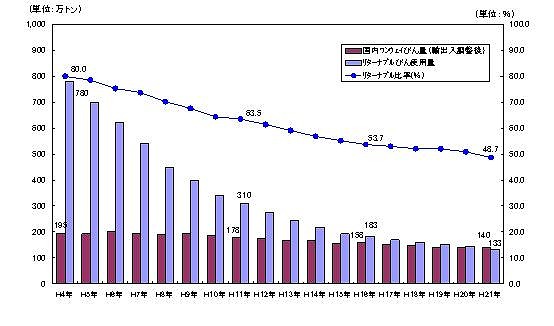
  - I was wrong about glasses: 70% of glass bottle source materials comes from recycled materials[3], and use of reusable bottles have declined over the years and converging into 50%[4](by numbers of bottles?).
 - Papers and milk cartons[5] are fine as had always been; I think those were recycled to toilet papers.
0: https://www-cycle.nies.go.jp/magazine/kenkyu/202008.html
1: https://www.sustainability-hub.jp/column/learn/about-chemica...
2: https://www.wbsj.org/activity/conservation/law/plastic-pollu...
3: https://www.glass-3r.jp/data/
> Collection happens through individual small trucks and the guy check the items and sort them directly into larger bins. If you made a mistake they will label it and leave it behind.
See, that's the key. In my area, we have compost, recycling and trash bins for each home. What you put in it is up to your moral compass. Nobody is checking or seeing what you put in there. If there was some peer pressure around that, things would change rather quickly, I'd imagine. Though I can't see such a system emerging in the states. People like to do their own thing, individually, and not be bothered with it.
The trash men check our bins in Seattle (although not very thoroughly). We can be fined for throwing compostable material in the trash (has never happened to me) and your recycling can be rejected for throwing away non-recyclables (has happened to me when someone dumped their trash in my recycling bin.)
Here in Germany, the only additional breakdown is that "glass" is separated into brown glass, green glass, and white (or clear) glass. Usually thought as beer / wine / other.
Here in Japan we are sorting and packaging our trash all at home and putting it out to be collected individually.
There is
- cardboard (to be cut flat and bundled with string)
- unlaminated and clean paper (to be bundled with string or collected in a paper bag)
- PET (clean, no bottle cap, label removed)
- Milk cartons above 1l (cut open, flattened and tied up with string)
- glass
- cans
- aluminum
- other plastics (if clean)
- other metals
Of the top of my head ;)
What’s left over is classified as Burnable or non-Burnable and collected separately.
Collection happens at central points shared by a few houses. So if you fuck it up, your neighbors will know.
Collection happens through individual small trucks and the guy check the items and sort them directly into larger bins. If you made a mistake they will label it and leave it behind.
I spend about an hour sorting trash each week. Given the opportunity cost, I really consider what to buy, order online etc.