"We will pay no more than the actual cash value of the damage until actual repair or replacement is complete." [0]
[0] https://www.iii.org/sites/default/files/docs/pdf/HO3_sample....
A secondary threat is prolonged flooding which can submerge entire homes with salt water for weeks at a time. That's very costly and not preventable with existing homes in flood zones.
It defies comprehension that despite being somewhat poorer and enjoying milder weather, Europeans built their houses from brick and mortar while the US insists on erecting cheap cardboard boxes that even if they're not blown away or flooded, will probably rot away within the lifetime of their owner.
In most of the US, only wood or steel frame construction is safe. Wood houses last centuries.
Wood holds up better in earth quakes and tornadoes than brick, but you could probably build safe buildings with bricks in the USA, they would just cost more and require similar or more maintenance.
While steel-reinforced masonry can be made safe, it isn’t obvious to me that actual brick-and-mortar can be.
America has lots of wood and lots of gypsum, and that's what we build our houses with.
Anyways, the point isn't the materials - the point is that the houses are fundamentally unsuited to the environment they are in.
Drywall walls have never been a problem for me, in fact they're pretty nice. It's really easy to modify the walls. Need to do a new Ethernet run? Want another power run? Feel like moving a lightswitch? Install new access points on the ceiling or change up light fixtures? Easy to drop down the void and cut a new box. Want to redesign the layout of a room? Often not a problem, easy to change.
Meanwhile a concrete wall is a massive pain to modify. You get the runs you get. Good luck redoing a layout. Say goodbye to having good wireless coverage.
We were talking about houses blowing away and falling over but sure.
So do you spend significantly more for construction for a failure that's still extremely unlikely? Y'all are acting like every time there's a thunderstorm all the houses just blow down. You're entirely disconnected from reality of the actual risks versus massive increase in costs.
Major hurricanes are a different story. But even then total loss is relatively rare except for storm surges unless you’re in the path of the eyewall.
There is no construction that can withstand storm surge, which is the biggest and most destructive hurricane impact. Even if the structure is intact, everything has to be ripped out of it. Most of them do survive winds short of tornadoes, though roof damage is very typical for major hurricanes and tree falls can cause problems.
We’re talking about the wind blowing up to 30ft of saltwater _miles_ inland. Given the comparative rarity of a major hurricane in any given geographical location and the oddities that determine the storm surge and where it comes in, the damage usually is worst in places it’s never flooded before - because places where it has are indeed required to build higher.
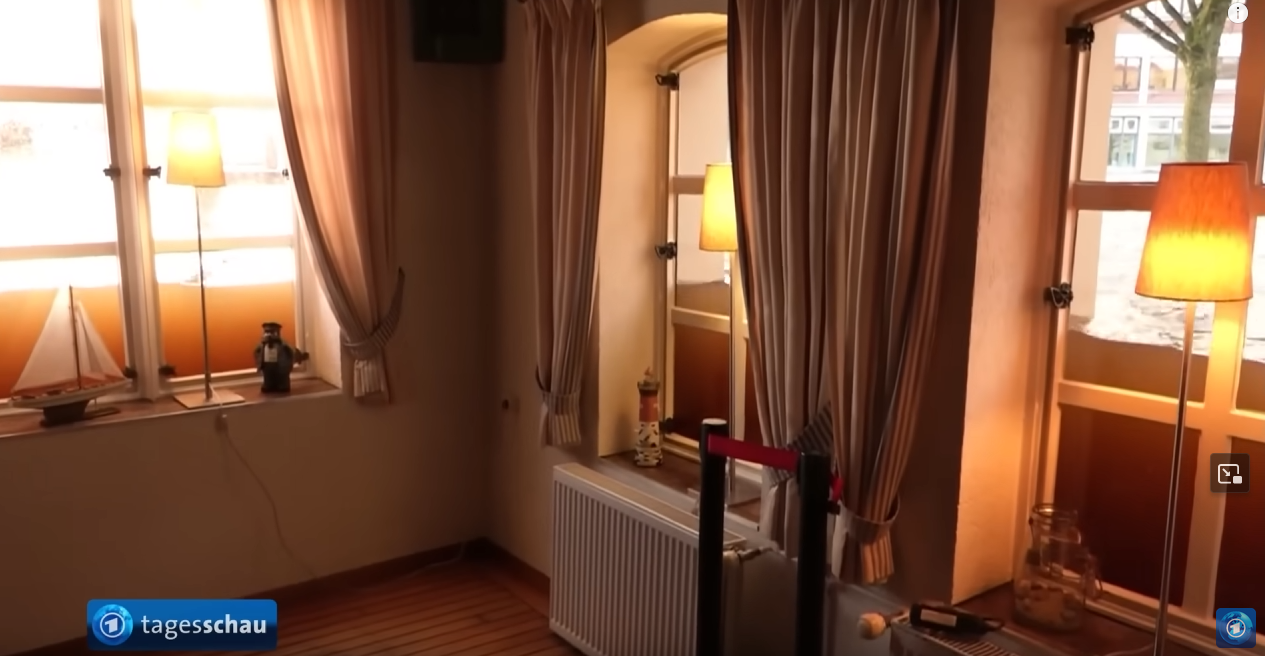
Do you notice the awkward protruding wall plug, seemingly used by the lamp, on the photo you linked? It doesn’t have to be that way - I have put a receptacle or switch in to the perfect spot as a one day project many times, and we have reworked wall layout in several places.
And, the photo looks like it has single pane windows with snow outside? They might not have had functional multi pane windows when the home was built?
Needs and technical capabilities change, and a design that is less committed to mass walls has important flexibility.
That's water outside. After a storm. That's a waterproof house in a coastal area of Germany that tends to flood during storms.
Needless to say those windows are designed with another problem than just insulation in mind. I can't tell you whether they're multi pane. All I know is that they open towards the outside rather than the inside for obvious reasons.
If they can’t build on it, who would buy it? Urban farmers?
In any case, your plan would destroy the land value, and the corresponding property tax revenue.
Sounds like the market effectively discovered the true value of the property with all externalities priced in. I don’t see a problem here?
On the downside, when the next disaster hit and FEMA didn't cover it, it would look like FEMA doesn't want to cover low income housing, which isn't a good look.
But there does need to be some mechanism to convince people to abandon homes and towns that are not appropriate given environmental conditions. And it needs to be done carefully so it's not like kick all the poor people out, do some civil engineering that never happened while it was a poor community, then sell the land to developers who make a huge profit.
https://www.nbcnews.com/news/us-news/hurricane-idalias-destr...
: Dozens of modest homes along the Big Bend coast were heavily damaged in the floodwaters, but interspersed among the debris were residences left relatively unscathed, all because they were built elevated on stilts.
If a house is destroyed by any form of reasonably common widespread disaster it becomes illegal to build anything on that lot that would likewise be destroyed. You can rebuild after the hurricane, you must build a house that will stand up to a hurricane. (Yes, it can be done.)
I wouldn't apply this to flukes--your town does a Tunguska there's no reason to require asteroid-safe houses.
I would also make an exception for things which by their nature must be in the line of fire--such things must never be permanent habitation and can't have community-rate insurance against whatever happened to them.
A business can rebuild it's beach cabanas but would have to go to Lloyd's if they wanted insurance.
This should carry with the property address - the next person who buys it should have to sign a form acknowledging that they aren't going to get a FEMA bailout if it gets destroyed.
Lots of Florida Republicans out there who complain about welfare but rely on some of the biggest welfare checks that get written to repair their homes because of the absolutely foreseeable results of their choices.