News for hackers. Stuff that matters.
Re:Intel Itanium IA-64 Support Removed with the Linux 6.7 Ke... by pram on Saturday November 04, 2023 @06:12PM (#38145711)
The Itanium sales forecasts never fail to make me laugh. Aged like the finest wine:

https://upload.wikimedia.org/wikipedia/commons/8/88/Itanium_...

Re:Intel Itanium IA-64 Support Removed with the Linux 6.7 Ke... by tux3 on Saturday November 04, 2023 @06:27PM (#38145835)
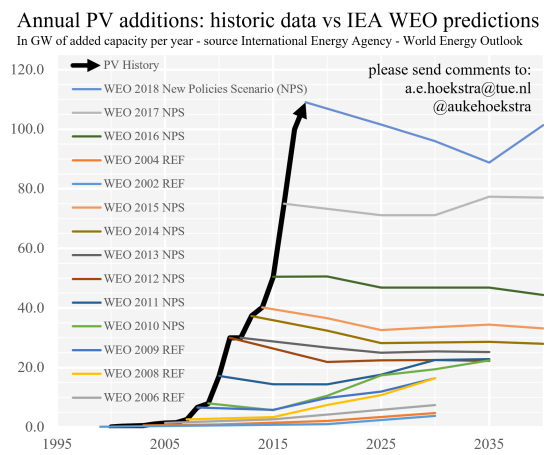
Contrast with the notorious IAE solar forecast: https://zenmo.com/wp-content/uploads/2019/01/iea-vs-reality-...

Statistics and modeling are complicated, granted. But when your model diverges from reality 5 years in a row, perhaps you should just extrapolate the current line next time around.

(In the case of the Itanic, that would have been the line at 0. Still a better forecast than what they did!)

Re:Intel Itanium IA-64 Support Removed with the Linux 6.7 Ke... by duskwuff on Saturday November 04, 2023 @06:52PM (#38146039)
> Contrast with the notorious IAE solar forecast

"There's no way this level of growth can be sustainable."

"Surely we've hit a stable level by now."

"Maybe that last year was a fluke."

Love to see it. :)

Re:Intel Itanium IA-64 Support Removed with the Linux 6.7 Ke... by MBCook on Saturday November 04, 2023 @08:23PM (#38146671)
The motorcar is a fad! Surely after 115 years it will be over!
Re:Intel Itanium IA-64 Support Removed with the Linux 6.7 Ke... by jodrellblank on Saturday November 04, 2023 @08:35PM (#38146752)
> ""There's no way this level of growth can be sustainable.""

Those are GW of added capacity per year, their prediction flatlining is predicting sustaining the same level of growth.

Re:Intel Itanium IA-64 Support Removed with the Linux 6.7 Ke... by duskwuff on Sunday November 05, 2023 @01:26PM (#38153988)
And yet, they were still (mis)predicting that each year would be an inflection point on that growth.
Re:Intel Itanium IA-64 Support Removed with the Linux 6.7 Ke... by mahkeiro on Saturday November 04, 2023 @08:15PM (#38146629)
Especially funny when you know that the figure for 2022 is 320GW which is completely off this chart!
Re:Intel Itanium IA-64 Support Removed with the Linux 6.7 Ke... by riffraff on Saturday November 04, 2023 @10:23PM (#38147436)
Were the post 2018 projections still this wrong? I'd love to see an updated chart
Re:Intel Itanium IA-64 Support Removed with the Linux 6.7 Ke... by cbmuser on Saturday November 04, 2023 @08:34PM (#38146742)
Subsidizing a technology and passing laws that enforce this technology to be widely installed leads to increased growth?

I am really surprised!

/s

Re:Intel Itanium IA-64 Support Removed with the Linux 6.7 Ke... by genmud on Saturday November 04, 2023 @11:47PM (#38147948)
This makes their modeling errors even more egregious and embarrassing. If you know governments are subsidizing it, and there are no foreseeable plans to cut said subsidies, you would be a fool to not forecast growth.
Re:Intel Itanium IA-64 Support Removed with the Linux 6.7 Ke... by photonerd on Sunday November 05, 2023 @12:40AM (#38148288)
Wait until you learn about the oil industry…
Re:Intel Itanium IA-64 Support Removed with the Linux 6.7 Ke... by the_why_of_y on Sunday November 05, 2023 @03:41AM (#38149391)
The governments have to subsidize solar, so it can compete with government subsidized fossil fuels. You may be surprised to learn that fossil fuel subsidies rose from $4.5 trillion in 2015 to $7 trillion in 2022.

https://www.statista.com/chart/31016/volume-of-global-fossil...

Re:Intel Itanium IA-64 Support Removed with the Linux 6.7 Ke... by vasdae on Sunday November 05, 2023 @04:06AM (#38149492)
"Indirect subsidies" sounds like a dubious metric.
Re:Intel Itanium IA-64 Support Removed with the Linux 6.7 Ke... by dtech on Sunday November 05, 2023 @07:56AM (#38150731)
Why? If you tax A and not B, that is not much different from taxing both but subsidizing B. Most reasonable definitions of subsidies include it.
Re:Intel Itanium IA-64 Support Removed with the Linux 6.7 Ke... by eigenvalue on Saturday November 04, 2023 @09:14PM (#38146983)
In this situation I would assume that the political/internal pressures from the member companies and advisory board were dominating factors as opposed to the forecasters being total dummies. There must have been some reasons why it was not appealing to assume the growth could keep ramping like that. Because it’s an obviously insane forecast after the first few data points are in.
Re:Intel Itanium IA-64 Support Removed with the Linux 6.7 Ke... by ethbr1 on Saturday November 04, 2023 @09:23PM (#38147050)
I'd love to hear someone chip in with what it takes to make a solar panel and the rate limiting factors.

E.g. if a solar panel factory (simplifying into a single entity) already exists, is there any reason not to run it at 100% production capacity? What consumables are used?

Re:Intel Itanium IA-64 Support Removed with the Linux 6.7 Ke... by adrianN on Sunday November 05, 2023 @02:03AM (#38149003)
Solar panels are just doped silicon, some wiring and support frames.
Re:Intel Itanium IA-64 Support Removed with the Linux 6.7 Ke... by jnsaff2 on Sunday November 05, 2023 @04:03AM (#38149478)
Silicon for solar panels has to be 99.999999 percent pure—six 9s after the decimal. Computer chips are even more demanding. Their silicon needs to be 99.99999999999 percent pure—eleven 9s.
Re:Intel Itanium IA-64 Support Removed with the Linux 6.7 Ke... by ethbr1 on Sunday November 05, 2023 @07:41AM (#38150651)
How consumable-intensive is doped silicone production?

Afaik, it's more strict metallurgy (materialurgy?): temperature, time, some physical process.

Point being, I'd be curious on the actual cost of material inputs, if the price of solar panels crashes. How low can they go... and still be worth making?

Re:Intel Itanium IA-64 Support Removed with the Linux 6.7 Ke... by rbanffy on Sunday November 05, 2023 @09:24AM (#38151365)
> How consumable-intensive is doped silicone production?

From https://news.ycombinator.com/item?id=38150735, it’s very energy intensive.

> if the price of solar panels crashes. How low can they go... and still be worth making?

Boules are very storable, so it’s the financials of pausing production and storing materials until the price (or new tech) makes it profitable. Not the most socially responsible thing to do in decarbonisation times, but done with aluminium and other energy intensive storables all the time.

Re:Intel Itanium IA-64 Support Removed with the Linux 6.7 Ke... by ethbr1 on Monday November 06, 2023 @09:55AM (#38163429)
The irony of intermittent solar's excess power potentially being soaked up by intermittent boule-manufacturing (followed by storage) is too delicious.
Re:Intel Itanium IA-64 Support Removed with the Linux 6.7 Ke... by xbmcuser on Sunday November 05, 2023 @03:50AM (#38149424)
They are running at full capacity. Chinese factories will produce more panels this year than what was the total world solar install 5 years ago. The problem today is not supply of solar but demand it faces similar problems as chip manufacturing as once new capacity is brought up the world needs time to train more workers as well produce equipment to use that capacity
Re:Intel Itanium IA-64 Support Removed with the Linux 6.7 Ke... by dagw on Sunday November 05, 2023 @04:21AM (#38149550)
Looked into getting solar panels last year and the problem wasn't getting the actual panels, but the hardware that let you integrate the panels to the electrical system. Spoke to several people who had had panels on their roof for months, but couldn't get the hardware that would let them connect them.
Re:Intel Itanium IA-64 Support Removed with the Linux 6.7 Ke... by rbanffy on Sunday November 05, 2023 @09:13AM (#38151270)
Depending on what you want, it might be very simple hardware, using panel provided DC for lighting and a 12V DC system and switching to utility provided AC when the sun isn’t providing enough power, all the way to house batteries and selling power back into the grid.
Re:Intel Itanium IA-64 Support Removed with the Linux 6.7 Ke... by philjohn on Sunday November 05, 2023 @10:36AM (#38152015)
That definitely seems to be a little better now - in Europe at least lead times on inverters and batteries are tiny.
Re:Intel Itanium IA-64 Support Removed with the Linux 6.7 Ke... by pjc50 on Sunday November 05, 2023 @07:56AM (#38150735)
The rate limiting is basically factory capacity, yes. Simplified process:

- Czochralski purification of silicon to produce a "boule"

- saw boule into "wafers" (surprisingly important, see "reduced kerf diamond wire saw")

- wafers can be used for microchips, or doped into solar cells

- apply contacts to top face

- package into a panel with glass and aluminium frames

The "wafer" market is somewhat independent. Purification depends on the price of energy (it's very energy intensive). Better sawing reduces waste and increases wafers per boule.

More factories come online all the time. Panels themselves are now extremely cheap, and it's worth looking at "balance of system" (labour, permitting, frames and racks, inverters).

I believe market data firms track all the relevant info, although they don't necessarily give the resulting info away on the internet.

Re:Intel Itanium IA-64 Support Removed with the Linux 6.7 Ke... by ironhaven on Saturday November 04, 2023 @09:58PM (#38147266)
It seems like the World Energy Outlook report the fossil fuel industry gets a lot of airtime. In the 2018 report[1] most of the sections are dedicated to oil and gas topic and the section on renewables is very skeptical on the viability of renewables.

[1] https://www.iea.org/reports/world-energy-outlook-2018/

Re:Intel Itanium IA-64 Support Removed with the Linux 6.7 Ke... by philwelch on Sunday November 05, 2023 @07:39AM (#38150633)
Based on the recent history of the Texas power grid, the skepticism is more than warranted. The cost per megawatt of capacity for renewables is lower than other sources, but the power only gets generated when the sun is shining or the wind is blowing, which means more reliable energy sources are priced out of being added to the grid.

Our most recent near-miss at a statewide outage happened because of unexpectedly low wind. It’s happening in Texas first because we have a smaller grid and it’s deregulated to the point where cheap but unreliable renewables can crowd out other sources of generation. The eastern and western grids will face the same problems in the long run the more and more renewables come to replace other sources of power.

Re:Intel Itanium IA-64 Support Removed with the Linux 6.7 Ke... by acdha on Sunday November 05, 2023 @09:45AM (#38151561)
That’s how the fossil fuel industry describes it, yes, but that’s just them trying to avoid competition. For example, the 2021 winter outages were caused by power plant operators not wanting to spend money making their plants more robust. During this summer’s heat dome, solar was reliable on days when gas, coal and nuclear power plants were offline due to the heat.
Re:Intel Itanium IA-64 Support Removed with the Linux 6.7 Ke... by philwelch on Sunday November 05, 2023 @10:41AM (#38152070)
> That’s how the fossil fuel industry describes it, yes, but that’s just them trying to avoid competition.

Renewables, especially construction of new renewables, is a big, lucrative, growing business of its own. That’s actually a direct implication of the triumphant statistics people keep sharing about how much renewable power generation gets built out every year. So the “fossil fuel industry” is not unique in its vested interest to propagandize against its competition. And this incentive is only increased by the movement towards ESG in finance. But if we’re done accusing each other of being shills, let’s get to the substance of the matter at hand here.

> For example, the 2021 winter outages were caused by power plant operators not wanting to spend money making their plants more robust.

This included the renewables too, of course, along with the entire rest of the state’s infrastructure. But the near outage this summer was directly caused by low wind. There are probably issues with solar as well—heat, and cooling demand along with it, peak in the early evening just as sunlight starts to diminish—but usually wind manages to cover that gap. That doesn’t always happen though.

Re:Intel Itanium IA-64 Support Removed with the Linux 6.7 Ke... by acdha on Sunday November 05, 2023 @11:25AM (#38152545)
The near outage this summer was more accurately described as wind being low enough that it almost wasn't able to fill the gap caused by the gas, coal, and nuclear plants going offline. Unlike wind and solar those are quite heat sensitive so you can get nasty correlated failures at peak summer demand, especially if the same weather system causes any kind of interruption to the cooling water supply.

And, yes, renewables are becoming a big industry but it’s nowhere near as big as the fossil fuel industry and orders of magnitude less lavishly subsidized. Texas Republicans tried to ban wind and solar expansion because that party has been owned by the oil industry for decades and the renewable industry has nowhere near the same level of lobbying clout.

Re:Intel Itanium IA-64 Support Removed with the Linux 6.7 Ke... by philwelch on Monday November 06, 2023 @12:14AM (#38159120)
> The near outage this summer was more accurately described as wind being low enough that it almost wasn't able to fill the gap caused by the gas, coal, and nuclear plants going offline.

I can’t find any good source about your claim of thermal plants going offline in the September incident. ERCOT’s statements consistently blame the combination of high demand and low wind. The federal Department of Energy even issued an order authorizing Texas power plants to exceed normal emissions limits in such an emergency, which is inconsistent with your claim that they “go offline” in these conditions: https://www.ercot.com/about/legal/doe202c

> And, yes, renewables are becoming a big industry but it’s nowhere near as big as the fossil fuel industry and orders of magnitude less lavishly subsidized.

I thought we were done accusing each other of being shills. I’ll just point out that there’s significantly more propaganda in favor of renewable energy than in favor of natural gas or nuclear. But this is Hacker News and I am assuming good faith of you rather than accusing you of parroting talking points that were fed to you by Chinese photovoltaic manufacturers or annoying Swedish teenagers. And I am simply asking the same courtesy from you.

> Texas Republicans tried to ban wind and solar expansion because that party has been owned by the oil industry for decades

I think there is a good faith reason for such a policy. And while I do live in Texas and usually vote for Republicans, I am asking you to engage with me in good faith instead of calling me a shill. Are you capable of that or is the idea that someone can disagree with you about energy policy in good faith beyond your comprehension? Because you seem to be using this idea as a thought-terminating cliche.

Re:Intel Itanium IA-64 Support Removed with the Linux 6.7 Ke... by acdha on Monday November 06, 2023 @08:06AM (#38162078)
Re:Intel Itanium IA-64 Support Removed with the Linux 6.7 Ke... by philwelch on Monday November 06, 2023 @11:06AM (#38164396)
Paywalled and published before the September incident I’m discussing.
Re:Intel Itanium IA-64 Support Removed with the Linux 6.7 Ke... by Reason077 on Sunday November 05, 2023 @07:53AM (#38150708)
Seems like recent IEA reports have taken a more upbeat and optimistic view in renewables:

https://www.iea.org/reports/renewable-energy-market-update-j...

Re:Intel Itanium IA-64 Support Removed with the Linux 6.7 Ke... by guiriduro on Sunday November 05, 2023 @10:24AM (#38151875)
Similarly, anyone get the feeling the forecast for Hydrogen uptake (as an alternative fuel) has more to do with a self-serving politically and commercially motivated hype train than an honest assessment of its effectiveness that then drives organic uptake?
Re:Intel Itanium IA-64 Support Removed with the Linux 6.7 Ke... by nullc on Saturday November 04, 2023 @06:32PM (#38145877)
Easily one of the best illustrations on Wikipedia.
Re:Intel Itanium IA-64 Support Removed with the Linux 6.7 Ke... by jmyeet on Saturday November 04, 2023 @09:21PM (#38147038)
There's a lesson here. Intel basically wanted to get away from x86 because it was licensed to AMD (and Cyrix) due to an earlier (and essentially unlimited) licensing agreement. In the late 90s, the likes of DEC, HP and Sun ruled the server and workstation space.

Intel wanted in on this space and didn't want AMD to be able to produce compatible parts so... enter EPIC [1]. The projections (as you point to) were wildly optimistic. Of course the whole thing was heavily delayed, produced in small volume, offered limited to no performance gain, required a ground up write of pretty much everything and was super expensive. What could go wrong?

What did AMD do? It just invented 64 bit extensions to x86 (ie x86-64). Was it ideal? No. You probably wouldn't design an instruction set and architecture this way if you were starting from nothing but you aren't starting from nothing. AMD released the wildly successful Opteron (and Athlon 64) and for 5-10 years completley ate Intel's lunch. Cheap parts, good performance, easy migration part, etc. Intel got to use these extensions by the same licensing agreement.

This coincided with the Gigahertz wars on the desktop front. From the Pentium for almost a decade Intel focused on Gigahertz and once thought they could run this up all the way to 10GHz+. We know how that went. Clock speed was a key marketing bullet point. AMD processors had higher IPC but that (at that time) was a harder sell.

About the time Opteron came out the Gigahertz wars were hitting the 3GHz barrier and Intel was stuck. At the same time their mobile parts used a completely different architecture. Thsi was Centrino with the Core Duo processors. These had much higher IPC (than Pentium lines) and more power efficiency. Some early enthusiasts constructed desktops from these mobile chips and the results were great.

Losing out to Opteron/Athlon and hitting the 3GHz barrier ultimately forced Intel to abandon their desktop architecture in favor of Centrino. Intel hung on as long as they could to milk some extra profit but eventually Core Duo was the future and this ultimately because the foundation for the Core processors we have today (but by now there have been many revisions). It might be more accurate to describe the Pentium years as the Netburst architecture years (IIRC).

But the lesson here is that a complete rewrite was an almost fatal mistake for Intel. It's almost always a mistake. You can't ignore what's there now and your desire to lock out competition doesn't necessarily translate to something customers actually want or need.

[1]: https://en.wikipedia.org/wiki/Explicitly_parallel_instructio...

Re:Intel Itanium IA-64 Support Removed with the Linux 6.7 Ke... by ethbr1 on Saturday November 04, 2023 @09:33PM (#38147089)
I've still got a 2.8 GHz Pentium 4 Northwood squirreled away somewhere.

The machine it originally ran in is humming away too, albeit with a replacement Pentium M using a socket 478 adapter.

I keep it as a reminder that even billions of dollars can't see around the future corner.

Re:Intel Itanium IA-64 Support Removed with the Linux 6.7 Ke... by arcticbull on Saturday November 04, 2023 @11:54PM (#38147987)
Fun fact: the Pentium M you put in is the actual predecessor to modern Core processors - not the Pentium 4 you took out of the socket.

The NetBurst microarchitecture of Pentium 4 was killed off and a 64-bit version of the P6 Variant Enhanced Pentium M microarchitecture took the baton.

Re:Intel Itanium IA-64 Support Removed with the Linux 6.7 Ke... by ethbr1 on Sunday November 05, 2023 @07:38AM (#38150627)
That's why I bought it! By that point, Core had already been released, and I figured "What a weird historical quirk to keep around."
Re:Intel Itanium IA-64 Support Removed with the Linux 6.7 Ke... by demondemidi on Sunday November 05, 2023 @09:41AM (#38151516)
Long live the Fireball checker-retirement unit and its double clocked pulse generator logic.
Re:Intel Itanium IA-64 Support Removed with the Linux 6.7 Ke... by dixie_land on Saturday November 04, 2023 @09:30PM (#38147079)
You seem very insightful on this topic. May I ask your opinion as to why ARM is taking off on the server market?
Re:Intel Itanium IA-64 Support Removed with the Linux 6.7 Ke... by tremon on Saturday November 04, 2023 @10:12PM (#38147352)
Is it? FAFAIK, the only places where ARM servers run is inside Amazon AWS and Microsoft Azure, and they design their own processors for that. The reason they chose ARM has to do with licensing, it has little to do with the characteristics of the processor architecture nor with processor performance.
Re:Intel Itanium IA-64 Support Removed with the Linux 6.7 Ke... by 0xDEADFED5 on Saturday November 04, 2023 @10:49PM (#38147574)
This isn't my area of expertise, I'm sure others on here can rattle off more names, but at the very least Oracle has ARM servers available (the free ones are decent for hobby stuff) and Hetzner has ARM servers available
Re:Intel Itanium IA-64 Support Removed with the Linux 6.7 Ke... by lallysingh on Saturday November 04, 2023 @10:55PM (#38147609)
AWS and other cloud providers are major, major, major buyers. They have a lot of influence in the CPU market.

ARM is cheaper and the performance hit is smaller than the savings. For scalable workloads you can easily just run more ARM and save money. Also, a lot (lot) of workloads are memory or I/O bound so the performance hit is negligible. ARM has gotten pretty optimized in both the CPU architecture and the tooling thanks to mobile uses.

Re:Intel Itanium IA-64 Support Removed with the Linux 6.7 Ke... by RedShift1 on Sunday November 05, 2023 @01:11AM (#38148777)
Is ARM cheaper? A few weeks ago I needed a small VM in the Google Cloud and the smallest ARM machine cost the same as the smallest x86 machine.
Re:Intel Itanium IA-64 Support Removed with the Linux 6.7 Ke... by __d on Sunday November 05, 2023 @03:32AM (#38149347)
It's not cheaper for you, it's cheaper for them.
Re:Intel Itanium IA-64 Support Removed with the Linux 6.7 Ke... by acdha on Sunday November 05, 2023 @10:57AM (#38152224)
On AWS it’s like a 20-30% discount - effectively free money for services like RDS, ElastiCache, and often Lambda or even ECS where the effort is either minimal or extremely low.
Re:Intel Itanium IA-64 Support Removed with the Linux 6.7 Ke... by dixie_land on Sunday November 05, 2023 @11:20AM (#38152477)
I am not nearly as knowledgeable as many of the commenters here on the hardware, but I do have first hand experiences running ARM on production at scale.

What AWS offers and what Google offers are not even close: on AWS, our workloads actually perform better (as in, higher QPS/core, resulting in fewer pods/instances), in addition to being more cost effective (both in terms of per-instance price to begging with, and less instances in total, due to aforementioned higher QPS/core serving same amount of total requests). For the limited ARM offer from Google we tested, the performance is worse than equivalent x86 instances, in addition to no price incentives.

Re:Intel Itanium IA-64 Support Removed with the Linux 6.7 Ke... by usr1106 on Sunday November 05, 2023 @01:09AM (#38148442)
Exactly. The year of the ARM server has been predicted for more than 10 years. (Only topped by the year of the Linux desktop, but the latter has probably just been a joke most of the time anyway.)
Re:Intel Itanium IA-64 Support Removed with the Linux 6.7 Ke... by faeriechangling on Sunday November 05, 2023 @01:56AM (#38148685)
The year of the linux desktop has been such a long prevailing joke that when the Linux desktop took over the education market nobody paid attention and people keep making YOTLD jokes.
Re:Intel Itanium IA-64 Support Removed with the Linux 6.7 Ke... by icelancer on Sunday November 05, 2023 @01:06AM (#38148754)
I think about this from time to time. The Linux desktop is actually here in huge sectors of the market and no one cares. They displaced Apple in education due to expense and Apple finally hitting escape velocity (and thus can price their goods at whatever they want), so you see a ton of Ubuntu/Mint/etc desktop cheap machines in schools that run web browsers and OpenOffice (but mostly the former).

It's pretty funny.

Re:Intel Itanium IA-64 Support Removed with the Linux 6.7 Ke... by qwytw on Sunday November 05, 2023 @02:40AM (#38149133)
ARM server has a niche. If Gravitron/Ampere is good enough for your use case and you care about cost they seem like a good deal. AMD/Intel are trying to directly compete with them now with Genoa and Sapphire Rapids.
Re:Intel Itanium IA-64 Support Removed with the Linux 6.7 Ke... by spockz on Sunday November 05, 2023 @01:57AM (#38148690)
Hetzner also has ARM servers you can order. Also on GCS: https://cloud.google.com/compute/docs/instances/arm-on-compu...
Re:Intel Itanium IA-64 Support Removed with the Linux 6.7 Ke... by qwytw on Sunday November 05, 2023 @02:37AM (#38149123)
Microsoft is using Ampere chips and Ampere has some other clients like Oracle, Hetzner etc. you can use their servers inhouse too.

> with the characteristics of the processor architecture nor with processor performance.

Why did AMD introduce Genoa and Intel is developing equivalent products too? There is market for CPUs with a very high number of low-powers cores and it seems ARM had an advantage there. Even now the price per core (which are good enough for many applications) for Ampere/Gravitron cores is significantly lower.

Re:Intel Itanium IA-64 Support Removed with the Linux 6.7 Ke... by hakfoo on Saturday November 04, 2023 @10:18PM (#38147403)
My two cents: Open source displaced a lot of propriatery stacks.

When you're running commercial software at $$$$ per license, the customers basically have to stick to whatever hardware is explicitly supported. And the vendors are going to be narrow there. Fewer platforms keep support costs down, and prevent exposure to uncompetitive corners of the market. As long as $expensive_product is only officially supported for x86, nobody needs to know it's riotously unperformant on ARM in ways that will require wholesale rewrites to fix.

When it's all open stuff, nothing stops people from compiling it for ARM, RISC-V, and hell 65C816, letting the market choose which platform fits their needs best. For many audiences it might not be "maximum performance under cost-no-object hardware"; it might be "what's the cheapest way to serve a fixed N workload units per month, when you include the purchase cost, electricity cost, rack-space rental cost, etc."

As a second-order effect, I expect removing license cost from the equation also impacts the metrics people care about. When the software price is the dominant aspect of the bill, nobody's going to make much of a case of "we can save 55 of the annual cost up front by using cheaper good-enough hardware" or "we'll save 1% per month on the energy bill".

Re:Intel Itanium IA-64 Support Removed with the Linux 6.7 Ke... by acdha on Sunday November 05, 2023 @10:44AM (#38152103)
I’d also add automation becoming pervasive, especially after containers showed up. In the 90s, people bought relatively few expensive servers and ran a ton of stuff on them, almost always hand-rolled (yes, there wren a few crazies running BCFG, cfengine, etc. but that was uncommon outside of a few niches). That meant you couldn’t migrate easily since mapping out dependencies was non-trivial and your admins didn’t want / have time to deal with portability issues. As you mentioned, open source took a lot of that away (no more dealing with bizarre vendor compiler bugs or broken tool chains) and repeatable more isolated builds and deployments made it a lot more realistic to use a different server class where it saved money.
Re:Intel Itanium IA-64 Support Removed with the Linux 6.7 Ke... by candiddevmike on Saturday November 04, 2023 @10:45PM (#38147553)
ARM servers can be made relatively cheaply (especially if you own an ARM server company like AWS), and they use less power (and cooling, I believe). So in a data center they're cheaper for the same functionality, kinda.
Re:Intel Itanium IA-64 Support Removed with the Linux 6.7 Ke... by ksec on Sunday November 05, 2023 @01:13AM (#38148787)
Not OP. And frankly speaking what he said should be common knowledge for those who lived through that period.

AArch64 and AMD64 has more in common than Itanium which is a bag of hurt from hardware to compiler.

ARM on Server actually saves money at the scale being deployed, while Itanium has zero cost advantage, and that is before adding the cost of software which was order of magnitude worst than any estimate had made at the time.

Most Server software operate on Open Source software. From Linux to Nginx, MySQL, Postgres, Memcache or Redis and tons and tons OSS. Which makes changes far easier than waiting for vendor to support AArch64.

AArach64 has a much bigger market to fine tune its software stack and toolchain from Smartphones. There are currently 4.5+Billion of Smartphone in uses, that is larger than all the x86 usage in the world. Compare that to IA64 /Itanium.

Re:Intel Itanium IA-64 Support Removed with the Linux 6.7 Ke... by KaiserPro on Sunday November 05, 2023 @09:41AM (#38151507)
To add to this, the IA64 required specialist knowledge to get to run efficiently, given that you've just spent a huge amount on new hardware, you also had to port your stuff to take advantage of the new arch. From what I recall, x86 emulation was there, but just really slow.

So for a few HPC type things, it was an a leap forward, for everything else, it sucked.

It was like the arm based windows surface laptops a few years ago. Lots of promise, none of the software that you actually wanted.

When you looked at the opteron which was 64 bit, run faster, cheaper than the intel and could run vanilla 32bit apps without any changes faster than before, it was a no brainer.

Re:Intel Itanium IA-64 Support Removed with the Linux 6.7 Ke... by jmyeet on Sunday November 05, 2023 @04:03AM (#38149477)
None of this is my area of expertise. I’m just old enough to have lived through this era and remember what happened.

Many people don’t realize ARM can trace its origins back to the BBC Micro. For a variety of reasons it found a niche in low power applications, even 30+ years ago. ARM, the company, simply sells licenses without producing its own silicon. There’s concern now with it going public that it will seek revenue by jacking up licensing costs.

It’s mobile devices where ARM flourished and entered public consciousness. There used to be other platforms but they died off. Intel sold XScale years ago because of a lack of vision.

ARM processors got sufficiently powerful to be in servers and power efficiency became a big deal. Google really transformed this space with sub-1.1 PUEs when no one outside even believed that was possible. Performance per Watt became a really big deal.

Also, I’m not sure if this is entirely fair but I credit Apple with a lot of ARM’s success. They bought a company called PA Semi and pushed the envelope with what ARM can do. I think that may have been the best $400 million (IIRC) ever spent.

Re:Intel Itanium IA-64 Support Removed with the Linux 6.7 Ke... by tssva on Sunday November 05, 2023 @04:40AM (#38149636)
"There used to be other platforms but they died off. Intel sold XScale years ago because of a lack of vision."

This makes it sound as if xscale was an alternative platform to ARM. Intel xscale cores implemented the ARMv5 isa.

Re:Intel Itanium IA-64 Support Removed with the Linux 6.7 Ke... by kalleboo on Sunday November 05, 2023 @08:34AM (#38150986)
ARM allows anyone to license their cores and make their own CPUs. x86 has been limited to Intel and AMD. (before x86 took over there WAS a huge variety of CPU architectures in servers - Alpha, SPARC, HP-PA, POWER etc)

Starting a CPU company and selling CPUs to customers has always been difficult since you need to compete with other CPU packagers and Intel had the largest scale so could always put you out of business if you became a threat.

With the rise of big cloud server giants (AWS, Azure, Google), they can license the cores from ARM, build their own CPUs and cut out the middle-man. They are their own CPU customers so don't have to worry about building a market.

It's the rise of vertical integration from tech giants.

Re:Intel Itanium IA-64 Support Removed with the Linux 6.7 Ke... by demondemidi on Sunday November 05, 2023 @09:44AM (#38151558)
Architecture doesn’t matter as much in the cloud. If the backend servers are running storage, kv store, load balancers, etc it doesn’t matter if it is arm or x86. Arm is lower power so you can cram more compute into the same 480V chassis. If architecture doesn’t matter and density improves at lower cost , there’s an opportunity for arm to swoop in. If ampere executes to plan they will succeed where cavium failed.
Re:Intel Itanium IA-64 Support Removed with the Linux 6.7 Ke... by cmrdporcupine on Saturday November 04, 2023 @10:32PM (#38147503)
Alpha would have been such a better path to follow, and Intel even ended up with a license for it because of Compaq/HP's incompetence.
Re:Intel Itanium IA-64 Support Removed with the Linux 6.7 Ke... by o11c on Sunday November 05, 2023 @01:12AM (#38148462)
Alpha was unequivocally terrible though. "Better than Itanium" is really not saying much.

* no byte operations

* no flags, thus no reasonable way to check for overflow (similar to one of the problems RISC-V is having, though at least they pretend to care).

Re:Intel Itanium IA-64 Support Removed with the Linux 6.7 Ke... by masklinn on Sunday November 05, 2023 @02:13AM (#38149037)
Also “notoriously weak” memory model even as multithreading was taking off, and

> The processor may lose track of your LDx_L if you perform any memory access other than a matching STx_C, or if you perform a branch instruction, or if you trigger a trap (such as executing an emulated instruction), or if you execute more than 20 instructions after the LDx_L.

(LDxL and STxC are locked load and conditional store)

Re:Intel Itanium IA-64 Support Removed with the Linux 6.7 Ke... by colejohnson66 on Sunday November 05, 2023 @08:07AM (#38150812)
What do you mean “lose track of”?
Re:Intel Itanium IA-64 Support Removed with the Linux 6.7 Ke... by masklinn on Sunday November 05, 2023 @08:19AM (#38150883)
Discard / clear the lock flag, so the store never succeeds.
Re:Intel Itanium IA-64 Support Removed with the Linux 6.7 Ke... by pm215 on Sunday November 05, 2023 @10:28AM (#38151919)
That is pretty standard for LL/SC instructions -- you'll find similar constraints on the Arm equivalent insns. In practice this doesn't matter because you only use them in a limited set of handcoded sequences to implement the atomic primitives you actually wanted, so you can always be sure that your LL/SC loop obeys the rules and makes forward progress.
Re:Intel Itanium IA-64 Support Removed with the Linux 6.7 Ke... by cmrdporcupine on Sunday November 05, 2023 @08:24PM (#38157713)
Was going to say. x86 I think has spoiled people in terms of what they expect in terms of memory model / consistency.

The answer is to be careful as a dev, and hopefully let the compiler and your libraries take care of the finger details.

Re:Intel Itanium IA-64 Support Removed with the Linux 6.7 Ke... by jabl on Sunday November 05, 2023 @02:22AM (#38149064)
IIRC they did add byte operations pretty soon after the initial generation.

The memory consistency model was pretty crazy, though.

Re:Intel Itanium IA-64 Support Removed with the Linux 6.7 Ke... by jmyeet on Sunday November 05, 2023 @04:20AM (#38149546)
Two fun facts about DEC Alpha:

1. Windows NT, which is the ancestor of modern Windows, was originally released on multiple platforms including Alpha and, I believe, MIPS; and

2. DEC, for awhile at least, had one of the most popular Web search engines: AltaVista. It wasn’t a commercial enterprise. It was mostly a technology demonstration for Alpha. For the time it was pretty good. No one at this time (the 1990s) thought there was a future in search engines. Many (including Yahoo) seemed to think curated directories were the future. Search engines were viewed as a solved problem, except by Larry Page and Sergei Brin who founded Google.

The highly underrated show “Halt and Catch Fire” covers this early era of computing really well and is worth watching.

Re:Intel Itanium IA-64 Support Removed with the Linux 6.7 Ke... by ngcc_hk on Sunday November 05, 2023 @08:07AM (#38150810)
When Windows NT and DEC is in the same message, may I suggest to mention that Windows NT is developed essentially by the DEC team.
Re:Intel Itanium IA-64 Support Removed with the Linux 6.7 Ke... by gbin on Sunday November 05, 2023 @08:38AM (#38151010)
I highly recommend watching the recent interview of Dave Cutler, it gives some perspective on that https://youtu.be/xi1Lq79mLeE?si=D8_40BPga4Qj5jsW
Re:Intel Itanium IA-64 Support Removed with the Linux 6.7 Ke... by javitron on Tuesday November 07, 2023 @03:07AM (#38174361)
Itanium was being defined around the same time the 1st Alphas came to market. By the time Itanium2 came out, it matched/surpassed the contemporary AXP parts.

FWIW the alpha design teams ended up cannibalized between AMD and Intel. The original Opteron and the first generations of Core i have a ton of AXP DNA in them, from a uarch standpoint. So in a sense, Intel and AMD did continue Alpha... sort of.

However. I feel that Alpha gets over fetishized on the internet sometimes. It was a clean arch, mainly because it was a clean 64bit design from the get go. But as far as uArch, it was pretty generic. Most of the uArch themes the AXP design teams used, which a lot of people think were native inventions to Alpha, came straight from industry/academia research, and plenty of other processors implemented them as well.

Re:Intel Itanium IA-64 Support Removed with the Linux 6.7 Ke... by genmud on Sunday November 05, 2023 @12:14AM (#38148104)
I worked on a large scale project that was itanium based and let me tell you, the compilers / software toolchains were an absolute dumpster fire. We were planning on being between 500 and 2000 processors in our cluster.

We used HP boxes and I want to say it was around 2002/2003 when this was going on. We were supposed to be a huge public showpiece client for both intel and HP. It… did not go very well. I remember the absolute defeated looks of the HP / Intel people when we pulled the plug and told them the discounts / free hardware still couldn’t justify the engineering efforts we had gone through for the last 18-24 months. This was right as opterons were coming out and that project jumped ship to them.

Re:Intel Itanium IA-64 Support Removed with the Linux 6.7 Ke... by ksec on Sunday November 05, 2023 @01:02AM (#38148727)
There were plenty of people sceptical of Itanium at the time, including many within Intel as well. I guess we all gave Intel some benefits of the doubt. But the great thing is that the whole industry learned a lot from it. Intel did too. It is just sad a lot of this learning experience within Engineering never got promoted to C-Level Management at Intel.
Re:Intel Itanium IA-64 Support Removed with the Linux 6.7 Ke... by acdha on Sunday November 05, 2023 @10:29AM (#38151924)
> There were plenty of people sceptical of Itanium at the time, including many within Intel as well

Credit especially goes to the people who stayed on the various x86 processor teams. Itanium’s single greatest source of failure was that successive Penguin generations undercut the advantage of x86 compatibility by adding the option of not migrating at all and still getting better performance. They probably saved the company but I doubt that got much praise at the time since it required acknowledging how badly the Itanium project had failed.

Re:Intel Itanium IA-64 Support Removed with the Linux 6.7 Ke... by Keyframe on Sunday November 05, 2023 @09:55AM (#38151642)
That's the tragedy behind it, since the whole premise on how Itanium was done was that compilers will be able to, eventually, any day now, optimize for it and then you'll see, just wait and then you'll see.. any day now!
Re:Intel Itanium IA-64 Support Removed with the Linux 6.7 Ke... by javitron on Tuesday November 07, 2023 @03:00AM (#38174321)
The compilers worked just fine. Itanium was not even that particularly VLIWish, as the instruction carrier wasn't that particularly wide (up to 4 instructions)

All that Itanium was, at the end of the day, was an in-order PA-RISC/SPARC hybrid that exposed a lot of the superscalar innards to the programmer (compiler)

VLIW scheduling even back then wasn't as much of a mystery as the usenet and register flamewars implied. It really is pretty straightforward for a compiler to behave like an in-order superscalar scheduler. And since the compiler has a much global information about the instruction stream it can do much more optimizations and static ordering than a normal in-order HW superscalar scheduler alone.

Plus itanium had plenty of dynamic microarchitectural components to complement the static ordering done by the compiler and increase FU utilization.

If anything, things like predication and its adverse effect in power consumption had a much worse impact on itanium than the compilers.

What killed the itanium was just simple economics; its performance was fine (for the time, at least for itanium2). It's performance/price ratio, however, was not.

Re:Intel Itanium IA-64 Support Removed with the Linux 6.7 Ke... by cptskippy on Sunday November 05, 2023 @01:38AM (#38148882)
Thank you, people usually miss the importance of Banias and Centrino.

Banias was the Israeli team asking how do we make an incredibly efficient mobile CPU and the answer was finish your work quickly and go to sleep.

In order to finish quickly, you had to be fast and efficient. Someone said well what if we don't actually go to sleep?

IIRCC, Core was a combination of the Banias CPU architecture, an evolution of P3, combined with the Netburst bus architecture from P4.

Re:Intel Itanium IA-64 Support Removed with the Linux 6.7 Ke... by jmyeet on Sunday November 05, 2023 @04:09AM (#38149505)
I believe you’re correct: the Pentium M in the original Centrino platform that became Core Duo was a Pentium 3 derivative (for laptops). I’d forgotten that.

Pentium 4 was heavily marketing driven, to win the Gigahertz war.

Re:Intel Itanium IA-64 Support Removed with the Linux 6.7 Ke... by javitron on Tuesday November 07, 2023 @03:22AM (#38174456)
P4 was also, initially, process-driven.

The fab side of Intel had a huge priority in setting early architectural themes. And some of the CMOs flows in lab, in mid 90s, were showing huge speed scaling, but they had very restrictive design rules and cell libraries. But with the payout of extreme GHz scaling.

From that point of view, the P4 made sense; a narrow architecture with very deep pipelines. Where each stage used the tiny datapaths between latches/registers those libraries supported. Netburst makes sense in terms of dealing with extremely deep out of order pipelines.

However, those processes never met the scaling roadmaps. While the power consumption scaled horribly, and things like thermal, leakage and variability started to become first order limiters.

Re:Intel Itanium IA-64 Support Removed with the Linux 6.7 Ke... by xattt on Sunday November 05, 2023 @09:01AM (#38151175)
> In order to finish quickly, you had to be fast and efficient.

How did they get to the point of finish-your-work-quickly? Short pipelines?

Re:Intel Itanium IA-64 Support Removed with the Linux 6.7 Ke... by cptskippy on Sunday November 05, 2023 @12:52PM (#38153561)
Intel invested heavily in P4 and made the P4 pipeline really long which allowed for higher clocks.

So for Banias started with the P3 pipeline which was already short and added the microop fusion that I believe was introduced in P4. As well a cribbing a lot of other enhancements from Netburst.

It's been several years since I read up on it so I'm rust on all the details.

Re:Intel Itanium IA-64 Support Removed with the Linux 6.7 Ke... by selimthegrim on Sunday November 05, 2023 @11:58PM (#38159034)
Isn’t Banias in Syria lol
Re:Intel Itanium IA-64 Support Removed with the Linux 6.7 Ke... by cptskippy on Tuesday November 07, 2023 @08:07PM (#38185441)
Intel's code names for projects are usually geographical in nature and this was designed by their Israeli-based R&D team, that that tracks.
Re:Intel Itanium IA-64 Support Removed with the Linux 6.7 Ke... by callalex on Sunday November 05, 2023 @02:06AM (#38149018)
> your desire to lock out competition doesn't necessarily translate to something customers actually want or need

For the sake of humanity, we need to crowdfund a blimp with this quote that just flies back and forth between Cupertino/Mountain View and San Mateo for the next 5 or 10 years.

Re:Intel Itanium IA-64 Support Removed with the Linux 6.7 Ke... by pjmlp on Sunday November 05, 2023 @03:08AM (#38149260)
The lesson here is that AMD should not have been allowed access to Intel's IP, that is what allowed them in first place to undermine Intel's Itanium plans.
Re:Intel Itanium IA-64 Support Removed with the Linux 6.7 Ke... by p_l on Sunday November 05, 2023 @07:09AM (#38150444)
The license was a requirement for intel to get initial sales of x86 at all.
Re:Intel Itanium IA-64 Support Removed with the Linux 6.7 Ke... by pjmlp on Sunday November 05, 2023 @07:14AM (#38150469)
I am aware of it, little did they know what pain it would cause them.
Re:Intel Itanium IA-64 Support Removed with the Linux 6.7 Ke... by postmodest on Sunday November 05, 2023 @10:07AM (#38151747)
When I read about Itanium and iAPX 432, I can't help but think that Intel _isn't good at what they do_ and just lucked into he PC market by being cheap, and then riding to coattails of the Windows monopoly.

I can't wait for ARM to eat their lunch. And dinner.

Re:Intel Itanium IA-64 Support Removed with the Linux 6.7 Ke... by jmyeet on Sunday November 05, 2023 @11:00AM (#38152263)
When you read now or when you read at the time? I'm curious because context matters. Back in the 1990s when all this kicked off there was still a strong believe that RISC (vs CISC) was the future. There was a lot of circumstantial evidence to support this, most notably that the workstation and server spaces were dominated by RISC chips like Sparc, Alpha and MIPS.

I do believe that whoever drove the Centrino movement (from mobile originally to desktop) saved the company. They laid the foundation for Intel's next 15 years of success.

The original licensing agreement with AMD is an interesting part of Intel history too. Were that to happen today, it would probably be viewed as a disaster. In our modern era of short term corporate decision-making, it would probably be viewed negatively too.

But it led to Intel's complete dominance thanks to x86 for decades. It killed pretty much every other architecture (other than ARM). It's only in the last 5-10 years that dominance has really wavered.

Intel's big strength had always been their ability to fab chips at scale with low failure rate so the parts were hugely profitable. For decades the likes of AMD just didn't have that manufacturing capacity at the same scale and price. Intel led die-shrinking that was a huge driver to profits. It's only when they tried to move to 10nm that it all fell apart. Now TSMC has eaten their lunch. Intel is at risk of moving from being a first-party designer and fab of chips to producing third-party chips.

If someone woke up from a 20 year coma and you told them about Intel's market position and fate they would be shocked. That's how big of a fall from grace it's been. But that's largely on the fab side, not the design side. Only recently has the Core architecture really hit its limit where Intel CPUs consume too much power and run too hot to eke out the last ounce of power.

Itanium was a joint venture betwen HP and Intel. We can certainly look back now and say it was bad. I'm not convinced that determination was as easy at the time although it did have its critics.

Re:Intel Itanium IA-64 Support Removed with the Linux 6.7 Ke... by javitron on Tuesday November 07, 2023 @03:11AM (#38174384)
Intel has some of the best architecture and design teams in the industry.

They have had failed products, no doubt.

But I don't think you understand also how insanely good at execution Intel was during the 80s and 90s.

Re:Intel Itanium IA-64 Support Removed with the Linux 6.7 Ke... by rasz on Monday November 06, 2023 @03:26PM (#38168482)
> AMD ... for 5-10 years completley ate Intel's lunch

That part didnt happen because Intel bribed OEMs. Just DELL alone was receiving ~$1B a year to exclusively sell Intel.

Re:Intel Itanium IA-64 Support Removed with the Linux 6.7 Ke... by javitron on Tuesday November 07, 2023 @02:44AM (#38174216)
LOL I am always fascinated by the soap opera scripts some people come up when it comes to stuff like this. Y'all be so let down if you knew how boring and much more pragmatic/economics driven the real stories, behind how these sausages are made, really are.
Re:Intel Itanium IA-64 Support Removed with the Linux 6.7 Ke... by pelasaco on Sunday November 05, 2023 @01:29AM (#38148847)
The best prediction of all times was the classic "just 2 weeks to flatten the curve.."
Re:Intel Itanium IA-64 Support Removed with the Linux 6.7 Ke... by nicetryguy on Sunday November 05, 2023 @02:32AM (#38149103)
Drake cringing: Shuns IA-32

Drake pointing: Runs IA-32