Clojure's forward-facing interface (a hundred functions that operate on one data structure) ended up breaking down for me at some point and became 10 functions on 10 data structures and those data structures became AFn, APersistentSet, APersistentMap, APersistentVector, IFn, IPersistentSet, IPersistentMap, IPersistentVector, ITransientMap, ITransientVector, IndexedSeq, LazySeq, &c, &c, &c.
Maybe I started writing code wrong. Maybe I dived too deep into the internals, Maybe it was something else. But at the end, there wasn't one data structure, there were dozens and dozens each with justifiable differences, but even so, that's not what was advertised. It took a decade to reach that point and perhaps the vast majority of folks never will.
The sad part is that I know none of it is up for change without creating a Clojure2, and that highlights the problem. Why should changing the internals need to break backwards compatibility? There is one unspeakable reason: the illusion wasn't complete and they weren't really internals to begin with.
My "real response" to is, I haven't seen this complaint(concern) to this extend that you describe in the wild or in my own life. I've definitely not coded in Clojure long enough to have seen any of that like you have, thus far my experience has been good with 'just' using maps.
I do feel my next "step-up" would be to incorporate something like SPEC or Mali to "define/check" the fields/structure of said maps.
An example of clojure performance issues covered here: https://tech.redplanetlabs.com/2020/09/02/clojure-faster/
All that stuff above should be fixed at the language/stdlib level.
But what is your take on what needs fixing ? What would have been your solution for the N data-structures/ M algo problem you mentioned above ?
> real structs
I'm not even sure if value types are conducive towards immutable, persistent data structures. I'm certainly excited for project Valhalla but I'm not sure if Clojure, nor any Clojure-like JVM language, written in an idiomatic fashion, would really benefit from it.
> light-weight concurrency like Go
Project loom is already in preview mode. Lightweight concurrency is practically here for any JVM language, and once it's fully released I will likely have zero reason to use core.async.
> type support
Static typing is A Thing you can choose to do, but I doubt you would get many daily Clojure users agreeing that it is "better". I think it's different and better in some circumstances but not necessarily others. It definitely feels trendy these days, sorta like how dynamic typing felt trendy 15 years ago.
One of the things I find most interesting is that the Clojure community seems very interested in a "Clojure everywhere" style of doing things: you have Clojure, ClojureScript, Babashka, deps using edn, build using Clojure source, etc. But at the same time, perhaps for historical reasons, they lean into heavy interop with the underlying ecosystem - it was a big reason why Clojure was able to become as widely adopted as it has been, and it's also a big reason why the language itself will never really hold you back despite being a niche one (you can always rely on a Java library, etc.).
There is a reason why all dynamically typed languages today are scrambling to add some form of static typing to their language, but never the other way around.
Static typing does everything dynamic typing does, but better, faster, allow automatic refactoring, faster programs, better navigation, better documentation, better maintenance.
However, to be fair, Clojure's response to types is `org.clojure/spec.alpha`, and if you give it a really good chance, you'll see that it brings a lot to the table.
It doesn't change that I believe strong typing (a Haskell or Idris/Agda-like flavour of it) to be the future, but what it did change was how I thought about type systems and how to write and test programs.
"All your life's work for naught, pepaw. If only you had been on the right side of history".
I do have a substantive disagreement with this statement: "There is a reason why all dynamically typed languages today are scrambling to add some form of static typing to their language, but never the other way around".
Languages like C#, Java, Scala, and Typescript all have all adopted some degree of type inference. Their users wanted it for a long time. To begin with, none of these languages are anywhere near as strictly-typed as a language like Haskell. Clearly even developers on "the right side of history" don't want to maximize static type checking in all cases, so the issue is not as cut and dry as you make it sound.
The thing is, having some structure in terms of types or data shape constraints helps you model and understand your program. You can change them as your understand of your program changes or the need arises. You can be against static types because they force you to slow down and think about things before you can just get to coding, and it can be sometimes annoying to model your system using them (and sometimes not so useful), or other technical reasons like some type systems don’t allow you to model certain things, but to say it just leads to devs putting the real world into stupid, arbitrary categories when the real world (and your program!) primarily have data that can be trivially categorized because that’s what Rich Hickey said makes you sound like cargo-culting or parroting a point without diving deeper into the specific reasons and potential counterarguments.
We have to have both: types and external schemas in oo languages.
Plus, types make working with maps cumbersome and force you to maybe unnecessary data cages called dto-s
I appreciate that it's a bit frustrating to have someone vaguely identify an area of concern and clarification and actionable suggestions are much more valuable.
There's two things. One is that the data structure ontology[1] is difficult to internalize because of its complexity. When I write Clojure code, I consider the capabilities of the data structures being passed to the function. I think we have some implicit understanding of this early on. You expect the type of such and such to support seq-ing or deref-ing or something else. You're thinking in terms of capabilities and that's good. But if you want to be exacting, at some point you'll have to be able to point to an interface or several in the diagram and say, "yes, I really do expect something that conforms to IPersistentVector or IMeta or something else. In order to preserve backwards compatibility, this is more confusing than it needs to be. Moreover, at that point, you're not in Clojure-land anymore.
My second point is that at this step in the narrative, you're reading Java code and the illusion of 100 functions is broken. I ask myself, "Why, aren't Clojure data structures implemented in terms of protocols?" There's a perfectly good way of abstracting functionality that seems good enough for users, but not good enough for standard library implementers? It feels like the answer is, "We don't want to break Clojure1.x and we don't want to deal with the Python3 problem." Which is fair, admirable even, but it still leaves me left wanting. I think there's a simpler, more consistent Clojure hiding in there, waiting to be let out.
Apologies for the awkward way this reads; I simply wanted to get it out before lunch time.
1. https://raw.githubusercontent.com/jafingerhut/clojure-classe...
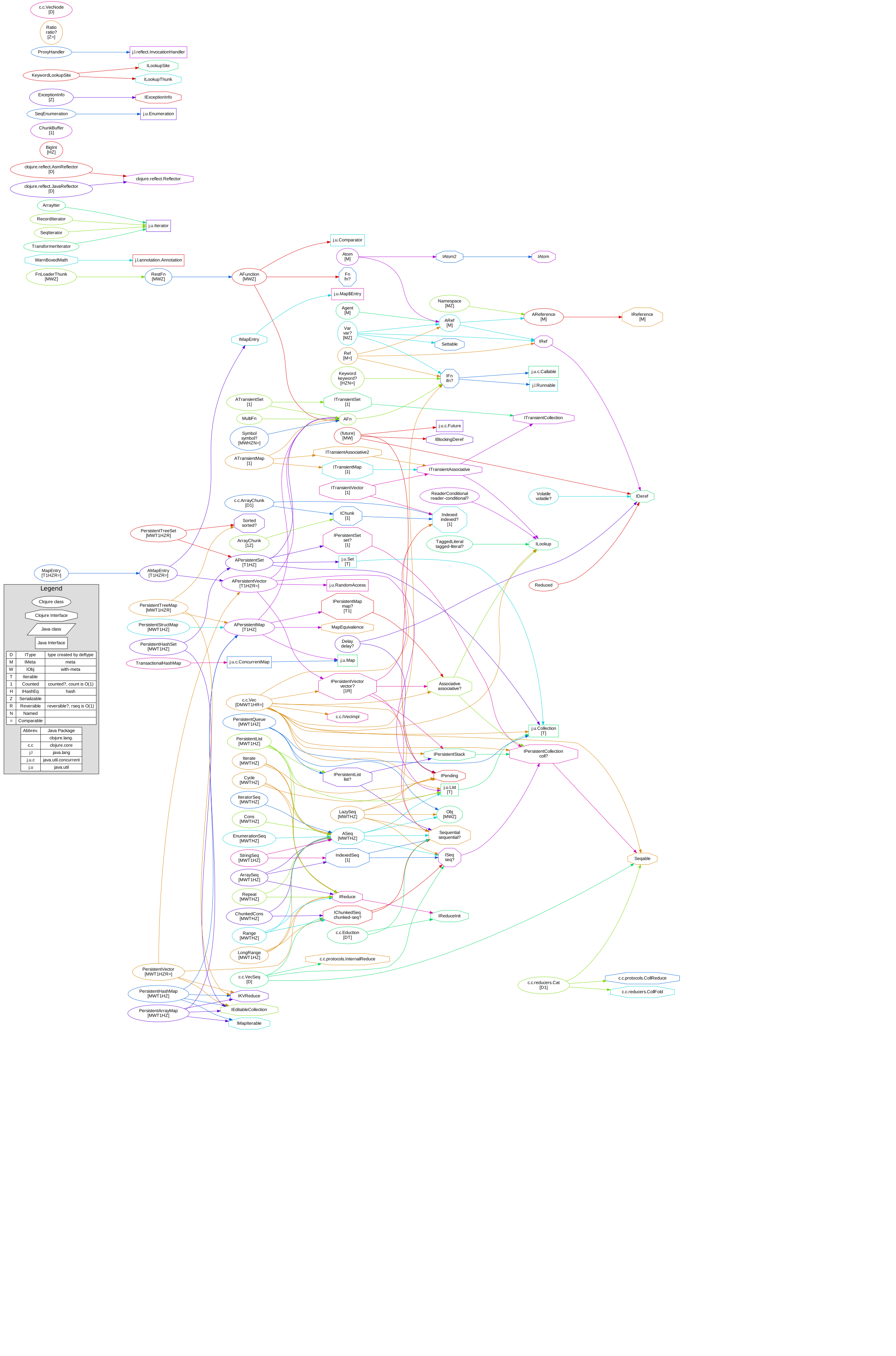
The mix of interfaces would be a huge pain if you needed their specific behaviours, but in my experience they've never mattered and lings like LazySeq just act as performance optimisations.
I've only needed to dig into that occasionally for a handful of specific situations (for example, in next.jdbc, where I create a hash map like abstraction over the (mutable) ResultSet object from Java -- to paper over some nasty interop issues).
> A ResultSet object maintains a cursor pointing to its current row of data. Initially the cursor is positioned before the first row [0]
0 - https://docs.oracle.com/javase/7/docs/api/java/sql/ResultSet...
Stage 1: Confused by parens/the lispiness. early uncertainty
Stage 2: learn the REPL and library functions and fall in love. irrational exuberance
Stage 3: build an unmaintainable mess and can't refactor. trough of sorrow
Stage 4: figure out how to decouple appropriately and evolve the codebase rather than refactor all the time. live happily ever after!
Lol only have joking. It really did surprise me how can something I hated some much in the beginning of learning Clojure (all the parens) has now become one of the things I most adore about the language (all the parens)
Nowadays I am happy to see a bit of them on the languages I actually get to use.
I think this is where people disagree regarding syntax. I love Clojure and agree with all the benefits of s-exps, but find it basically impossible to scan and very tedious to read. While it tends to be easy to refactor do to the REPL, at least for me it's on the wrong side of readability vs expressivity.
The argument I'd make in favor of Clojure and s-epxs is that, when you write good functional code that composes lots of small functions, it can literally read just like English. If foo and bar do baz else qux. But bad Clojure code doesn't have this property to me, it just looks like a lot of noise.
Curse of good languages.
Here's a short one to give a taste of that: https://www.youtube.com/watch?v=rQ802kSaip4
A good section from another talk specifically about that "don't type at the REPL" point: https://www.youtube.com/watch?v=Qx0-pViyIDU&t=740s
Here's a longer set of related references: https://clojure.org/guides/repl/annex_community_resources
Learning to evaluate forms directly from the editor is great, but _never_ typing in the REPL forces you to clutter up a file with evaluations you may not want to save, and jump around a lot between your comment blocks and code.
But it has also been a fun and liberating experience, after I went down the static type route for some years. I feel like Clojure just doesn’t get in my way and doesn’t force me to follow a certain style or paradigm; it provides many different choices (“providing more” instead of “taking away”) and treats you like an adult who can make responsible decisions on their own.
Although I missed the linguistic art of domain modelling through type definitions, spec gave me some of that back and even provides stuff like generative testing, which is pretty awesome. Of course, it is not meant as a replacement for static typing and has a different philosophy (see Rich Hickeys talks about it), but for me it is the best of both worlds.
The dynamic development style is something that I experienced before through learning Lisp/Scheme and it is also one of the thing that I enjoy most about Clojure. Coding “experimental”, building functions from individual pieces that I iteratively design using the REPL as my assistant (which actually means - as parent wrote - communicating with it from the editor itself, which we mostly do), feels so natural and I would miss it now that I am so used to it.
I have to disagree with this characterization. It also seems a bit patronizing.
Having more choice can be good in some cases, and having fewer choices can be good in other cases. One isn't treating you less like an adult than the other.
This is really not correct. Certain choices Hickey made, prevent you from coding as you like. E.g., Hickey doesn't allow strong reader macros or inheritance in Clojure.
Clojure has a lot a faults (just look at some of the comments here) BUT and it's a BIG BUT for me...
Clojure is SUPER FUN :)
Over the years(15+), I've been coding in PHP (suck it haters), Go, Rust,Java,Python AngularJS+, Svelte and I can honestly say for me, nothing is more fun that coding in Clojure.
It's fun testing a function in "realtime" by just "eval" it on the spot. I don't even code "in the REPL" I just use Calva and eval inline in VSCode
Maybe it's cause it's my new toy but it really does bring back the "joy of coding" I've been missing in the other languages.
*Learning Clojure became much more easier, once I told myself "It's Maps All The Way Down :D" Sure there are stuff like atoms that make it possible to code around the "immutability" but that is like using a cheat-code to go back to the old ways. Yes there are many times when mutable-data-structures are required, but while learning, don't grab for them as a first solution !
Anywhoo YMMV but once you get over the warts (many there are), much fun and insights awaits :)