Great as long as it works for you. Just wait until you yourself are stuck in a situation such as "Google locked my account and I can't reach support", "Stripe banned my business for no good reason" or "Wise froze my funds" - you literally see these threads on HN every week. Crypto suddenly starts to look a lot more appealing once you've experienced these situations yourself.
Have used Wise in the past because it's very convenient to use but they are just extremely expensive compared to P2P crypto.
Also they don't support many countries or only support one direction.
Not a crypto bro and very critical of crypto fads normally but this use case actually works for a regular person like me.
Going to try Xoom though and check their rates. Hadn't heard of them.
https://www.freethink.com/technology/crypto-argentina-black-...
Locally, Binance P2P is used a lot for remittances, and plenty of establishments use it as a way to receive payments as well. I've seen the Binance QR code in a bunch of restaurants and autoparts stores, for example
I used it earlier this year to send money to my sister in Argentina. Super fast, no fuss.
If the biggest player in the crypto space can’t get enough users, I’m doubting any real adoption.
> It is a massive mistake that Stripe is offering anything in the crypto space as everyone and Stripe knows it is full of fraud, money laundering, scams and it is completely unregulated.
The argument is engaging in "everything is X" talk by blanketing an entire space as only engaging in negative impacts.
It should be noted that the percentage of crypto used in illicit activity is significantly less than 1%, compared to the estimated 2-5% of global GDP that is involved in money laundering alone within traditional financial ecosystems.
https://blog.chainalysis.com/reports/2022-crypto-crime-repor...
https://blog.chainalysis.com/wp-content/uploads/2022/01/char...
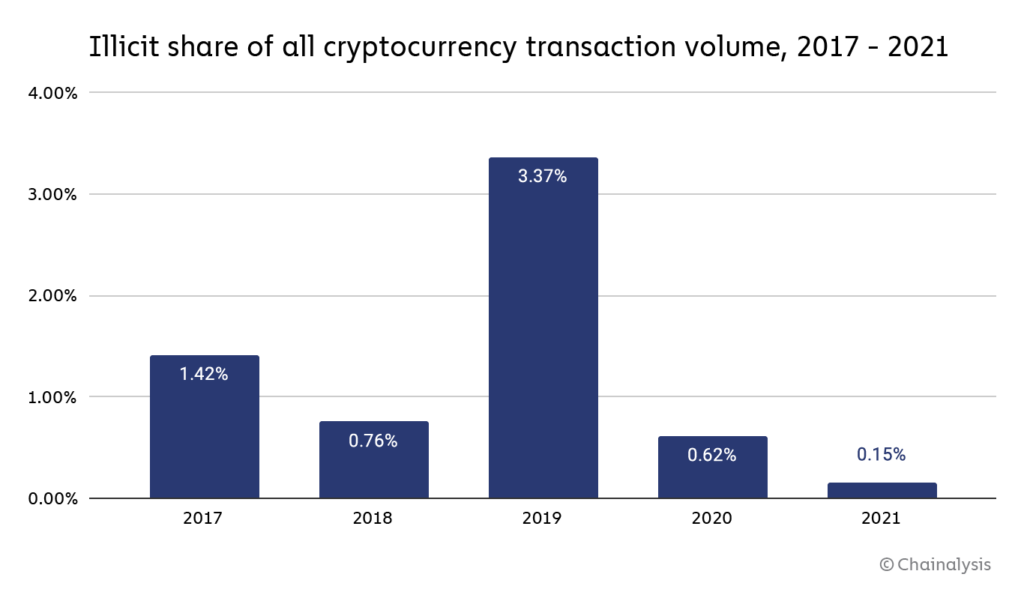
https://crsreports.congress.gov/product/pdf/IF/IF10873/3 (page 1)
Using the same argument, it could be said that cash should be banned because its private & semi-anonymous nature allows for its use in transactions for gambling, drug use, child porngraphy, assasinations, & slave trafficking.
If we somehow magically had come up with a cashless system first, and cash instead was introduced now, I am quite sure that yes there would be calls to ban it for those reasons. It is however an ancient legacy system that's deeply entrenched in our societies, so we're living with it for now, although perhaps not forever.
Sure we have issues in the current financial system, but augmenting (and dare I say) replacing it with an entirely worse unregulated system which loses people money through scams, increases and emboldens ransomware and exposes people to huge volatility is not the way to go.
> The argument is engaging in "everything is X" talk by blanketing an entire space as only engaging in negative impacts.
The negative impacts are FAR greater than the positive impacts of crypto.
i recommend reading the original bitcoin whitepaper to understand what is new: https://bitcoin.org/en/bitcoin-paper
The Bitcoin whitepaper outlines a P2P payments system, today it isn't used as such, rather a store of value, not even Stripe is using Bitcoin for payments at all.
So what use are these cryptocurrencies for, if not for scams and fraud?
Cancellation resistance. Protection from oppressive governments trying to squash freedom. Protection from retroactive laws targeting previously legal transactions. Asset protection.
And look I agree with you. And everything I posted above carries a huge cost given the volatility of most cryptocurrencies, but unfortunately we live in times where if you truly care about freedom from tyranny, your behaviour is going to overlap heavily with criminal behaviour.
So you're back to the current regulated system that works, is stable and is the best we have.
> Speed is one advantage of crypto payouts. Reach is another. Millions of talented freelancers live in countries where it’s hard, if not impossible, to open a local bank account. For example, a majority of the people in Djibouti, El Salvador, and Bhutan don't have bank accounts. With Stripe, freelancers in those countries are now able to receive funds via USDC in minutes. With the addition of USDC, Stripe cross-border payouts extend to more than 4.4 billion people in more than 110 countries—a majority of the world’s population.
Say, you get paid in USD.
    You got paid: 10000 USD

    Income tax: 15%

    Government exchange rate: 130 ARS per 1 USD
    Unofficial exchange rate: 330 ARS per 1 USD
10000 USD * 130 = 1300000 ARS and then 1300000 * (1 - 0.15) = 1105000
10000 USD * 330 = 3300000 ARS and then 3300000 * (1 - 0.15) = 2805000
    You got paid: 3300000 ARS (fair market value)

    Government rate: (3300000 - 1105000) / 3300000 = 0.66
    Unofficial rate: (3300000 - 2805000) / 3300000 = 0.15
> With Stripe, freelancers in those countries are now able to receive funds via USDC
That is just people opening bank accounts, but with extra steps.
How is this decentralised money that was promised by crypto and blockchain? You may very well use Wise, Moneygram and other regulated alternatives which works better, is also relatively faster and is more stable and widely accepted than these USDC tokens.
https://www.circle.com/blog/how-to-build-trust-usdc-audits-a...
I don't see any fully independent verifiable real audit of their entire reserves anywhere with USDC, and a lousy blogpost by Circle isn't strong enough evidence and no substitute of this.
Curious what US Treasury, FinCEN, OFAC, etcs take on this is. The plumbing is easy, it’s the laws, regulation, and compliance that are the work.
High level, Stripe is reaching for growth when there isn’t much innovation to be had in financial utilities besides reducing waste and inefficiencies by cannibalizing your business or someone else’s while the industry continues to commodify basic services like payments, cross border transfers, and deposit accounts (lending and data is the last bastion of profits for financial services).
https://www.pymnts.com/news/fintech-investments/2022/stripe-...
It is a fragile, brittle system that is highly likely to fail, you only need to look here to see why. [0]
This absolute statement is asserting that ALL smart contracts don't work. There is overwhelming evidence of some smart contracts working just fine, and of course a lot of smart contracts also have problems. It is wild to just drop all of the nuance of such a complicated issue. What new technology has been flawless without any failures along the way?
They are just pieces of code in esoteric programming languages running on world's slowest VMs. They encode primitive trivial rulesets and are still so complex that their own authors fail to see trivial errors even after multiple audits.
An actual real world contract such as buying or selling property (which I've done several times now) would be a beast of such byzantine proportions that it would take until the heat death of the universe to write and audit it. And it would still be unenforceable after that.
I also don't recall any regulated bank accounts getting automatically drained or losing everybody's money due to a single scammer or a bad actor.
One single error or exploit in these smart contracts results in millions being drained. This happens on a weekly basis with a giant lack of consumer protection, unaccountability or any chance of getting your money back (which that is a huge unsolved problem). So yes, these smart contracts do not work.
It's a system designed to fail with thousands of disasters, rug pulls and scams just waiting to happen.
One single failure on an airplane can kill hundreds of people, even a single line of code could crash several planes. There are just thousands of accidents waiting to happen. Planes do not work. They have had a hundred years to make planes perfectly safe. Every year more and more people fly. It is a system designed to fail.
Crypto is a lawless 'decentralised' wild west that has zero accountability for when anyone loses their money in smart contract hacks, scams, wallet draining and rugpulls, in all cases your money is gone with no refunds or consumer protection.
So yes, it is a system designed to fail.
Of course, I’d say the benefits of cryptocurrencies are far smaller than the benefits of the internet (it’s pretty hard to compete with connecting almost the entire world into a single instant global network for the first time). But some benefits do exist, and I feel like you’re being wilfully blind if you disagree with that.
Of course, you might feel that the downsides (massively) outweigh the upsides. And that’s fine. Others will disagree.
One thing I think we can all agree on is that crypto is at least decentralized and permissionless enough to not go away any time soon, no matter who wants it gone.
I would agree with you that more regulation is needed, but to keep saying there is zero regulation is either ignorant or disingenuous. Regulation can also coexist with something that is decentralized and is not obviously adversarial, e.g. we have regulations for gold markets to prevent scams, etc.
The list of course is too large for this comment section so somebody has already done parts of the work. [0]
Any user would be very lucky to get their money back in these situations, but like I said, no refunds or consumer protection in the crypto space when you lose your money.
---
EDIT: So? My point still stands about accountability, regulations or not, even Paypal knows the buying and selling of crypto assets is completely unregulated after 15 years.
The main point of this thread is that there is more evidence of broken smart contracts causing more damage to consumers and there is nobody to hold scammers accountable when a rugpull happens.
Because nobody is going to get their money back for them.
How is crypto, this brittle, 'decentralised' broken and unregulated system going to augment or replace the current financial system?
I think it is easy to dismiss as a value proposition. In the end, the future will show, so we probably should not spend too much time speculating.
They don't deny the existence of negative rates.
Total bitcoinization would be dystopian but as a lifeboat against the inexorable spread of the negative side effects of inflation and the skyrocketing price of assets due to the cantillon effect - it is remarkably effective.
Hate to be a parrot but... "zoom out".
Crypto is hardly inflation-proof, with major cryptos having fallen 80% or more in the last 6 months putting it on pace with the Lira - if you then adjust it for inflation you lose another 10%. It's somehow managed to do all that in the single most inflationary period in 50+ years. I was pretty sure we'd given up on that silly narrative. Crypto is a high-beta speculative play on US dollar liquidity in the global financial system, not a hedge on inflation.
Wanna save money from inflation? Buy some I-bonds.
So uh, zoom back in ;)
[edit] Also, liquidity per (as defined by the size of the Fed's asset book) se isn't really correlated with asset prices, which is why we're doing interest rates. I recommend listening to the Odd Lots podcast with Kashkari in re: inflation.
Where do we find proof of the cantillon effect then? Government spending as a percentage of GDP and subsequent public sector employment but then again, this isn't something new, it is boring and obvious, not some conspiracy of the government scheming against you.
If you're worried about inflation then I-bonds seem like a less risky way to handle this. (Though the limits are too low for many people, and the website is pretty bad.)
TIPS and I bonds are in my opinion the way the economy should work everywhere. Yes it means nominal yields can be negative but the entire point of the concept is that the unit of account should be stable and not inflating. Even if rates are excessively negative, it is still more predictable than inflation and you know exactly how much you are losing and prices will stay the same so your salary doesn't shrink over time.
Most of crypto is built on speculation which results in direct losses to consumers. And extensive and endless hacks, which is just another tax on consumers. Very little of bitcoin or any cryptocurrency is used for drugs, terrorism or other serious crimes.
Real world money laundering (trade based etc) is 500x that of bitcoin and real world drug dealing is at least 1000x greater than darknet markets.
I look forward to the day that Stripe will get investigated for all of the above with this and end up like Paypal, eventually freezing or banning these accounts.
Crypto does not offer anything new at all.
EDIT: It seems Stripe and Crypto apologists have downvoted & flagged my comment since Stripe is somehow a HN / YC darling that is immune from valid criticism even if they venture into crypto scamming, with no usecase that is better than the current financial system.
Crypto is only used for speculating and will eventually collapse under regulation.
@karaterobot
Stripe is no exception here for regulation and will comply by banning accounts if these 'remittances' are fraudulent as the majority of them most likely are.
Even in El Salvador, the country that has adopted bitcoin, merchants aren't using it for payments because they lose money extremely quickly due to volatility, so there isn't a usecase for cryptocurrencies or blockchain at all.