News for hackers. Stuff that matters.
Re:The true costs of inflation in small-town Texas by nostromo on Thursday July 21, 2022 @11:19PM (#32188092)
I’ve seen some people showing actual price increases they’ve seen in their local communities. For a lot of folks it’s much higher than is being reported. Here’s one from a person in Seattle:

https://preview.redd.it/max54wqv9kb91.png?width=1112&format=...

Re:The true costs of inflation in small-town Texas by chomp on Thursday July 21, 2022 @11:39PM (#32188232)
I'm super skeptical of posts like this because they seem cherry picked, or at best, have local price increases that aren't reflected elsewhere in the country. Half of those are restaurants, who have had challenges for the past 2 years outside of inflation. Gas has its own challenges, a head of lettuce at my local grocer is $1.52 which is cheaper than that person's 2021 price. Notably not included in that post is things like pork, which has fell in half since 2 years ago, and beef has had 4 straight months of decreases. Car prices are also down too from their peak.

My point isn't that inflation doesn't exist. It's a very difficult number to compute. My point is that people on the internet aren't good at picking unbiased points to base their data on.

Data like this is good to understand how the cost of living is increasing in certain segments, but we all need to remember (I make this mistake sometimes too) that an increase in the cost of living is not inflation.

Re:The true costs of inflation in small-town Texas by once_inc on Friday July 22, 2022 @02:53AM (#32189286)
The term "Inflation" is used in two forms interchangeably by most people, and this leads to miscommunication. Inflation is used for:

(a) price inflation: increasing prices for individual goods.

(b) monetary inflation: an increase in the amount of money used.

Both types of inflation means you get less goods for the same amount of (in this instance) Dollars. Monetary inflation (b) is mostly created by central banks and commercial banks, who increase the amount of dollars via Quantitative Easing, or fractional reserve banking. Price inflation (a) is the effect of markets reacting to changes in supplies and macro trends.

Price inflation isn't even over all products, and products generally fall into three categories: deflationary goods, stable goods, and inflationary goods. Deflationary goods have traditionally been electronics like televisions. Innovation in these areas drives down prices for products hard. Stable goods are products like lumber, food, or oil. Inflationary goods are often luxury brand items like Gucci bags, or yachts.

What is noticeable now is a marked increase in price inflation for stable goods. The source of this inflation is usually one of the following:

1. Supply-side issues (Chinese harbours closed because of Corona outbreaks, the issue with meat as discussed in the article)

2. ESG goals driving up energy prices (which affect production costs and prices for fertiliser. A good example of this is Sri Lanka)

3. International sanctions against Russia (further increasing the cost for fertiliser and increasing the price of energy for the western European market).

Re:The true costs of inflation in small-town Texas by somewhereoutth on Friday July 22, 2022 @05:39AM (#32190222)
My understanding is that economists use the term inflation for the rise in prices - strictly the fall in value or purchasing power of a currency.

The increase in money is termed 'expansion of the money supply'. There are a number of measures of money supply, going from narrow, cash only, to broad to include cash like instruments.

There is a strong relationship between money supply and inflation, different schools of economic thought understand it differently, but in general when you increase the money supply, its purchasing power falls.

Ballooning asset valuations have largely/entirely been caused by QE and ultra low interest rates, other prices are going to be affected by this too. Supply side shocks of course play their part, but current inflation is probably primarily driven by this loose monetary policy.

Re:The true costs of inflation in small-town Texas by konschubert on Friday July 22, 2022 @03:00AM (#32189323)
Let me add to your list:

4. Russia artificially limiting the Gas supply to freak out the Europeans.

5. Russia preventing wheat and corn feed from being exported out of Ukraine, forcing it to rot.

Re:The true costs of inflation in small-town Texas by leereeves on Friday July 22, 2022 @11:20AM (#32192900)
I'd also like to add to the list:

6. Many industries have become oligopolies, so companies can increase the prices consumers pay even faster than their own costs increase, leading to record profits.

For example, Tyson Foods' profits nearly doubled:

https://www.cnbc.com/2022/02/07/tyson-foods-higher-meat-pric...

Re:The true costs of inflation in small-town Texas by konschubert on Friday July 22, 2022 @02:59AM (#32189316)
Inflation is when the ratio of <money available>/<goods available> grows.

This can happen by the numerator growing (your (a)) or the denominator shrinking (your (b)).

Re:The true costs of inflation in small-town Texas by hgomersall on Friday July 22, 2022 @05:43AM (#32190247)
A moment's consideration would show that's too simplistic. Money available has been growing for years without any notable inflation. It's not like we all rush out to spend every bit of income we have, a fair amount gets saved which effectively neutralises it.
Re:The true costs of inflation in small-town Texas by throwaway9870 on Friday July 22, 2022 @09:52AM (#32191855)
So has the goods available. I suspect China's ability to manufacture cheaply and in huge quantities has masked a lot of the increase in the numerator.
Re:The true costs of inflation in small-town Texas by seanmcdirmid on Friday July 22, 2022 @08:24AM (#32191181)
A lot of the extra money was being plowed into real estate or the stock market, preventing inflation from happening elsewhere outside of the real estate or stock markets. Interest in saving accounts was too low for the money to just be saved.
Re:The true costs of inflation in small-town Texas by konschubert on Friday July 22, 2022 @06:45AM (#32190561)
<Money available> is a simplification, yes: https://en.wikipedia.org/wiki/Money_supply
Re:The true costs of inflation in small-town Texas by RC_ITR on Friday July 22, 2022 @03:54AM (#32189636)
Hate to be pedantic, but goods and services.
Re:The true costs of inflation in small-town Texas by Nick87633 on Friday July 22, 2022 @04:46AM (#32189936)
Seems like correlation more than causation. There could be plenty of money available but fearful people do not want to spend it.
Re:The true costs of inflation in small-town Texas by spaceman_2020 on Friday July 22, 2022 @04:24AM (#32189809)
> My point isn't that inflation doesn't exist

Heads of lettuce are really poor markers for inflation. What percentage of your take home do you spend on lettuce anyway?

You're much better off looking at median rent and median home price. Which can be quantified and clearly shows a big uptick. And you're likely spend anywhere from 25-50% of your pay on them.

Re:The true costs of inflation in small-town Texas by dublin on Friday July 22, 2022 @06:57PM (#32198111)
Anything is potentially cherry-picked, but there's no question that superinflation is real now (inflation is really much higher than the officially reported), and we stand on the precipice of hyperinflation. Later this year, the dry, hot summer (that's just weather, folks, not global warming, but the timing sucks), in conjunction with skyrocketing costs of fertilizer, diesel fuel, and hay/feed will drive real food prices higher than they've been in the lifetime of all but our oldest citizens. Food will become a very significant part of family spending.

It's no better on the industrial side - I've got a client in light manufacturing (oilfield sensors) - they can't get critical components, they can't get wire, they can't get adhesives and chemicals. They can't even get some of the blocks of metal that they start machining with!

They have orders that have been sidelined waiting for parts for a year now. Most vendors have stopped quoting delivery and now just say "52+ weeks", since they have no idea when they'll have product to sell again. Their customers are furious, but they can't deliver what they don't have.

This cannot end well. Our economies, worldwide, have been deliberately destroyed in a very intentional set of moves that are not nearly over yet. This is going to get a lot worse before it gets better, unless there's a massive uprising. Canadian truckers and the farmers of the Netherlands are just the beginning of the unrest that's going to happen.

Prepare for something much worse than the Great Depression, because our governments sure appear to be colluding to make sure it happens. The only thing good about this is that social media and tech companies will be the hardest hit. People need food, they need manufactured products, but no one NEEDS Facebook... (We're already seeing people drop expensive unessential subscriptions (Netflix, etc.), and even seeing enough late payments to AT&T that they have to call it our in defending their falling earnings.) The Great Reset is here, and it's likely to turn bloody before it's all over...

Re:The true costs of inflation in small-town Texas by dagw on Friday July 22, 2022 @06:33AM (#32190495)
beef has had 4 straight months of decreases

Even that’s uneven in my experience. Cheap ‘bulk’ meat isn’t up much, but ‘fancy’ meat (local, organic, grass fed etc.) is up over 30% where I am. Although I suspect that is at least partially due to “price gouging” the more price insensitive customers that buy that sort of product

Re:The true costs of inflation in small-town Texas by UncleMeat on Friday July 22, 2022 @08:04AM (#32191046)
My area has the inverse. Cryovac ground beef is way up but both the fancier stuff at the grocery store as well as the local stuff at the farmers market is roughly the same.
Re:The true costs of inflation in small-town Texas by Aeolun on Friday July 22, 2022 @06:05AM (#32190352)
Hmm, I’m not in the US (Japan), but all prices have been rising. On top of that the yen went from 110 per $ to 140 per $, so that by itself inflates half of my recurring costs by 30%
Re:The true costs of inflation in small-town Texas by yonaguska on Friday July 22, 2022 @07:59AM (#32191002)
I started my matcha addiction at the wrong time it seems. Just bulk ordered a bunch of tea from Japan, and while the dollar is relatively strong, it wasn't cheap. Still cheaper than Starbucks every day though, which is how I'm justifying it.
Re:The true costs of inflation in small-town Texas by oldjavacoder on Friday July 22, 2022 @12:23AM (#32188505)
"My point isn't that inflation doesn't exist."

My wife tells me different, so I'm going with her real world experience in the matter.

Re:The true costs of inflation in small-town Texas by chomp on Friday July 22, 2022 @12:37AM (#32188575)
If you or your wife look at the past and current price of lettuce in the local store and then use that to make the conclusion that the purchasing power of the US Dollar has decreased 47%, then I don't know what to tell you.

Your cost of living may have increased, but I do not understand how you can conclude an increase in inflation from living your daily life.

Re:The true costs of inflation in small-town Texas by leereeves on Friday July 22, 2022 @02:22AM (#32189129)
I know that my total grocery bill (not just lettuce) has more than doubled in the past few years. Gas too.

"The purchasing power of the US Dollar has decreased 47%" sounds about right.

Re:The true costs of inflation in small-town Texas by imtringued on Friday July 22, 2022 @02:55AM (#32189300)
A company selling a product I frequently buy went out of business, the purchasing power of the USD has decreased by 100%.
Re:The true costs of inflation in small-town Texas by leereeves on Friday July 22, 2022 @03:15AM (#32189429)
In terms of that product, it has.

And if that product was as essential to life for as many people as food and gas are, that might be important.

Re:The true costs of inflation in small-town Texas by throwaway6734 on Friday July 22, 2022 @06:54AM (#32190603)
No it doesn't
Re:The true costs of inflation in small-town Texas by tchalla on Friday July 22, 2022 @03:13AM (#32189417)
You can always calculate your personal rate of inflation

https://www.destatis.de/EN/Themes/Economy/Prices/Consumer-Pr...

Re:The true costs of inflation in small-town Texas by maneesh on Friday July 22, 2022 @09:06AM (#32191486)
You could almost elect Walter Mondale with this amount of cherry-picked data
Re:The true costs of inflation in small-town Texas by gruez on Thursday July 21, 2022 @11:27PM (#32188154)
That seems massively susceptible to sampling bias. eg. are you really reporting all of your costs, or only the costs that you noticed going up? Meanwhile BLS provides regional CPI numbers[1], which puts "Seattle-Tacoma-Bellevue WA" inflation at 10.1% between Jun 2021 and Jun 2022.

https://www.bls.gov/regions/west/factsheet/consumer-price-in...

Re:The true costs of inflation in small-town Texas by lend000 on Friday July 22, 2022 @01:19AM (#32188790)
CPI has been engineered to meet targets for a long time. Several major flaws with CPI:

Hedonic adjustments are more or less at the mercy of the bureaucrats. For example, new vehicles did not go up in hedonic-adjusted price from 1997 to 2020 according to the BLS [0]. The justification is that new cars have bluetooth and other features that counter-act the price change. An automatic Toyota Corolla was $12373 brand new in 1997. It was $19700 in 2020. Our inflation numbers over those years did not incorporate a price increase AT ALL, so it's a fair assessment that real inflation was higher based on that alone. The Big Mac index has probably always been the most accurate assessment, free of political pressures.

And the most fundamental problem: the survey evaluates the median spending of a sample of Americans, but the median American spends pretty much all of their money. So you end up with the dotted line in this chart: [1]. Spoiler, it's pretty much a flat line. Real median wages don't move because CPI is calculated by measuring median wages. If prices rise, people can't <consistently> spend more than all of their money, so they buy cheaper things and buy less of them, and this changes the weights and reduces the inflation numbers. The fact that some economists with PhD's think this makes sense is why you should always do your due diligence instead of accepting a doctor's diagnosis blindly.

[0] https://fred.stlouisfed.org/series/CUUR0000SETA01 [1] https://www.bls.gov/charts/usual-weekly-earnings/usual-weekl...

Re:The true costs of inflation in small-town Texas by missedthecue on Friday July 22, 2022 @02:00AM (#32189001)
I agree in general about the hedonic adjustments and their potential for manipulation or miscalculation. But automobiles are probably the worst example!

Toyota didn't even roll out passenger side airbags until 1998. Only the driver had them prior to this. The new Corolla has 8 airbags. Today we have better fuel efficiency, collision protection, driver assistance, remote start... Even the seats are more comfortable. Not to mention most car brands have much better warranties today than they did in the '90s.

Other things get hedonic adjustments but shouldn't. Shirts for instance.

Re:The true costs of inflation in small-town Texas by lend000 on Friday July 22, 2022 @02:39AM (#32189215)
But it's irrelevant when that's the cheapest new vehicle, most working Americans need a car, and despite better fuel efficiency, it isn't really that much cheaper to own a car. Hedonic adjustments make sense in theory, but in practice it's a loophole to make inflation whatever the government wants it to be. In the case of vehicles, they clearly went overboard. The counterargument to hedonic adjustments is that almost everything should become cheaper over time, including all vehicle parts and assembly, due to technological progress in manufacturing. I don't think it's unreasonable to assume hedonic adjustments should cancel out increases in manufacturing technology and just ignore them both, probably resulting in a simpler AND more accurate CPI.
Re:The true costs of inflation in small-town Texas by RC_ITR on Friday July 22, 2022 @03:59AM (#32189666)
> But it's irrelevant when that's the cheapest new vehicle, most working Americans need a car, and despite better fuel efficiency, it isn't really that much cheaper to own a car. Hedonic adjustments make sense in theory, bpractice it's a loophole to make inflation whatever the government wants it to be.

The average new car in the US lasts like 2x longer than it did in 1998. Shouldn’t that factor in?

Re:The true costs of inflation in small-town Texas by spaetzleesser on Friday July 22, 2022 @08:07AM (#32191061)
“The average new car in the US lasts like 2x longer than it did in 1998. Shouldn’t that factor in?”

Absolutely not. Where do you stop with this game? Do you factor in that the seats are better so people go less to the doctor for back pain?

Re:The true costs of inflation in small-town Texas by RC_ITR on Friday July 22, 2022 @11:33AM (#32193079)
“I pay $30k for something I have to buy once every 10 years and that is ‘inflation’ vs. paying $20k for something I have to buy every 5 years”

I mean, I really struggle to follow your logic.

If a paper towel roll has 2x the sheets but costs 1.5x more, is that inflation too?

Re:The true costs of inflation in small-town Texas by spaetzleesser on Friday July 22, 2022 @12:26PM (#32193836)
A lot of people buy a car every n years. For them it doesn’t matter if it lasts longer. How do you quantify how much longer cars last? Maybe people use them longer because cars are better or maybe they use them longer because they can’t afford new cars.

The paper towel is a bad example because you clearly can quantify the number of sheets. It gets more tricky if you say new paper towels are more absorbent so you need less so there is no inflation although the sheet costs more. How do you measure that? These metrics are way too easy to be gamed. Next is apples costing twice as much but they are crunchier so no inflation?

Re:The true costs of inflation in small-town Texas by RC_ITR on Friday July 22, 2022 @01:26PM (#32194611)
> A lot of people buy a car every n years. For them it doesn’t matter if it lasts longer.

You can’t just keep randomly changing the relevant populations. First it was working people who can’t afford a breakdown. Now it’s wealthy people who choose to buy cars regularly. Maybe that’s why it’s difficult to grasp inflation: it’s a basket of everybody

> How do you quantify how much longer cars last?

https://ihsmarkit.com/research-analysis/average-age-of-vehic...

> Maybe people use them longer because cars are better or maybe they use them longer because they can’t afford new cars.

You’re implying that people used to junk old cars because new ones were so cheap? Interesting take.

> The paper towel is a bad example because you clearly can quantify the number of sheets

I can also literally quantify how much longer cars last (see link above).

> It gets more tricky if you say new paper towels are more absorbent so you need less so there is no inflation although the sheet costs more.

Yeah, you know inflation takes a basket of spend into account, right? So yeah if in a year, the average consumer buys half as many paper towels that cost 2x as much that is exactly “no inflation”.

> These metrics are way too easy to be gamed. Next is apples costing twice as much but they are crunchier so no inflation?

I really suggest you read up more on the thinking behind inflation if you’re going to have such a strong opinion about it. Apples being crunchier is not accounted for in hedonic adjustments [0]. Like literally. Go to FK011

[0] https://www.bls.gov/cpi/quality-adjustment/home.htm

EDIT: Learn something new I guess. Cars aren’t even subject to hedonic adjustment. They have their own adjustment system that seems pretty fair if you read it[1]

[1] https://www.bls.gov/cpi/quality-adjustment/new-vehicles.pdf

Re:The true costs of inflation in small-town Texas by lend000 on Friday July 22, 2022 @01:31PM (#32194680)
I think the original poster's claim of lasting twice as long is a big exaggeration, but it'd be interesting to see a source. Regardless, cars are likely more expensive to maintain now with all of the added complexity / sensors that can break (remember when everyone could work on their own car? I bet they didn't factor that negative into hedonic adjustments.)
Re:The true costs of inflation in small-town Texas by RC_ITR on Friday July 22, 2022 @01:45PM (#32194890)
Surprisingly only a little!

The USDOT tracks this! That’s why cars are such a bad example.

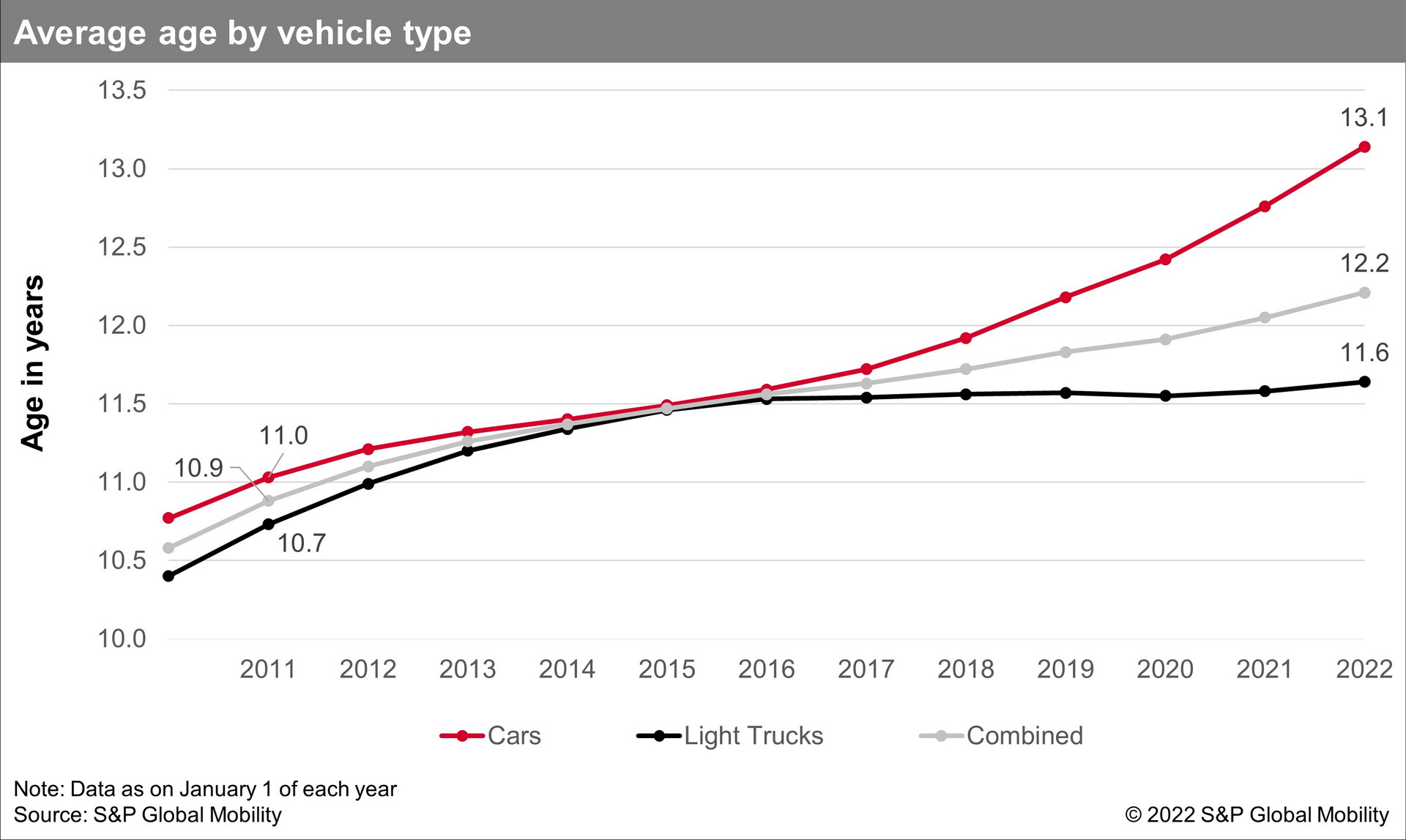
In 1998, the average age of a car on the road was 8.8 years. [0]

In 2022 it’s 13 years. [1]

Factor in install-base effects and the multiple probably rounds to 2x

[0] https://www.bts.gov/content/average-age-automobiles-and-truc...

[1] https://www.carscoops.com/wp-content/uploads/2022/05/SP-Glob...
Re:The true costs of inflation in small-town Texas by lend000 on Friday July 22, 2022 @02:06PM (#32195192)
That's actually a pretty big difference compared to the OP's claim, AND note that this statistic incorporates a delay (we are comparing 1990 vehicles to 2009 vehicles instead of 1998 to 2020). Granted, we don't know how long 2020 vehicles will last yet. The final caveat being the second point I made about people holding onto their cars longer as inflation rises / changing their preferences, not necessarily because the cars are holding up better.
Re:The true costs of inflation in small-town Texas by RC_ITR on Friday July 22, 2022 @02:29PM (#32195485)
> The final caveat being the second point I made about people holding onto their cars longer as inflation rises / changing their preferences, not necessarily because the cars are holding up better.

I’m sorry but the idea that “we used to junk cars sooner because new cars were cheaper” is a very big stretch to support your bias (much moreso than the concept of hedonic adjustment)

Re:The true costs of inflation in small-town Texas by lend000 on Friday July 22, 2022 @04:02PM (#32196469)
> we used to junk cars sooner because new cars were cheaper

This is not obvious to you? Look at how many things (especially plastics and electronics) are wasted today while they still function because they are so cheap. How many times have you replaced your smartphone while it still worked fine?

The point, again, is that we can do reasonable mental gymnastics to more or less counter-act any hedonic adjustments (which were also mental gymnastics to make inflation seem lower in the first place). A better metric would involve fewer loopholes like this that allow arbitrary mental gymnastics in the first place and instead say "how much does an entry level vehicle cost, amortized with upkeep costs and fuel for the average American." There should be no adjustment for better airbags or bluetooth, nor a reverse adjustment for taking into account improved automation in factories.

Re:The true costs of inflation in small-town Texas by RC_ITR on Friday July 22, 2022 @05:49PM (#32197512)
> This is not obvious to you?

It is very much not obvious to me because it’s not true. Critical safety features like airbags (required by US law in 1999) and ABS (required by US law in 2000) were not standard in cars back then, which is a huge incentive to junk a car.

Since then, mandatory safety features include traction control (2011) and backup cameras (2018), and idk about you, but I’m fine driving a car without Either of those things, but not ABS or Airbags.

Honestly, if you’re going to have such strong opinions about cars, maybe do research into them.

And to your amortization point, literally amortization means “cost over useful life” so we agree?

And please look at the link on my other comment [0] because that is not how car prices are adjusted by the BLS

[0] https://www.bls.gov/cpi/quality-adjustment/new-vehicles.pdf

Re:The true costs of inflation in small-town Texas by lend000 on Friday July 22, 2022 @06:54PM (#32198091)
It's possible to have many correct points but miss the forest for the trees/argue past each other. I didn't mean that last comment to be condescending, by the way.

To my original post (the second part), the BLS primarily measures the spending of people who never save a substantial portion of their income. Vehicles are a necessity for most of these people, so they are going to stretch out the lifetimes of their vehicles if the prices increase relative to their wages. Furthermore, people who might have bought a Camry with some upgrades in 1998 might be relegated to a stock Corolla in 2020. Sure, things are getting nicer all the time, but it's getting easier to make things all the time, too. Technology goes both ways, and at the end of the day, it's still a car. If they took out the rear airbags and removed all of the cheap microcontrollers, would the price really drop 40%?

The way the BLS does its survey does not account for preference changes due to price increases. When wealth inequality is constant, it's probably a decent measure. But even then, it's a political metric and the Big Mac index is the best, simple metric we have for true inflation (which has been consistently higher than CPI for decades).

Re:The true costs of inflation in small-town Texas by thfuran on Friday July 22, 2022 @06:53PM (#32198082)
Do you think most people wouldn't get new cars more often if they were free?
Re:The true costs of inflation in small-town Texas by thfuran on Friday July 22, 2022 @10:27AM (#32192182)
Yes, that sounds like a good idea if what you're trying to estimate is the cost of maintaining a certain quality of life.
Re:The true costs of inflation in small-town Texas by spaetzleesser on Friday July 22, 2022 @12:27PM (#32193852)
If you push this far enough then you can argue inflation away from almost anything.
Re:The true costs of inflation in small-town Texas by thfuran on Sunday July 24, 2022 @09:05AM (#32213104)
So what? The goal of measuring inflation isn't to compute the biggest, scariest number, it's to track changes over time.
Re:The true costs of inflation in small-town Texas by symlinkk on Friday July 22, 2022 @08:03AM (#32191037)
No
Re:The true costs of inflation in small-town Texas by marvin on Friday July 22, 2022 @03:09AM (#32189380)
If anything, shirts should get negative hedonic adjustments as the quality of the fabrics and craftmanship decrease. But I’m guessing negative hedonic adjustments isn’t a thing.
Re:The true costs of inflation in small-town Texas by EVa5I7bHFq9mnYK on Friday July 22, 2022 @12:39PM (#32194001)
Yeah, like many other things. Tomatoes of today do not smell and have no taste. Nobody would buy such tomatoes 40 years ago even for half the price.
Re:The true costs of inflation in small-town Texas by californical on Friday July 22, 2022 @03:08AM (#32189370)
> the survey evaluates the median spending of a sample of Americans, but the median American spends pretty much all of their money.

I feel like this is relevant. If you already don’t save anything, then your spending power decreases drastically over a year or two, you still spend all of your money but just buy fewer of the nonessential or “nicer” things.

So CPI adjusts and assumes that “this is normal spending now”, but really there was no flexibility in someone’s spending anyways.

They would’ve kept buying more if they could, but now their quality of life has decreased but CPI treats it as if the product has improved & they don’t need as much anymore (even as a QOL increase).

Am I understanding this correctly?

Re:The true costs of inflation in small-town Texas by lend000 on Friday July 22, 2022 @10:23AM (#32192138)
That was my interpretation when I first read the detailed process about the BLS survey.

It will still measure inflation, but if the median American's spending preferences changes when prices change (which is true until the median American can never afford anything except the bare necessities to begin with), then those changing preferences will result in falsely lower inflation numbers. Combined with Hedonic adjustments, true inflation has probably been about 50% higher than reported for the last two decades (and more in line with the Big Mac index) [0].

[0] https://medium.datadriveninvestor.com/what-do-big-mac-prices...

Re:The true costs of inflation in small-town Texas by tyingq on Thursday July 21, 2022 @11:50PM (#32188309)
The CPI is well thought out, though it's possible that their choices on weighting don't match your own spend.

Some detail here: https://www.bls.gov/cpi/tables/relative-importance/2021.htm

Re:The true costs of inflation in small-town Texas by imtringued on Friday July 22, 2022 @03:01AM (#32189331)
People don't seem to grasp that 9% inflation is extremely high across an economy as large as the US. The 70s had 15% inflation, everyone with their rage boner demanding 50% inflation in the CPI wants ridiculous reports of hyperinflation.
Re:The true costs of inflation in small-town Texas by tyingq on Friday July 22, 2022 @08:40AM (#32191284)
Well, and 9% YoY, where the previous year was also up ~7% from its own previous year. The magic of compound interest and all.
Re:The true costs of inflation in small-town Texas by Enginerrrd on Friday July 22, 2022 @10:15AM (#32192050)
Yes! And a lot of people forget that, but I calculated it and the average spending increases I've been seeing in my household are up more like 15% YOY over the last 2 years. And that coincides with a significant reduction in consumption on our part as well as substitution for cheaper goods over that same period.
Re:The true costs of inflation in small-town Texas by themaninthedark on Friday July 22, 2022 @11:20AM (#32192906)
If the CPI does not match people's spending habits, then it does not matter if it well thought out or not because it is a bad metric.

Looking at the table, Energy(CPI-U 7.348%,CPI-W 9.029%) looks to be massively undervalued. Everything in our modern life, from food and clean water to our leisure activities require energy.

Re:The true costs of inflation in small-town Texas by SoftTalker on Friday July 22, 2022 @12:33AM (#32188559)
Last year I could buy a whole chicken for roasting for about $10. Now they are $17 or so. 70% increase. Beef the same. Pork hasn't jumped as much for some reason. Ground turkey is about the most affordable meat I can find right now, but when you cook it you can see that it has a lot of water in it.
Re:The true costs of inflation in small-town Texas by gimmeThaBeet on Friday July 22, 2022 @02:09AM (#32189053)
This is where I'm always curious to see what other dynamics are going on in other places, I don't know how else to say it except that has absolutely not been my experience. In live in just normal midwest suburbia, so if there's places living with that, I should really count my blessings I don't.

With a lot of these things nowadays, I've been looking at my receipt data and rooting through FRED, and obv the absolute numbers are probably not going to be bang-on, but the percentages are definitely pretty similar.

So yeah, it's not fantastic, but FRED data for chicken, beef, sirloin is like 20%, 26%, 51% in two years, which agrees pretty well with what little data I personally have, or their estimate is a fair bit higher for the sirloin (also prob hard to estimate since I wouldn't treat it like as much a commodity as ground beef). Milk is a similar story, FRED has like 40% in two years, knock on wood I don't think I've observed that, but dairy might be a midwest speciality for these purposes.

whole chicken, beef, sirloin. https://fred.stlouisfed.org/series/APU0000706111 https://fred.stlouisfed.org/series/APU0000703112 https://fred.stlouisfed.org/series/APU0400703613

Re:The true costs of inflation in small-town Texas by mellavora on Friday July 22, 2022 @04:25AM (#32189815)
Avian flu resulted in mass culls.

Feed prices also higher due to Ukraine/grain shortages increasing demand for grain.

The very real price increases you are seeing are driven in part by very specific and focused economic shocks which exceed the baseline macro-level shock (officially measured at circa 10%, with all the caveats around that measure)

Re:The true costs of inflation in small-town Texas by nonameiguess on Friday July 22, 2022 @06:44AM (#32190555)
Thanks to buying almost everything from Amazon, I get a nice record of exactly how much I spent and can compare to the price being offered today, so I'm going to do that. I'm just going to go to 2020 and see what I can find:

- Topo Chico 24 pack of 12 oz glass bottles: then $20.99, now not available (damn shame because it's my wife's favorite drink, but these seemed to disappear in the pandemic and never came back)

- Chameleon cold brew coffee, 32 oz: then $9.99, now $8.36

- Fire 7 HD tablet for my niece: then $99, now $139 for the Fire 8

- Optimum Nutrition Whey Protein, 5 lbs: then $58.64, now $59.36

- A wireless keyboard: then $29.99, now $27.99

- Deep conditioning hair mask: then $25.00, now $25.55

- Organic Valley heavy whipping cream, 16 oz: then $4.79, now $5.69

- Set of 3 floating shelves: then $14.99, now $13.69

- Fage full-fat greek yogurt, 32 oz: then $5.49, now $5.99

- 1 pint organic blueberries: then $4.49, now $4.49

- 2 pack of 3.4 oz Sensodyne toothpaste: then $20.48, now $12.79

- Cabinet mounted USB fans, 12": then $39.99, now $39.99

This isn't cherry picked in any way, not pulling from memory or looking back after sticker shock. It's just everything I bought in December 2020.

Re:The true costs of inflation in small-town Texas by lotsofpulp on Friday July 22, 2022 @09:15AM (#32191555)
All of the price changes in my retail purchases are meaningless when compared to price increases in land, healthcare, education, and taxes since I started working in mid 2000s for the location I lived / wanted to live in.

Daycare has more than doubled, $20k+/year increase for 2 kids, land is hundreds of thousands more. How much price changes have affected you are very dependent on what resources you were/are aiming to buy and who you are competing against to secure it.

Re:The true costs of inflation in small-town Texas by noirbot on Thursday July 21, 2022 @11:27PM (#32188151)
I'm always curious for some of these how much it's just a problem of round numbers. Something like the vet visit, I totally believe, but marking down the $1 increase in airport parking cost feels like it's less a percentage and more that they just added 1 to the number because making it cost 36 cents more would just be awkward.

Not that that doesn't cause a problem for the people paying it, but pricing for relatively cheap items is a coarse instrument. If you're a business owner and you have no idea how long inflation will be this high, you maybe just err on the side of pricing in some future price increases now and raising prices more in one go vs. changing them every couple weeks. Most consumer goods aren't like gas where people just expect the price to go up and down constantly day to day.

Re:The true costs of inflation in small-town Texas by Semaphor on Friday July 22, 2022 @09:10AM (#32191519)
I’ve just done that with a selection of products I commonly buy (Germany). 2021 is January till March, 2022 is from July.

https://i.imgur.com/suESNqF.png

Rather painful to see, no idea what happened to Almonds though, maybe they were extra expensive in 2021. I skipped both cauliflower and celery sticks because prices fluctuate wildly for both. I left out meat as well, but ground beef almost doubled in price.

Re:The true costs of inflation in small-town Texas by onlyrealcuzzo on Friday July 22, 2022 @06:30AM (#32190472)
I'm assuming there are many things in that person's basket of goods which did not change in price at all, and many others that did not change in price as much.

Housing makes up 37% of the basket. It's noticably absent. And it's measured... Interestingly.

Lasagna at a restaurant is just a small part of food away from home which makes up <6% of the basket...

https://www.bls.gov/cpi/tables/relative-importance/r-cpi-e-2...

Re:The true costs of inflation in small-town Texas by godmode2019 on Friday July 22, 2022 @05:18AM (#32190122)
In Australia you would need to double those prices, to be on the low end of prices.

Maybe we earn more money?

Re:The true costs of inflation in small-town Texas by ac29 on Friday July 22, 2022 @11:43AM (#32193202)
An Australian dollar is worth ~30% less than a US Dollar, which explains part of it.
Re:The true costs of inflation in small-town Texas by bitshiftfaced on Friday July 22, 2022 @10:40AM (#32192330)
The median income in Australia is higher than in the US, yes.