Toyota didn't even roll out passenger side airbags until 1998. Only the driver had them prior to this. The new Corolla has 8 airbags. Today we have better fuel efficiency, collision protection, driver assistance, remote start... Even the seats are more comfortable. Not to mention most car brands have much better warranties today than they did in the '90s.
Other things get hedonic adjustments but shouldn't. Shirts for instance.
The average new car in the US lasts like 2x longer than it did in 1998. Shouldn’t that factor in?
Absolutely not. Where do you stop with this game? Do you factor in that the seats are better so people go less to the doctor for back pain?
I mean, I really struggle to follow your logic.
If a paper towel roll has 2x the sheets but costs 1.5x more, is that inflation too?
The paper towel is a bad example because you clearly can quantify the number of sheets. It gets more tricky if you say new paper towels are more absorbent so you need less so there is no inflation although the sheet costs more. How do you measure that? These metrics are way too easy to be gamed. Next is apples costing twice as much but they are crunchier so no inflation?
You can’t just keep randomly changing the relevant populations. First it was working people who can’t afford a breakdown. Now it’s wealthy people who choose to buy cars regularly. Maybe that’s why it’s difficult to grasp inflation: it’s a basket of everybody
> How do you quantify how much longer cars last?
https://ihsmarkit.com/research-analysis/average-age-of-vehic...
> Maybe people use them longer because cars are better or maybe they use them longer because they can’t afford new cars.
You’re implying that people used to junk old cars because new ones were so cheap? Interesting take.
> The paper towel is a bad example because you clearly can quantify the number of sheets
I can also literally quantify how much longer cars last (see link above).
> It gets more tricky if you say new paper towels are more absorbent so you need less so there is no inflation although the sheet costs more.
Yeah, you know inflation takes a basket of spend into account, right? So yeah if in a year, the average consumer buys half as many paper towels that cost 2x as much that is exactly “no inflation”.
> These metrics are way too easy to be gamed. Next is apples costing twice as much but they are crunchier so no inflation?
I really suggest you read up more on the thinking behind inflation if you’re going to have such a strong opinion about it. Apples being crunchier is not accounted for in hedonic adjustments [0]. Like literally. Go to FK011
[0] https://www.bls.gov/cpi/quality-adjustment/home.htm
EDIT: Learn something new I guess. Cars aren’t even subject to hedonic adjustment. They have their own adjustment system that seems pretty fair if you read it[1]
[1] https://www.bls.gov/cpi/quality-adjustment/new-vehicles.pdf
The USDOT tracks this! That’s why cars are such a bad example.
In 1998, the average age of a car on the road was 8.8 years. [0]
In 2022 it’s 13 years. [1]
Factor in install-base effects and the multiple probably rounds to 2x
[0] https://www.bts.gov/content/average-age-automobiles-and-truc...
[1] https://www.carscoops.com/wp-content/uploads/2022/05/SP-Glob...
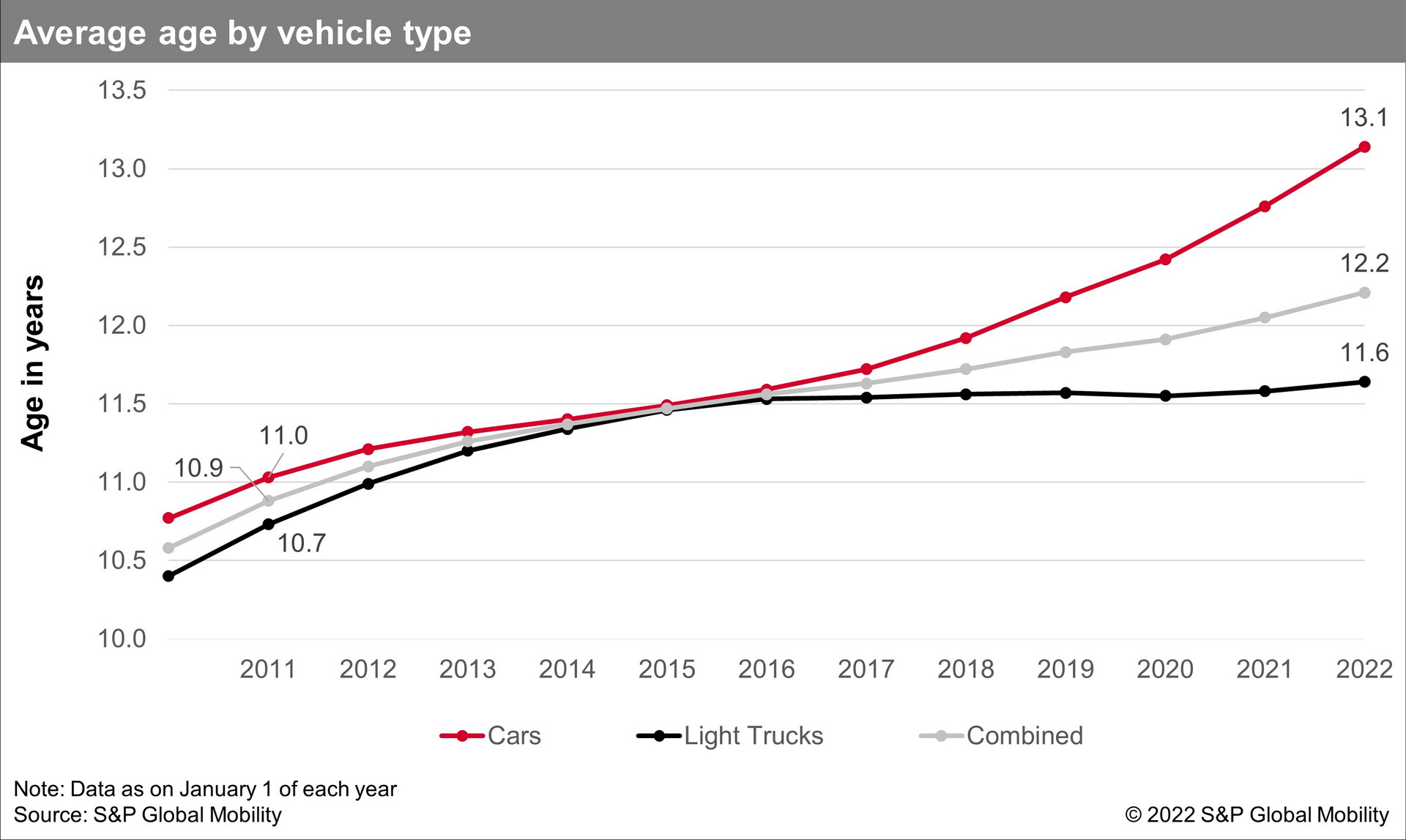
I’m sorry but the idea that “we used to junk cars sooner because new cars were cheaper” is a very big stretch to support your bias (much moreso than the concept of hedonic adjustment)
This is not obvious to you? Look at how many things (especially plastics and electronics) are wasted today while they still function because they are so cheap. How many times have you replaced your smartphone while it still worked fine?
The point, again, is that we can do reasonable mental gymnastics to more or less counter-act any hedonic adjustments (which were also mental gymnastics to make inflation seem lower in the first place). A better metric would involve fewer loopholes like this that allow arbitrary mental gymnastics in the first place and instead say "how much does an entry level vehicle cost, amortized with upkeep costs and fuel for the average American." There should be no adjustment for better airbags or bluetooth, nor a reverse adjustment for taking into account improved automation in factories.
It is very much not obvious to me because it’s not true. Critical safety features like airbags (required by US law in 1999) and ABS (required by US law in 2000) were not standard in cars back then, which is a huge incentive to junk a car.
Since then, mandatory safety features include traction control (2011) and backup cameras (2018), and idk about you, but I’m fine driving a car without Either of those things, but not ABS or Airbags.
Honestly, if you’re going to have such strong opinions about cars, maybe do research into them.
And to your amortization point, literally amortization means “cost over useful life” so we agree?
And please look at the link on my other comment [0] because that is not how car prices are adjusted by the BLS
[0] https://www.bls.gov/cpi/quality-adjustment/new-vehicles.pdf
To my original post (the second part), the BLS primarily measures the spending of people who never save a substantial portion of their income. Vehicles are a necessity for most of these people, so they are going to stretch out the lifetimes of their vehicles if the prices increase relative to their wages. Furthermore, people who might have bought a Camry with some upgrades in 1998 might be relegated to a stock Corolla in 2020. Sure, things are getting nicer all the time, but it's getting easier to make things all the time, too. Technology goes both ways, and at the end of the day, it's still a car. If they took out the rear airbags and removed all of the cheap microcontrollers, would the price really drop 40%?
The way the BLS does its survey does not account for preference changes due to price increases. When wealth inequality is constant, it's probably a decent measure. But even then, it's a political metric and the Big Mac index is the best, simple metric we have for true inflation (which has been consistently higher than CPI for decades).
I feel like this is relevant. If you already don’t save anything, then your spending power decreases drastically over a year or two, you still spend all of your money but just buy fewer of the nonessential or “nicer” things.
So CPI adjusts and assumes that “this is normal spending now”, but really there was no flexibility in someone’s spending anyways.
They would’ve kept buying more if they could, but now their quality of life has decreased but CPI treats it as if the product has improved & they don’t need as much anymore (even as a QOL increase).
Am I understanding this correctly?
It will still measure inflation, but if the median American's spending preferences changes when prices change (which is true until the median American can never afford anything except the bare necessities to begin with), then those changing preferences will result in falsely lower inflation numbers. Combined with Hedonic adjustments, true inflation has probably been about 50% higher than reported for the last two decades (and more in line with the Big Mac index) [0].
[0] https://medium.datadriveninvestor.com/what-do-big-mac-prices...
Hedonic adjustments are more or less at the mercy of the bureaucrats. For example, new vehicles did not go up in hedonic-adjusted price from 1997 to 2020 according to the BLS [0]. The justification is that new cars have bluetooth and other features that counter-act the price change. An automatic Toyota Corolla was $12373 brand new in 1997. It was $19700 in 2020. Our inflation numbers over those years did not incorporate a price increase AT ALL, so it's a fair assessment that real inflation was higher based on that alone. The Big Mac index has probably always been the most accurate assessment, free of political pressures.
And the most fundamental problem: the survey evaluates the median spending of a sample of Americans, but the median American spends pretty much all of their money. So you end up with the dotted line in this chart: [1]. Spoiler, it's pretty much a flat line. Real median wages don't move because CPI is calculated by measuring median wages. If prices rise, people can't <consistently> spend more than all of their money, so they buy cheaper things and buy less of them, and this changes the weights and reduces the inflation numbers. The fact that some economists with PhD's think this makes sense is why you should always do your due diligence instead of accepting a doctor's diagnosis blindly.
[0] https://fred.stlouisfed.org/series/CUUR0000SETA01 [1] https://www.bls.gov/charts/usual-weekly-earnings/usual-weekl...