The only things that have a strong correlation with recessions are rising interest rates and balanced budgets. So maybe we should stop doing the things that are known to cause recession?
Debt is money and that an economy needs money to function. And if an economy is growing, it needs more money, which means either more personal or more corporate or more government borrowing.
Perhaps the problem is a steady state versus growth model economic configuration, and we also need finer grained control over stimulating or discouraging very specific economic activities.
This is the vast majority of homeowners in most countries.
Which also spills into rent costs, of course.
There's an alternative, which is to ask whether something EVEN HAS A CHANCE of being relevant in 10 years. Experimentation and risk-taking is fine, hamster-wheeling and "bullshit jobs" are a waste of life and destroy the earth, for little benefit.
Slap on sunscreen, then use statins to counter the high blood pressure (rather than get free exposure to the sunlight we all evolved to live under).
Have both parents in full-time employment, while kids get warehoused in daycare.
Overwork people to the point they have neither time nor inclination to cook for themselves from scratch, instead using meal kits, ready meals, takeout, restaurants.
Alienate people from their own bodies with manipulative marketing that weaponizes their insecurities against them, then patch up the self-esteem with totally unnecessary cosmetics, gyms, fashion, surgeries, etc.
All these activities fatten GDP, but which of them really represent human flourishing?
We measure the wrong things, at least in part because the right things so often cannot be measured. We need to trust in the unmeasurable, but that is antithetical to the technocrat.
I have always thought most of the sunscreen products we have today have shady ingredients by just looking at the list of endless number of chemicals. I mean why do we need 50+ chemicals in a product when just zinc oxide can do. This was confirmed when Neutrogena last year had to tee all some of their sunscreen products last year. Increasing blood pressure is a new one I haven’t heard of before.
The interventionist’s prescription, though, is to always wear sunscreen, to take vitamin D supplements, and to take statins to control blood pressure.
I suppose my original point was that this represents a perverse exercise in ditch digging and filling. Using one expensive product to block the sunlight we evolved under, then using yet more products to compensate for the disrupted natural functioning of our skin (which we likely don’t fully understand anyway, so the counter-interventions are a partial remedy at best).
[1]: https://www.ncbi.nlm.nih.gov/pmc/articles/PMC6830553/ [2]: https://pubmed.ncbi.nlm.nih.gov/26992108/
I sympathize with this sentiment, but it's impossible in practice to reliably predict what will be relevant in 10 years.
Also, I don't believe it's possible to get the signal without the noise. I've even come to believe the noise may be the generator of signal. We live in a probabilistic universe, not a deterministic one.
Pre fiat, economies did have continuous injections of gold and silver mining to provide debt free money supply. Would it be wrong to QE via direct printing and government spending? At least then we may get roads, bridges, and other societal assets out of QE vs record prices for picasso’s.
Please excuse my economic ignorance.
In the absence of money (or debt), we are reduced to barter. I give you a donkey, you provide me with grain for a month.
But suppose you don't need a donkey? Well, you can trade it for something you do want; so the donkey is now a medium of exchange, i.e. money. Instead of carrying donkeys around, you can instead carry some token, with the legend "I promise to pay the bearer on demand one donkey". You could even stamp a donkey's head on the token.
> if an economy is growing, it needs more money
I get that. But why does that mean the government has to print money (or buy back government bonds, or whatever)? Why does the market not automatically synthesise the means of exchange that lubricate the matching of supply and demand? Is it simply because a barter economy is inefficient? But then why doesn't a barter economy automatically produce means of exchange that are efficient?
Again, I apologise for my manifest ignorance.
Say you give me a donkey and I give you an "IOU - one donkey or equivalent". That IOU represents my debt to you. If my reputation is good, you could trade that IOU to someone else for say, 10 chickens, you pass my debt to them. If my reputation is really good, your town could pass my IOU around for different goods and then my IOU acts just like money.
Cash (and money) works the same way as an IOU. It's just that the owner of the debt is abstract and far removed from the holder of the cash.
So it seems that in an economy without money, money will arise automatically, in the form of debts that are to a greater or lesser extent formalised. So why do economies need central banks? What's wrong with that kind of "informal money"?
I have a strong suspicion that we don't; that it's governments that need central banks.
This is generally the way we react to that sort of things. And even if things still sometimes break (in slightly different ways than before) these systems have allowed us enormous amounts of economic growth.
The central bank won't have to set the interest rates anymore if the reserve requirement is something sane like 20% or 30% as banks are limited in their bank reserves and thus incentivized to choose the right interest rate for themselves. This also eliminates the need for QE.
You still need the central bank as an inter banking network by the way.
The correct solution to avoid being at the wim of such friendly countries as Russia, Saudi, and China would be for Japan, Europe, the US, to massively invest in increasing internal free (renewable) energy sources, and diversifying strategic imports like silicon chips.
From 2015-2017 in the US renewable production increased from 558TWh to 710TWh, a 13% increase per year. Staying at that rate for the next 5 years would have put US renewable at 1,300TWh today or 31% - 500TWh more than today, leaving 500TWh of gas and oil to be used elsewhere and reducing the power of Russia and Saudi over the global economy. By 2030 the US would have hit 3,500TWh, up to wards 100% of current electric generation, and by 2040 at the latest to include the extra electric load from things like battery cars.
But instead the US didn't.
Point is Fed has done a lot of damage. In a functioning democracy, Fed chair would be summoned by congress and Fed would be held responsible for not keeping its dual mandate - price stability (which inflation is causing wreckage) and unemployment ( from an impending recession). If a Fed agency can’t keep its mandate, it’s time to look at its validity.
But of course our elected leaders won’t. They love nothing but delegating to unelected agencies full of so called experts so they don’t have to make hard choices/decisions and bear the consequences from voters. So they just shield themselves with experts.
That changes demand, not supply, as you astutely observe. Fed has no tools for supply, by design.
That's why they've pushing back on the US govt recently, talking publicly about how current inflation is 30% due to demand (oversupply of money, low interest rates) and 50% due to supply constraints (food, energy, and Asian supply chain slowdowns). They're telling the US govt that solving inflation will require govt and private sector solutions to the supply problems. The Fed has no tools for those.
If they just let market run its course, we'd have a severe recession caused by shutdowns and job losses in early 2020. Demand for consumer goods would be significantly reduced and the crippled supply would be sufficient.
If I were to guess, the labor supply for those types of jobs will continue to decline, so I do not think there is any short term way to counter that factor of inflation without lowering expected quality of life or some miraculous automation innovations.
They don't have to be miraculous. In the UK, Brexit has caused the supply of ultra-cheap East European fruit-picking labour to dry up. Fruit growers are consequently now investing in automating fruit-picking.
Automation is simply engineering; these problems don't require miraculous inventions. Anyone can build a machine to pick a strawberry. The trick is building one to a price-point, that can pick an entire polytunnel clean, without damaging the fruit too much. It's not innovation, it's just applying stuff we already know to solve practical problems.
They warned that massive investments into windmills and solar MUST be accompanied by massive investments into the grid, and that Germany fails spectacularly in the latter, especially because of onerous regulation and incessant NIMBYism. Namely, a lot of power from renewables is being produced in northern Germany and the shallow seas around it, where the country is only sparsely inhabited, and it is almost impossible to get this power in adequate volumes to the consumers in the highly developed and power-hungry regions in the south - Bavaria, Baden-Württemberg.
One of them also stated that Germany managed to build only about a fifth of the necessary network of new power lines in the last decade.
Greetings from Europe. It is not really any better here. Logistics is hard. Logistics in electricity doubly so.
In 2019 it was 7.73, despite interest rates having dropped from about 6% to under 1%, making mortgages far more affordable. The monthly cost of buying a home (which is what mainly drives the price).
In 1997 it cost 27% of the median gross income for a 90% 30 year mortgage on a median house at the 7% base rate.
In 2007 it cost 44% with a rate of 5.25%
In 2019 it cost 25% with a rate of 0.5%
Today it costs 32% with a rate of 1.25%
How do you explain Quantative Easing from 2007 to 2019, coupled with historically low interest rates, barely touching house prices. How do you explain house prices doubling from 1997 to 2007 without Quantative Easing?
Or did the QE in the UK not go into real estate market?
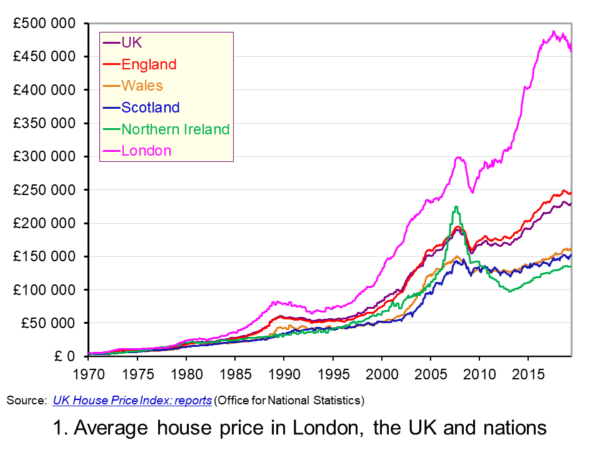
Instead, you should be looking at the top locations that attract investment capital, such as London, which has experienced a much steeper price trajectory:
https://pearsonblog.campaignserver.co.uk/wp-content/uploads/...
The correct answer is nuclear and investing in our own fossil fuel industry.
Furthermore you are advocating for supply side economics. Totally agree - we need to cut taxes massively on business and encourage everything we can do for the private sector to invest in more supply production - of everything! But the left endlessly attacks business and sees them as the enemy, which results in less production and higher prices.
Fantasy land everywhere.
For example, why did the Fed went out of their way last year calling it transitory?
This article does not bring up the key issue that we have had in last 15yrs post GFC - motivation of having endless QE. At some point everyone knew there would be repercussions but everyone looked the other way and was like “trust the fed” or “don’t fight the Fed”. Just kicking the can down the road.
Well now Fed has its hands tied. It can’t raise rates too fast or the economy craters. The other option is let the inflation run hot.