News for hackers. Stuff that matters.
Re:How Not to Fight Inflation by incrudible on Saturday July 16, 2022 @10:17AM (#32118369)
The main driver of price inflation is money printing, but you need to account for where that money goes. Stock and real estate prices did experience massive inflation. The CPI does not account for this. Print money that can only be spent on hamburgers and sure enough, hamburgers will experience price inflation as well.
Re:How Not to Fight Inflation by iso1631 on Saturday July 16, 2022 @02:25PM (#32120560)
In England and Wales the median house price to median wage ratio in 1997 was 3.55. By 2007 this was 7.17. It dipped to 6.35 in 2009 before recovering.

In 2019 it was 7.73, despite interest rates having dropped from about 6% to under 1%, making mortgages far more affordable. The monthly cost of buying a home (which is what mainly drives the price).

In 1997 it cost 27% of the median gross income for a 90% 30 year mortgage on a median house at the 7% base rate.

In 2007 it cost 44% with a rate of 5.25%

In 2019 it cost 25% with a rate of 0.5%

Today it costs 32% with a rate of 1.25%

How do you explain Quantative Easing from 2007 to 2019, coupled with historically low interest rates, barely touching house prices. How do you explain house prices doubling from 1997 to 2007 without Quantative Easing?

Or did the QE in the UK not go into real estate market?

Re:How Not to Fight Inflation by incrudible on Monday July 18, 2022 @07:16AM (#32136865)
"The median house in the UK" isn't a particularly attractive asset to anyone except those who want to live in there, which isn't that many people.

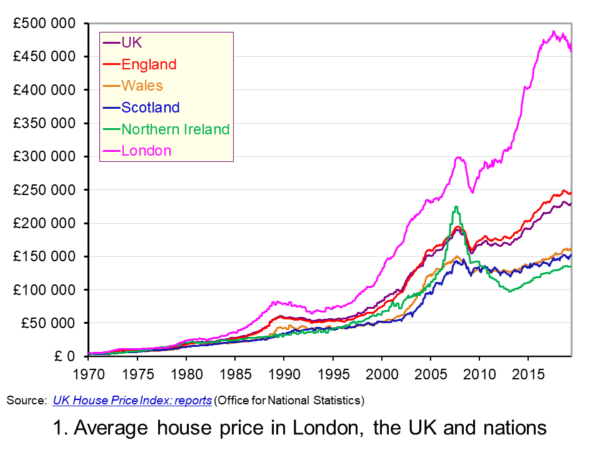
Instead, you should be looking at the top locations that attract investment capital, such as London, which has experienced a much steeper price trajectory:

https://pearsonblog.campaignserver.co.uk/wp-content/uploads/...
Re:How Not to Fight Inflation by imtringued on Saturday July 16, 2022 @08:11PM (#32123124)
People don't seem to grasp that lower interest rates make it cheaper to build new housing but more expensive to buy existing housing. Existing housing sits on land that appreciates in value, that is the primary driving force of higher real estate prices. The two effects basically cancel each other out.