Granted, that's a pretty difficult metric to track (if you even can).
I am learning this as I am reading the book Stolen Focus. The author goes in-depth on how tech companies are turning us into Pavlov's proverbial Dogs. We are lab hamsters who, when taught to respond correctly to stimuli, give them money.
Kinda wonder if this is in part because of: "this way we've found we can make users use GPS more often and be more precisely tracked/monetized" by degrading uses where you can easily orient and navigate yourself without turning on GPS.
Google was technologically a few years ahead of everybody - they had vector map tiles in late 2010 while Mapbox released their version only in 2014. HERE also used vector tiles at best from 2013 (app release date, so a lower bound, not sure what tech they started with)
She had a pretty short tenure, and was mainly focused on "Google Local" (remember that? didn't think so) and not Maps. Giving her serious credit for the Maps UX is seriously wrong.
She also acquired Zagat, and in fact that was the only time I actually spoke to her.
I used to search for tradespeople in this way, but then I realised there's a big industry of while-labelled SEO-friendly companies which register 100s or 1000s of names like "<location> plumber" or "<location> roofer" each with a pin on the map at <location>. When you contact them you go to a call centre 100s or 1000s of miles away who know nothing about your area, they outsource the actual work to gig workers, and when they start getting negative reviews that instance just disappears.
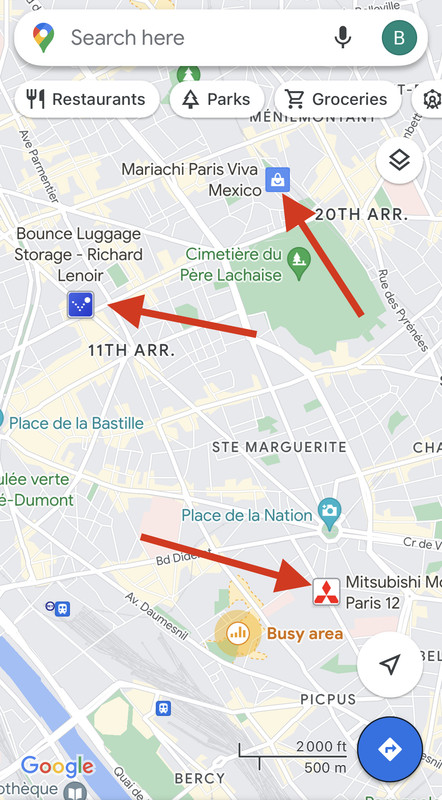
Advertised businesses in Maps appear at a higher zoom level with a square icon, and up higher in results. An example in Paris: https://i.postimg.cc/26dGZCkX/09169-E16-6-CFB-44-BA-9189-693...
That's not the right metric to use. Google has a long history of using software and services as a weapon to prevent competitors from entering a market, or to control a market even if it's not immediately/directly profitable.
Once it's no more useful it's suddenly dropped, e.g. Google Reader.
Oh, hello golang!
You're right, but in every patent infringement case against geo, the plaintiff's "damages expert" makes up a theory about this, so they can go after the AdWords money pot. Because there's no revenue in geo.
If Google endorsed one such theory, that would be bad, very bad, no good at all.
I was the Ads emissary to the Owned and Operated Properties (like Maps and YouTube) in 2010. I managed to increase the RPM by a small but noticeable amount. They used to have ads on the bottom of the screen, which was the revenue source I was optimizing. Then later I was actually IN Maps when Marissa Mayer was nominally in charge. We were trying to develop "maps for business." That all came to naught when they decided it wasn't worth the bother.
Maps is fabulous PR for Google. I can't count the times someone outside of Google said to me, "Oh, I love Google Maps!" But it's a gigantic money loser and always will be.
"What about imputed revenue?" you ask? They don't want to measure that, because then every patent litigant would use it against them, and Maps attracts a LOT of patent lawsuits.