Back in they day, they went out of their way to use non ATX power supplies.
My first xps desktop was utterly incapable of having all of its drive bays used without said drives cooking to premature failure.
My current work XPS laptop will downclock to 800mhz when chromium has hardware acceleration enabled. Other colleagues have had multiple laptops replaced because theirs downclocked when plugged into AC.
Dell is no better in quality than most of the MFGs who died in the 90s and 00s.
(As a random aside, I loved how HP would use a nice ASUS mobo and then trash everything else back in the day. We used to joke those little cases were what an Antec 1080 pooped out)
That is at least partly Intel's fault for creating CPUs with "configurable TDP-down" and the whole power limit thing. It happens to Lenovos too. There are utilities that can stop that from happening and let you use the full potential of the hardware. There's some discussion about that here: https://news.ycombinator.com/item?id=18425687
Also, their motherboards are not a standard size.
At least they aren't pulling the crap HP does on the enterprise side - requiring service contracts to access firmware updates. This means there's financial incentive to include bugs in component firmware now, to "fix" over time.
Oh yeah, and they also DRM'd drive caddies by integrating a bunch of useless capacity indicator LEDs on the front of the drive tray, because they want people to buy their stupidly overpriced drives instead of buying caddies at $5/pop off ebay and putting bulk-purchased drives in.
For less than two days each.
All returned. The quality control is a joke and I more wouldn't touch Dell with a bargepole.
One XPS 15 powered off every 5 minutes. One had a high pitched whine. In one I had the keys were loose and not fitted properly. In another the hinge was screwed and another became inexplicably hot at idle to the point it was painful to touch.
When I asked to return these they didn't even care why I was returning them.
How dell makes money out of this is beyond me. Every post to the dell redit is about returning an xps
I basically can't depend on the computer to be usable on battery unless I fully shut it down when I know it's full.
A quick google found https://www.notebookcheck.net/Dell-backtracks-on-XPS-15-9570..., which notes that the BIOS removed S3 sleep support (the standby method used since the dinosaurs) in version 1.3.0. The suggestion might be actively harmful, impossible, void your warranty, irrelevant for reason(s) I'm not aware of, or any combination thereof, but I wonder what would happen if you downgraded the BIOS to that version. (Once again, this suggestion is the equivalent of blindly reaching into a Pandora's box full of piranhas, pulling the first thing out I touch, and going "hmm, would this work?" :D)
In any case, googling around for "modern standby" and "s3" (ie, "9570 s3") will reveal the debacle behind the curtain ._.
Edit: Found https://www.dell.com/community/XPS/XPS-15-9570-BIOS-1-3-0-sl... which adds some interesting insight ("The issue is the following"), along with https://www.dell.com/community/XPS/XPS-15-9570-BIOS-1-3-0-sl... (BIOS downgrade blocked starting at 1.4.0) :(
So I documented in more detail my finding for the 9250/7275 on https://www.reddit.com/r/Dell/comments/kolf5f/patching_the_d...
I got in touch with a few other people, but nobody seemed very interested, so I gave up and got myself a Thinkpad instead.
If you want to work on that, on a BIOS advertising S3 support, IIRC all you need to do is keep the EC powered so it can proceed the GPE from the power power button. On S01x it's powered off to avoid spurious wakeups.
Get the schematics, disassemble the BIOS, and you'll the logic would be about as complicated as:
if (S01x) { EC_poweroff; }
else { EC_powered; EC_monitor_GPE_something; }
Before updating...
I was under the impression 1.3.0 was The Update Of Doom, not prior versions. Your BIOS might still have the S3 option available, and furthermore, based on the anecdata I found about downgrade being blocked starting at 1.4.0, you might be able to go to even lower BIOS versions too if you need to.
Even if the option does not appear to be available, it might be an interesting idea to ask around wherever this is being discussed, before updating, in case there's any interesting insight to be had there.
In any case I'd definitely have a thorough look around the current BIOS version first.
If onsite IT has their heads screwed on correctly :) it shouldn't be too difficult to demonstrate the benefits of a) checking the BIOS (if you don't have read-only access) and b) enabling the option if it's available (if you don't have read-write access).
Technology has advanced to the point where they can get some components to fail soon after warranty period expired with decent accuracy. Power unit failure tends to be a common one.
In terms of PC, your best bet is probably Framework laptop.
Unless the hardware is designed to be damaged (or restricted) by software, there's no way this is true. Technology can be great, but you can't "program" hardware to die on a certain date without knowing how it will be used, how long it will be used, what temperatures it will operate in, etc.
And you're not even considering that the manufacturer has no idea when the hardware will be sold and therefore doesn't even know the date that the hardware "should" fail.
Unless you have some evidence that this is both possible and happening, it's just a conspiracy theory.
One doesn't even need to be that devious: just make 'consumables' like batteries and flash drives not easily replaceable nor easily sourced. Then just sit back and wait for them to start failing. As long as most manufacturers did this, you wouldn't have to worry about losing business to your competitors due to the practice. Pretty sure you can put a check mark next to most phone and laptop manufacturers on that front these days.
This isn't unique to tech. A couple of real world examples of planned obsolescence via designed-in failure modes: incandescent lightbulb filaments were designed to fail ~1000 hours of use (even though they could easily have lasted far longer) and most clothes washers are designed to fail after ~10 years (IIRC, manufacturers design a seal in the tub to slowly disintegrate via your laundry detergent.)
Worse :( Seal can be easily replaced. They cast Drum Support/Spider part from specially selected alloy with curious property of easily Dissolving in washing powder :)
https://www.google.com/search?tbm=isch&q=corroded+spider+was... https://www.automaticwasher.org/cgi-bin/TD/TD-VIEWTHREAD.cgi...
Drum spider corrodes and falls apart, incidentally it is often the Only internal part not covered with anti corrosion paint :), and drum itself is obviously stainless. For comparison something like Miele is all stainless.
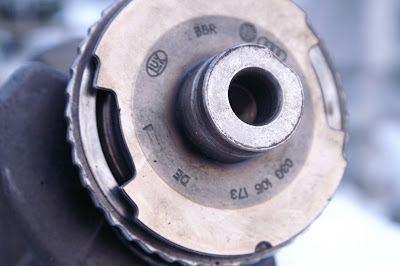
Audi (VW group) 2.0 TDI BLB Engine is made to fail at ~200K no matter what you do, from oil pump to head micro fractures. Crankshaft sprocket at 200K http://lh6.ggpht.com/_m_33vQTtsxM/SyuSlFIeSXI/AAAAAAAAG9o/rt... http://lh3.ggpht.com/_m_33vQTtsxM/SyuSn5YALLI/AAAAAAAAG9s/ul... http://lh3.ggpht.com/_m_33vQTtsxM/SyuSp1yUs4I/AAAAAAAAG9w/mO... VW answer: this part is non serviceable, whole crankshaft needs to be replaced :D Why is it made out of putty while smaller sprocket (the one taking more force) is still 'working'? Why is it designed not to be replaceable? Good 'old timer/not by the book' mechanic is still able to replace it (heat whole crankshaft, use big hammer). 200K is usually first crankshaft turn/grind, engine block itself is good for >500K easily.


Based on the lack of profits from selling hardware in the first place, it makes more sense to me that these lower quality products are made with tradeoffs that result in a lower price for their target audience. The grand conspiracy idea, even if it were true, clearly did not pan out considering the loss in market value for basically every laptop brand other than Apple.
> This isn't unique to tech. A couple of real world examples of planned obsolescence via designed-in failure modes: incandescent lightbulb filaments were designed to fail ~1000 hours of use (even though they could easily have lasted far longer) and most clothes washers are designed to fail after ~10 years (IIRC, manufacturers design a seal in the tub to slowly disintegrate via your laundry detergent.)
Source? Unless there was only 1 or 2 washing machine manufacturers, it seems kind of trivial for a competing company to sell the tub with a better seal with a longer warranty. Once again, it is probably lower quality products aimed for people who want to pay lower prices. The speed queen or Miele washer with 5 year warranty is available for those who want to spend for it.
Personally, I would rather buy a washing machine that costs half as much from Costco which comes with a 4 year warranty, and trash it when it breaks. If another manufacturer wanted to sell a washer with a 5 year warranty that cost the same, or a 10 year warranty that cost less than double, I would be game for that.
The same situation for the light bulb. If there are competing manufacturers, people would rather pay more to not have to change light bulbs. Although, this depends on how easy it is to change the bulb. For a parking lot light needing a truck with a boom, I would spend double to get a quality bulb with a better warranty. For a house bulb I can change with a step ladder, I would rather pay $2 and gamble on it lasting longer than a $4 bulb, because even if it does fail after 1 year instead of 2 years, I am not going to spend my time warrantying a $4 item.
That is simply consumers opting for the better value, making the sale of longer lifetime bulbs an uncompetitive option.
This is repeated a lot but not correct. All the "forever incandescent" bulbs have one thing in common: they're dim, and they have a very red color temperature. They live long, because their filaments are much colder. If you want whiter light, and more of it (because lower filament temperatures are less efficient, since they emit even more infrared, as the entire spectrum is more red-shifted and flatter), the only way with incandescent is a higher filament temperature, which inherently lowers lamp lifetime.
What changed, besides lifetime, when lamps went from around 2000-3000 hours to 1000 hours is that they got way brighter and more white. Which is what customers wanted.
Check out the dubai lamp to see a lamp designed to be efficient and last:
[1] https://www.osram.com/ecat/PARATHOM%20Retrofit%20CLASSIC%20B...
which seemed comparable, though running at about double wattage.
Anyway, they last and last, and I'm perfectly happy with their light.
Meanwhile I upgraded everything else also, and have a few of these
[2] https://www.osram.com/ecat/PARATHOM%20Retrofit%20CLASSIC%20A...
also non-dimmable and clear, for lamps with a single E24 socket, which should be bright, at 7.5W & 10.0W, 230V/50Hz.
Still very happy with the light, but can't say much about lasting, because only about 2 to 3 years in use, while the candles are now 5 to 6 years old.
All 2700k btw. I like it that way.
edit: I should add, before that I followed the fad with the CFL stuff, none of which lasted longer than 6 months,
made ugly light, and that not even instantly(warm up), sometimes with noisy chirping.
So for me it looks like I should have skipped the CFL phase until these were available.
I'd say it would be less complicated to implement than the stuff which caused Diesel-Gate.
It's quite easy and I think most manufacturers of electronic devices, electric appliances and even cars are doing it.
You just have to calculate what the average working time during the warranty period and adjust the quality of materials and the build quality so the MTBF is just a bit higher than that time.
Cars are not doing it. Like I said: provide a source that isn't your own suspicions and anecdata.
I am a shareholder of an auto insurance company, and our actuaries would know if cars were doing it. There is a lot of very high-quality data about vehicle reliability, and major trends are very visible.
Car companies are often stupid and/or evil, but they can't (and don't) precisely plan obsolescence. Car usage is a huge bell curve, with the average American driving ~15k miles/year, but large groups of people driving far less or far more. You couldn't possibly plan a car to fail at X years.
we are close to 2022, this shouldn't really be a conspiracy theory anymore
As some have mentioned Lightbulb is one of those prime examples. Where vast majority of LED lightbulb offer say 10 years of warranty, and yet because manufactures know most people dont bother sending them in, they cheap out on quality. Most LED ( if not all LED ) dont fail at all, it is the controller that fails, it is expensive and makes the difference. As long as it last 3-4 years, no one is going to complain. People will attribute this failure to bad luck / QA and just buy another one.
As well as other mention of capacitor. One easiest way is to get have Power Unit fail after 3-5 years, which seems long enough for Consumer Electronics. Most dont go and figure out it was X failure and just buy a new one. Synology J series NAS power unit is an example of this.
Consumer Electronics has been doing this in China for over a decade. There are reason why things are cheaper. And most internet user are still stuck with "Spec" comparison as if spec means everything.
>And you're not even considering that the manufacturer has no idea when the hardware will be sold and therefore doesn't even know the date that the hardware "should" fail.
Electronics get used when they are sold. MTBF since usage in many cases can be extremely predictable.
There is another point to look at it, a lot of consumer actually prefer to have CE fail within reasonable time so they get an excuse to buy something new. The market for some people like me who thinks something should last at least 10 - 20 years is ridiculously tiny. Although the buy for life internet following is certainly helping a bit.
You're moving the goalposts here. You said that:
> they can get some components to fail soon after warranty period expired with decent accuracy
But then you specifically mention a window of 2 years. From a business perspective, 2 years is not "decent accuracy".
These dont ever reach the shore of US or EU unless you order them via Aliexpress. Consumer protection and expectation sets things apart. But doesn't mean vendors dont do it.
I also gave the LED light bulb example where evidence are given with respect to warranty and lifetime usage.
And no one implied that all of these product, every single batch of it will specifically failed at the same time. Which I think is what you are getting at. My original post only mention it is technically possible, and in many cases actively done so.
This assumes a positive correlation between quality and price for parts. That isn't always the case. There's no reason a better part will be more expensive.
And again, you're ignoring my primary argument: "lifespan" is not measurable in calendar years for electronics. Some people I know use their laptops 360 hrs/mo, and some people (like me) only use them when traveling, ~20 hrs/mo.
After a calendar year of that, my laptop has only 240 hrs of life lost, while another laptop might have 4,000+ hrs of life lost.
Please provide a source about how a hardware manufacturer (without the aid of software) could plan for a component to fail after either 240 hrs of usage or 4,000 hrs of usage.
And really it’s not that companies in the past did that much better, it’s just that in the past getting replacement parts was easier and you had fewer integrated components. Today everything is pretty much in a single package even basic electric circuits like a bridge rectifier. So things got smaller and are more likely to fail and they are harder to replace.
Where did I disagree with this?
What I'm saying is that MTTF is measured in usage time, whereas warranties are measured in calendar time.
Again, provide a source please. Otherwise this is just unprovable speculation on your part for something that is theoretically difficult in the first place.
after that I bought a custom 14 inch laptop in pcspecialist back when they still had amd ryzen models (Ryzen 7 4800H 8 cores, 64 Gb ram, no preinstalled OS...) which is the best laptop I've ever had in my entire life. It's been complete opposite experience in terms of enjoyment and reliability, with very few issues using Linux (my only complain the inability to put to sleep, because it messes up the video after waking up even with the latest kernel).
For me personally, it's because I never use my laptop without it being plugged in. There's nowhere I would want to use my laptop that I can't find an output (home, work, planes, airports, friends' houses, etc.)
The only exception I can think of is when actively riding public transit, but I never use my laptop in those situations.
A lot of laptops are also bought by people's employers and are a tiny cost that no one cares about (~$1,000 every 3 years for an employee making $300k+ in that amount of time). They don't care if the battery degrades.
The only time I ever cared about battery life on a laptop was in highschool where it had to last all day without being charged.
It’s like buying a car with tires that last 50k miles, but if you want to replace them you have to cut off the entire drivetrain and weld on a new one. Technically possible but only with excessive effort.
I think that car manufacturers can borrow a lot of bad ideas from IT: not being able to own a car, instead just renting it from the company, artificially gimping it and requiring a sum of money to "unlock the features".
Tesla already did this
Tesla also has a monthly fee to unlock rear heated seats in the Model 3.
I didn't realize. This kind of thing is really lame. In my case it wouldn't matter at all but for some reason it really rubs me the wrong way.
takes about 10 minutes and the correct screwdriver to replace the battery on most every dell XPS laptop i've seen.
Not to divert from the topic, but I sometimes wonder how companies on Twitter have their staff monitor tweets to get on top of social media controversies started by random people involving their brand (race, discrimination, etc.), while giving a cold shoulder to paying customers complaining about broken product features or design (with staple replies such as "contact support" or "see warranty info").
I've had good experiences with HP Elitebook x360.
The first time it had a meltdown, my touchpad stopped working completely, so I went with an external mouse. Second time, the touchpad melted itself back into place I guess, so now it works again.
Part of that is unavoidable as laptops become ever more thin, but I am reasonably sure Apple could make the keyboard replaceable.
I always suspected that 60+ screw solution was very much over engineered but I guess they wanted to eliminate any potential for flex of any sort.
And my XPS desktop had faulty connections on it's mother board (That were known by Dell even before I bought it) for the Hard Drive controller that I discovered just after the warranty replacement expired on it... 2 problems that lead to costly repair and buying expensive replacement parts.... I have a 10 year old Dell XPS 16 that still runs (granted only windows7), but I never had any problems with it.... XPS quality has declined greatly since my first one.
The standard 1 year warranty isn't enough for the way Dell computers have become shoddy, I'm deeply disappointed in Dell, and will not be buying any more of them... I don't have time to build my own, does anyone know a rock solid/powerful brand I can buy instead of Dell? I kind of miss Micron PCs.