Worse :( Seal can be easily replaced. They cast Drum Support/Spider part from specially selected alloy with curious property of easily Dissolving in washing powder :)
https://www.google.com/search?tbm=isch&q=corroded+spider+was... https://www.automaticwasher.org/cgi-bin/TD/TD-VIEWTHREAD.cgi...
Drum spider corrodes and falls apart, incidentally it is often the Only internal part not covered with anti corrosion paint :), and drum itself is obviously stainless. For comparison something like Miele is all stainless.
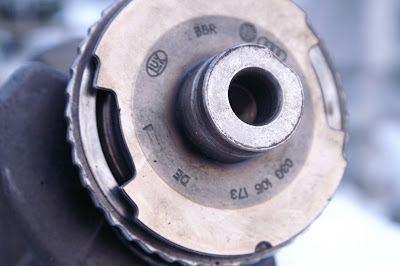
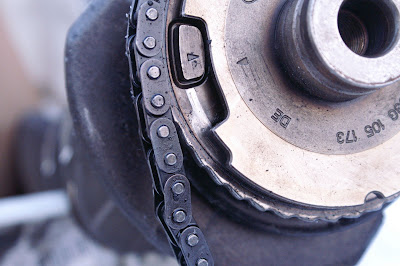
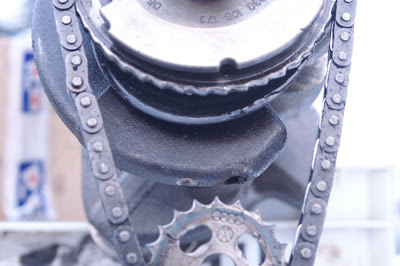
Audi (VW group) 2.0 TDI BLB Engine is made to fail at ~200K no matter what you do, from oil pump to head micro fractures. Crankshaft sprocket at 200K http://lh6.ggpht.com/_m_33vQTtsxM/SyuSlFIeSXI/AAAAAAAAG9o/rt... http://lh3.ggpht.com/_m_33vQTtsxM/SyuSn5YALLI/AAAAAAAAG9s/ul... http://lh3.ggpht.com/_m_33vQTtsxM/SyuSp1yUs4I/AAAAAAAAG9w/mO... VW answer: this part is non serviceable, whole crankshaft needs to be replaced :D Why is it made out of putty while smaller sprocket (the one taking more force) is still 'working'? Why is it designed not to be replaceable? Good 'old timer/not by the book' mechanic is still able to replace it (heat whole crankshaft, use big hammer). 200K is usually first crankshaft turn/grind, engine block itself is good for >500K easily.
Based on the lack of profits from selling hardware in the first place, it makes more sense to me that these lower quality products are made with tradeoffs that result in a lower price for their target audience. The grand conspiracy idea, even if it were true, clearly did not pan out considering the loss in market value for basically every laptop brand other than Apple.
> This isn't unique to tech. A couple of real world examples of planned obsolescence via designed-in failure modes: incandescent lightbulb filaments were designed to fail ~1000 hours of use (even though they could easily have lasted far longer) and most clothes washers are designed to fail after ~10 years (IIRC, manufacturers design a seal in the tub to slowly disintegrate via your laundry detergent.)
Source? Unless there was only 1 or 2 washing machine manufacturers, it seems kind of trivial for a competing company to sell the tub with a better seal with a longer warranty. Once again, it is probably lower quality products aimed for people who want to pay lower prices. The speed queen or Miele washer with 5 year warranty is available for those who want to spend for it.
Personally, I would rather buy a washing machine that costs half as much from Costco which comes with a 4 year warranty, and trash it when it breaks. If another manufacturer wanted to sell a washer with a 5 year warranty that cost the same, or a 10 year warranty that cost less than double, I would be game for that.
The same situation for the light bulb. If there are competing manufacturers, people would rather pay more to not have to change light bulbs. Although, this depends on how easy it is to change the bulb. For a parking lot light needing a truck with a boom, I would spend double to get a quality bulb with a better warranty. For a house bulb I can change with a step ladder, I would rather pay $2 and gamble on it lasting longer than a $4 bulb, because even if it does fail after 1 year instead of 2 years, I am not going to spend my time warrantying a $4 item.
That is simply consumers opting for the better value, making the sale of longer lifetime bulbs an uncompetitive option.
This is repeated a lot but not correct. All the "forever incandescent" bulbs have one thing in common: they're dim, and they have a very red color temperature. They live long, because their filaments are much colder. If you want whiter light, and more of it (because lower filament temperatures are less efficient, since they emit even more infrared, as the entire spectrum is more red-shifted and flatter), the only way with incandescent is a higher filament temperature, which inherently lowers lamp lifetime.
What changed, besides lifetime, when lamps went from around 2000-3000 hours to 1000 hours is that they got way brighter and more white. Which is what customers wanted.
Check out the dubai lamp to see a lamp designed to be efficient and last:
[1] https://www.osram.com/ecat/PARATHOM%20Retrofit%20CLASSIC%20B...
which seemed comparable, though running at about double wattage.
Anyway, they last and last, and I'm perfectly happy with their light.
Meanwhile I upgraded everything else also, and have a few of these
[2] https://www.osram.com/ecat/PARATHOM%20Retrofit%20CLASSIC%20A...
also non-dimmable and clear, for lamps with a single E24 socket, which should be bright, at 7.5W & 10.0W, 230V/50Hz.
Still very happy with the light, but can't say much about lasting, because only about 2 to 3 years in use, while the candles are now 5 to 6 years old.
All 2700k btw. I like it that way.
edit: I should add, before that I followed the fad with the CFL stuff, none of which lasted longer than 6 months,
made ugly light, and that not even instantly(warm up), sometimes with noisy chirping.
So for me it looks like I should have skipped the CFL phase until these were available.
I'd say it would be less complicated to implement than the stuff which caused Diesel-Gate.
One doesn't even need to be that devious: just make 'consumables' like batteries and flash drives not easily replaceable nor easily sourced. Then just sit back and wait for them to start failing. As long as most manufacturers did this, you wouldn't have to worry about losing business to your competitors due to the practice. Pretty sure you can put a check mark next to most phone and laptop manufacturers on that front these days.
This isn't unique to tech. A couple of real world examples of planned obsolescence via designed-in failure modes: incandescent lightbulb filaments were designed to fail ~1000 hours of use (even though they could easily have lasted far longer) and most clothes washers are designed to fail after ~10 years (IIRC, manufacturers design a seal in the tub to slowly disintegrate via your laundry detergent.)