To be fair, an architect with 15 years on the UCSB Review Committee resigned over this... so it's not just outsiders and the media who are bagging on the design.
https://www.independent.com/2021/10/28/architect-resigns-in-...
So yes, I agree that the UCSB dorm design sounds terrible in comparison.
Sometimes, we are stuck in a local optimum, and a new redesign is needed, which involves some tough calls and unusual solutions.
As for a bedroom without windows, when I sleep I like that my bedroom is dark. When I don't sleep, I'm not in my bed or my bedroom.
So I'm not exactly sure what people complain about his design.
My comment was responding to a call for authority. I’m not using their position for anything more than to say that they’re informed.
> When I don't sleep, I'm not in my bed or my bedroom.
I’m similar now but I was in my room a lot when I was in uni. There were also plenty of kids on my hall who were in their rooms at basically all times, leaving only for class and food.
If I may venture a guess, it may have been caused by the lack of better alternatives.
Reducing the sleeping room to its core feature (sleeping!) may give more space to build rooms for other important features, while disincentivizing staying in one room at basically all times (which I see as generally a bad idea)
And I would also say if you are a professional who got cut out of the process, you are gonna be pissed off no matter what.
not to say this architect is bad/wrong, just that he doesn't exactly have any incentive to celebrate this.
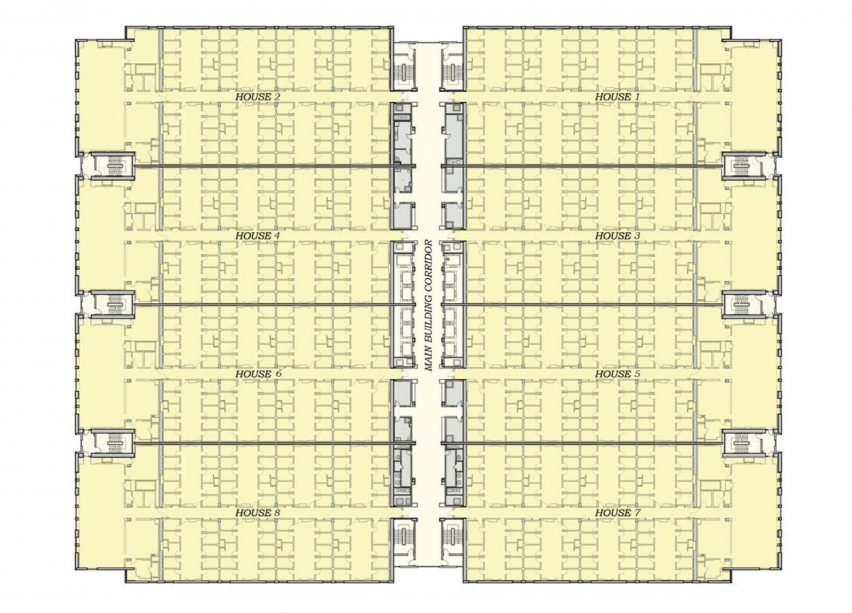
The designs are so different the relative success of the UM dorm shouldn't transfer much credibility to the design of the UCSB dorm. Going from sharing a lit common space with 7 people to 70 people is a massive change in the dynamics of those spaces. At a very basic level the UM space is owned and controlled by few enough people you can call it semi-private. At the UCSB level it's just a full public space which is a different dynamic.
https://detroit.cbslocal.com/2021/11/03/heres-what-its-like-...
https://i.redd.it/81yfb7wkxby51.jpg

https://static.dezeen.com/uploads/2021/11/munger-hall-univer...
https://www.youtube.com/watch?v=__cfVWiAxSU
[0] I say somewhat because people hate the windowless individual rooms it has enough amenities that they still rate it highly. He's fully banking on the fake windows making the new smaller rooms palatable. While massively increasing the number of people you have to share your nearest source of natural light with. edit: even that conclusion isn't universal some people had a pretty bad time living in those dorms https://www.reddit.com/r/UCSantaBarbara/comments/qkmp5h/i_wa...
By whom? A suspicious site with terrible English and reviews like “you’ll get used to it” and “grat (sic) room”. If Amazon can’t keep scammy reviews away, how is some site like “veryapt” supposed to do so? It seems there is plenty of criticism of the Michigan project (even from residents)[1], but it also differs in a key point, in that all the rooms are suites, whereas the proposed project is even denser, with 8 bedrooms sharing 2 bathrooms a piece.
[1]https://www.reddit.com/r/UCSantaBarbara/comments/qkmp5h/i_wa...*
Also good reviews on google - 4.5/5 similar to the above.
https://en.wikipedia.org/wiki/Pruitt_Igoe
"Apartments clustered around small, two-family landings with tenants working to maintain and clear their common areas were often relatively successful. When corridors were shared by 20 families and staircases by hundreds, public spaces immediately fell into disrepair.[20] When the number of residents per public space rose above a certain level, none would identify with these "no man's land[s]"
One would expect that a major University building would not suffer from disrepair but the psychological effect of "disowning" the common areas might remain.
The apartments in Pruitt-Igoe were also deliberately small.
This is total conjecture but I can imagine him doing something like this: Question: how do you make students the most miserable? Answer: create a dorm that discourages social interaction, and is far from classes and amenities.
Starting from that, you do the opposite: create a large, centrally located dorm where the design discourages sitting in your room and encourages use of shared spaces while benefiting from greater density and central location.
If the question is "are windowless rooms good?" the answer is "no." If the question is "are we willing to sacrifice bedroom windows so that we have grater communal life and better walkability" the answer is probably "yes, possibly."
Logically it's the same argument for why some people prefer to live in small city apartments when they could live in a much larger home elsewhere for the same price. The very nature of city real estate is tied to the nature of city life (both as a cause as an affect) and it's simply a tradeoff. Asked on its own "do you want a cramped apartment" the answer is always "no" yet people often opt for it in context.