This summary from her website doesn't make Apple sound all that terrible in my opinion:
> I raised issues about workplace safety in March, upon which Apple subjected me to a nonconsensual sexism investigation on my behalf. Then I faced retaliation from my managers, ER, & HR. I continued to raise my workplace safety concerns as well as my concerns about the employee relations processes at Apple. This led to a second, much larger investigation that I actually requested this time. However, before we could finish gathering & reviewing the evidence, Apple forced me onto indefinite paid administrative leave.
[1] https://foiaonline.gov/foiaonline/api/request/downloadFile/N... (PDF download)
Looking past her editorializing, the Apple communications she leaked aren't really unreasonable. She raised concerns about harassment, so Apple started an investigation. She then complains that the investigation was "nonconsensual", despite being the one to raise the concerns. She then requested a second investigation, which Apple started. The part about being placed on administrative leave is particularly confusing, because this article says that she requested to be placed on the administrative leave.
Her Tweets are hyper-dramatic. She calls her Employee Relations contacts "Employee Retaliation" and even insinuates that she thinks Apple might assault her at her home after they requested a meeting:
> Any bets if I get a literal knock on my physical door from #Apple today?
> Hey #Apple, "This feels a little like witness intimidation. I let @NLRB know." Love, Ashley
> Clutches panic button & Mace while still laying on floor pondering the brutality of U.S. capitalism...
Source: https://twitter.com/ashleygjovik/status/1436080433175818259
At the same time, she is giving these veiled threats to Apple while an investigation appears to be underway,
> .... also makes me wonder what would happen if I shared the incidents [redacted] investigated and said weren't "policy violations" like [redacted] [1]
I can see why Apple would want to part ways with that. It's standard for everyone to keep their mouths shut while an investigation is underway. If you don't understand and follow that contract then you're tainting the investigation.
[1] https://www.ashleygjovik.com/uploads/1/3/7/0/137008339/publi...

Self-help guru Tim Ferriss even copyrighted the phrase and made a big deal about publicizing a $10,000 seminar in his "Opening the Kimono" event in 2011: https://tim.blog/2011/04/12/opening-the-kimono/
Then the phrase quickly died, as it should have. Strange to hear an Apple manager using it, but I wouldn't assume they were implying anything or had ill intent.
The phrase comes from Japanese<->American business relationships in the 70s through 90s. It is not sexist or racist. It literally means providing transparency to internal affairs.
> Strange to hear an Apple manager using it, but I wouldn't assume they were implying anything or had ill intent.
"Look, I will let you invest a million dollars in Apple if you will sort of open the kimono on Xerox Parc." -- Steve Jobs, Xerox Parc, 1979
Under the Xerox Parc kimono, he found a prototype of the modern computer mouse.
Ashley's source for why this is offensive and my source for why it's not are the same (from her screenshot): https://www.investopedia.com/terms/o/open-kimono.asp
Investopedia says the term is "offensive" but the only reason they cite is an NYT article from 1998:
> New York Times reporter Stephen Greenhouse became one of the first to draw broad attention to the term when he noted that marketers at Microsoft (MSFT) had embraced it. At the time, he did caution that the use of open kimono may have originally indicated a disrespectful attitude toward the Japanese businessmen who were buying American companies.
It wasn't even disrespectful because of race, it was because Japanese businessmen were buying lots of American companies and doing due diligence. Also, kimonos are worn by men, women, and children.
In reality, Investopedia is probably labeling it "offensive" for people like me who know it is not offensive, but are unaware that using it could lead to problems.
The purpose of political correctness is to go mad. Its whole point is to control others.
Nothing is objectively inoffensive. Whether something is or not depends on delivery and to whom it's delivered. Clearly "open kimono" does imply nakedness, so if you ask a person to be "open kimono" I can see how someone might be offended by that when just saying "be more open" would serve. I don't know the exact phrasing that this employee found offensive. It could just be a misunderstanding where a manager was saying they need to "open the kimono" on a product, such as by making an API that other people can use to easily interface it.
Apparently not.
There's almost 0 chance that managers at Apple got the colloquialism wrong and were using it in any sort of sexual or racist way. And if they were, Ashley would have surely brought it to light. This was not a misunderstanding.
What happened here is that Ashley thought the term sounded offensive enough to weaponize, and so she did.
From the Slack reaction emojis, and from our own sibling HN comments, we can tell other people also feel grossed out by the "open kimono" phrase. Particularly people who have never heard it before.
The obvious conclusion is that the phrase just doesn't pass the vibe check in 2021, and no additional research is required. It sounds kind of old and maybe a little racist or sexist, so anyone that uses it needs to be called out, so we can erase this uncomfortable phrase from the tech lexicon. Problem solved?
The real problem is that adopting such a niggardly view of workplace language leads to precisely the type of in-group/out-group division and discrimination that people like Ashley claim to be fighting against. Of course, if it works, she ends up in the in-group with power because she knows the rules. The in-group is then free to exclude other cultures because they're seen as crude or offensive or somehow "less than" the enlightened rule makers of civil society.
Cause some may say you haven't passed the vibe check either, as far back as 1999 and at least as recent as 2011.
https://en.wikipedia.org/wiki/Controversies_about_the_word_n...
It sounds kind of old and maybe a little racist, so should we call you out on your usage?
I don't agree, but others might not agree of your classification of the open kinomo phrase either.
You're asking all the right questions.
Lately, it seems that the only thing that matters is passing the vibe check.
Things that surprisingly pass the vibe check:
* "long time no see" or "no can do" -- making fun of broken English (particularly Chinese and Native American)
* "got gypped" -- clearly insulting toward gypsies
* criticism from the "peanut gallery" -- that's a reference to poor seating for black people during the Vaudeville era, which is super racist by any standard
Things that unsurprisingly don't pass the vibe check but should if people were more educated:
* "jimmies" for sprinkles has a pop culture reputation for being racist and people have corrected me for saying it, but actually ice cream sprinkles were just invented by a guy named James
* "niggardly" shares no root with its racist homophone
* "那个" is a filler word that chinese speakers need to be careful with because of the same racist homophone
I get that language is always evolving and the vibe check does matter to lots of people, so I try to accommodate the sensibilities of the masses.
I know that "niggardly" is so uncommon these days that it practically is a racist dog whistle (though it really shouldn't be), so I wouldn't use it in daily speech.
But I also think it would be a shame if all the interesting turns of phrase that have stuck around over the years are intentionally censored and removed until we have nothing but bland language without metaphor or history or anything that could possibly cause offense.
"Opening the kimono" is certainly not a phrase worth censoring. I think you could make a good faith argument that trying to censor it is actually a reflection of racist and sexist American stereotypes about Japanese people.
That sounds more like jumping to conclusions than objectivity. We're not going to know the truth on either side of this. The facts are, she felt harmed, reported it, started an investigation, threatened to publicize some details, and was let go.
> What happened here is that Ashley thought the term sounded offensive enough to weaponize, and so she did.
You think she pretended to be offended in order to raise a stink publicly, thereby risking her job over a false claim? That doesn't pass the smell test for me. More likely is she truthfully felt wronged, wanted it made right, and overstepped herself a bit along the way.
> The real problem is that adopting such a niggardly view of workplace language leads to precisely the type of in-group/out-group division and discrimination that people like Ashley claim to be fighting against. Of course, if it works, she ends up in the in-group with power because she knows the rules. The in-group is then free to exclude other cultures because they're seen as crude or offensive or somehow "less than" the enlightened rule makers of civil society.
Not everything's a conspiracy. Quit looking at the world in black and white. People are complex.
Edit: explain downvotes and don’t downvote just because you don’t like the perspective. Sure there are men’s kimonos but ask some random person on the street and ask who wears kimonos and men will not be the answer.
For the puritanical American mind it might be offensive to even imagine nudity, but other than that I really don't get it.
Look I don’t make American culture, I’m simply pointing out how a huge chunk of office workers will perceive it.
Anyway, I can tell people can see this perspective, but want to pretend it’s invalid because they don’t like it. those against what they call “cancel” culture then reacting to opinions they deem unpopular by downvoting shows they don’t care about the principal of what they call “cancel” culture in general but only care that what they are used to is being “cancelled”.
Has anyone tried googling the term to see what comes up? Many posts explaining or talking about why the term is problematic. People downvoting are trying to ignore facts they dislike, but that doesn’t make facts go away.
This even comes up https://news.ycombinator.com/item?id=23549563
On hacker news it may seem like there is little difference in opinion, but keep in mind hacker news readers are a fairy like minded subsample of the population.
https://www.npr.org/sections/codeswitch/2014/11/02/360479744...
If you play a word association game, having people say the first word or words that come to mind when they see the word “kimono” what do you think the top few will be?
My guess is that for an average American, the top three would be Japan, geisha and clothing.
What do you think most Americans would say? And what are your top three?
Samurai also wear kimonos, as do priests and sumo wrestlers. Sure, the general public is uneducated but come on, this is reaching.
I seriously doubt most people even make the connection between geishas and kimonos. In fact, most people don't even mean kimono when they say kimono, they mean a vaguely asiatic thin robe, pretty popular in the 80s.
That also makes more sense for the expressions, since they are easy to open. An actual kimono takes 10 minutes to open, it's probably the least sexually suggestive garment in the world.
> “ In fact, most people don't even mean kimono when they say kimono, they mean a vaguely asiatic thin robe, pretty popular in the 80s”
The difficulty in understanding how most people would react to the phrase appears to be because you’re judging it based on your understanding of the term, not on what you yourself said is the general public’s understanding.
It's not implying in any way that women are prone to flashing, that women would be in any way inferior, or that actual women should open their actual kimonos. You are just using the image of a (supposedly) female garment.
Just like saying "like a kick in the balls" isn't sexist. It doesn't imply you want to kick men or anything like that.
But yes, many people in america group "geisha" "oshiroi" and "kabuki" all sort of mix together into this image: https://geishakai.pl/wp-content/uploads/2017/12/HANAFUSA-240...
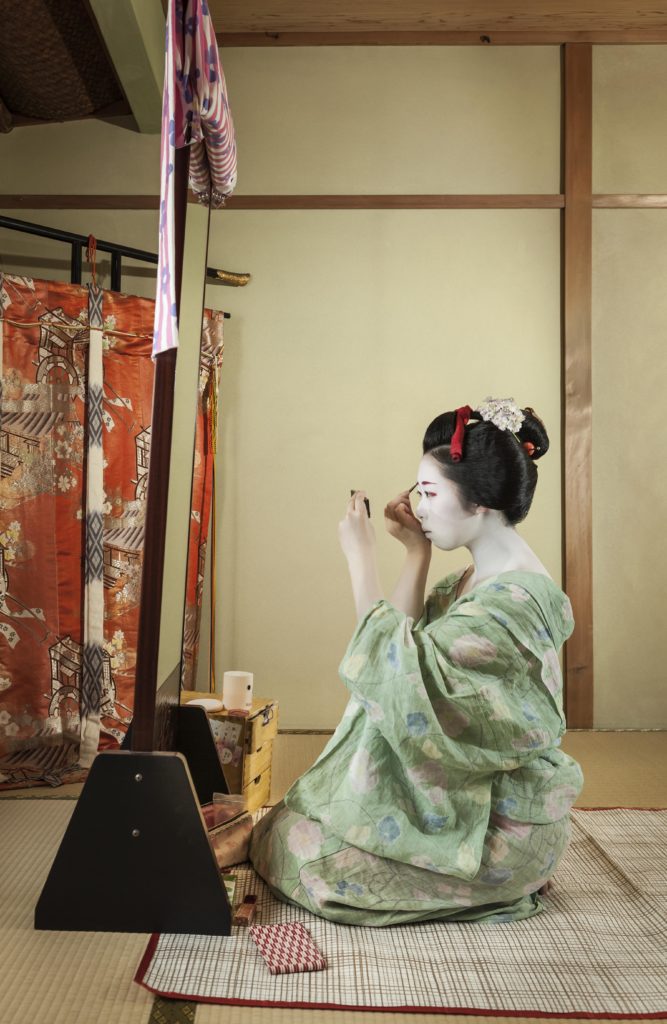
I would be more than happily to be pulled up to HR if a coworker reported me for saying "open kimono" (not a phrase I would normally say). I'm sure HR would have a wonderful time talking to my lawyer.
You're right, the answer is likely to be "Japanese".
Why does it sound problematic?
As others have already explained: it’s not an offensive phrase and kimonos are certainly not most commonly associated with women, so what’s your goal here?
What’s the point of trying to find offense?
They’re basically t-shirts. The cut differs on men and women as a function of fashion, suitability to body type, and some formal rules (e.g. wearing a family crest historically made it a different kimono subtype).
There was a period during the late 20th century where kimonos were only in fashion for women (men wore western styles except at weddings) but both historically and presently kimonos are for men and women. Random people on the street who say differently are probably just misinformed about a culture they don’t live in.
Tying it back to the phrase used… this cultural dissonance is why it’s generally difficult to import phrases/metaphors from foreign cultures: people simply misunderstand you.
If your mental image of a kimono wearer is a vulnerable Japanese woman, as it may be if you are an American that's still reverberating with echos of WW2 racism, then Ashley's disgust makes some sense.
I really don't understand why it would be offensive. Is it because kimonos are (originally) an "ethnic" (i.e. non-American) thing? Or is it related to the American panic about nudity?
The one that gets me the most is someone taking the phrase "Chinese wall" as being offensive. The phrase means a hard separation of business units in some companies, such as analysts evaluating companies and investment banking units trying to win business from those companies.
I always took it to mean "Well, there is one country that's rather famous for having an incredibly extensive barrier that serves to separate 2 areas." I literally have no understanding of how this could even be considered racist, if anything it's praising an incredible human feat and using it metaphorically.
Yes, I can imagine oblivious men repeating it if they did not realize it could be interpreted sexually. However you do deserve to be called out if you continue using it while feigning ignorance. Your response should simply be, "oh, I'm sorry, I didn't realize the implications of this phrase. I'll stop using it." And if you can't do that then HR should get involved. It sounds like that is what was happening. Then she threatened to make her case more widely known and Apple decided, "alright, it's better if you're not employed here while you pursue that."
I don’t agree with her methods, but I do admire the commitment to doubling down.
> Her entire social media presence appears to be built around capitalizing on these stories
Or, she is focused on shedding light on bad behavior of others and she was actually bullied and picked on by some twats at Apple and she wants consequences?
So in the end, I don't understand why it would be a problem to create a website for news coverage and tweet highlights. If she feels she's been wronged, it's okay to fight back, even if she was employed by Apple. What's wrong with that?
On this site, people always say "bad Apple" ("bad Google", etc) behaving badly and abusing its power. Yet, when an employee comes out with complaints, we pretend it is not okay to complain about your employer?
I don't know who is in the wrong here, we have seen both dramatic employees that take offense in everything innocent, but we have also seen corporations covering up bullying and abusive behavior. Which one is it in this case? I don't know yet, I bet you don't either.
It's really hard to tell who is right from the outside, considering all parties might take things out of context.
Just as a personal comment, that is why am the most boring person ever with my coworkers. (Assuming you are right) Is it really worth writing a "joke" ticket like this when it might come back in 6 years and you'll be painted as the bullies of Apple?
I'm sure her old team is dismayed to see her lying about it now.
""" > Abuse disguised as a joke happens when abusers make comments about you that they want other people to believe are funny, but you know they are threats and put-downs in disguise. They’re sick personal jokes between the two of you. Only you know the real story behind his “humor” so friends may wonder why you cry or become so upset when he teases and jokes... Abusers tend to use sarcastic humor and make fun of other people – but they rarely if ever poke fun at themselves. """
Strange how confident you are in accusing her of lying. Almost like you have this strategy down to a science. Can't imagine why.
It's one thing to have a complaint (or several) you bring up internally through the right channels, it's something else entirely to run a continuous campaign of shaming a company that you currently work for. How anyone can go to work at a company every day while also actively working against it is beyond me — not to mention how her relationships with her colleagues are impacted by her tweeting.
She calls herself a whistleblower, but was also tweeting about issues that were still under internal investigation at the time, and which was confidential. That's absolutely the wrong way to go about things.
A lot of corporations are making their own "laws" (warranty stickers, abusive contract clauses, anti-piracy disclaimers, etc.) and they are keeping them even when they know it's total lies.
Authorities also take what corporations tell them as granted truth.
So even if the odds are in favor of corporations being right (corps are usually a lot of people), don't fall in that kind of trap especially when it favors the corporation or if there are facts casting doubts.
-- This is my personal view not necessarily the view of my employer. I may be POTUS too. I may or may not think Apple is right. You owe me $100 if you read that sentence.
And she's talking about unions and such on company Slack, come on now. Reckless lol. https://www.ashleygjovik.com/ashleys-apple-story.html
I've worked with people like this, they cause a silent rot within teams.
I mean look at this https://twitter.com/ashleygjovik/status/1422380335703101443 - totally benign feedback so that you don't sound like you're always asking a question (I've personally had this feedback given to me!) and immediately she skewers her boss as "sexist". Bad juju.
this reminds of that Google ethics researcher who was fired for sabotage and then built a big following on Twitter as a professional "victim of racism"
BTW, I worked with TPUs on the hardware side, and the entire section about hardware power usage is just completely and totally wrong (I would have asked for the paper to be retracted if it was published, the errors are so large). As for the obvious flaws part, yeah, some of the flaws are obvious (and known to all practitioners of the art already), some are irrelevant but made to sound like they are existential crises, and some of the "flaws" are just per personal opionion about what she doesn't like.
Hopefully she can find some academic position from which to propound her opinions. However, I do think in her behavior, she excluced herself from future employment.
"are just per personal opinion about what she doesn't like."
The field of AI Ethics is an amalgam of computer science and moral philosophy. What do you think value judgements are? What are those "personal opinions" and things she "doesn't like" and why?
It seems you're using a lot of euphemisms to hide some very unpleasant truths about your world view.
I'm familiar with ethics in science; worked in biology for many years before concluding humanity isn't ready for gene modification.
It's pretty clear that her opinion space in ethics is just one view, and not a particularly representative one. I know other ethicists who are far more careful (Sara Hooker for one) and say things that have much more impact, through careful writing to make it clear they are showing a societally relevant position on ethics.
I don't know if you saw Jeff Dean's response, but here it is https://docs.google.com/document/d/1f2kYWDXwhzYnq8ebVtuk9CqQ...
There was also a thread on reddit with her colleagues reactions https://www.reddit.com/r/MachineLearning/comments/k77sxz/d_t...
She is not a 'professional victim of racism.' She is a professional who was fired for raising ethical concerns around larger language models.
This is a clear mischaracterization of the reported events. Gebru, in her own statements on the subject, stated that she was fired for demanding to know the identities of peers who submitted critical feedback on her work through confidential HR channels. Leaving aside the question of whether those criticisms had merit, her being fired was a foregone conclusion of making such an ultimatum. No confidential peer feedback system can function if there is a possibility of reviewers being de-anonymized at the demand of sufficiently influential coworkers.
On a more opinionated note - making a demand like that displays critical lack of judgement in the important responsibility that all employees in supervisory roles have in ensuring a non-hostile working environment. Even if her intention was not to retaliate against her peers after determining their identities, it’s essential that people in positions of power do not take actions that even suggest that they are seeking to retaliate against less powerful peers. The importance of this principle is extreme to a healthy collaborative work environment. The fact that someone as intelligent as Gebru was surprised to be fired for making an ultimatum like this is itself surprising.
Generally speaking she does seem to have issues, but why wouldn't you discuss unions on a company Slack?
was this the plan all along?
> was this the plan all along? Would you say this about Larry Nassar's victims? (sadly, yes, when it was just the first few women, you probably would). I'd like you to reflect on this comment next time Blizzard's abusive culture is back the news and you're wondering why women abused in the workplace are turning to suicide over legal mediation.
You can choose to look away, but never again can you say "you didn't know."
Edit: I'm not arguing that she hasn't made the situation worse, I'm only arguing that her behavior doesn't excuse Apple's.
Sorry if I'm being insensitive but it just seems inappropriate to handle this via social media vs. going through internal mechanisms, and then escalate to local PD/LE. I mean I feel like if I was in a position to run a megacorp, I'd try to cultivate a culture of innovation and curiosity. If there are bad actors that are abusing other colleagues, I'd want to fire them (i.e. her alleged abuser) and do my best and make sure the abuser can't engage in any retributive behavior to the individual or anyone else (going even further than just the org) - even so far as to potentially recommend the incident be investigated by the police.
EDIT: I truly sympathize with her situation. It sucks to be bullied, abused, etc. I just don't feel like airing dirty laundry, even if it feels useful in the moment, is an effective way to force organizational change. I know of several cases against major banks that involved sexual harassment and I can't image the hammer of God force of nature damage the legal team at some of the megabanks would cause against this person (as an example), so you have to be realistic and careful. I just don't think in any professional capacity I'd ever say "wow my coworkers looked at my genatalia and I am extremely offended at this - isn't this terrible?" Yes, of course it is terrible. However, is the manner by which you are conducting your counter-offensive truly effective?
If you have cause, take notes, collect as much explicit documented evidence and then go to a lawyer. Airing out your dirty laundry will literally never end well and makes you radioactive in terms of future employment opportunities - except in this case, it's on the person - not the employer. Build your case, move slowly, strike - don't just start tweeting about your grievances. Am I crazy or what?
Firing someone who has become oppositional, doesn't seem to have any interest in "patching things up", discloses confidential information and trash talks you on Twitter? That seems perfectly reasonable. There's no point in keeping them on the pay roll.
I don't give Apple the benefit of the doubt when their entire company culture is about secrecy and forcing decisions on its users.
Not really the same thing. She was an employee, and Apple was already willing to investigate the issue twice. She wasn't facing indifference, and "showing a controversy to the public" involved leaking confidential documents.
Ever heard of Edward Snowden? You think what he did was totally ineffective?
Have you ever had to report misconduct of a higher-up to HR? HR exists first and foremost to protect the company and they're only helpful insofar as it's in the company's interest. And do you really think the police would be at all interested in getting involved in something like this?
And taking Apple, one of the most well-funded corporations in the world, to court? To spend years and large chunks of savings on litigation for the chance that someone will get a slap on the wrist?
Whew, I'm just saying - maybe people who don't have experience in this area should chill.
This is not true. There are good people in HR who actually believe what they say.
There were headlines and outrage about her being placed on administrative leave by Apple recently. Reading the finer details, it turns out she requested to be placed on leave (From the article: "She was placed on administrative leave in early August while Apple investigated some of these concerns — a placement she says she requested as a last resort.")
She has a dedicated form on her website for press to fill out to request an interview with her. ( https://www.ashleygjovik.com/press.html )
She maintains a website called iWhistleblower ( https://www.iwhistleblower.org/ ) with details about past cases involving Apple and links encouraging people to report Apple information to different regulatory bodies.
Her personal website leads with "Apple Labor Advocacy" as well as "Public Health Advocacy" where she describes how she thinks there might be a toxic waste container somewhere on the property of her old 3rd-floor apartment. She believes it was causing her blood pressure and heart rate to change, according to monitors that she wore. She published photos of herself wearing a blood pressure monitoring cuff and her story here: https://sfbayview.com/2021/03/i-thought-i-was-dying-my-apart...
While I fully agree that all allegations should be given due process and properly investigated, I get nervous when someone is visibly invested in building a personal brand on social media around being a victim. The story about the toxic waste apartment, the story about Apple's lawyers needing her work phone for an investigation, and the story about her alleged harassment at Apple all happened within the past 6 months. Her entire social media presence appears to be built around capitalizing on these stories.