Vis-à-vis costs, the government can poof into existence trillions of dollars with no ill effects. Cost is an easily overcome obstacle.
If a mandate came down to produce 1000 new nuclear reactors by 2030, I think it could be achieved. The country just needs the political will to make it happen.
Exactly. You need look nowhere further than the french nuclear timeline for that to be clear: the country grew from 4.5GWe capacity to 49.5GWe between 1977 and 1987. 900MWe class reactors took 5~6 years to build, and the 1300MWe 7 to 8. And when you've worked out the kink, this can be parallelised massively (as long as you have sites to put them on), for about 20 years the country had a dozen reactors being built concurrently, the slowdown in construction times really started as the number of plants being built decreased: https://upload.wikimedia.org/wikipedia/commons/2/24/Chrono-p....
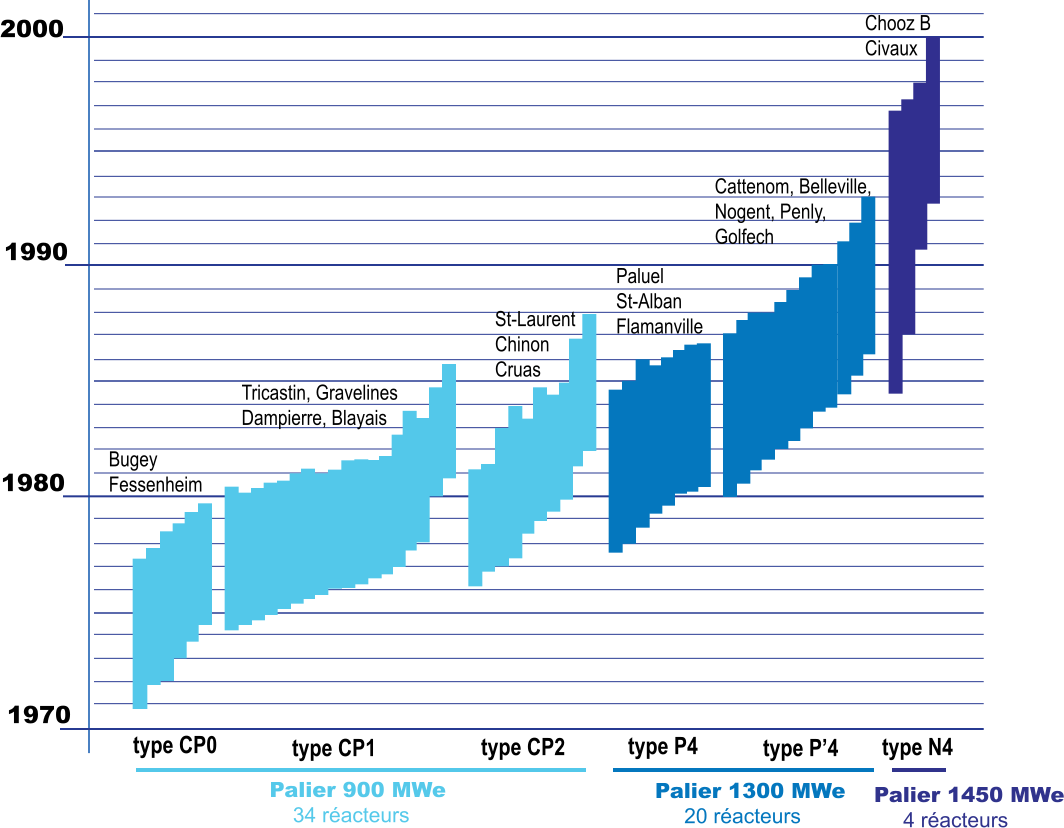
The design got more complex and there were teething issues with the N4, but Chooz took 16 years to enter service where the P3s took 8 years at most.
https://www.statista.com/statistics/270367/share-of-nuclear-...
https://ourworldindata.org/grapher/fossil-fuels-share-energy...
Meanwhile back at Heathrow that would have taken months of permits and planning and dealing with useless subcontractors.
State monopolies FTW.
Too bad really: nuclear power was a way to gain independence (from the US and the oil) but then it kinda fell by the wayside as the country largely went with oil anyway (though the grid is both powerful and rather clean owing to the high ratio of nukes).
Would have been interesting for the country to ride the contrarian gallic spirit and decide to go all in on electricity and renewable way back then.
Maybe we’d have working large-scale SMR too.
The best time to plant a tree was 20 years ago. The second best time is now.
This is because the federal reserve's printed money goes basically into treasuries and stocks.
The rich save basically all of their money. If they decided to spend it on real-world goods, there would be huge inflation.
But it's probably all nil. The cost of building enough nuclear power plants with economy of scale is probably near the same as building enough solar and wind farms.
1. https://en.wikipedia.org/wiki/Smith_Mountain_Dam#Hydroelectr...
The power needs of the occasional cold wind still winter week are fairly large.
Exploration programs are expensive.
SMR's made in a factory seem like the only way to address that, but I have no idea if we can ramp SMR's to national viability in the next ten years.
The only reason it would have worked in France 40 years ago but not today is institutional malaise and bureaucratic capture.
Roots of Progress has an interesting review here [0], which is what I base that on. (It's on my list to read, just haven't gotten to it yet)
This isn't practical everywhere, but on the island of El Hierro (Canary Islands) there is a wind-and-battery solution in the form of a wind-pumped hydro-electric station. In effect there is a big pool of water acting as a battery and the wind turbine "charges" it.
When I ran across it on a trip to the island I was really impressed. Very original solution!
https://www.researchgate.net/figure/The-basic-configuration-...

https://pl.wikipedia.org/wiki/Plik:Dlouhe_strane_horni_nadrz... and another one

General concept: https://en.wikipedia.org/wiki/Pumped-storage_hydroelectricit...
If it would be actually climate emergency then we would be building in mountains all where reasonable. No matter the damage to some rare species, panorama and tourism.
https://www.google.com/amp/s/grist.org/article/monbiot-we-ca... https://books.google.com/books?id=vsPYv7jm-34C
Even today we as a whole struggle with decommissioning nuclear plants, and the costs are astronomical this is already a huge problem now, let alone in a post climate change world
In fact, you don’t need to imagine it, you are living the dream.
People did try decarbonise industrial economy to 70% - it worked with technology existing not now but in the eighties. And it did not put any limitations on consumers, while taking just 10 years to implement.
Surely at code red we should be looking at things that were shown to work?
Then waiving almost all regulations on nuclear power and accepting some meltdowns would be reasonable.
And also waiving nearly all regulations on solar power, wind power, massive construction of hydropower etc.
And the west IMO will reel in horror at even a single meltdown there and back off any plans to adopt nuclear the day that happens, wasting precious time we really don't have.
If this were truly "code red" and people really believed that, we would find a way to push the bureaucrats out of the way and build nuclear capacity way sooner than 20 yrs. Humans can do amazing things under dire stress.
This is not happening, so I will assume "code red" is hyperbole, something that the IPCC is not entirely known to shun.
If you take the current pandemic as an example of what we do when under dire stress, I don't think we should be that confident. Yes, some people can perform astonishing feats, and yet other people can deny there's even a problem even when it's obvious.
> we would find a way to
In this case "people" and "we" just doesn't refer to the same cohort.
I'm not sure that’s the case and I would encourage you to dig into what the worst or medium range scenario would mean. As I understand it, the _middle_ scenario predicts that a billion people would either die in a climate-related catastrophe or be displaced before 2050. That means that several ethnic or cultural groups would go through essentially genocide.
There are details like loss of water reserves in California and the impact on food access in the US, fish population collapse, climate-related migration from the densest populated areas in the world that are very concerning.
I’ve seen scientist give very clear alarms on several global issues (usually my father was making the point); I’ve personally made several myself, and every single time, the reaction was… dumbfounding: trying to minimise, negotiate, taking the most optimistic scenario as a worst case, delaying…
I have, unironically, witnessed several conversations that literally went:
“If you do that, you, your family and your way of life will die forever.
— You are exaggerating, that’s too scary.”
They did nothing, and soon later: exactly what the prediction said.
This is not only the most common scenario, it is the only scenario I’ve seen, with one exception: CFC and the Ozone layer. And that was because there’s a handful of industrials, who had clear alternatives that proved cheaper.
“Other people do nothing; I’d rather believe the reassuring story than evidence” is exactly how we end up with the bystander effect.
Now, I'm sure these are soluble problems. I'm by no means anti-SMR. But most of the actual serious proposals I've heard discussed for decarbonization lean much more heavily on already-existing technologies such as solar panels, which are getting cheaper and more efficient every year and which we are putting in the grid right now.
Most of the time, when I hear people talking about SMRs, it's as an excuse to do nothing. "This research tech will solve the climate problem, so all we need to do now is wait for it to pay off." Like the original poster in this thread, who claimed that a lack of investment in nuclear somehow proves that things aren't really that bad.
Apparently, the IPCC does expect and hope for substantial increases in nuclear power as a portion of our energy supply [2][3], but "[a]chieving a rapid decarbonization of the electricity sector will require, at first, deploying proven technology," presumably because nuclear on its own is not enough, and because SMRs are too experimental to lean on in any substantial way.
[1]: https://www.sciencedirect.com/science/article/pii/S036054422...
[2]: https://news.un.org/en/story/2019/10/1048732
[3]: https://www.world-nuclear.org/press/press-statements/the-ipc...
Good luck with that...
500 days for a small modular reactor (450MW) https://www.rolls-royce.com/innovation/small-modular-reactor...
At least, that's what the brochure says.
[0] https://en.wikipedia.org/wiki/Nuclear_power_in_France#Messme... [1] https://www.nao.org.uk/report/hinkley-point-c/
> wind power can be zero at some parts of the day
There are a few solutions to this actually. First, having a more nationalized grid can amortize variant weather conditions (very unlikely it’s not windy everywhere, for example). Second, there actually are long-duration battery solutions coming out. Look up “energy tower” for a very weird one, and “form energy” for a more traditional model.
Finally — I will agree that nuclear is probably some piece of the pie in the future. But analysts think we can get to 80% renewables with currently existing tech: https://www.google.com/amp/s/www.technologyreview.com/2012/0...