Sure there are a few strewn candy wrappers or something, but there really isn't any big problem. It's all quite nice.
What country do you live in that your beaches are so bad?
Japanese beaches that aren't ultra popular tourist destinations are currently flooded with trash. Going through Shizuoka, Aichi, and islands of Kagoshima, they're increasingly looking like dumps. Some are completely covered in pieces of trash, and most of it isn't Chinese. It's washed up laundry detergent bottles and toys and stuff all from here. Some places like Okinawa and Kamakura beach are generally cleaned, but having visited Kamakura 4 years ago and again a year ago, it's noticeably filthier.
Major beaches are maintained and cleaned daily. Walk a few hundred meters beyond the crowds and there's a good chance you'll see trash everywhere. Two weeks ago I visited a beach I last went to a couple years back, and it was depressing seeing the state of it. The beach used to have crabs and isopods roaming the sands and crawling around the rocks. Now it's covered in shards of plastic and washed up tires and other things. Not a crab to be seen.
> Japanese beaches that aren't ultra popular tourist destinations are currently flooded with trash.
This is exactly my experience as well. Every place that I have been, if it is a remote site that no one is actively cleaning up, then it has weeks, months, years, or even decades of accumulated garbage. Popular destinations, like beaches around resorts, well-maintained hiking trails, private beaches; these all have people regularly picking up garbage.
Some of the most "pristine" beaches I've seen were on outer islands of Fiji. But they were pristine because they had resorts on them, or near them. Kayak over the other side of the island, where no one picks up, and it's trash city. The global ocean system deposits garbage everywhere, on every beach. Depending on where you are in the various gyres, that beach gets more or less washup. I've been to beaches in New Zealand, Australia, Japan, Hawaii, Fiji, Africa, Europe, and both coasts of the US. The primary discriminating factor on how much garbage you see is how regular and thorough the pickup is.
Pic: https://blog.qiqitori.com/wp-content/uploads/2017/08/DSC0249...
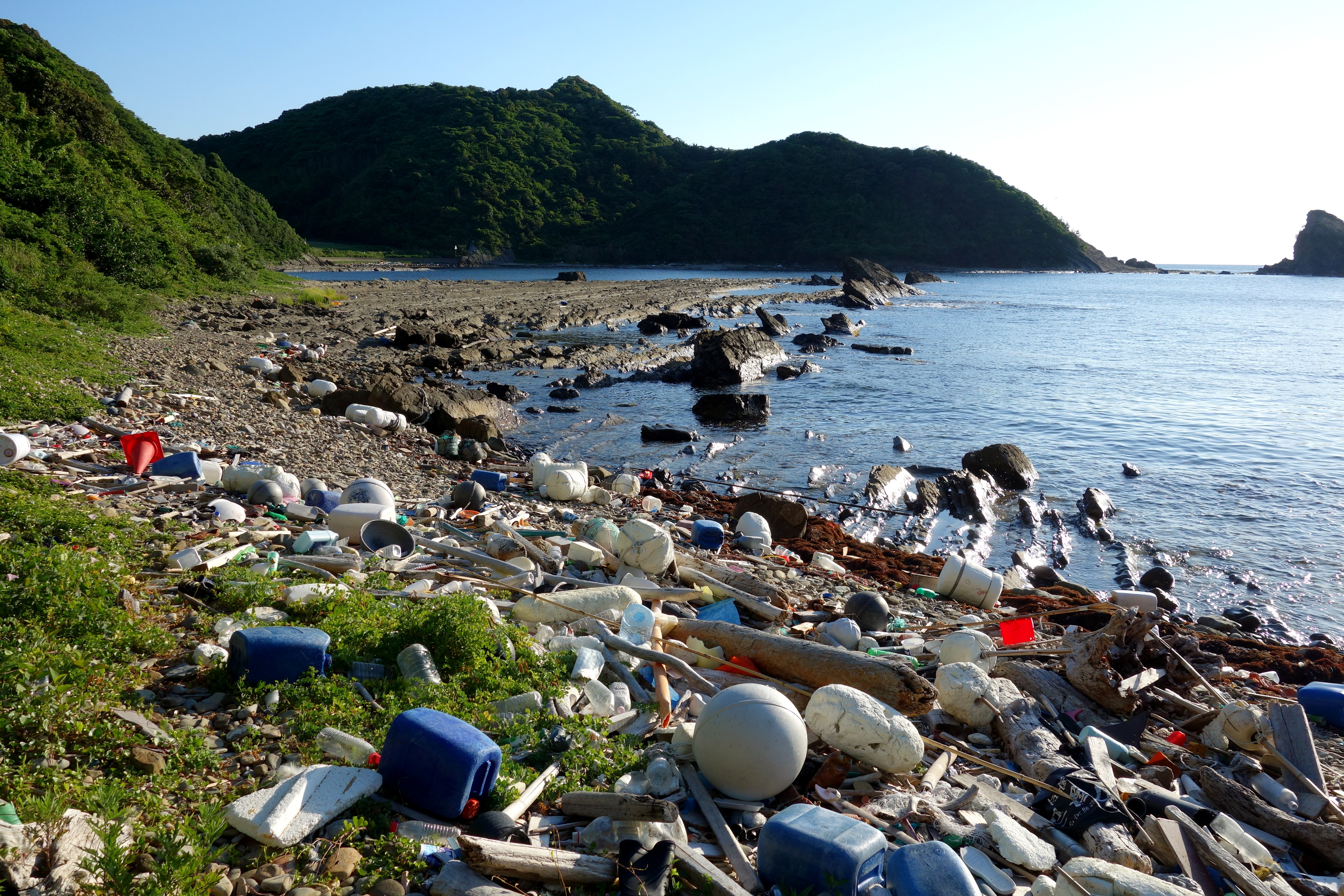
Boring blog entry: https://blog.qiqitori.com/2017/08/beach-cleaning-in-matsue-j...
Litter ends up in streams, rivers, and eventually the ocean. You can argue it’s an issue with plastics, but it’s equally an issue with trash.
I'm seeing mainly trash from Japanese companies that are Japanese products with Japanese labels. It's easy to recognize. Externalizing blame isn't the solution because it's not the problem.
Currents likely help carry trash away from certain regions. Japan's east coast isn't really being affected by trash that would be coming from, say, China, because currents don't carry most of it to our beaches. It's stuff being washed out locally and brought back by waves here. Much more is likely being passed out into the middle of the ocean.
That said, Asia really does have a much larger issue here than the rest of the world. 90% of plastic pollution comes from “Asia: the Yangtze; Indus; Yellow; Hai He; Ganges; Pearl; Amur; Mekong; and two in Africa – the Nile and the Niger.”
https://www.weforum.org/agenda/2018/06/90-of-plastic-polluti...
> Upon implementation of the policy in 2017, plastic imports to China plummeted by 99%.[9] This led to waste stream backlogs across Europe and North America.[9] When they could find buyers, most European plastic was diverted to Indonesia, Turkey, India, Malaysia, and Vietnam.[9]
Western governments are sending trash to these places knowing it's finding its way into rivers just so they don't have to spend money processing it themselves. These impoverished countries are overwhelmed with trash that isn't theirs. It's a problem because Western countries are selling trash that they claim is recyclable and a valuable resource, but is literally useless trash. The moment one country bans the system (such as China), the EU and US find another place to dump it instead of processing it on their own.
Trash in rivers in Asia is from local littering, pure and simple.
Trash that Western countries send over is simply buried or burned. It's not the source of plastic pollution in rivers. There's real concern with it being a source of air pollution when burned... but it's simply not turning into litter.
The US and EU have plenty of landfills, their exporting plastic which was actively separated from the waste stream for recycling which can be profitable. If nobody wants to pay for it then the default is to burn it domestically for energy.
Contaminated recyclables are just garbage. Countries are getting fed up with the EU and US sending supposedly separated recyclables because it's pure garbage falsely labeled as usable plastic. [1]
The issue is the degree of contamination. Different municipal waste streams all have their own internal systems a 98% plastic stream and a 99.9% plastic stream are very different economically.
Completely separate from that it’s a political issue as nobody wants their country to be thought of as a dumping ground. “Malaysia says up to 3,000 tonnes of rubbish will soon be returned to the UK, US, Japan, China, Canada, Australia, the Netherlands, Germany, Saudi Arabia, Singapore, Bangladesh, Norway and France.” what’s not mentioned is this represents 1% of plastic sent to the country. The don’t want to ban the process because the other 99% is quite valuable domestically.
My experience has been the exact opposite: https://news.ycombinator.com/item?id=28025358
It can also be under the sand.
I once spent a morning cleaning ~50 plastic bags in the wet sand of the beach at low tide. They were empty shopping bags, but had opened up and filled with sand, so they were basketball-sized and really deep; they required _digging_ every single one to get them out. Next day, 50 more were there. There was no way that many washed up in one night. So I did a little digging with a spade, as deep as I could go in the sand, all the way down to my armpit. And I brought up piece after piece of plastic from the depths, punching through bags on the way down; I don't know how many layers deep. Then I realized these "new" 50 bags had just been there under the surface. The layer of sand made free by yesterday's cleanup was now washed away by the tide to reveal them. That was just the worst feeling, knowing that that beach was basically a 1km-long landfill, riddled with garbage at least a meter deep. An extreme example, but it kind of broke me.
As for Okinawa that seems to depend on the island. When I was there some years ago, many beaches on the smaller islands were covered in trash (mostly of Western origin – one could often still decipher the letters on e.g. beer and shampoo bottles).
Personally, I'm not surprised Japan has a plastic waste problem, the shops and manufacturers here are addicted to plastic, and the culture is one of appearances above truth so I'm not surprised to hear about the differing levels of care dependent on whether tourists frequent a place.
I've also lived in other parts of Asia and I've seen some shocking things to do with waste. India was the worst. As another comment mentions, it's probably best that developed nations export knowledge and attitude towards waste, not just waste.
Not just the beaches, but every single waterway, alley, forest, jungle. Literally everywhere.
I have pictures of the waterways in Saigon at low tide and the ground is covered in plastic. At high tide, there are government run boats that go up and down some of the waterways to collect a fraction of the trash that people just dump in there.
Every single little town/commune/village has a spot on the way in/out of town with mounds of trash (mostly plastic). Usually partially burning, smelly and covered in bugs.
It is tragic.
It washes up on beaches. Uninhabited islands thousands of miles from the nearest settlement are covered in plastic:
https://www.nationalgeographic.com/science/article/henderson...
By comparison, I’ve lived and traveled all over the US, cities and rural areas, beaches, forests, etc. Litter is rare. Where you will find it are freeway underpasses, neglected urban or near-urban waterways and railways: places where people aren’t really “supposed” to go, and are therefore loitered in and rarely cleaned.
There are many areas where the US lags Europe, but in my experience when it comes to litter, we have far less of it.
And what's with all that trash on freeways? I've seen a whole couch casually waiting to biodegrade by the side of the freeway. Discarded bumpers and tyres aren't even worth mentioning anymore there's so many everywhere. Large debris like that gets cleaned up immediately in Europe because it's a hazard.
I just don't even understand what process operates in a head of someone tossing an empty bottle out of a car... sometimes, I feel like I have trouble recognizing them as a fully-formed human, more like someone who needs house-training, like a dog.
Perhaps things are trending the other way lately. I do seem to notice more litter now than I did when I was younger. But there are more people now also.
Another big issue I see around where I live is when storms hit on trash night. They'll pick it up around 6AM so people bring it out the night before, but on a regular basis we'll get a strong thunderstorm that blows trash everywhere.
This last bit is not directed at you but re: the issue in general: I get really frustrated with how distorted the notions of “right” and “wrong” behaviours are among many environmentalists — rather than being rooted in fact, they’re all about virtue signalling.
My local grocers are all eliminating plastic and switching everything to paper, and I highly doubt that decision was informed by a thoughtful analysis of potential environmental impact.
No disrespect but I don’t think anyone can uniformly sample all the beaches. There might as well be prevailing currents that fill certain places disproportionately more, and leave others disproportionately pristine.
This “making a global inference based on the beaches we’ve personally been to” is going to be deceptive in either direction of the argument.
I've been to beaches on four continents and every. single. one. The only place you do not see[1] trash is where someone has specifically picked up there, recently. That tends to be places around resorts and people's homes. Unless someone does it out of their own goodwill or is paid to, the trash just floats up and accumulates.
There's a place for healthy skepticism, but not denial.
[1] You don't see it, but microplastics are thoroughly distributed through the ocean by this point. There is literally no way of cleaning up microplastic pollution at this point. We can only improve the optics at our scale.
I’m not saying I’m necessarily denying your premise, at least not wholesale, but what is the point of skepticism if it doesn’t include the possibility of rejecting a premise?
It’s like saying “I’ll allow you to ask questions but ultimately you have to come my conclusion”
We can be passionate and rational at the same time.
There's a point where skepticism becomes more than just irritating, but entirely subtractive from the discussion. It's hard to know what your intentions are from that pushback, but it was borderline IMHO, and it certainly muddies the waters.
I'll be completely open about my intentions. I want people to stop fucking up my river and, damn it, it's not China or India's fault. OP is a complete distraction from a real problem that exists where I live. I'd like to dump a few bags of garbage I picked up from the river on their lawn and see what they think about some vague plan to clean up the Ganges.
There were several weaknesses with your argument that I was hoping you to strengthen;
- you were making yourself prone to availability bias; I've been to beaches recently and none of those have the problems you mention. That doesn't mean the problem doesn't exist, it means we don't get to make sweeping generalization from the partial reality we contact. Your original rebuttal to the OP was "have you ever been to a beach lately"
- appeal to emotions; I'm personally sorry to hear your local beach is in heartbreaking condition, but that alone does not amplify the strength of your claim that "beaches are covered with litter". In fact it makes it more easy to refute for anyone who doesn't readily sympathize with your story, and that would harm what I assume to be your ultimate goal which is a reduced pollution.
- overgeneralization: you're perfectly entitled to talk about your personal experience, but when you assert that as a method of establishing the global truth, that is the motion that brings the burden of proof on you, not me pointing that out. Maybe keep the strength of your assertion in proportion to the data you personally have.
It might look like waters are muddied for you, but I think you might be the only one in confusion probably because you seem to be very emotional about this topic. Which is OK, like I said being passionate is OK, but the weaknesses in your argumentation will only hurt your cause.
I'll be getting back to my representative sampling of the world's beaches. And you made a mistake in that I didn't claim that "all beaches are littered". Someone else posted that. I wrote, "I've been to beaches on four continents and every. single. one." That's about my experiences.
> appeal to emotions; I'm personally sorry to hear your local beach is in heartbreaking condition
You also misattributed this as an appeal to emotions. I have a local problem. People are arguing about problems in other countries as excuse to block action here. Stop doing that.
> overgeneralization:
Again, I didn't. I pointed out the scale of the problem is at least as big as my personal experience. It is, in fact, larger than that.
This side turn is subtractive from the discussion and I hope you would consider not replying again with how wrong I am and how my arguments are so bad.
It might feel like it is subtracting from your sense of being right, which I am not saying you’re definitely not, but I think some readers might find it valuable in terms of reaching to more well-thought-out conclusions.
> A personal attack couched as some kind of psychological diagnosis. "You're being emotional."
I'm sorry you felt attacked, that wasn't my intention. Having emotions is a human condition, not a psychological diagnosis, and I thought I made it clear that I didn't find anything demeaning about it. You just can't base your arguments mainly on it though.
> Please deal with the substance of arguments, and don't make the person the subject of discussion
It so happens you made your personal experience and your feeling about it the grounding of your argument; making rebuttals on that basis is not making it personal, it is actually an argument against making things personal. And at no point I invalidated your experience or emotions or your personhood.
> You also misattributed this as an appeal to emotions. I have a local problem. People are arguing about problems in other countries as excuse to block action here. Stop doing that.
Maybe the readers were mislead when you talked about 4 continents, especially after an opener of "have you been to any beaches recently". It wasn't clear, at least to me, you were interested in talking about the local phenomena. But thanks for clarifying that.
Let's get one thing clear though, since we can't read people's minds, it is equally undesirable ascribing intentions of blocking action and other negative predictions salient to you in your mind, to others. So I'll kindly ask you to refrain from that first.
> I hope you would consider not replying again with how wrong I am and how my arguments are so bad.
I've considered and still I think it would be to the benefit of the community to remove the confusion between the local-global, personal-general, emotional-rational. If you are upset about receiving responses, you always have the option of removing yourself from the discussion first. Asking others to stop talking is a bit censor-y.
I didn't write that, please check the thread. That was someone else.
> > don't make the person the subject of discussion
Each time I replied I brought the discussion back on topic and strengthened my arguments but your entire reply is about me again, and there is precious little that steer it back to a good resolution.
> you always have the option of removing yourself from the discussion first. Asking others to stop talking is a bit censor-y.
There is a different, meta-level dialog embedded in our dialog, but this terribly ironic juxtaposition is exactly the kind of distracting, subtractive, thing I meant. I regret this exchange terribly at this point. I'll go back to picking up garbage, since in my experience, that is the only activity that reliably has impact.
Sorry I was confused about this, but the context to which you seemed showed up in defense of; namely a personal "observable"ism as a sufficient means to define the nature of a global phenomena, makes the point stand.
> There is a different, meta-level dialog embedded in our dialog, but this terribly ironic juxtaposition is exactly the kind of distracting, subtractive, thing I meant.
I've been following that meta dialogue very closely and here's what I wish we can agree on. Distraction and subtraction hinges on our personal formulation to solve the problem at hand.
My formulation strongly presupposes that rational argumentation can scale through time and people better than an emotional and personal appeal, at least in forums similar to this. Your formulation seems to presuppose that concentrating on the emotionality of your personal experience and impressing the audience to action through that is a better way to get results. You seem to feel any poking holes in the logic is a disservice because it takes away from that concentration of emotions and impressions.
To the extent these approaches are at odds (and I don't think they necessarily are) any one could accuse the opponent formulation of being subtractive, distracting, action stopping etc.
My plea is for you to see that you're willfully asserting a supremacy of your particular formulation in this meta-dialogue, without clear evidence that it is the case, and with a desire to evacuate alternative formulations out of an open forum.
> I'll go back to picking up garbage, since in my experience, that is the only activity that reliably has impact.
Since you've shared this, it is fair game to ask about it, and I know it might piss you off but bear with me because it has a point; is it an impact to the environment or impact to your conscience? One could cut their arm to feed the hungry, but how far could that go for making a change?
I'm bringing this up because it ties back to my original point of taking time to make sure we have the right formulation. The observable, the immediate, the emotional is super-salient to us but that doesn't automatically mean more true, more effective and ultimately the best thing to follow.
Isn't the whole issue that they DON'T break down? Yes they can wear into smaller pieces of plastic, but chemically they're still plastic. And when they get to a certain size, they become small enough to easily absorb into the body.
There are of course more and less chemically stable plastics, but they all last much longer in a landfill than the vastly more harsh aquatic environment.
It is just assumed, that everyone knows what to do with plastic bags and stuff, but the reality is, that many people do not have any sense of responsibility and throw stuff everywhere. Every week I see new heaps of trash in forests, which were definitely not there the week before. We need to start educating dumb/lazy/irresponsible people not to throw their trash everywhere, if needed by leveling up punishments and rewards.
If anyone is caught throwing trash into the forest, there should be hefty fines for that. If anyone takes time, for example on their weekends, to clean the forest, there should be rewards.
The forests would be a lot nicer if we spent more time raking and cleaning them, like in Finland.
I don't live in the US but it's certainly not a developing country. Beaches are absolutely covered in plastic waste and it's noticeably worse each time I go. Forests are steadily becoming filled with plastic that either gets tossed there or blown there. Animals eat garbage and die. It's horrible. Assuming I live a very long life and die in 70 years, that plastic will still be there. New plastic will be there as well.
America and the EU "manage" their plastic waste by literally shipping it to other countries, then blaming them for mismanaging it. Most was sent to China, then it was banned by China.[1] Now the EU and US ship it to other countries, claim they manage their plastic, and blame new countries. The US and EU have yet to manage their plastic, though. They're just dumping it on their neighbor's property.
My worry about paper bags is that, corporations doing what they do and going for the lowest bidder, they'll be made with clear-cut rainforest wood from Indonesia and Malaysia instead of sustainable sources. I'm sure a lot are.
I just reuse bags and never use paper or anything unless it's forced upon me. I bought some durable bags 5 years ago. I keep a couple in my vehicle, a few at home, and others in other places so I almost always have a bag with me.