It's not because the status quo is globally optimal, but because humans have invested a lot in the way things are.
We happen to have built cities on coastlines, put farms where food grows, put bridges where the rivers are, and so on. We can shake things up and get unknown results, but most random changes will be for the worse because we've molded our civilization to the planet we already have.
And this goes not only for humans, but even moreso for other species, who are much slower to adapt to changes.
I also think we need to seperate out how humans are driving species extinct, and climate change. These two can be very different things, yet are always conflated in the media for hype.
Most species are going extinct because their habitats are actively destroyed by humans, or are fished to extinction, not because the planet is warming.
basically everyone agrees that the climate is changing, has always changed, and will always change. there is debate over how much of climate change is anthropogenic, but this is irrelevant to the point that predictive climate models are functionally useless, due to the complexity of the thing it's modeling.
[0] https://www.scientificamerican.com/article/clouds-may-be-the...
downvoters: I would appreciate an explanation as to how my understanding of this situation is inaccurate. my views are never set in stone, I'm always open to learn new things. I just don't see how, short of a complete holistic Matrix-style simulation of the planet, one can obtain meaningful predictions from a data-driven climate model. I'm wrong about a lot of stuff all the time and I'd like to know where my understanding of this situation is incomplete or inaccurate.
That is false. Although you’re correct that climate is very complex and it is impossible to model every detail. The notion that you cannot make valid conclusions from modeling because a set of observations do not match models is fallacious because it discounts the correct conclusions that climate models have achieved. For example, the first climate models from the 1960s predicted that the mesosphere will contract and cool as a result of increasing co2 concentrations, and this conclusion has been backed by empirical observations. Furthermore, modeling from the 1970s by scientists at Exxon Mobile found that by 2020, net warming would reach an average of 1 degree centigrade, which we’ve since exceeded.
Conclusion
Climate models published since 1973 have generally been quite skillful in projecting future warming. While some were too low and some too high, they all show outcomes reasonably close to what has actually occurred, especially when discrepancies between predicted and actual CO2 concentrations and other climate forcings are taken into account.
A clock that is stuck is a poor model of time because it does not model the progression of time, even though it is still correct twice a day.
We can make a very simplistic climate model that would be valid. We have a sphere of radius 6,357km, which is illuminated by electro-magnetic radiation centered at wavelengths of 0.6um. When the light hits the surface, it is absorbed and is re-emitted as black body radiation with a wavelength centered at 10um. It has an atmosphere, which contains a gas, which blocks the escape of wavelengths at 4um and 15um. This reflects some of the black body radiation back to the sphere, causing it to warm. In 2009 for the earth, this lead to a net accumulation of 0.6 W/m^2 of energy absorption [1]. If accumulated over the entire area of the sphere and accumulated over time, this would lead to an increase in temperature. Although the model does not take into account land formations, ocean currents, air currents, seasons, etc, it still models the underlying process of the earth’s energy balance and can answer the question of whether the planet will warm and can provide estimates at how quickly this will occur.
I think you’re hinting at systems being so complex that they can vary based on minute changes in initial conditions, you’d be correct to say that climate is chaotic. Not all chaotic systems are the same though. A double pendulum will swing in eccentric motions, but if you look at something like the stock market, there’s a lot of short term variability with long term certainty. I cannot tell you what my stocks will do next week. But markets generally converge on a doubling of money in 10 years. In fact that’s reliable enough that I’m willing to have a 401k. With the pendulum, I can tell you with a lot of certainty that if it’s damped, it will settle to its lowest energy state and stay there permanently.
A climate model will not predict the weather. But in the same way that I can tell you that winter will be cold, I can also tell you that Arctic amplification and Hadley cell expansion will lead to very different weather patterns that civilization has not seen before, such as much more extreme swings in temperature and weather.
[1] https://en.m.wikipedia.org/wiki/Earth's_energy_budget#/media...

At large scale climate change isn’t that complicated - sun hits earth, heats it up, some energy escapes. We can get a pretty good picture from models and the details just add to that.
no—I, knowing basically nothing about climate science and having been taught to more or less blindly trust climate models as accurate predictors of the future, read an article that said we have no idea how to model clouds with anything resembling accuracy, because clouds by themselves are crazy complex things. this led me to realize that this should have been intuitive knowledge without even reading the article, which led me to truly consider the scope of the climate system w.r.t. how it could possibly be modeled by computers, which led me to realize that the idea that it's possible for a data-driven computer model to predict anything about the future with any kind of reliability is pretty silly to begin with.
A couple counterpoints from former climate skeptics:
- Richard Mueller is a prominent physicist who founded an institute to debunk anthropogenic climate change, only to change his mind after thorough examination of the data. https://youtu.be/Sme8WQ4Wb5w
- Jerry Taylor is a libertarian and former climate debunker for the Cato Institute; a noteworthy pivot moment was speaking to a risk analyst for a financial institution, whose job it is to make bets on complex systemic risks in the context of uncertainty. He claimed that from a financial lens, AGW was a slam-dunk case for mitigation, not because of the certainty of any one model, but of the full probability distribution in aggregate. https://www.reckonings.show/episodes/17
But as good Bayesians, we also have to consider the opposite case: crises and "black swan" events do happen. How do we filter signal from noise? We probably could have benefitted from more "enlightened alarmism" re: COVID in Jan/Feb 2020, when billions in preventative measures could have saved trillions to world GDP (and millions of lives).
It's a double-bind politically: given a non-trivial long-term risk, how does one frame its urgency? A calm and measured tone spurs little action (the unsqueaky wheel doesn't get the grease); a tone of urgency and panic bypasses badly-needed rational faculties, and/or flips the "bullshit detectors" based on the history of proverbial boys crying wolf.
While I'm not opposed to FDR-ish green infrastructure plans, the answer from economists is undramatic and uncontroversial [0]: tax the externality to establish a price signal, and return the dividend back to citizens, whose consumption behaviors then change in response to those signals [1].
Of course, we've had to contend with decades of FUD from vested O&G interests, no different than the tobacco cancer debacle [2], despite having had credible evidence for AGW since the late 70's. I'm happy to concede the potential for scientific groupthink and perverse Big Government incentives on the green side, so long as we're also acknowledging the enormous financial incentives for muddying the waters (uncertainty = inaction = status quo = profit).
[0] https://www.wsj.com/articles/economists-statement-on-carbon-...
I am under the impression that the worst-case scenarios in most models have pretty much all come to pass, often earlier than expected. Seems to me that they’ve been very predictive. It would have been nice had the media more accurately delivered those predictions; perhaps it would have prompted some early action.
Our current CO2 levels, ocean temperature & acidity, glacier melt, and global temperature are in excess of all “good case” predictions. We failed to rein in CO2 production and now we’re pretty much living the worst-case scenarios… as predicted.
If the model predicts that a glacier disappears in 2050 and it disappears in 2070 instead?
Or if the lack-of-model makes a lack-of-prediction about glacier disappearance, and then it disappears in 2070 by surprise?
Error accumulation makes sense to worry about if you're planning a voyage and worried that dead-reckoning navigation will leave you kilometres off course. But if you're on the voyage already, out on the open ocean, you can argue with the navigator's math but you still need to navigate -- you won't do better by just blindly insisting the boat never left the harbour.
Think of climate modeling as saying that for a given species of trees, half of them will be dead at a given latitude in 50-100 years, not pointing at a specific tree and predicting that it will die on July 7th, 2047.
https://en.wikipedia.org/wiki/Holocene_extinction
And regarding your second point, we know it won’t do anything good, but we don’t know exactly what (nor could we ever!).
So no, there is no possibility of anything positive in this.
But if you were to pose that question in the context of a discussion about a Holocaust survivor's fund, for example, then that's definitely not historical research you're engaging in.
Likewise, when you interrupt discussion about global warming with "maybe there are good sides", without providing any actual evidence for your supposition, then your actions have the effect of redirecting the conversation away from the scientific consensus and casting a shadow of doubt, on the basis of nothing more than speculation.
Rainfall pattern/acidity, humidity, average temperatures, extreme temperatures, animals living the the area (providing nutrients through body waste and decomposition), insect population, &c. are all factors, and most of these factors are interdependent
Trees, like animal, migrate, this migration isn't a matter of months, or years, but centuries, since the lifecycles of trees are very long and their locomotion speed is ... limited
If plant kept up with our co2 production we wouldn't get a graph like this when we look at atmospheric co2 level: https://www.climate.gov/sites/default/files/CO2_emissions_vs...
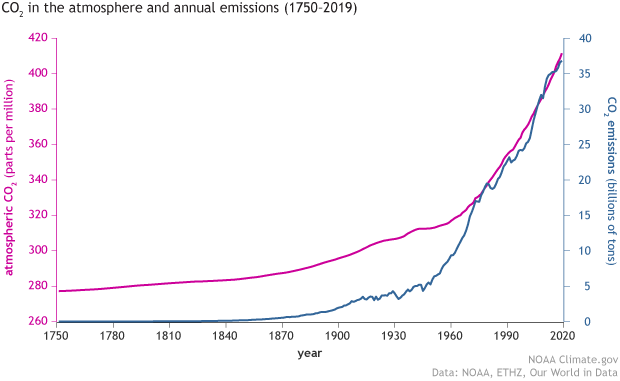
Arguing that "the greenhouse is good because we get more plants" is extremely reductive, and factually wrong
Please see : The Biggest Little Farm
I think the central problem is that the way they divide the atmosphere / oceans into 100km square grids is too large for local weather, but if they shrink the grids it takes way too long to run the simulations, so they are in a bind. I am of the opinion it's better not to risk increasing the amount of CO2 because we don't know what will happen. But I wouldn't consider any of our models even low-confidence. It is impossible to solve given how chaotic nature is, the number of variables, and how slow our super computers currently are.
This kind of absolute confidence about an extremely unpredictable change in an extremely dynamic and complicated system is not remotely scientific. We can predict (reasonably) that the changes will be overall worse, but it would IMO be pretty shocking if there were _no_ positive effects:
- Growing seasons are longer in near-arctic regions - Higher CO2 means plants photosynthesize easier, requiring less water in desert regions - The arctic passage means shorter cargo vessel trips
This doesn't balance out the overall crisis, but there are going to be a lot of changes both directions.
This is true, but is also a bit of a red herring. All hierarchical organizations from the individual to the country is optimized to the environmental condition they are situated in, and any level of uncertainty at that scope should alarming in of itself.
Just two examples of our optimization and as a consequence, our lack of resiliency to disturbance: Suez Canal and the Ever Given, chip shortage, cargo container mis-allocation in shipping that is happening at the moment.
If the poster boy of efficiency, the market is so easily impacted, what do you think will happen to lumbering and lethargic political institutions that we like to rail about so much?
Turns out, when scientists say that, they literally mean it.
Cue 49°C heat wave at Canada.
"We don't really know" should be considered an absolutely terrifying phrase out of the mouth of a climate scientist - and we'll be hearing it for years to come.
TL;DR climate change isn’t necessarily an extinction-level event. It is just possibly an extinction level event. I would argue that if you’re looking at it and saying “meh” then you’re not assessing risks properly.
http://burro.case.edu/Academics/USNA229/impactfromthedeep.pd...
Page 6 helped grow my imagination. The ice ages are not the worst it ever was.
Technological civilization isn't a balloon or a tower, it's a pyramid. In order for the peak to climb higher, the base levels -- a stable and inexpensive supply of food, air, land, and water -- need to grow as well. Undermine that foundation and you can't expect the upper levels to float.
1. The greenhouse effect is very real
2. What that's going to do to ecosystems is largely unknown
Having been made to believe that it was going to cause the next mass extinction event, I found #2 fairly underwhelming. Never-the-less, this isn't a gamble worth messing with.