https://www.npr.org/2020/09/11/912193742/california-bill-cle...
First,
> Law enforcement groups and prosecutors opposed the bill saying the former inmates pose a danger to the public.
The culture that creates these restrictions is still there, it's still the predominant view from law enforcement and prosecutors that prison labor should be punitive, not rehabilitative. None of the people who created and supported that system are gone, and they still have an outsized degree of control over how that system works.
Second,
> The bill, sponsored by Democratic Assemblywoman Eloise Reyes, lets prisoners who received "valuable training and [placed] themselves in danger assisting firefighters to defend the life and property of Californians" to petition the courts to dismiss their convictions after completing their sentences.
A right to petition is not a guarantee that your petition will succeed.
Third,
When you dig into the details, the bill only allows removing the specific convictions that the prisoner was serving time for while they were a firefighter. If they had previous convictions or served time in the past, they'll still be restricted from getting EMT certification.
Fourth,
When you dig into the details, this bill actually doesn't get rid of restrictions on felons. It provides prisoners with a very narrow path to remove their felon status. That's not really the same thing as getting rid of the restrictions, and it's only available to prisoners who have "[placed] themselves in danger assisting firefighters".
Think of it this way: if it's illegal for women to vote, and instead of letting women vote I instead say, "here's a pathway to get the courts to declare you a man", then I haven't really gotten rid of the restriction on voting, and it would be inaccurate to say that my system provided women with the right to vote.
----
It's good that prisoners have at least some recourse that they can use to try and benefit from the life threatening work they did in prison, but it's a far cry from solving the overall problem, and it arguably doesn't even fully solve this specific problem.
The amount of forms that need to be filled out is obscene. Determining which forms need to be filled out is a nightmarish exercise all to its own. Many of them need to be submitted in person. Email and online submission forms apparently don't exist. Each step has an absurdly short deadline for the the petitioner, and multiple month turnaround times for the state.
Then comes the fees. I had to pay out several thousand between attorney fees, application fees, filing fees.... Then come additional charges for each certified copy that you need, as you need to send one copy to any facility that would have any record for you. In my case, that came out to be 13 different facilities. Thankfully I've managed to get a decently paying job, but for most of those trying to get their life back in order, this is a complete non-starter.
I'm still in the process of trying to do this, and have been working on it for months now. It was made apparent to me that the process is designed extremely asymmetrically, and is just another form of exerting control.
Edit: This process will likely vary from state to state, but that's just what I've experienced.
The financial incentives are set up to produce as many dangerous criminals as possible. Without repeat offenders, many private prisons would have to close.
The solution is simple: The US should actually ban slavery and should also ban private prisons.
It should replace private prisons with ones that are rewarded when their former prisoners become productive members of society.
There should also be a cap on the ratio of prison spending to education, mental health, and community service programs.
The rest of the inmates are in prisons that are state-owned and thus inherently nonprofit, and the guards & other staff are either state or federal workers. Contractors do things like provide commissary goods or run the inmate telephone system, but the guard in the tower at your local prison is a state employee.
Although there's also the factor of better social safety nets as well, which will play a large part.
And why are they "dregs"? The entire attitude towards crime and punishment in the US is seriously FUBAR IMHO; people seem to think everyone who spent any time in prison as some psychopath ready to loot, plunder, rape, and murder at the drop of a hat. In reality, it's not like that at all. People are regularly shackled during trails like they're some Hannibal Lector with superpowers. Police will chase people even for fairly minor offences putting everyone's life at risk, as if they're chasing Ted Bundy. AFAIK it's the only country that routinely does drug tests on employees as if every drug user is a rabid maniac and a danger to the company.
The US puts more people in prison than China. Before the internment camps in Xinjang really took off it was more even in absolute numbers, and now even with the internment it's still significantly higher per capita. If you're locking up more people than a country which literally locks up people based purely on their ethnicity then you're doing something wrong. Very wrong.
People have been talking about the police a lot in the last year. But that's not really the core problem, it's just a consequence of the toxic and dehumanizing attitude much of the country seems to have.
I'd think HN folk would think one step past ad hominem responses before posting.
The role of firefighters has also expanded well beyond fighting fires - they also act as medical first responders, and it's required here that firefighters get EMT certified in their first two years on the job, or else they get fired.
So it's... kind of a position with a lot of public trust. I'm not saying I agree with this, but I imagine it would be very bad for a city's leadership if their firefighters went to someone's home for a medical issue and then robbed them.
How can our society accept people risking their lives for without trying to compensate them?
Really we simply doing pay based on risks. It’s far more dangerous to be a long distance trucker than a police officer, but truckers don’t get respect, pensions, or high pay.
I mean, just look at our type of jobs in IT. I can't just tell my employer that I'm leaving for a call. It seems it was the small community businesses that were the most understanding when you had to leave for that type of service.
https://www.npr.org/2020/09/11/912193742/california-bill-cle...
A third possibility is 'removal'. The idea is that a potential criminal is under the control of the state.
Correlation vs. causation and all that, but given the likely lack of results from either punishment or rehabilitation, perhaps that is what happened here.
https://marroninstitute.nyu.edu/uploads/content/_1400_700/Cr...
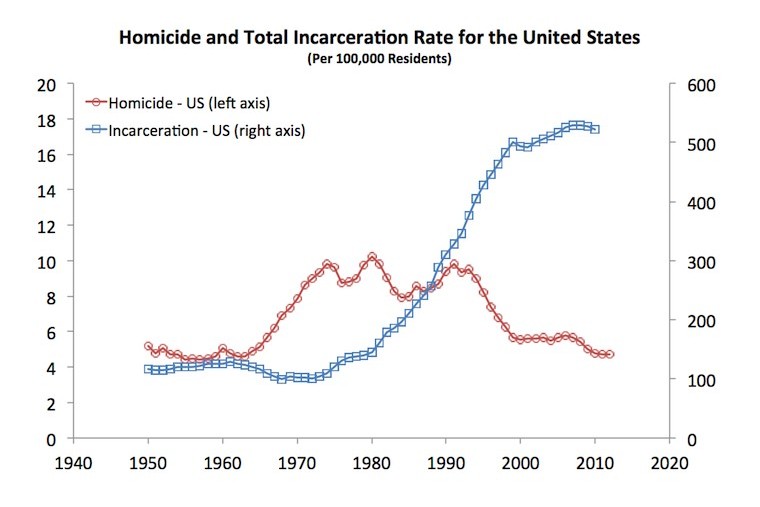
The problem with this approach is that its counterproductive, as many prisons act as graduate schools in crime.
Combine this with society mandating severely curtailed opportunities to participate in non-criminal work and you get a perfect storm where prisons churn out more hardened criminals, which leads to more crime, which leads to more prisoners.
As are the streets.
In this model of 'removal', I'd say that the main point of a prison is to take a more crime prone demographic (by that I mean age, gender, ethnicity, location, wealth...the whole ball of wax) off the street until they are older and less likely to do things that the straights don't like.
In the long run, I would expect for universal surveillance (and the increased ability to parse data we are seeing) to be the main driving force in social control rather than mere warehousing.
If I were designing a prison system, it would be a mini-society. Only a minimal set of rules would be specified and enforced by those outside the prison. The rest would be voted on and enforced by the prisoners themselves.
I don't think I'd recommend it for the U.S.
If you can accept "comprehending and accepting your crimes and their consequences, and having a genuine desire to return to society as a member of it looking to make a positive contribution" as punishement then they are compatible.
But you want to transition somebody psychologically from being in the out-group "criminals" to re-joining the in-group of law-abiding citizens, and most purely punitive measures actively make a person feel further pushed into the out-group.
You want strong incentives and support towards positive re-integration. I always thought that repeat offences ought to be the most damning statistic for prisons, and their performance and budget should mostly be influenced by success on that metric.
Profit from holding prisoners and their labour are basically negative incentives to improve the repeat offending rates.
I can imagine a prison system with a redemptive quality where prisoners feel they’ve labored to redeem themselves to society (this requires society to esteem them accordingly to some degree) and learned a valuable trade in the process.
I think liberals (myself included) would do better to cast that vision for prison reform, rather than the current messaging which IMO comes across as hyperbolic (e.g., “literal slavery”) and naive (prison should be a comfortable place and the rest will work itself out).
But countless studies have shown that it's not an effective deterrent.
To be quite clear, I don't believe that prison's sole value is a deterrent. I think there's an element of justice (criminals should have to pay for their crimes), an element of deterrence (prison should make criminals think twice--this feels intertwined with 'justice' and yet distinct), an element of rehabilitation (to the extent that we can rehabilitate prisoners, we should), but mostly I think there is significant social value in protecting innocent people by keeping harmful people away from innocent people.
Even if the deterrent effect is nil and even if you don't believe in justice (or for many of my fellow liberals, you reserve 'justice' for crimes that offend you, such as white collar crimes), I would still keep prisons around for the protection of the innocent. That said, I have an optimistic view on the potential for prisons.
For the freely given work, it becomes a question of who deserves it. Giving it to a prisoner who is supposed to be punished instead of a law abiding individual stuck at a dead end job appears to be rewarding the individual with bad behavior. The same reasoning also applies when there isn't enough free labor for rehabilitation and money is spent buying more labor.
If at any point the rehabilitation offered within prisons is better than that offered for free outside of prisons then it becomes a reward. Rewards are generally viewed as incompatible with punishment and seen as cancelling out, when they are of similar scales.
Additionally, the notion that there isn’t enough social programs to go around is a lie. There most certainly is enough social programs to go around, but our elected officials in America want to bolster the ultra wealthy and the mega corps instead. This is an artificial scarcity mindset that tries to make us pull each other down.
Is your help getting clean only offered to substance abusers that assaulted another person? If so, you might see why someone who is addicted, wants but can't afford help, and who hasn't assaulted someone might not appreciate the help only going to those who have assaulted another.
If the help is offered to everyone who needs it, then the logic wouldn't apply.
>Additionally, the notion that there isn’t enough social programs to go around is a lie.
Where did I suggest such? I pointed out that there isn't enough purely from volunteering, meaning you'll have to spend money. I specifically pointed out that money could be spend buying more.
>and money is spent buying more labor.
Right there. My argument is that the money spent on buying more help follows the same issue. Spending money to help someone who committed a crime that you wouldn't spend to help them if they hadn't is not a widely agreeable position.
It seems to me that doing so is a great idea. Firstly, given that these folks have (presumably so, but many folks plead guilty to crimes they have not committed, which is a travesty, but beyond the scope of this comment) committed a crime is pretty clear proof that they are having issues integrating into society.
Secondly, except for those who commit violent crimes (a minority of inmates), most folks will be released at some point.
Once those folks are released, they are now responsible for taking care of themselves economically and living in society. If we continue doing what we do now, by not giving them tools and skills to reintegrate into society and stigmatizing them for life, we severely limit their ability to live as productive members of society.
This has a negative effect on society (in that these folks are being actively discriminated against and shut out from many decent jobs) and limits the productivity and economic output of these people in performing jobs compatible with society.
Those are huge negatives for all of us. We're reducing economic output, creating pariahs and increasing the possibility of recidivism, which costs society more when those folks re-offend and are then re-incarcerated.
As such, I posit that rehabilitation along with reducing/removing the stigma of a felony conviction would increase both economic output and societal well-being.
And IMHO those benefits far outweigh how much you (or anyone else) wants to stick it to those dirty criminals.
To clarify, I'm explaining why it would be unpopular. I'm not saying I personally agree with it. Please try to not conflate the argument with the person.
Many people aren't great at seeing long term or higher order effects. I'm explaining the immediate visibility problem, where someone is told that more help is provided for criminals than non-criminals. That the long term effects are worth it doesn't work well to convince people whose views are short term. We can see many government problems resulting from prioritizing short term reasoning.
Take the war on drugs. People see drugs, think "I should ban it so my kids won't be hooked on drugs." They don't think of the long term effects of a war on drug, and as a result we have our modern day war on drugs with all the harm it has brought us.
The real main difference is when people stop viewing prison as being for punishment, but that goes back to the original question of why is rehabilitation incompatible with punishment. If prison is seen as being for rehabilitation and containment for safety while rehabilitating then the comparison is different (though ideally the services offered shouldn't be better than those offered to people who follow the law).
As an example from around here (Denmark) if someone want to hire a person they do not by default know that this is a former inmate and they will only have access to this information if the job somehow is related to the crime committed in the past. You could ask the job applicant to bring a form from the police but if the sentence is unrelated to the job (or a set amount of years have gone past if it is a lesser crime) the form will be completely blank. Only related crimes will be shown.
All in all I believe that such a system is also punishment (few like to be locked up) but this rehalibation-first-system will punish everyone else less in the long run.
Picking fruit is a valid occupation and one that is not limited by post-incarceration rules like not being a stockbroker after committing securities fraud or not being a childcare worker after pedophilia. While many agriculture jobs provide on the job rather than classroom training, there are skills to be acquired that can enhance productivity and value.
My point was that fruit picking, in contrast to many other potential professional activities, is not something that is likely to help an inmate build a post-release career.
When you apply for a job as a fruit picker, the employer is not going to reject those candidates who lack former experience.
Not really, it's a seasonal job (at least in Germany, but are there climates where plants bear fruit year round?) that doesn't pay enough through the season to sustain you through the entire year.
Although there are strong caveats, and like for like data doesn't exist. After 5 years US rate goes up a lot, my link doesn't have that for Germany.
> Recidivism rates vary significantly around the world, and many countries have insufficient data. Rates of criminal recidivism around the world are reported to be as high as 50% and have not declined in recent years. It is challenging to compare recidivism between countries because definitions of recidivism outcomes vary from re-arrest to reoffending to reimprisonment. Within these definitions, countries differ in their inclusion of misdemeanors, fines, traffic offenses, and other crimes. Additionally, follow-up times (period after release from incarceration) are inconsistent between and within jurisdictions and vary between six months and five years.
https://worldpopulationreview.com/country-rankings/recidivis...
Another great example: "The U.S. incarceration rate is 693 per 100,000 residents —compared to 76 per 100,000 in Germany, and 69 per 100,000 in the Netherlands."
There is some real academic research on the topic, but as far as international comparison goes, it's not a solved issue. For example, this paper basically concludes that countries should update their reporting:
I guess one also has to look at the sort of crimes and duration of the sentences.
Also somebody who got a death penalty won't come back ...
What percentage of the US prison population is on death row?
Let's compare "lifelong sentence" in Germany you have a high chance to get out after 15 years. (There is a mechanism for true lifelong, but that's then more of a psychiatric treatment than jail)
Point is: Comparing some statistic without context is not easy
It's one thing to learn a job, and another to waste a large part of your own life making other people rich.
"And yes salaries are low, but they get free food and accomodation and aren't there for fun but punishment ... "
So what's the point of punishment, exactly?
Endless studies which have shown it's not an effective deterrent.
However in Germany a large part of prison work is around qualification. The inmates can learn a job and once released have a useable qualification for finding a job. Most prisons in that way are self supporting. Meaning food is made by inmates who are cooks or are learning to be a chef. Repairs for heating or doors or furniture are made by inmates etc. Only a small part of the work is for external customers and even a smaller part is for the prison's online Shop like https://www.haftsache.de/
And yes salaries are low, but they get free food and accomodation and aren't there for fun but punishment ...