Food chemistry is one of the most complicated chemistries ever. Not only we can't simply construct an argument of safety from first principles but also nutrition labels hardly makes an exhaustive list of the contents and processes involved. Not even mentioning the labeling regulation quirks.
> All food is processed.
This is reduction to absurdity. Even if genetically engineered, the process of cell divisions that end up being a living cow is so complicated that it would lend itself more readily to a claim of integrity, one much stronger than a decade old factory assembly process of dead nutrients. We've co-evolved with the former process for millions of years and created the latter in the last several decades in the name of profit maximization.
That's not what processed food means. A slice of steak from a GMO cow is not processed food, except inasmuch as slashing a knife is a process.
Furthermore, more or less traditional cheese is not considered "processed food" in that context even though it is definitely processed for a long time and with significant effort. Nor is wine or sauerkraut for that matter.
> In 2013, Ramsden resurrected another long-lost randomized study, the 1960s-era Sydney Diet Heart Study. Reanalyzing its unpublished data—also stored on old nine-track computer tapes—he found that volunteers who replaced much of the saturated fat in their diet with polyunsaturated fats high in linoleic acid had a higher risk of death from coronary heart disease
Food has extremely strong cultural significance and a lot of people tie up their identity with it. I can understand that. If they feel that their diet is under attack they see it as life and death for their identity.
I imagine you've picked a side and will seek whatever information or studies suits you; everyone is doing that these days. It's anti-scientific.
Oh and australopithecus ate meat, this goes far beyond modern humans. This is why we got smart, because intelligence pays off far more for hunting than for foraging, particularly for an otherwise frail creature.
In terms of the last thing you said. You phrased it as "australopithecus ate meat"; it seems they predominantly were herbivorous according to wikipedia[2]. Which doesn't preclude eating meat, but could easily be misinterpreted from the way you put it.
[1] https://livinontheveg.com/wp-content/uploads/2017/02/compara... [2] https://en.wikipedia.org/wiki/Australopithecus#Diet
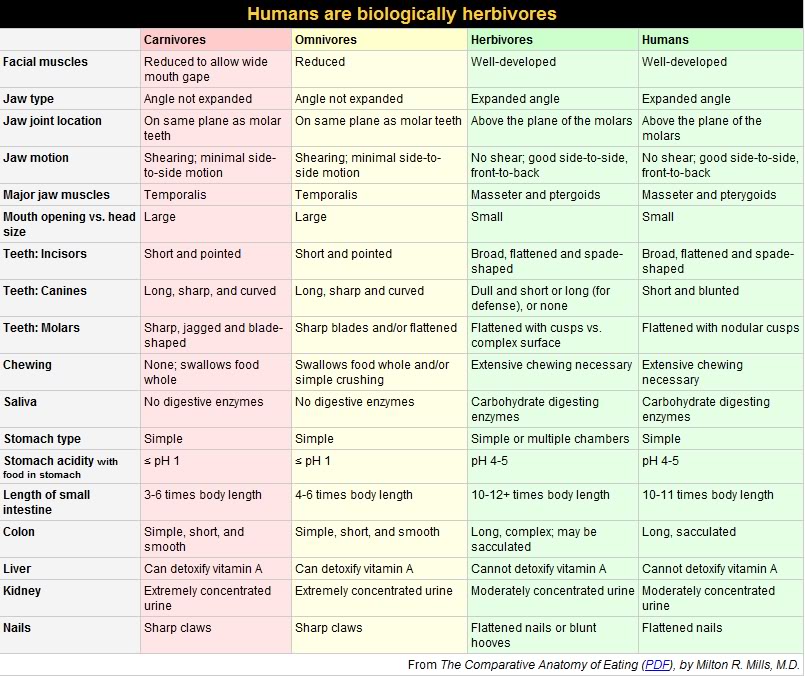

I didn't mean to imply that australopitecus was predominantly carnivorous, but I recently found out they had tools for hunting and/or cutting flesh, just to make a point that the trend started much earlier than homo sapiens.
Might come back with more links/thoughts later
If you care about the environment, your health and animal well being then just eat less animal product (you need some anyway), buy only local food (local meat) and above all stop wasting so much of it.
Just a few decades ago people knew what they were eating, no processed food in any way. They were raising their livestock in their yard, they knew their single sheep / pork / cow and poultry and respected them. At some point you need to eat and kill them, people getting shocked by this have just become brainwashed or oversensitive. Go spend some time in Africa, Asia or Eastern Europe, they're laughing at this nonsense trend.
If I'm really going to be dead within 100 years, why am I doing anything?
Lots of reasons, but the easiest is because it's more enjoyable than the alternative. Who cares if a plant burger is heavily-processed? I like it and I don't have to think about whatever died to bring me my meal.
Yes, it would be better if I grew my own lentils and only ate homemade dal. But that's not realistic for most people, and from a health and environmental perspective, it seems like it's hard to do worse than red meat.
If you are going to not care about any life in 100 years why should you concern yourself with thoughts of death now?
The problem here is that everyone takes the info they want and discards the rest.
Eating meat is not problematic, if done moderately. But nowadays there is not such moderation. There is meat in every meal.
Fake burgers are probably not healthy too, but this is not proven yet.
Just be moderate with what you eat.
Also, while super sweet fruit can be problematic, it's far from one of the biggest problems. No one is getting diabetes from eating too many bananas.
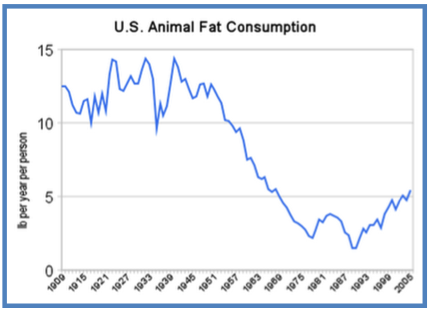
(thankfully a recent uptick since official sources are starting to admit that saturated fat isn't bad)
Red meat consumption has been going down for decades: https://content.fortune.com/wp-content/uploads/2015/10/annua...

There is a ton of info, just look around. Also, what is the common ingredient in all processed foods? This is what is making people fat. Omega-6 integrates in body fat, easily oxidized and unstable, rendering our own fat inaccessible for energy, so we're chronically hungry, tired, and inflamed. Than add in sugar and salt for hyperpalability. We've been hacked.
Seed oils are nothing more than industrial waste sold as food for profits.
This orthorexic behavior by labeling certain foods as unhealthy or healthy is the real problem.
Any kind of diet needs to be accompanied by a proper lifestyle. Eating a high calorie diet and then not having any physical activity is just asking for a bunch of metabolic issues.
Particular food item is not healthy or unhealthy, toxic or rejuvenating. It's the lifestyle+diet that can be labeled as healthy/unhealthy.
These are the worst ones: Canola, Corn, Cottonseed Soy, Sunflower, Safflower, Grapeseed, and Rice bran.
Also, olives and coconuts are fruits.
This idea that physical activity will balance out an unhealthy diet is wrong and has been proven wrong by decades of people attempting just that. It doesn't work. Once your metabolism is damaged by your diet, no amount of physical activity (if you can muster it) will fix it.
There's a bunch of papers on Neu5Gc, should I start being scared of meat toxicity?
Diet containing seed oils can be healthy. Nowhere have I made an argument that an unhealthy diet will be countered by physical activity.
Toxicity of certain compounds in meat or other foods has nothing to do with the food itself being healthy or unhealthy.
Similarly how antioxidant, vitamin or macronutrient content has nothing to do with that particular food being healthy or unhealthy.
Promoting the idea that a particular food or ingredient is healthy or unhealthy is promoting orthorexic behavior, an obsession over what to include or not include in your diet because of a made up measure of (un)healthiness.
There are similar studies on casein/whey.
These studies do not make meat, milk, cheese or seed oils inherently unhealthy or show that you can't have them as a part of a healthy diet.
edit: doing a quick Google Scholar search I can find a bunch of studies that show positive outcomes after regular consumption of flaxseed (rich in omega 3s) or pumpkin seed (rich in omega 6) oils. These studies do not make these oils healthier.
Sufficient omega-3 intake doesn't entirely mitigate the ills from omega-6 anyway, and there are other toxins in seed oils as well.
And obviously, few food-processing factories or bulk shipping methods of ingredients cause enough greenhouse gasses that you can just eat local meat instead, if you care about your footprint. Saying that none of this is solving a real problem is wishful thinking.
If 10% of whopper sales switch to impossible whoppers, that's a big deal, and foods like this can provide a bridge to consumers who have never considered vegetarianism.
I do buy or grow local food, I'm a vegetarian myself. Your view is, in my opinion, too black and white. There's serious momentum around plant based meals, and that's making even more plant based foods available elsewhere.
I think you could do better by simply eating more veggies and cutting red meat consumption.
Are gas turbines a part of a zero emissions electricity grid? No of course not. But are they an improvment on what's happening today? In some cases yes.
Ultimately you're right, eating locally grown plant based diets would be better for an individual, but you're also wrong because the beyond burger is a hell of a lot better than the food it's replacing in most cases.
It seems like we are going backwards.
You know what uses less greenhouse emissions, less water and less land? The orginal plant based food that gets processed into a beyond burger.
If you really care about the planet why are you buying processed anything? That get's shipped nationwide / worldwide that creates factories, chemical waste, greenhouse gases. Buying locally and growing locally really helps the planet. Going to burger king and getting an absolute burger instead of a whooper is just pretending.