The Little House on the Prairie family caught malaria, and was so sick they almost died of dehydration because they couldn’t get down to the river to drink.
https://littlehouseontheprairie.com/dr-george-a-tann-pioneer...
Crucially, they didn't need to get rid of all the mosquitoes to do this: they just needed to drive mosquito-to-human transmission low enough for long enough.
https://en.wikipedia.org/wiki/National_Malaria_Eradication_P...
Clearly that hasn't happened.
I know here in Louisiana the local abatement program has trucks that spray synthetic pyrethroid chemicals (resmethrin, sumithrin and prallethrin) at night and uses an organophosphate (naled) from planes.
And residents are routinely urged to be aware of and eliminate standing water on their property.
We just don't use DDT anymore -- we almost wiped out our state bird with it.
Edit: I have to wonder how much housing changes also mattered. With modern air conditioning and well sealed homes it's fairly rare to have mosquitoes in the home at night.
In fact, of the ~200 mosquito species which occur in the United States, only 12 are known spread any sort of human disease [2].
[1] https://en.wikipedia.org/wiki/Anopheles
[2] https://www.cdc.gov/mosquitoes/about/mosquitoes-in-the-us.ht...
https://upload.wikimedia.org/wikipedia/commons/b/b3/MalariaM...
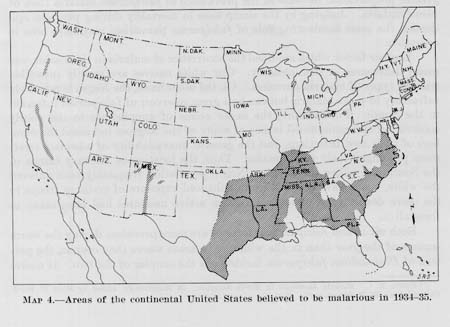
Probably DDT. Not thwebest of ideas!
In 1882, the range of malaria in the USA extended from the Canadian border on the north to southern border with Mexico on the south. The only states of the current 48 contiguous states unaffected were Nevada, Utah, Arizona, Idaho, Main, Vermont, and New Hampshire. Something like 41 states had malaria cases (the maps are a bit hard to read).
Approximately 375 cases acquired in the USA per 100,0000 population were reported in 1920.
Eradication efforts continued until the 1950s when the USA essentially became free of malaria. See [1].
[1] https://www.cdc.gov/malaria/about/history/elimination_us.htm...