> It sounds like a simple fix and it has obvious appeal for all of us who love trees, but its impact on climate change is overblown. Although trees absorb some carbon, they can never take in enough to offset the damage from our modern lifestyle. To absorb the lifetime emissions that will be produced by every American alive today — just 4 per cent of the global population — you’d need to plant and permanently maintain trees on more than 16bn acres, roughly half the landmass of the world.
From: https://www.ft.com/content/c11bb885-1274-4677-ba05-fcbac67dc...
You don't need to absorb ALL co2 currently being output by Americans. A large percentage of that is already being converted/stored by algae / trees
So the baseline isn't "we need to store all CO2". The baseline is, we need to convert the part that is currently "overcapacity" for our environment. And for that, planting trees IS a good solution. But don't take my word (or Bills) for it.
https://science.sciencemag.org/content/365/6448/76
... Ecosystems could support an additional 0.9 billion hectares of continuous forest. This would represent a greater than 25% increase in forested area, including more than 200 gigatonnes of additional carbon at maturity.Such a change has the potential to store an equivalent of 25% of the current atmospheric carbon pool.
- Trees are being cut down at record rate for meat production. Meat production is one of the bigger culprits in deforestation (and particularly of the Amazon and other tropical rainforests). If the world were willing to eat less meat (we don't have to be all-out vegan, we just need to eat much less of it) we'd be a lot better off in terms of how much arable land we need to feed everyone instead of feeding a bunch of cows and then feeding everyone
- The world population is much bigger now. All environmental problems are essentially only an issue because we have too many people in the world right now. If we had the population of the 1800's, none of our modern lifestyle habits would be a serious problem.
For example, choosing fancier, JavaScript-heavy ways of building webpages probably results in clients consuming extra electricity. One could hypothetically estimate the impact, and then come up with an analysis to the effect of, "For a site generating X amount of traffic, you'd need to plant Y trees to offset the decision to use Google Tag Manager."
and furthermore
"Pieter Hoff says that we can replant a hectare for approximately 2,500 USD. We need 2 billion hectares of trees to disconnect all present and past CO2 what is produced through fossil fuels. The total investment to clean the air from the CO2 pollution is therefore 5 trillion USD. This investment is smaller than the costs of saving the bank system since 2008. Both USA and Europe spent over 6 trillion USD to save their banks."
Note: it's an investment, not an expense. ie profitable.
[1] https://www.groasis.com/en/downloads/download-the-treesoluti...
With respect to reforestation: Gates says it would help, but possibly not as much as you'd think and he's a bigger proponent of stopping the deforestation.
Yishan Wong thinks that growing forests (as opposed to just planting trees) is an important tool for carbon sequestration: https://www.terraformation.com/about
I totally agree that we need to do a wide variety of things. Stopping deforestation, reforestation, less meat, electric cars, etc. We need to do it all.
So, we need all we can think at same time, now. :/
Simply, current amount of carbon in the atmosphere has been released from sources that were not there, and we are still cutting trees more than we plant. Some calculation say we need between 1-2 trillion trees. But even then trees need a quite some time to grow and become effective.
I imagine a solution where people grow stands of fast growing trees, clear cut every $optimal years, use (magic?) chemistry to separate the harvest into carbon and not carbon, then dump the not carbon back onto the soil, and replant.
Even with that, I’m not convinced there are enough acres of land on earth. I haven’t seen anyone do the math, and suspect direct carbon capture plants and olivine reactions will scale better.
The resulting carbon, called biochar, can be co-composted to prepare it for use in soil, where it protects the soil from drought and flood alike. Plants grown in soil with higher carbon content are bigger and healthier, and these soils can produce more of whatever you're growing.
I make biochar at home but there are companies that do it on an industrial scale.
Humanity has been pumping CO2 into the atmosphere at an epic scale for decades. In addition to going carbon neutral with more wind, solar and nuclear, we need to draw CO2 back out of the atmosphere on an epic scale. And biochar resulting from pyrolysis is one of the major tools since it has synergistic effects with other tools, like mass tree plantings. Biochar production can also offset other energy uses, for example by either directly burning the syngas on-site for heating purposes, or for capturing it and using it later as a fuel in an application that would otherwise use fossil fuel.
Either way, I completely agree. Planting trees doesn't solve the problem if those trees are allowed to naturally decompose. Trees are just really efficient carbon fixing machinery, we need to store the solid carbon somewhere.
So how do we sequester large amounts of wood for a century at least?
Energy is still 73.2%.
If you want to change the course of emissions, you need to change Energy. Luckily, we have the technology and understanding to decarbonize all energy. (The challenge is just to do it quickly and cost-effectively.)
You’re right about coal being the biggest emitter for energy. But... Energy is not just coal but oil and natural gas.
https://ourworldindata.org/uploads/2020/09/Emissions-by-sect...
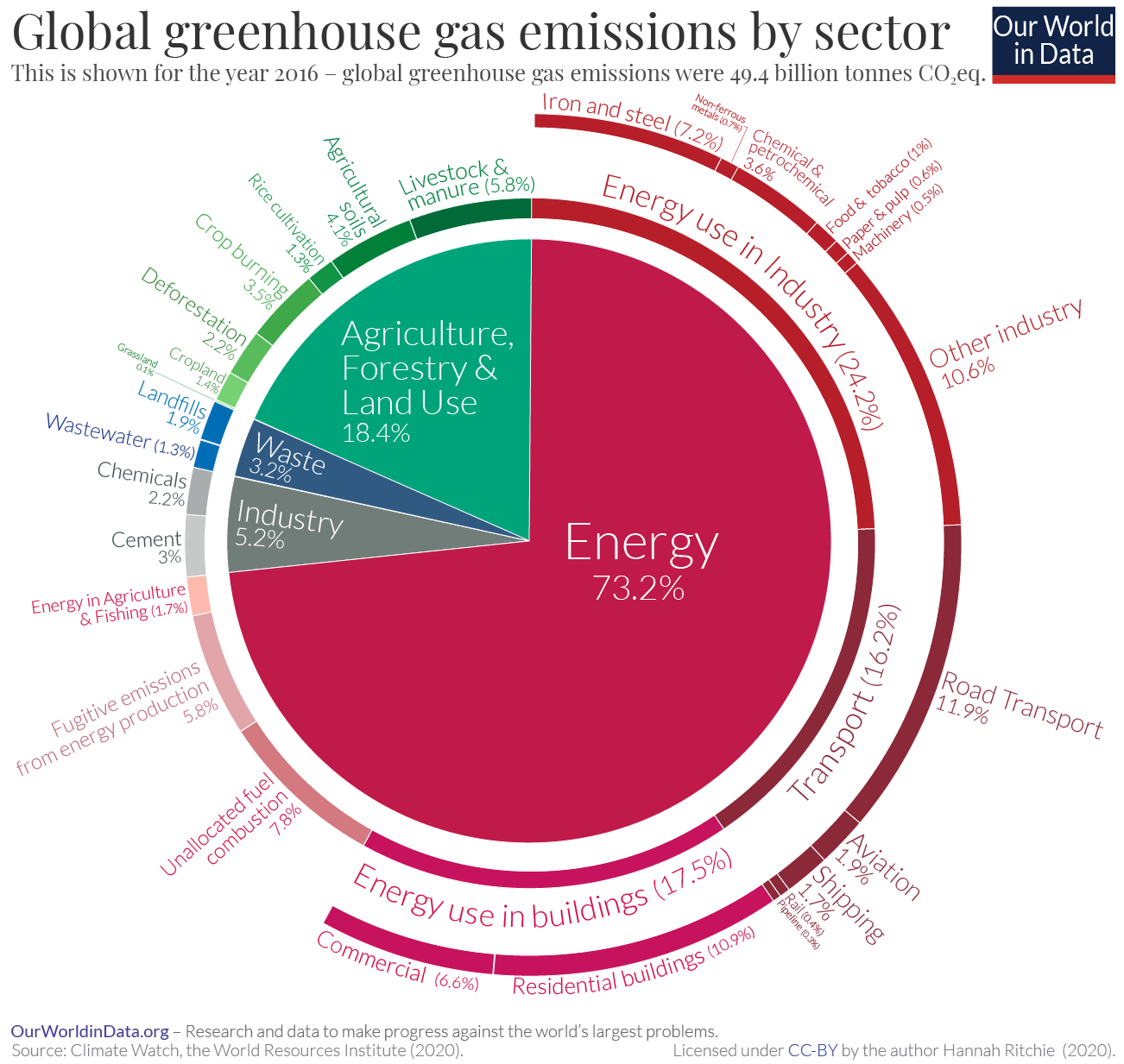
https://ourworldindata.org/emissions-by-sector
Oil is nearly as big of an emitter as coal, and gas plus oil is now bigger than coal itself. https://ourworldindata.org/exports/CO2-by-source_v16_850x600...

Based on that data, oil is a much higher emitter than agriculture and gas emissions are about the same as agriculture emissions (but will soon be higher).
So as of 2021 it’s likely primarily coal and then oil that are the biggest emitter, followed by gas and then agriculture.
Typically what counts as agricultural emissions are literally tilling, tractor fuel, cow emissions, etc. we really need to look at the whole system, together, for a clear picture. When we do that it obvious that our industrial food production is deeply tied to every aspect of fossil fuel use, land use, and atmospheric c02 in general.
Petrochemical production, nitrogen fertilizer production in particular, is simply energy. And, in fact, nitrogen fertilizer just needs hydrogen, not hydrocarbons (which is a sort of misconception... many think hydrocarbons as a fundamental component of fertilizers when the actual Haber Process uses straight hydrogen), so should be much easier than hydrogen cars. And transport is relatively easy to decarbonize. Road and rail transport, in particular.
That's correct and everything, but I do think that for a while the best strategy is to focus on coal. Yeah, some electrifying of transportation won't harm either, but the largest short term gains and the largest long term opportunities all start on replacing coal.
If replacing coal leads to lots of peaking natgas plants, so be it. It is still a gain on the short term, and it creates clear target for storage on the long term.
Each new conventional car sold is a locked-in 100 tons of CO2 (lower if we we crush them sooner). Electric cars are much smaller (half to start with), and depending on how fast we transition the electric grid could be only like 10-25 tons and then next to nothing (as even manufacture becomes decarbonized).
How did you arrive at this number? climate.gov article from last year estimates 900ppm by the end of the century if energy demand continues to increase at same rate and it is all met by fossil fuels.
https://www.climate.gov/news-features/understanding-climate/...
How long are you expecting to live? Just wondering as we’re not really expected to breach 950ppm by 2100: https://skepticalscience.com/rcp.php?t=3#concentrations
Edited to add: ignore me, looking at ppm and not ug/m^3
I did some research into this a few years ago. Here's what I remember. Most of it is easy to search for to verify, just slightly time consuming. Broad brush strokes here to get you started.
Your average "big" tree (oak, pine, maple) will absorb about 10-20 pounds of CO2 every year once it's about 10 years old, on average. Lots of variables obviously. From what I saw, and there's debate, but the rate of CO2 absorption doesn't seem to speed up as much as we'd expect as they get older. I don't know how true that is, but at the same time, I could never find hard numbers to disagree. I have to work with what I got.
According to the US Forestry, per acre, you can have 100 really big trees or 500 really small trees. The problem with higher density is the increased wildfire hazard. It was something like 150-250 trees is the most they like to manage an area. This allows enough space to slow fires and ability to easily clean debris (if it's a managed forest) to choke out the fire.
For this, let's say we want 150 big trees per acre and on the best case scenario, once these trees are 10 years old, they're sucking up 20 pounds of CO2. That's about 3,000 pounds of CO2 being absorbed from the air with the hopes and prayers that a wide fire doesn't come through and undo that work.
Back in the day, I did this to figure out how bad Bitcoin was to the environment. Let's do Ethereum since NFTs are so hot right now: https://digiconomist.net/ethereum-energy-consumption. Every Ethereum transaction puts out roughly 29 kgCO2 (63lbs). That's an energy usage that truly never has to happen, but does out of vanity for the idea of saving the world from the 1% so it can create a different, new set of 1%ers. I'll get off my soap box now. That's 3, 10 year old trees needed to be carbon neutral for the average Ethereum transaction. Bitcoin is far worse, 367kg(800 pounds) per transaction. That's 40 trees needed per bitcoin transaction for carbon neutral. According to https://bitinfocharts.com/ethereum/, there were 49,000 Ethereum transactions yesterday, 250,000 for bitcoin (same site). So that's 147,000 trees or 980 acres of 10 year old trees needed to be planted every day to offset Ethereum. 66,666 acres, per day, to offset Bitcoin. Hopefully a wildfire doesn't come by and fuck up everything. Forcing you to replant to catch up on an amount of space that's incredibly unrealistic. Not to mention the CO2 of the logistics to move that many personnel around to plant that many trees.
Moral of the story, you're right. The impact of planting a handful of trees is shit. And don't get me wrong, I think we should be planting trees and trying to bring back forests. Rehabilitate destroyed and distressed ecosystems is a fantastic idea. But let's not suck each other's dicks that we're going to save the planet with YET ANOTHER PIECE OF DIGITAL TECH that is "going to solve the world's problems". Go buy a fucking tree, some seeds and a shovel. Get off the computer and go get your hands dirty. Anyways, it's far better to just cut the bullshit out of the planet instead. I just focused on the 2 largest cryptocoins. They're a drop in the bucket compared to everything else, coal, gas, etc. Cutting the CO2 producers will do more than you can realistically replant.
Plant and ocean response to rising CO2 is unknown at this time. The only mostly certain thing is that it is highly non-linear.
Any world-ending projections of CO2 content in thousands of ppm are wild guesses and scaremongering.