Of course, Intel's CPUs have less PCIE lanes, no ECC support, lessor upgrade path, generates more heat, etc.
Finally my old desktop was Intel and I am working on a lot of kernel/VM stuff. I don't want to switch architecture halfway. I did that before and it was painful.
> Of course, Intel's CPUs have [...] lessor upgrade path
One big + for AMD is their socket system, and keeping it the same for multiple generations via a roadmap so people can plan. Contrast that with intel, who comes up with a new socket every generation forcing you to buy a new motherboard and likely new ram if you want to upgrade. AMD's Socket AM4 was released in 2016 and works with Zen+, Zen 2, Zen 3 and Excavator microarchitectures. If you upgraded every 2 years, that's 3 motherboards and memory sets you would have had to purchase if you went with Intel vs a single motherboard/memory and upgrading only the cpu with AMD. That's quite a premium.
What? Aside from edge-cases resulting from slightly divergent microcode implementations you should not be dealing with that. They are both x86-64. (Forgive me if I am missing an elephant in the room.)
It's out of stock everywhere..
https://semiaccurate.com/2020/10/29/intels-palpable-desperat...
Just filter out Charlie Demerjian's grudge against Intel.
Companies don’t backport because a core is designed for a process. It’s efficiency and architecture is based on the transistors that it will use from the design start, caches are sized based on the process too, and a lot of the architectural gains are due to the added transistor counts. If you backport a CPU you lose the efficiency of these new transistors so the energy use goes up and the clocks likely go down as well. Cores take up 2x the size, or at least a lot more than the older core did on the older process, so costs go up too. You can either cut out bits of the core and lose performance or eat it on area and therefor cost. Backporting a design not made for portability isn’t a lose/lose proposition, it is a lose/lose/lose/lose proposition. But Intel is desperate so…
This review makes it clear that unless Intel magically gets a process improvement they're entirely screwed.
This is precisely the same kind of design issue that hit with the latter end of the P4 era, where thermal limitations were so severe that they were crippling the chips. I'd have to do some digging, but I absolutely remember reading an interesting set of benchmarks that made it clear that you were 99% likely to thermally throttle those P4s even with proper thermal paste and an improved high-end heatsink/fan.
AMD will make gains for sure at this rate, but TSMC can't serve the whole market. Intel owns fabs, and these rocket lake chips will sell to the mainstream just fine.
I expect intel's fabs to be a big asset in these COVID times with sold out computers.
Their fixed costs & massive R&D requirements have to be paid for by shrinking revenue: Projected 1st quarter 2021 revenue is down about 12% over the same quarter in 2020. This isn't COVID-related: AMD's projected revenue for the same period jumped 80% year over year.
Intel is far from okay. They are far from having a safe path due to production bottlenecks by competitors: TSMC's 7nm capacity-- which is what AMD uses-- is on track to increase 18% in just the next quarter alone. I don't know how sustainable that production growth is, but it doesn't have to last long when they're bringing new fabs online and Samsung's fabs may be taking on some of Apple's M1 production, further freeing up TSMC capacity.
I don't think I'm saying anything particularly controversial or surprising or new when I say that Intel probably has about 2 years to figure out their own fab problems before they're well out of things for the next decade or so, having to claw their way back the way AMD has done.
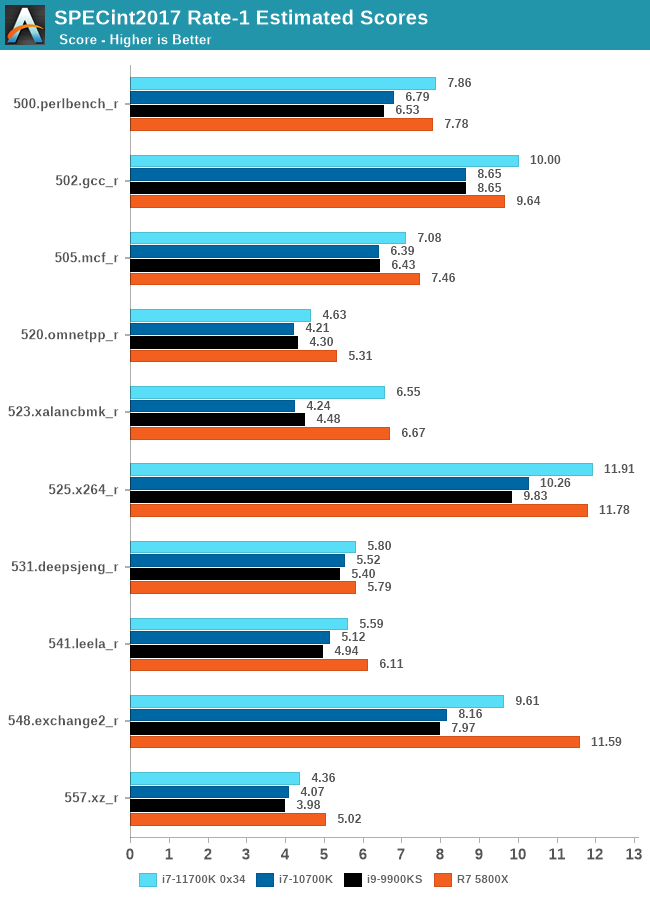
Pretty much every Rocket-lake score is faster than Skylake across the board.
I'd definitely buy a Rocket Lake over any old Skylake based off of these reviews. Rocket Lake seems a wee-bit inferior to Zen3, but AMD Zen3 is pretty much sold out, so if you need a computer, Intel is still there.
Except for gaming, where rocket-lake is across the board slower. Which is important since gaming was Intel's last holdout prior to the arrival of Zen3. So if you're gaming this is worse, and if you're not gaming why would you go with this over a 3900x at basically the same price? Even verse skylake if you're doing productivity stuff a 10920x seems likely to be consistently faster thanks to 50% more cores (and way way more pcie lanes if you're into that)
The only reason to get this seems to be if the unique combination of avx512, no ECC, and only up to 8 cores is somehow ideal for your use case.
"The new generation Rocket Lake is the combination of two different backported technologies. Intel took the Sunny Cove core from 10nm Ice Lake, and re-built it on 14nm, calling it now Cypress Cove. Intel also took the Xe graphics from 10nm Tiger Lake and re-built those on 14nm, but these are still called Xe graphics."
So, yes, it appears to be a backport.
What happened? I’ve never seen a computer die during use.
>My work desktop died [..]
Are these related, perhaps? I found the juxtaposition quite humorous.
         10700K  11700K
  single  1,321   1,767  +33%
  multi   8,821  10,474  +18%
PS My work desktop died on Wednesday afternoon during the SpaceX SN10 flight. I rushed to my local computer store to replace it. Out of the entire store, only 2 motherboards models with Intel's LGA1200 are in stock. All the other motherboards on the shelf were for AMD.
I picked the i5 10400f as it's under deep discount. I asked around and everyone agrees that Intel is competing only on price point right now.