I think the vertical integration they have is a major advantage too.
I used to work at arm on CPUs. One thing I worked on was memory prefetching which is critical to performance. When designing a prefetcher you can do a better job if you have some understanding or guarantees as to the behaviour of the wider memory system (better yet if you can add prefetching specific functionality to it). The issue I faced is the partners (Samsung, Qualcomm etc) are the ones implementing the SoC and hence controlling the wider memory system. They don't give you detailed specs of how that works, nor is there an method where you can discuss with them appropriate ways to build things to enable better prefetching performance. You end up building something that's hopefully adaptable for multiple scenarios and no one ever gets a chance to do some decent end to end performance tuning. I'm either working with a model of what the memory system might be and Qualcomm/Samsung etc engineers are working with the CPU as a black box trying to tune their side of things to work better. Were we all under one roof I suspect we could easily have got more out of it.
You also get requirements based upon targets to hit for some specific IP, rather than requirements around the final product, e.g. silicon area. Generally arm will be keen to keep area increase low or improve performance / area ratio without any huge shocks on overall area. If you're apple you just care about the final end user experience and the potential profit margin. You can run the numbers and realise you can go big on silicon area and get where you want to be. With a multi-company/vendor chain each link is trying to optimise for some number they control, even if that overal has a negative impact on the final product.
A lot of the examples you see are similar to what you talk about. You can cut down on the friction between different parts.
I remember an example of software controlling a blinking icon on the dashboard, where this was a 10 minute code change for Tesla but a 2-3 month update cycle for a traditional automaker due to the dashboard hardware coming from a supplier.
And I assume the partners also do some things differently, for at least somewhat legitimate reasons, and no one ARM design can be optimal for everyone.
? shared prefetch queue ?
Also in 2008 they secured exclusive access to a then new laser cutting technology that they used to etch detail cuts in the unibody enclosures of their MacBooks, and then iPads. This enables them to mill and then precision cut the device bodies out of single blocks of Aluminium.
They’ve also frequently bought small companies to secure exclusive use of their specialist tech, like Anobit for their flash memory controllers, Primesense for the face mapping tech in FaceID, and there are many more. For Apple simply having the best isn’t enough, they want to be the only people with the best.
Other manufacturers seem to be completely oblivious to it. They still equip their laptops either with full hd or 4k screens. The resulting ppi are all over the place. Sometimes way to low (bad quality) or way to high (4k in an 13" laptop, halves the runtime). Same with standalone screens, there is a good selection around 100ppi, but for "high res" the manufacturers just offer 4k in whatever size, so once again the ppi are all over the place again.
Apple realizes there's diminishing returns in upping the resolution beyond what your eyes can see. So they hit Retina, and then move on to focus on color accuracy, brightness, and contrast.
They do this throughout their product stack. Only as much RAM as their phones actually need, because RAM is both costly in terms of BOM and also consumes battery life.
Using fewer Megapixels than competing phones because it's about the quality, not quantity, when other manufacturers trip over themselves to have the most Megapixels.
When your customers are picking a product based off a spec sheet, that's the trap you easily fall into.
It's still not enough resolution for x2 upscaling that Apple argues optimal.
Apple's focus and commitment can be a pain to users who want something different, but overall it's a huge strategic advantage.
Software developers are building their apps for M1 because they know beyond a shadow of a doubt that Apple isn't going to keep Intel around any longer than they have to, whereas Microsoft had and will continue to have a hard time persuading anyone to adopt ARM Windows because the opposite is true.
But Wintel will own business desktops for probably a decade, unfortunately.
Do you see this as being different from what was going on pre-M1?
Aside from shared math libraries, seems like most stuff required cross compilation just to work - I’m not clear that M1 adds more work on top of that.
Apple, what are you thinking? People who can afford that display might want to connect their desktop mac and their laptop to it.
https://en.wikipedia.org/wiki/Dell_Inspiron_laptops
That's about 130+ish dpi and it was unmatched for years: I know I had one and was depressed to see dpi do down and down afterwards :)
Hopefully Apple restarted the dpi race.
By the time I was ready to purchase one of their keyboards to put in my iBook G3 Snow, they had shut down. Little did I know...
https://technical.ly/philly/2013/01/09/jeff-white-fingerwork...
Maybe compilers would be default spit out binaries that run on all of them, like Apple's Rosetta or whatever it's called.
Universal binaries. Apple calls those binaries “Universal binaries”. Rosetta is more like running different arch binaries through qemu. A brief look through Google says that there was a FatELF specification created years back, but never really went anywhere. Presumably because Linux users tend to know what arch they are using.
Fat binaries would make distribution easier, but would double (or triple) the size of a binary. I doubt it would be worth the size trade off.
Docker also supports multiarch images.
Given how easy it is to JIT or BT RISC ISAs, the future is good for binary portability.
That said, I don’t know what Apple does. For example, in the main download for Big Sur, is (for example) zsh a universal binary, or are there a specific x86/M1 downloads. I haven’t looked.
    /usr/bin$ du -schL .
813M totalAlso much of this tech only existed when it did due to their investment in technology development and tooling. Microsoft had dragged their feet on Hi-DPI for years before Apple jumped ahead with retina and 5K and forced them to pull their socks up. Android phones probably went to 64-bit two years earlier than they otherwise would have. With Surface devices Microsoft has come up with some genuinely innovative and forward looking designs and engineering, but would they have done that without the spur of competing with the iPad and Mac? Apple have been single handedly dragging the rest of the industry kicking and screaming into the future, to everyone's benefit. How is that outcome 'evil'?
And they do this so well because they're led by Tim Cook who approaches the big picture in part in terms of supply chain.
I don't argue that cornering the market isn't an accounted-for and desirable side-benefit of this arrangement. I just don't think it's usually the starting point for them.
There are pro's and con's to both models; choose the one that works best for you. Even if it's not Apple :)
It's usually a legitimate justification, too. Nobody else makes hardware this nice, almost as a general rule.
So when compared to other companies which do put out products with similar materials the difference is that Apple never reaches low. They won't sacrifice their premium material usage and expression to reach lower end markets.
Air Pods Max might be the situation backfiring on them. They were so wrapped up in having aluminum enclosures for the headphones they ended up with an overweight and overpriced to many product. It is going to be real curious what a lower cost version of these entail; the rumor is they will come but when and of what materials?
I think you precisely have it. There is no single magic reason the M1 is so good, just a lot of things coming together. They start with a better instruction set than x86, have of course the best process available, and perhaps the largest part, they have built up an increadible team over a decade. And they are extremely focussed in what they target. If anything, that is Apples "magic". They are not making a chip which is built in an abstract manner to be sold to random customers. They have exactly their needs in mind and execute towards those. In a sense AMD did that with the chips for the Playstation/XBox. Like the M1 it is basically a SOC. There optimized for great graphics performance. Unfortunately, those chips are not sold separately for building your own PC.
Perhaps you haven't been paying attention?
Apple shipped 64-bit ARM processors for the iPhone at least a year before Qualcomm could do it for Android devices. The reaction to the A7 was similar to what we're seeing now with the M1—not possible, there's some trickery going on, etc.
Apple is pretty good at this processor transition thing, going from 68k to PowerPC to Intel to ARM.
And it more than makes up for some pretty spectacular tactical mis-steps (I’m looking at you, puck mouse, cube mac, butterfly keyboard).
Except for the recent keyboard issues, you're literally talking about another era. I wouldn't put the shape of the mouse for the 1998 iMac in the same category as transitioning a $9 billion revenue product line to a radically different processor architecture.
“...and even if they did it, it doesn’t matter” (though I guess not many are saying that about M1)
The Apple IIgs did end up on the 65816.
That is because it is not possible to ship a top-end design for a new ISA in that amount of time. The more reasonable answer is they had been working on a new core design for some years before. AMD has hinted that their Zen design makes it relatively easy to swap the x86 frontend for an ARM frontend.
Apple was considering buying MIPS around that time. I suspect they strong-armed ARM into accepting their ARMv8 proposal because it was good and because Apple buying MIPS would be disastrous for ARM's share price. At that point, it wasn't faster than possible, it was just designing the last part of the chip (or if both frontends were being worked on in tandem, cancelling one of them and focusing everyone on the other).
This explains why ARM announced v8 and then took the full 4 years to ship their first low-power core (A53) and even longer to ship their bad first try at a high-performance core (A57 -- with the more baked A72 being superior in almost every way).
Yes, Apple managed to lock up most of the global supply of capacitive touchscreens for about a year after the iPhone came out. The iPhone wasn't the first phone to use a capacitive touchscreen, but for a while, it seemed like it was because nobody else could produce devices with them in large volumes.
People used to dismiss Tim Cook as "just" a supply chain guy. But I think it's become clear that supply chain management is at least as important to Apple's success as anything on the design or marketing side.
One area that I've always wished CPU's would take would be a dedicated core or two for the OS that is completely isolated from the other cores, which would be for the software/applications you run. Now if those ran about two different architectures - darn that would be the inner geek in me appeased.
Scheduler wise it would become easier as no juggling cycles upon main core that the OS is running upon. Whilst not hitting real-time OS levels, it would be a nice middle ground in some area's as well.
Also for cores, the OS and user software don't need the same OS when the OS is just API calls passing parameters, so would be viable to have the OS upon one core type and the user-space cores a totally different architecture. That again would add another level of security.
Unfortunately it looks the project is now abandoned
Exactly. ARM has been progressing faster than Intel. For the past 8 years or so, Apple has had the fastest ARM CPU out there on the iPhone/ iPad. Apple has sucked up TSMC's 5nm production. They've integrated a pile of relevant coprocessors into the CPU and put fast RAM on the package. The SSD is lightning fast and SSD encryption is done via a dedicated coprocessor.
It's not one magic trick, it is countless bits of engineering, manufacturing, and purchase choices.
Except for all the people practically begging Apple to make a phone for years, except all the analysts who wrote essays on how computer companies could make successful phones, except for all the fanboys making fan-art of phones with that big circular wheel.
People always make the point that the X86 decoder is only ~5% of the die. Sure, that's true, but keep two things in mind:
(1) While it's only 5% of the die, it runs constantly at full utilization. The ALU is also only a small percentage of the die (5-10%). How hot does your CPU get when you're running the ALU full blast? Now consider that there is a roughly ALU-sized piece always running full blast no matter what the CPU is doing because X86 instructions are so complex to decode. Not only does this give X86 a higher power use "floor," but it means there's always more heat being dissipated. This extra heat limits thermal throttling and thus sustained clock speed unless you have really good cooling, which is why the super high performance X86 chips need beefy heatsinks or water cooling.
(2) It apparently takes exponentially more silicon to decode X86 instructions with parallelism beyond 4 instructions at once. This limits instruction level parallelism unless you're willing to add heat dissipation and power, which is a show stopper for phones and laptops and undesirable even for servers and desktops.
People make the point that ARM64 (and even RISC-V) are not really "RISC" in the classic "reduced" sense as they have a lot of instructions, but that's not really relevant. The complexity in X86 decoding does not come from the number of instructions or even the number of legacy modes and instructions but from the variable length of these instructions and the complexity of determining that length during pipelined decode.
M1 leverages the ARM64 instruction set's relative decode simplicity to do 8X parallel decode and keep a really deep reorder buffer full, permitting a lot of reordering and instruction level parallelism for a very low cost in power and complexity. That's a huge win. Moreover there is nothing stopping them from going to 12X, 16X, 24X, and so on if it's profitable to do so.
The second big win is probably weaker memory ordering requirements in multiprocessor ARM, which allows more reordering.
There are other wins in M1 like shared memory between CPU, GPU, and I/O, but those are smaller wins compared to the big decoder win.
So yes this does foreshadow the rise of RISC-V as RISC-V also has a simple-to-decode instruction set. It would be much easier to "pull an M1" with RISC-V than with X86. Apple could have gone RISC-V, but they already had a huge investment in ARM64 due to the iPhone and iPad.
X86 isn't quite on its death bed, but it's been delivered a fatal prognosis. It'll be around for a long long time due to legacy demand but it won't be where the action is.
The 16 core Ryzen has the same TDP as the 8 core Ryzen. Increasing the clock speed for slightly more single core performance is an intentional design decision, not an engineering flaw. Clock up those Apple chips and they are going to guzzle more power than AMD's chips. https://images.anandtech.com/doci/14892/a12-fvcurve_575px.pn...
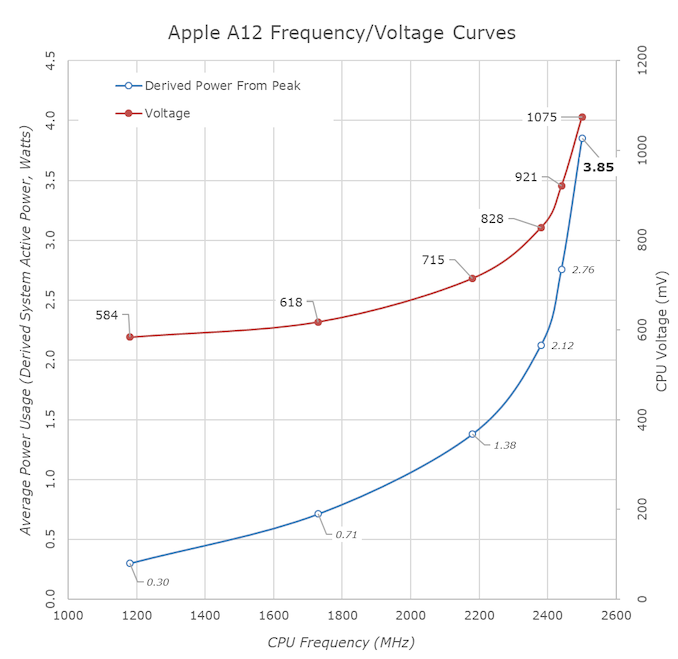
Apple's preference for manufacturing processes that optimize for mobile low ower consumption below the 4Ghz range mean scaling up is harder than just slapping a higher TDP on the chips. Remember the TDP of the whole package already exceeds the TDP of the most power hungry Ryzen core running at 4.8Ghz. Apple has enough headroom to boost to the same frequencies but they don't, because of the manufacturing process they have chosen which loses all of its efficiency beyond 4Ghz.
My go to example: my 2011 x220 sandybridge stinkpad is faster than my 2017 kaby lake mbp. 2005 machines (I dunno, Lakeport?) aren't even in the same ballpark as modern machines. Had that pace continued up to current year, the M1 chip would be a stinker. As it is, AMD is close and could smoke M1 in next generation 5nm chips, restoring order to the universe.
Dude, has Intel called you yet? You've got some serious CTO chops.
Comparing next gen to current gen is a strange way to do things. Apple will also have a next gen M chip.
Apple do not of course, but TSMC have stated they expect 3nm to be produced in volume in 2H22 which tells us we have at least one more round of Apple Silicon on 5nm.
In 2021 we will presumably see Apple Silicon parts with increased core counts and desktop TDP
This will be our first chance to see how the best of ARM goes against the best of X86 in like-for-like configurations.
Analogous to the iPhone being foreshadowed by the iPod without most experts believing Apple could make a mobile phone from that, the M1 was foreshadowed by the A1 for mobile devices with many(most?) experts not forecasting how much it could be the base for laptops and desktops.
It seems, the M1 includes numerous small engineering advances and the near term lockup of the top of the line fab in the supply chain also reminds me of how Apple had secured exclusivity for some key leading edge iPhone parts (was it the screens?).
So the M1 strikes me as the result of something that Apple has the ability to pull off from time to time.
And that is rather hard to pull off financially, organizationally and culturally. And it more than makes up for some pretty spectacular tactical mis-steps (I’m looking at you, puck mouse, cube mac, butterfly keyboard).
EDIT for typo