I don't see why people are so obsessed with instant and explosive growth. Almost no recreational product has seen this kind of growth and they have all continued to exist just fine.
VR is ready today if its something you want. Its fun, cheap enough and has loads of games. If you hold out for something better you will always be waiting because there will always be something much better in 5 years.
Education (language learning, geography, biology, engineering...), real estate, porn, psychology, situational training (firemen), scientific visualization and collaboration, spatial painting and other artforms, social interaction, movie shots planning, etc.
Suppose we had 2 computer games.
One that perfectly reproduced real world "graphics" and "gameplay", looks like a real life high resolution video. Everything is life-like but you use fairly standard controls and a regular display.
Second that comes with perfect VR integration including physical resistance somehow, unlimited running space, ability to taste foods and whatnot. But the mechanics and graphics would still be off (current-gen).
It's pretty clear to me #1 would be way more immersive and the bottleneck is game/simulation tech, not VR tech.
This comments sounds like what people would've been saying of smartphones: "I've gone my while life without a smartphone, why do I need one now?"
I said the same thing about smartphones, big screen TVs, good office chairs and a few other things. You either learn from your mistakes, or you don't.
Not all, no.
You can't lay paint strokes in mid-air around you if you are not in a virtual reality with different physics. That art form simply did not exist before.
You can't understand whether the dimensions and arrangement of a not-yet-built house or movie set is appropriate if you can't visit it in person. It's a threshold change from seeing a model or a 2d tour.
If you are a burn victim, you can't "escape" your thoughts unless your visual cortex is completely flooded by imagery. Similarly, researchers trick the brain of people with spinal cord injuries to reconnect or regrow neurons. Again the "headphones-for-your-eyes" aspect that floods your input channels is used to trick the brain, and this was simply not imaginable before.
> real estate
How often do you do that ? Once every few years ? Aren't regular 3d models / regular virtual visits enough ?
> porn
Tried it, extremely awkward at best
> psychology
?
> situational training (firemen)
You can train in your Vive for 5 years straight, nothing will prepare you to the real deal. Just like playing a racing video game doesn't make you a racer.
> scientific visualization and collaboration
It's neat but does it change anything fundamentally ?
> social interaction
Nothing will replace real world interactions, be it facebook or VR it's all a gimmicky at best
> movie shots planning
?
Sounds like a solution looking for a problem. VR isn't new at all and besides gaming it really didn't pick up speed in any other industry. If anything AR could be a "revolution", if miniaturised enough (contact lenses size).
I received a free HTC vive after participating to a conference in 2016, used it a month and it's in a drawer since then. None of what the speakers were promising happened, VR is still the thing you get out once every 6 months to show it to a friend, the wow factor lasts 30 mins.
Edit: gaming is larger than the movie and music industries combined
Unless we can come up with a use case for VR beyond gaming and fulfilling escapist fantasies. It will likely just be another contender for entertainment dollars.
Smartphones on the other hand essentially made it possible to do anything a general desktop pc could do for people on the go without having to be tethered to a chair infront of a desk. Phones can be used for payment, notetaking, etc. There are people who use smartphones and don't play games at all.
It's sort of the inverse of the smartphone use case.
Is it there yet? Of course not. But if/when it does get there... that's a much more compelling use case than a smartphone.
I predict VR will be slightly larger than the racing wheel market but they will not become super common in the next decade because they require a large amount of space. This doesn't matter at all because even today VR games and hardware are great fun to use.
nowhere near comparable in reach. Way more people watch movies than play games. Since movies are typically cheaper to consume, it appears as a smaller industry while it is actually bigger in reach.
I don't believe that is true, any evidence for this?
Gamers like to pay for collectables, DLC, limited editions, figurines, steam sales for games they don't play, etc.
Meanwhile unlimited music streaming is $9/mo. (Are concerts and merch considered in the "industry" revenues?)
Unlimited steaming on Netflix is $13.99/mo for their mid-tier plan.
If games had an "unlimited streaming" subscription equivalent, the industry's revenue would be much smaller.
In addition, there are unlimited streaming services for games, one of which being Xbox Game Pass which is growing in popularity. Unfortunately it doesn't feel the same because how many games can one truly complete on a monthly basis?
Single player video games are also in that range - 30-40 hours of gameplay for $60. But where it gets really crazy is endless games (Sims, Factorio, Simulators) or free to play games (League of Legends, Fortnite) where you could be entertained for thousands of hours for a couple of dollars. I personally played a free to play game for 2000 hours while spending about $40 total on it.
Even movies are pretty cheap, considering we most of us watch what’s included in our monthly subscriptions of Netflix/Amazon/Disney. Even buying/renting movies works out to about 1$/hour.
Conclusion - we’re in a golden era for entertainment where the options are nearly unlimited and dirt cheap.
That's only half the gaming market by revenue. The other half is mobile gaming and those games are typically under $5.
If you count by player, then the mobile market is larger.
I think that at some point there will be an iPhone moment for VR. However, I think we're still far enough away from it to not know what it'll look like.
56% of US households have at least one gaming console.
Likely no consumer product will reach the success of the smartphone.
Which is to say, it's still an unwieldy box you put on your head. But even hand-tracking works well now, so for a lot of games you don't strictly need the controllers.
And while cooking is enjoyable, that doesn't mean you want to spend the time on it every single day, twice or more!
Do you think restaurants are a novelty? Takeout/delivery/fast food?
It's a great demo but not something I want to spend much time in.
Though there’s something unpleasant about them that keeps me from going back when the novelty wears off. I think it might be because I don’t want to be standing and moving around when playing a game and if you’re not doing that, the motion is kind of unpleasant.
I’m not sure this is something it can really overcome. I think an AR overlay of our actual world is more likely to be the next real platform (assuming the hardware is possible to pull off something like this).
Being in VR is just kind of an unpleasant/isolating experience for me and I’m a pretty early adopter of most things.
In other people I’ve mostly seen a small number of games (mostly beat saber) keep people coming back, but I haven’t seen most people keep using it once the novelty wears off outside of that.
I think there are probably some narrow applications where it’s clearly better than not having it, but I’m skeptical of VR as a platform.
Maybe when the hardware is 10x better/lighter it’ll be a difference experience? We are pretty early on in the medium, movies and tv were pretty bad for the first fifty years. It might just take a while for people to figure out how to use VR well.
Fitness. It is much easier to grind in a VR game for an hour than it is to grind on a treadmill for the same amount of time.
I have a Quest, the games suck, but the fitness experience is paradigm changing. Beat Saber was and still is the Quest's killer app, but there are lot of similar games that keep the experience somewhat fresh (not to mention new beat saber music packs, I also use FitXR more than Beat Saber).
I bought my Quest back in May 2019, it died around June 2020, but I was already using it a couple of hours a day by then so had to get a new one from a scalper (during the Pandemic, Quest units were hard to get). I really don't want to go back to life without it.
I actually got the Quest 2 when it came out, but being as the Quest 1 plays that game fine, and I figure I'll ruin it by sweating into it so much, I hardly use my Quest 2 at this point.
Untethered is the future, and once they get lighter and more comfortable they'll be killer devices. I do find the complete shut-off from the real world a little unpleasant, and especially fumbling around for controllers now and again when the unit is on my face. But otherwise, I've gone from skeptic to fan for VR. (And I do think longer term AR is where it will really take off).
I‘ve had a Quest 1 and loved most of it, except that for me, it was extremely uncomfortable and even left marks in my face after a while. So I sold it before the Quest 2 was released.
For me a VR headset needs to be at most half the weight of a Quest 1 (~0.5kg) to consider it for now. And a bigger FOV would also be nice :-)
The sweat on the rest of your body is a completely different issue. After about 40 minutes of VRWorkout I usually look like coming fresh out of the shower. Without VR I could never build up the willpower to "grind on" for so long.
Our game does not try to put the game aspect first but the workout. The game elements are subordinate to the movements if your body and the muscles you are using not the other way around.
That's something we have can't compromise on since the movements that are expected from the player (jumping, pushups, crunches, burpees) should not be compromised by trying to achieve some arbitrary goal like hitting an enemy.
Here is a video of this crazy idea https://youtu.be/mFYzaQzsUI4
[1] VRWorkout https://vrworkout.at
Any idea when it will be released natively on Quest?
BUT, Oculus will officialy allow third party games in some form starting early in 2021. So if you are not a SideQuest user you will still be able to use it hopefully soon. Although I'd really recommend SideQuest it adds a lot of value to your headset.
Another alternative would be to use our experimental WebXR version, but that is really only for a quick peek, it's not on par with the native version, not even close.
It is like hanging out in a sweaty gym, you get used to it. But the quest isn't exactly idea for it, which is why I think my headset konked out after a year of heavy use. I hope it gets better.
> not "grinding" and distracting yourself while getting this physical thing done.
To each their own of course. Shadow boxing has been a thing for a few decades now, this is just shadow boxing to music with visual, audio, and a bit of force feedback. I personally need to be distracted, and I like to be able to keep my heart rate at 70-80% without expending extra will power.
It works really well and mostly solves 80% of the issue.
She's really good at beatsaber (top ten in global leaderboards for many of the songs), but plays under my account (just because I already had one).
Somewhat comically this lead to a coworker seeing my username and asking me about my beatsaber ability. I'm pretty mediocre myself.
I like Beatsaber a lot, it is less of a grind than FitXR, but I still come back to FitXR since I can get a better workout there (Beatsaber is a good warmup).
For example, I used to go running and weightlifting while listening to music and podcasts for example, because I was in the mindset of physical exercise == unpleasant & time consuming therefore I must distract myself "to get it over with". VR workouts sound a lot like an idea coming from that same mindset.
Fitness is literally getting your body into a more physically fit form, it has nothing to do with "connecting with the real world.", whatever that means. I'm down with anything that motivates people to elevate their heart rate.
No disrespect to you, but I can't help but feel sad about the future that that video game points to. Your last sentence, especially, is for me really lamentable, in the literal sense of that word.
I understand where you're coming from, but I disagree.
When I first got into VR back in 2013 it was cool for a minute, then the novelty wore off. I dabbled with it over the years, but it never stuck. I felt like you do.
2016 the CV1 came out and I was briefly reunited with a strong interest in VR which, eventually, faded. The next few years I didn't play much, and when I did, it wasn't for very long.
The problem was entirely CONTENT and it is FINALLY in 2020 starting to come around.
We have seen some absolutely excellent AAA games released that are loads of fun and not just glorified tech demos (though to be sure, those still exist).
- POPULATION:ONE
- Metal of Honor: Above and Beyond
- Half Life: Alyx
- Asgard's Wrath
Any many more. I'm finally finding myself using my VR headsets DAILY. In fact my Oculus CV1 which came out 4 years ago is still my all around favorite!
I think as content improves (especially multiplayer content) and the headsets get more comfortable and easy to put on / take off, we will hopefully see continued expansion of this medium. It's THE way to game, if you ask me. Nothing is more engaging then jumping off a building, spreading my arms to fly, then pulling them together to grip my gun and land a quick snipe on someone in mid air. Keyboard and mouse can suck it.
The appeal, unarguably I believe, is in being immersed in the fantasy, which I think is a different kind of appeal from what you seek. I actively dislike "abnegation" type games, but the idea of being transported to somewhere else, exploring different realities, amazes me (I'm dying to try Myst on VR), and putting physical effort on it adds to the fantasy. So maybe VR isn't for you, simple as that.
I've seem lots of people (online, yes, but still) keep coming back for Pavlov, Population One, Half-Life Alyx, Star Wars Squadron, VR Chat... I really think there's something there.
Could this be because of the missing resistance while moving / throwing / touching VR objects?
VR tries a few tricks for this, teleportation, tunnel vision, etc. but ultimately if you're doing movement like you would in a normal FPS/RPG style game where your character is walking and you are not it's unpleasant.
You can get used to it, but I still prefer just sitting and playing on a couch with a TV. The VR controls are still a little clunky though and better haptics would definitely help, but that's not most of the issue.
This is what stops me from buying VR. I don’t want a new form of gaming(r)(tm), I just need 3D display and my chair, kbd & mouse to play my regular AAA games as-is, but with depth perception and appropriate fov. Instead they suggest you to stand and waive your arms in few pretty average if not crappy games. Also, finding a VR-enabled game that will actually work with your headset is not as easy as one may think.
Project Cars 2 and DCS make it worth the headset alone - throw in Elite Dangerous and No Man Sky and I have enough VR entertainment to keep me busy for the foreseeable.
How are both those games with the Quest 2? Those two are my primary interested for VR but I worry about the resolution, frame rate, and controls with my motion sickness.
In the Rift S on a 2080 it's jaw dropping, I'm hoping the 50% res boost on the Quest 2 will make it more so.
I also have a T16000M on the way because of the limitations of VR is you can't see the keyboard so I need more buttons to map everything plus it's a full HOTAS so will work great for DCS.
The hassle you skip with inside-out tracking is worth it on it's own, and the Quest games are honestly pretty good, and I haven't had any issues with Link to PC. Great for PC VR, great for taking with you to family/friends for fun demos (post-covid).
I strongly dislike the forced Facebook integration, but it's hard to contest that Oculus Quest (and likely 2) is a fantastic product.
Even so, it's incredibly immersive, and if that problem gets fixed it's going to be amazing.
I'm the exact opposite. I enjoy that a lot more. It's more immersive, and I've already lost about 15 lbs just playing VR. imo it's a fitness machine disguised as a video game peripheral
One of the biggest reasons to be skeptical of VR taking off is that Facebook is one of the major players. Between the login shenanigans and their anti-competitive dealings with developers, they have an opportunity to single-handedly tank the industry.
There's some competition on PC headsets, Rift headsets are not even the best, feature-wise. But just like the quest, they score very high on the cost-benefit analysis (I guess we pay with a combination of cash and data).
And that, IMHO, is why FB wants you to use FB login for your VR experience.
Zuckerberg sees that it has the potential, and he wants to have an early angle of attack in case someone else innovates first.
Zuckerberg views platforms as chess pieces. He doesn't care what they are - he just wants the most valuable and strategic ones. He's not like a Musk that just builds or a Cook that refines product into a cohesive vision. Zuckerberg is playing war and finding the reverse salients. He's destabilizing and weakening the platform and expanding his reach. He's more like Bezos or Ellison.
Ironically, by getting acquired by a giant company, Quest development was set back by that many years.
The real problem isn't technology or even adoption, it's that people who work at giant companies suck at making games.
Facebook wants to be the company to invent the first mainstream VR Metaverse, but that doesn't mean they won't invent the hardware and get beaten to market on the software. They are about to release Horizons which is clearly in this vein, but I expect they are still too early.
The reality is, the acquisition of best VR game of any objective measure, Beat Saber, set back VR for all game developers because it will rob other VR platforms of a doorbuster title (i.e. Beat Saber 2).
Also, it enables Beat Games to keep using unlicensed music by fiat of Facebook's legal might, a completely unassailable competitive advantage that is strictly better than actually licensing the music and making a game with it.
It is illustrative of how the things giant companies are good at, which is using their huge cash piles to achieve totally anti-competitive advantages, changes nothing for the status quo of the consumer - they don't pay for the music no matter who the game's owner is - but just winds up harming other game developers.
Consider also Facebook Horizon is seeking to replace VR Chat, I believe the #1 free VR title by installs. How is that benefitting game developers and gaming culture? Just compare a screenshot of VR Chat here (1) to Facebook Horizon here (2), it tells you everything you need to know about why the kind of people who work at giant companies are awful at making games. It's so fucking sterile dude, and it's sterile on purpose.
People have said this for eons about Disney, but it's not comparable. By the way, Disney also totally blundered Disney Interactive, shutting down under the CEO Bob Iger who was known as the "tech" CEO of Disney.
(1) https://miro.medium.com/max/3840/1*I5c-QMDHVPeyC35pM1V4Ng.pn...
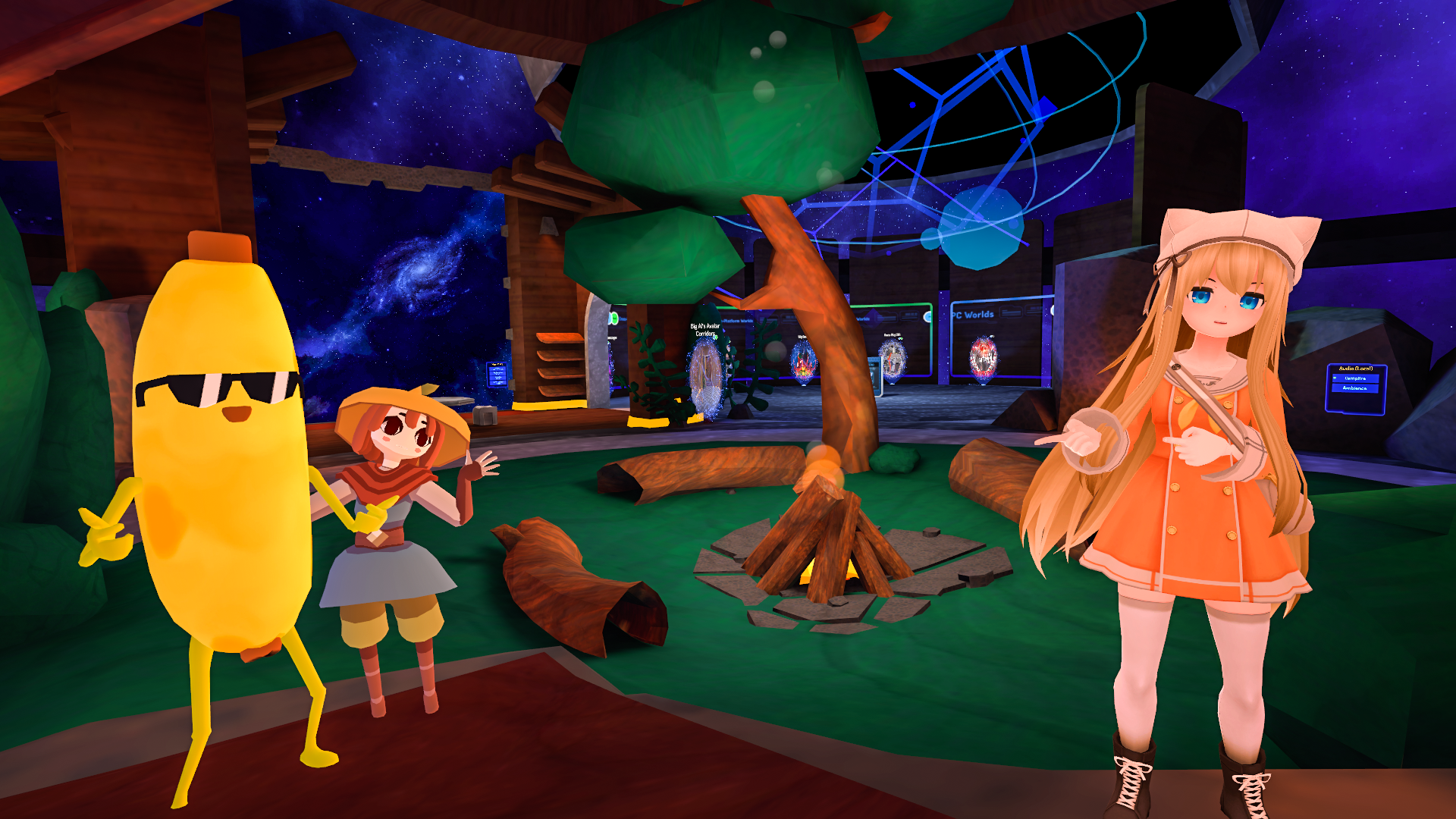
(2) https://cnet1.cbsistatic.com/img/9kGJANvUNFtxp5mGEgMIDI95DnA...

There isn't a 100% chance that Beat Saber 2 will be exclusive, but you're right that it's likely and if that happens it will be a shame. My hope is that Facebook moving away from PC VR as a focus means they won't see it as competition, and start releasing previously exclusive games on Steam in the same way Microsoft and Sony have started releasing previously console exclusive titles, but I won't hold my breath.
Huh? All BeatSaber music are originals or licensed.
I don't understand this statement. The Oculus store is open to developers and is filled with third party games. All of the games I personally play are not Oculus/Facebook games.
They're actually opening support for off-store apps [1], but with some limitations:
> Applications will have to meet the obligations of the Oculus Content Policy, but won’t be held to the same technical standards as official Oculus Store Apps.
[1] https://www.roadtovr.com/oculus-quest-distribution-non-store...
Many companies besides Facebook have developed games for the Quest. I guess you could say Facebook sucks at working with game developers, but I’m not sure if that’s true either. Unreal and Unity have well-developed integrations with Oculus [0].
I think where Facebook really falls down is tying customers’ FB account to their Oculus Store purchases (and ability to use the Quest at all). They’re applying a social media platform’s aggressive algorithms to suspend or ban accounts which violate their expansive TOS, which is wrong in consumer product and digital marketplace space. For that reason, mixed with personal experience at the hands of Facebook's algorithms, I have no interest in developing for Oculus.
What does this mean? We likely wouldnt even have a Quest (or really even a 3rd headset imo) from Oculus if not for Facebook. The Oculus founders were all almost completely about building high end enthusiast hardware, which wouldve almost surely made the market die off again.
Wouldn’t have been possible without a large enough company to bankroll it.
The feeling of vertigo and momentum in games like Jet Island that makes you weak in the knees, looking out your cockpit and being awestruck by planets and stations in Star Wars Squadrons or Elite Dangerous, dodging bullets in Pistol Whip and Superhot. The dream of the 90's is alive - the technology is here! It's so good and I can't wait until quarantine is over to share this with more people.
Previously I'd used a friend's Oculus DK1 (not good) and then later a friend's HTC Vive (getting there). The Quest 2 is a major improvement and I look forward to the next generation of headsets.
Unfortunately, I lost my lunch after 5 minutes or so and had to lay in a dark room for a couple hours to get over a bout of nausea. Excited for the future though if they can solve that problem for people like me (I also get seasick easily).
I know that personally I once binged GTA V hard over a week or so, and had to catch myself before I started driving on the wrong (right-hand) side of the road one day out of habit.
Nausea is heavily tied to framerate and latency -- a really beefy machine with a Valve Index should be a lot easier on your lunch.
Wondering if the same thing is not going to happen with VR as well.
I also enjoy watching movies in it as well, I don't watch a lot and was considering buying a TV but this has really delayed me doing so.
Maybe it is just me but I can achieve perfectly satisfactory immersion with a good book.
But i guess it's just me there could be a market for instant immersion. I have second dev version of oculus at home, never used it much. I also went to a VR venue in London and it was great fun. From my perspective VR would work great in venues, as a night out alongside bowling, karake and similar options. I can't imagine using it reguralrly at home.
I think a domain where it can exceptionally shine is the adult entertainment industry.
Comparing to phones, I think this is the point where we have keypad-phones. Content is still limited, but using your imagination you can create good experiences.
Personally, I switched to VR/Quest gaming from PC this autumn, and I feel good about it. I feel healthier than sitting in front of PC. I also feel less isolated with the family, as we have more 'playing together' now. As a developer, I'm exited to try out to create new kind of experiences, like I did 16 years ago with phone SDK's.
If you think yourself as a creator, I think you feel a fool if you wait another ten years - seeing the times when a single person could do something meaningful, going past.
I have tried VR many times over the years (I vividly recall there was an interesting arcade game back around 1990 that used it). I got a vive. I tried others.
But after using it for a while, I returned to a monitor and keyboard as my preferred way of interacting. There's still something sort of self-limiting/tiring about VR.
Is it just me?
It's surprising how much imagination people lack.
It's like people who told me "humans will never fall I'm love with an artificial human". Lo and behold, that Chinese AI has 600M users. Now the discussion have moved to " they shouldn't " and then it will change to "I want one too".
The same will happen with VR and AR.
Your second paragraph is compelling, except there are exceptions. Remember 3d tv?
I think once the need for a headset is eliminated (like Star Trek's holodeck) it will take off. Until then, having to strap something over your face is asking too much. It's too isolating.
You can't obstruct people's eyes - glasses get a pass because they're a handicap, and folks with sunglasses communicate by wearing them.
We will need to live many more rounds of evolution to give up the idea that covering your eyes to 'go somewhere else' won't be a survivally threatening move...
and what's more, we're just starting to fully appreciate how smells and air (quality, pressure, etc) play a role in 'us being there' - don't even begin to think about the small gravitational pull between all of our bodies at a concert.
Long story short, it will take a long time and a lot of generations to die off before we appreciate VR as much as a physical experience.
If that's the case, the sales are hardly convincing. If this was such a revolution you'd see more people buying them. Beyond head tracking and movement tracking, the fact that you cant feel anything (no feedback) in the world you are supposed to be in makes it illusion breaking.
Except for the iPhone part, I bet this exact comment was made in 1991.
It's not clear this generation of technologists will be able to get there even keeping it in sight. Which isn't to say it's not worth plugging away at.
But for all you jaded folks out there, let me tell you that this is an absolutely unstoppable evolution of computing. All entertainment since sung epic poetry has aimed to briefly take us into another world. Plays, novels, movies, theme parks, and video games have always offered immersive fantasy. This is the ultimate fufilment of that very human impulse, to consciously enter another world. If we lose sight of that, then it will be up to the next generation of technologists to create it.