Ugh, this is nonsense. Mozilla has not "ditched Rust as a core component of a tech focused corp". Mozilla has ditched the idea of developing entire components of Firefox in a silo for 5-8 years, and then spending 3 years trying to integrate that component back into the browser, the entire time trying to keep both components maintained and up-to-date with ridiculously fast changing web standards.
They want to continue using Rust, but it will be done more piecemeal and in-place, rather than trying to keep two entirely separate browser engines maintained and standards-compliant for the next 5+ years.
Azure, AWS, Google Cloud are all major Rust sponsors at this point. It doesn’t make sense for Mozilla to remain a major sponsor for a product that almost certainly can and will exist, and likely flourish even more, as a more independent project.
At this point Mozilla’s ownership of Rust would likely only cost resources and serve to limit the growth and development of rust.
From where I am at it was a massive opportunity for Mozilla and Web developers all round the world. They didn't have to take on Android and iOS directly, but may have gotten there eventually thru 'worse is better'.
Imagine a web developer learning just a few APIs and being being able to customize their web app for smart TVs
This was WebOS in 2009.
Windows Phone, WebOS, Meego and Ubuntu Phone all "failed" around the same time period as Firefox OS. I have a hard time laying blame solely on Mozilla there.
So, what would have happened to Android, if Google didn't have the Maps / Play Store big stick?
Every device manufacturer wants to differentiate. None of them are good at it.
Elop was an incompetent leader, but he had not been involved in creating the mess. He went for a worse option, but that does not say that Meego would have ever succeeded.
Yes, I am stuck in the past myself, typing this on SailfishOS. But one has to see the realities.
https://en.wikipedia.org/wiki/Nokia_N9#Reception
> The Nokia N9 was announced at Nokia's Connections event in Singapore, June 2011. The reception for the device has been very positive, citing the MeeGo v1.2 Harmattan UI, pseudo-buttonless design, polycarbonate unibody construction and its NFC capabilities. Still, many reviewers did not recommend to buy the N9 only because of Nokia's earlier decision to drop MeeGo for Windows Phone for future smartphones – often questioning this decision at the same time. Engadget's editor Vlad Savov said in June 2011 that "it's a terrific phone that's got me legitimately excited to use it, but its future is clouded by a parent that's investing its time and money into building up a whole other OS." In a later review, Engadget writes: "Love at first sight — this is possibly the most beautiful phone ever made," and "MeeGo 1.2 Harmattan is such a breath of fresh air it will leave you gasping — that is, until you remember that you're dealing with a dead man walking."
> I can't understand how Mozilla failed to execute on Firefox OS.
This is naive. They did execute, and failed. That’s different than not executing at all. You can’t break into this segment without cooperation from the mobile phone operators... even in India and Southeast Asia whom were the primary target markets (less disposable income than Americans)
I had a Firefox OS phone. There was nothing great about it. It was average (by intention in order to work on restricted devices). I never used it to make calls, I used it for development. And it only had a wifi connection because I did not buy service for it.
There was nothing really “disruptive” about it as I recall. $20 Android phones destroyed any hope after the mobile operators turned a blind eye.
p.s. I still have the phone.
People do this all the time. I did it with my first android phone, a Nexus S, despite having bought the phone with no intention of doing so. The Chinese crapware it came loaded with didn't really leave any alternative.
Then Mozilla's leadership didn't have the patience to wait for the right opportunity.
I.e. if you've got something to claim as the reason it can't also apply to KaiOS unless there was something KaiOS did right that Mozilla didn't.
We actually:
- have been friendly to 3rd party clients developers, like Loquim (https://loqui.im/). Once WA turned on e2e encryption, the situation for 3rd party clients changed from "difficult but fun" to "mostly impossible".
- wrote a JVM in JS to run the S40 version of WA (https://github.com/mozilla/pluotsorbet).
- partnered with a company specialized in bringing android apps to other OSes (they had Windows Phone support for instance).
The only people I know who don't use WhatsApp are very privacy focused and therefor use Signal.
More roughly, my understanding of the messaging space was:
- USA: Facebook Messenger
- Japan, Taiwan: LINE
- China: WeChat
- Everywhere Else in the World: WhatsApp
And the comments here seem to basically bear that out.
I've seen a number of comments on Windows Phone since then (on HN), and one and all they emphasize how much better and nicer Windows Phone was -- from a consumer perspective -- than any other phone.
What was the failure? This isn't a retrospective that makes any sense.
As of 2019, however, 52.4% of the mobile OS market belongs to iOS, and 47% to Android[1]. Neither of our favorite mobile phone OSes have succeeded in comparison.
[1] https://www.statista.com/statistics/266572/market-share-held...
This doesn't pass the sniff test, unless you're doing something weird like measuring the mobile OS market in dollars spent on phones.
> Neither of our favorite mobile phone OSes have succeeded in comparison.
To be clear, I have no experience of Windows Phone. I'm just bemused that 100% of comments about what it was like are so glowing. For some other product, you'd expect to see some comments saying "this was the greatest product ever to be commercially available" and some others saying "no, I had one of those, and it sucked". That doesn't seem to happen for Windows Phone.
A lot of patent fees paid to Apple and Google for every phone sold.
Windows Phone was really good and it had millions of fans. It would probably do well in today's duopoly market if relaunched but MS has lost interest in phones presently.
Windows Phone was an epic disaster in how badly it was rolled out. It was Ballmer at his worst. MS kept oscillating between whether they wanted Windows Phone to be an iPhone competitor or an Android competitor. They picked the worst of all worlds, by choosing to focus on distributing through 3rd party vendors, but refusing to allow them to make any changes to the interface, therefore basically eliminating any major vendors from adopting and promoting Windows Phone. It’s still amazing that MS was unable to unseat Android at a time OEMs were desperate for an Android alternative thanks to the uncertainty around the Oracle lawsuits (and were already paying more to MS than Google for Android! thanks to MS’s OS related patent portfolio).
Ubuntu Phone never made any sense, targeting the most expensive niche of the market as it did.
Windows Phone had great, snappy, intuitive UI (which was really surprising coming from Microsoft). However it had no apps. If you look at the top 10 iPhone apps in the app store, only Facebook and Netflix were officially supported on the platform. I recall there being (great) 3rd party apps for apps like Instagram, but there was a dearth of anything else.
They needed Samsung and HTC to have adopted them at the time.
People didn't buy it. Simple as that.
Doesn't matter how much better people think the consumer experience is if nobody's buying it.
I don’t need to do anything!
The only thing that matters is people didn’t buy it. It wasn’t a success.
No YouTube, no Snapchat etc.
With YouTube Google used their position to keep it that way.
It also wouldn't surprise me if someone told certain app developers that "that's a nice app you have there, it would be shame if there was a bug in the Play store that made it hard ro find".
When it comes to App Store I have heard it is pretty well established that you won't get featured, no matter how great your app is if it is available on other platforms.
> With YouTube Google used their position to keep it that way.
YouTube is available to anyone with a web browser, such as people using a smartphone.
> “In the software world, particularly for platforms, these are winner-take-all markets. So the greatest mistake ever is whatever mismanagement I engaged in that caused Microsoft not to be what Android is. That is, Android is the standard non-Apple phone platform. That was a natural thing for Microsoft to win. It really is winner take all. If you’re there with half as many apps or 90 percent as many apps, you’re on your way to complete doom. There’s room for exactly one non-Apple operating system."
https://www.theverge.com/2019/6/24/18715202/microsoft-bill-g...
Because this product could only be sold to a hardware maker. It doesn't matter how good it was/is, because hardware makers are smart enough now not to rely on a 3rd party supplier of an OS, in fact they've been working hard on degoogling Android as much as possible.
Another failed alternative that comes to mind is WebOS, and yes indeed, it got acquired by LG for the reasons above.
I have personally gone through carrier negotiations and they’re the reason why Android phones come with bloat ware and people go to such lengths to build and distribute minimalistic Android systems.
When the pandemic is over and the world opens again go visit Mobile World Congress. Bring a tissue because the industry might make you cry.
Wasn't it initially too slow and bloated for the hardware they released it on?
Might it have something to do with the word "OS" in the title? It's never worked except for Apple, but because Apple is selling a whole product, not an OS, it doesn't seem to hit in the same way.
Marketing something as "____ OS" appears to more or less guarantee a marketing failure.
This is the meat of my problem with Firefox as it stands. I've not stopped using Firefox since the mid 2000's but come on, you need something more than just checks from Google. Charge me for a commercial version of FireFox that includes a VPN subscription and funds its development. Just do it ten years ago.
Honestly, if they're not going to embrace Rust and Servo becomes completely usable I may just jump ship eventually. My hope for Servo is that it becomes 100% Rust as much as sustainably possible (I understand for codecs and some things recreating them in Rust might be overkill when there's standardized libraries just use them), even the JS engine.
“How will we ever earn money here at Mozilla? All we have is this world class web browser that provides massive value to millions of people, but we refuse to directly monetize. Oh whatever will we do?”
they fired so much talent to focus on junk to drive revenue, that it's not something i can do anymore. very sad.
Mozilla has buckets of money, between the Corporation and the Foundation. They are separate, for good-ish reasons? But they are separate. If they start allowing customers or businesses to pay for Firefox, then they will have to provide an entirely different level of support. They will need a billing and support team that is beholden to those paying customers.
It will shift the focus that Firefox has on attracting and retaining users to attracting and retaining paying users.
It will mean they need to meet various warranty and regulatory requirements around the world, and potentially introduce new business risks and liabilities related to those requirements (e.g. non-compliance with specific regional legislation).
What you are asking for is to pay Mozilla for Firefox, and to get there you need a radical shift in the organization that supports and ships Firefox.
Or, you could do what the rest of folks who want to support Firefox do, and make a donation in the way that Mozilla is signalling is the best way to support Mozilla's mission and Firefox development.
If that isn't good enough for you, track down an OSS contributor to Firefox, and give them money. Direct action for the win!
That's the rub here. Mozilla's mission is a much larger scope than just Firefox. Some people want to support Firefox, but don't want to donate to Mozilla's mission. One such reason is because it's important to have more than one browser implementation. There's no way to support that without Mozilla allocating some portion of your donation to some unrelated part of their mission.
(Maybe you can? I haven't donated to them...)
9HZZRfNlpR is right. Not only do you get to say this, you have no other choice but to say this. Buying a laptop sends the strongest possible message that you're giving your money to the laptop division, and not to the tablet division. If you wanted to support the tablet division, you would have bought a tablet. And Lenovo will keep very careful track of this. They may choose to cross-subsidize, but your message will be received loud and clear.
If you want to pay for using their browser, you could always donate to them.
According to the author, the problem contributing to this misprioritization was that “Firefox exists just to give Mozilla a seat at the table when the web is defined,” such that they didn’t care if it was the best. I doubt that’s true. Few want second, third, or fourth place. So let’s assume they wanted it to be the best. Where did it go wrong?
As much as Rust is great and FF was a great project to try it out on, I’m not convinced that FF needed a full rewrite, and in my experience there were significant problems with performance as Rust wasn’t fully there and the developers didn’t test adequately on all platforms, which they should’ve pushed more for if the funds were there.
That was the straw that broke the camel's back for me.
The day I found out about that I stopped using Firefox and switched to qutebrowser.
Have you ever compiled and run servo? I have. It's really cool but nowhere remotely close to being ready for a full production browser.
Mozilla are embracing Rust, they are just no longer interested in the idea of developing entire components of Firefox in a silo, maintaining both at once during the entire process, and then spending multiple years trying to integrate it back into the browser.
Back when the Servo team was let go, what they basically said is that moving forwards things will be done more piecemeal and in-place, rather than hundreds of thousands of LoC at a time.
I've said this many times and I'm going to repeat it again; I wish Mozilla would offer me a way to purchase a monthly subscription for Firefox.
I want to support the open Web and I want to support FireFox development (but not any n+1 random Mozilla products / experiments) and I hate that they don't offer this.
The problem with optional subscriptions is that most people will never opt-in. If subscriptions are made mandatory, the general public will be driven to one of the other major browsers.
It's a matter of "can't", not "won't". Subscription revenue would go to Mozilla Corp directly and therefore has no restrictions, because it's taxed as income. It at least has the possibility of being spent on Firefox development even if it actually goes to Rust maintainence or whatever else.
Though would Mozilla grant some type of premium version of Firefox or premium support for your subscription monies?
But the feedback from people who do use it is overwhelmingly positive. A lot of people love Pocket. It's enormously popular, despite the impression you would get if you exclusively went by HN comments.
Personally, I've just recently started to try using it. It hasn't really captured my enthusiasm yet, despite addressing one of my larger pain points with a browser. I still think I'd prefer management capabilities that felt more built into the standard (well, Tree-Style Tabs) tabs/history experience. But it's early days, I'll have to see how my Pocket experiment goes.
They're certainly good at surfacing appealing-looking content that isn't vapid when I try reading it. That's worth something.
It's execution is not actually very good, if "doing well" means quality. I was actually avoiding getting a smartphone for a while, but the rise of kaios-powered phones, at least the ones in the US, drove me to smartphones. Contrary to the promise of firefoxOS/kaiOS, there was no kind of "app store" or other way to install custom apps, it just had the usual featurephone features. What there was, was a phone where every keypress had like 750ms-2000ms of latency until it had an effect on screen, making it almost unusable. It ruined feature phones, at least for now. I tried a couple. It's a pretty terrible product on every US phone using it I have seen; whatever led to it being on those phones, it was not quality.
It may be that KaiOS phones available in other countries (always the target market) are better, and an improvement from what came before. (But why are phones available in the US using it for such awfulness worse than what came before?) I would like to think if Mozilla had stayed involved, it would be better.
The business question of course is how the current (Chinese?) company behind KaiOS found enough runway to get it to market when Mozilla did not. Lowered standards/expectations might be part of it though. But it may not at all, I have no idea the story behind what happened. This thread has people giving their reasons for why FirefoxOS failed... but most of their reasons fail to explain why someone else could somehow take the open source IP behind Firefox OS and have a succesful company which succesfully got it onto phones. What was the difference?
That said. I've been using Firefox as my main browser for years. I only use chrome when a website needs it or works better in it.
I'm not convinced changes to the browsers themselves at this point is anything other than a very marginal improvement.
I am curious as I don't relate to this and recommend Firefox to friends and family.
I don't know whether those are bugs in Firefox or if Chrome is doing something funky that causes it to work but not Firefox.
I haven’t tried using Citrix for years. It used to work fine in Firefox, but given the quality of it I wouldn’t be surprised if they’ve broken something.
My uncle (who clicks on popup ads, and installed spyware twice a day until he got a non-admin account on a non-Windows OS last year) doesn't care about that. He doesn't know what an experimental API is. He wants to click the thing and have a video call open with his coworkers, kid's teacher, and family. There are alternatives. None of those people use them.
This is how open standards die: by convenience and cowboy tricks. Get with it.
All those LOB applications that were designed for IE only have basically been left high and dry. Nobody wants to support or use IE anymore, and the applications that require it don’t look so good any more.
Mozilla was tired of getting smoked by Chrome, which actually invested in browser development using what the tools they already had ("engineering"), as opposed to subsidizing PhDs on programming language theory.
Now it's too little too late. They've passed the point where they could catch up on technical grounds, so they make appeals to morality to market their software. Yes, I agree it was bad leadership.
I was little infuriated when they added pocket.
Google meet does work well on chrome only. (Not firefox's fault completely)
I didn't like how they suddenly changed layout on Android and made many extensions unusable.
I didn't like Mozilla the corp / foundation's political alignments, a personal opinion and actually I don't even care about politics. But we Indians (much like South America I guess), have an aversion to SJW virtue-signalling politics because we have seen how it brings too-much right leaning parties into power. Why would a tech company get into politics at all unless it's about some virtue signalling execs pushing their agenda?
They fired some actually talented programmers but kept the C-suite, with their non-technical CEO being paid big amounts despite company being in losing game. While I personally don't like some aspects of rust community, the language itself is solid and could be a differentiating point for firefox.
As soon as I have seen their management take such decisions and their pushing of political agenda, I can't trust these people to maintain a browser well. No offense to engineers I was telling about Mozilla itself. So I somehow migrated to chrome. I miss UBO on mobile but bromite is good enough. Google is not much better
They may not lose much from a middle-class Indian dude switching to other browser. But think about it. Bringing politics and favoring useless C suite execs is a great way to lose future donors. A company should not do politics. They say they do politics for open web, that's not what I am talking about. FSF has done much better than Mozilla foundation in this regard. Mozilla just favoured execs and their agendas before technology, and lost the market.
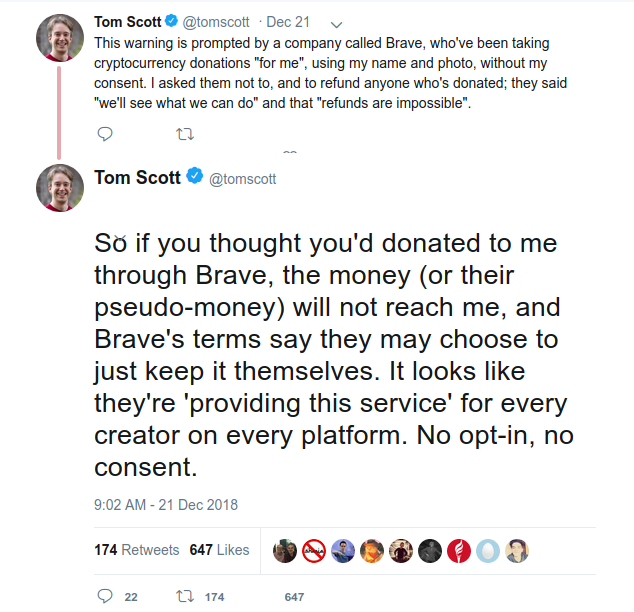
that is why founder started brave.
[1] https://twitter.com/BrendanEich/status/959909542246019072
have i missed something?
They did not lay of all of their Rust developers, or even most of them. WebRender and Stylo are now integral parts of Firefox, and are actively maintained by teams of people, and a lot of new code continues being written in Rust.
The Servo DOM and HTML engine is massively complex - far moreso than Stylo or WebRender - and nowhere near ready for production use. Mozilla decided that rewriting the remaining parts (read: vast majority) of Firefox slowly, in-place, would be a better path forwards than maintaining two massively complex browser engines in parallel and trying to swap it out completely.
1. Ask that the DOJ strips Chrome from Google. You can't make the browser, search, and ad platform. Monopoly power. Google needs to exit Chrome right now.
2. Ask the DOJ to force vendors like Apple to allow other browser engines. They can't lock down all "code execution" on generic computers they sell.
3. Integrate Ad Blocking in Firefox.
4. Collect money from advertisers willing to make non-invasive ads that want to be seen.
Brave's business model, but with much more badass tech.
After revenue comes back, make a mail service.
FireFox OS could have provided such model, in fact, its successor kaios is doing very well and one can imagine that in the future, it will be the primary OS of half the mobile users on the planet. 'Feature phones' aren't dead. They provide a cheap alternative to touch phones, are usually more robust, and allowing them to run web apps instead of MIDP stuff is a giant opportunity for any web actor.
Ditching Rust as a core component of the future of Firefox is also a demonstration that Mozilla isn't a tech focused corp anymore. Rust is going to yield a lot of result when it comes to security, memory saftely and maintainability and firing Rust devs was terribly short sighted.
So yes Firefox was always enough. Leadership at Mozilla doesn't get it.