Moral of my story (and this article), is stay competitive, you don’t have to crush it, but don’t lean back too far either.
There are a large number of people, including smart and successful and accomplished people, who work to live, not live to work.
For the people who live to work (myself included), it's a good reminder to stay competitive and avoid complacency. But you have to understand yourself and what you're looking for. And that's what I think the real moral of the story is: understand what you want, what makes you happy, and what gives you meaning and purpose. Then make sure you're working towards that. Too many people forget to do the first thing and skip straight to the second because they inherit the answer from their environment without questioning it.
For lots of people the answer to that question is not career related.
What you or I want is no longer a question afforded to us sadly.
Indeed the economy doesn't, but, my dear friend, that's not the point.
You're not the economy, and you can't escape the shell you were born in (yet). You only get to choose which game you play. So, my dear friend, if you're going to lose the game anyway, at least pick a game you actually want to play.
_We don't read and write poetry because it's cute. We read and write poetry because we are members of the human race. And the human race is filled with passion. And medicine, law, business, engineering, these are noble pursuits and necessary to sustain life. But poetry, beauty, romance, love, these are what we stay alive for._
PS: how good was that movie?! So Good!
Here's a poem I wrote back in high school in reaction to the famous quote, "Poetry is the art of creating imaginary gardens with real toads", which I was taught was by Emily Dickinson but turns out to actually be by Marianne Moore. In any case...
    A poem is a thought that tried
    In vain, just once, before it died
    To reach the page's
    Right hand side
  They're only words, and always spoken
  much too late  to stay
  -- only for a moment,
then they take the breath awayThat’s when you got to get real.
The romanticism of good faith and idealism is romantic, but a lot of good expression is rooted in despair. I see despair in that anecdote, the desperate plea of ‘don’t you see what I feel?’. We have to infer that such an unstated thing needed to be dramatically expressed, for no other reason than catharsis. Which leads us to the conclusion that, yes, there is a story of sadness here.
I just finished watching Manolis Kellis explain [0] how computational biology is transforming our understanding of the human genome and changing how we treat diseases. Who will argue that this is not a gripping story of how humanity has risen in it's ability to understand how the world works and consequently to control it. This exciting adventure has both passion in the seekers and beauty in what they have found. And of course there are endless songs (e.g., [1][2]) already written about this noble pursuit.
[0] "Decoding a Genomic Revolution: Manolis Kellis at TEDxCambridge" https://www.youtube.com/watch?v=zlVZ0ORtpPM [1] "The Molecular Shape of You (Ed Sheeran Parody)" https://www.youtube.com/watch?v=f8FAJXPBdOg [2] "A Capella Science - Rolling in the Higgs (Adele Parody)" https://www.youtube.com/watch?v=VtItBX1l1VY
I'm genuinely curious: Are there periods of history where people could choose what to go into without it having a large effect on their income or quality of life? From my point of view, it seems like our standard of living is at an all-time high and our freedom to choose what we do with our lives is unprecedented. But I'd be open to being shown empirical evidence to the contrary.
Remember the 50s in America? That lasted forever right? You don’t need empirical evidence for this, the hard data is there on a variety of industries.
If you believe we’re immune to these forces you’ve got another thing coming.
If you want to reach the top of your field then sure, you always have to be hustling. But for the rest of us we are lucky to be in a field where there is a degree of comfort and flexibility.
Are you depressed?
One needs to stay competent, if not competitive, to stay employable, even for moderately advanced and moderately-paid positions. There's no chance to learn the craft and expect it to stay the same for a lifetime.
if you are reasonably competent you can get a boring coding job at a large firm that pays probably twice the average national salary.
Software development pays so well compared to other sectors and is so starved for workers pretty much always, and unemployment is basically nonexistent, I think like the author you might confuse "working hat hip startup XY and making 200k" with being employable and living comfortably
The parent's point is that there are more aspects in life than work that you can improve on (eating healthier would be one of them). And as long as your work can sustain your life, you are free to choose to work on something else.
Of course, you can choose to focus even more on working, too, if you please.
My hair is increasingly gray, and I'm a person who has always been motivated by challenge, and never by money. The notion of poverty is somewhat terrifying to me, because I'm keenly aware of my motivations. "Find a job" is not a satisfying challenge.
I'm nowhere near retirement -- by which I mean, if my income tracks with inflation, I'll be able to comfortably retire about 5 years before I expect to die of cancer.
I can't trust my company. I can't trust them to stay afloat. I can't trust them to retain me if their funding droops again.
I live very economically; my biggest luxury expenditures are food and I could easily cut those. I really don't give a shit about money, but I have a kid and that's a big expense.
So unemployment is scary. Staying competitive brings peace of mind, and it's a game that I can challenge myself with; that I get satisfaction from.
No, the point is to be able to get another job if you lose your current one.
Perhaps you are projecting your own beliefs?
Plenty of people choose careers for other reasons e.g. that give them personal satisfaction, or a career that revolves around their belief system.
The article still applies even if their career goals are neither status nor money.
That was exactly my reaction. I was a lead for three years and recently decided to go back to a purely technical role. I just didn't like the work, and the prospect of spending the rest of my career in middle management was not appealing.
I currently received an offer from a FAANG(M) company. This was a real offer from someone I had worked with in the past which would have required a very thin interview process. I declined because I very much enjoy the work I'm doing today.
It may turn out to be a bad idea down the road if all I consider is money and that nice company name on my resume. I decided I don't care. I'd rather be a big fish in a small pond and work on truly interesting tech than be another cog in the wheel. I'm well past the "live to work" phase of my life, I just want to be happy, and I can't complain at all about my salary and benefits.
(Founding a company is another possible route, much more risky, though.)
The other problem is that high level IC roles are very rare whereas the equivalent management roles are plentiful. At a previous company I was the one and only Principal engineer in a division with enough Sr.Directors (equivalent level there) to fill a school bus.
Currently I'm at a Distinguished engineer level which is even more limited, but it is still less than a VP. But we have hundreds of VPs of this and that on the management ladder.
The fact that you bring up celebrity engineers as examples pretty much showcases the problem. There are very, very few of them.
Someone needs to write "waste your personal life, one comfortable year at a time".
And skip “comfortable” in the title.
Bottom line, moving to a new job regularly is about investing in yourself and allowing you to control the direction of your life and not allowing others to control it.
I don't mean to say that you have to enter the rat race and keep up with the Joneses and burn out. I just mean that money and status are these dirty words that are taboo to admit caring about in some circles, but it is money and status that earn you freedom and the ability to not give a fuck what people who you don't respect think about you. It is the only thing that will make annoying people you don't care about still act as if they respected you so you can concentrate on all the people and things you do care about.
Please, help me understand.
It seems to me like not being bothered by what anybody thinks of you requires neither money nor status.
Not only that, obtaining or maintaining social status, by definition, involves other people thinking highly of you in one way or another. And it would seem like one would need to be keenly aware of that in order to climb that ladder.
I say this as somebody rather uninterested in their social status (what's the point of it?), who went from relative poverty to relative wealth and saw no difference in how much I care about either money or status. So, very much interested in understanding how this works for others. What am I missing?
I can basically afford to say “no” to my boss because I make a decent living and so I’m not scared of him reacting badly or firing me because I said no. By saying no, I don’t really give a fuck about what he’s thinking about me (will he like me, dislike me, resent me, respect me?) but I can only do that because if I were out of a job tomorrow I could still keep paying my rent and eat without skipping a beat. I’m not a millionaire either but I have built my life so that basic expenses can be met for a long time no matter what and that is in part because whenever I’m working for money, I get a better salary than most people in the country.
Of course you can also not give a fuck about what others think do you without money but it’s a lot more uncomfortable I’d think. Everyone enjoys having food on the table and a roof over their heads.
Any advice for scoring this on my personal OKRs? I’m vacillating between 0.6 and 0.7 for this quarter, and I’m circling back with the other members of my household this afternoon.
Silicon Valley culture sort of expects you to move around every few years - you will get a more well-rounded perspective both technically and personally.
In other places, particularly with different employment opportunities, the picture might be different.
The one that got me here was "misplaced loyalty" because looking back, most of the companies I've worked for are either radically different or ...gone.
But the blog author wrote the opposite of your characterization. Excerpt from article of not letting money distort your goals:
>Staying in a job for loyalty or money's sake is like staying in a bad marriage for the sake of kids. [...] Optimizing learning over money early in your career.
[EDIT to the many downvoters: Did I totally misunderstand the author's blog article? Where is the "overly driven by money" message? His framework chart doesn't have money anywhere on it. See: https://cdn.substack.com/image/fetch/w_1456,c_limit,f_auto,q...]
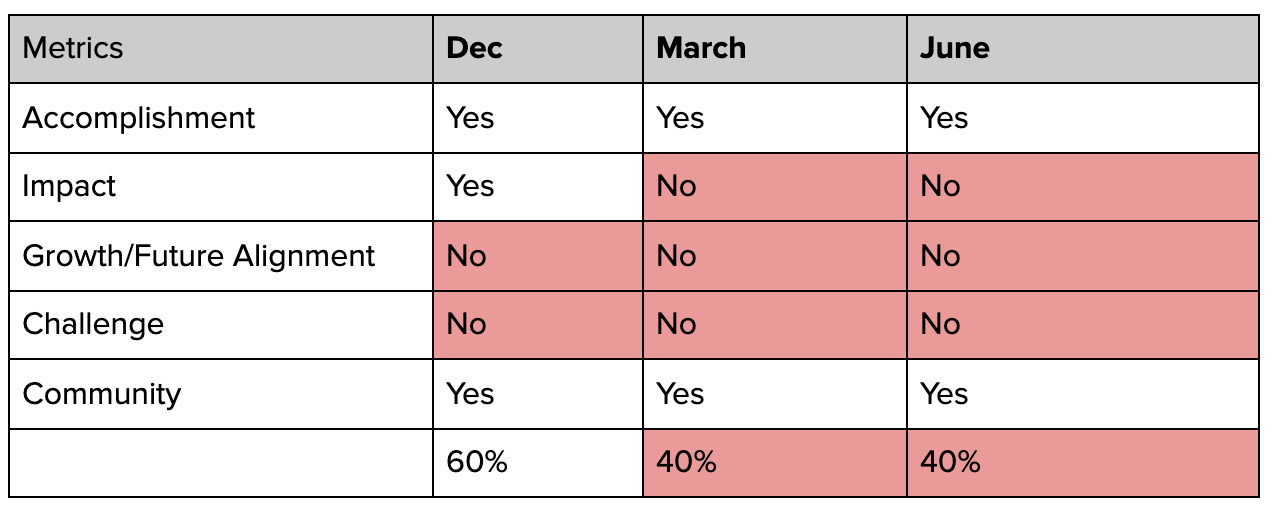
The person writing this post lives for his job. His goal is to have a job that brings him some combination of achieving job related results, learning job related skills and earning money from that job. And if the current job situation is not optimized for that (no learning opportunities, no achievement opportunities limiting future employment opportunities etc.) it should be seen as a cancer.
While it’s a completely valid point of view to not live for your job, but to do your job to (financially) facilitate your life: earn money in a stable (but from the authors point of view boring and pointless) job so you can take nice vacations with your wife and kids. Or keep a “9 to 5 job” because you like to explore foreign cinema and Russian literature from “5 to 11”, while the author is still busting his ass so he’ll end high on the corporate ladder in the future.
I think you are completely mischaracterising the author. The article is about career: for most of us a career is a necessary evil that cannot be avoided.
If you read the article as though the heading were “optimising your career to suit your lifestyle”, the article still makes sense.
Nowhere in the article does it imply that you should prioritise work/money over living.
There are multiple references to ensuring that you achieve personal goals inside and outside your job:
“if you don't want your talent to go to waste”
“Staying in a job for loyalty or money's sake is like staying in a bad marriage for the sake of kids. It's not healthy for anyone involved.”
“Am I excited and happy to go to work every morning and see my teammates.”
“She had grown tired of her role and was burnt out.”
The author mostly talks about the time cost (not $) of your choices - most of us are given similar lifespans so choose how you invest your time wisely.
PS: “Valley Girl Newsletter” - @leokennis: assuming “his” is impolite IMHO.
To the content of the article. This is what the author describes as the scenario to be avoided:
> Your choice becomes limited to employers who want a cog in the big machine while your career will fade into a 9-5 job.
As if this is per se a bad thing. As I said, if your career is your life then indeed, follow the authors advice. However if your career is just a tool to financially enable your real life, it’s great to be a cog in a 9-to-5 machine: you get to go home in time for dinner every day and you probably have mental energy to spare when you do.
Further down, this is written:
> If you're not paying attention, you lose precious years stagnating and being unhappy.
Below, signs of unhappiness are: lack of work accomplishments, lack of “resume worthy work”, lack of new skills for future employment, lack of overthinking work problems in the shower, lack of kinship with colleagues felt.
Again, for many people, work is not a goal in itself. I like my colleagues and I enjoy my job, but in the end the place I really want to be is not my office (but my home) and the people I really care about are not my colleagues (but my family and friends).
Final exemplary quote:
> You have at best 120 quarters left to make something of yourself. A year wasted at a poor job or role is equivalent to you throwing away 3.3% of your career.
Again, apparently “making something of yourself” is equivalent to not wasting time at a job and having a good career?
I fully stand by my points:
* It’s fine to be very career and job minded.
* You need to read the linked article with a lot of flexibility and creativity to come away with any other impression than the author is very career and job minded.
* It shows a lack of perspective (or an abundance of personal insecurities) to write a preachy article like this without even considering that your goals (the authors goals) might not be the same as everyone else’s.
And then the cog's skills fall behind that of their peers, they slow down because of aging and other factors, and all of a sudden their resume is not attractive enough to overcome any ageism that exists in our industry, particularly if another dotcom bust happens or other economic crash happens. Game over.
Your career may not be your life but your career is definitely your meal ticket. And nobody should assume that the easy money for developers that exists today is going to be stay that way for the entire 40+ years of their working career.
And even then, if someone wants to cash in easily now while the getting is good, and in a few decades becomes unemployable in IT, who’s the author to preach the gospel of “you need to have a resume worthy achievement four times a year or you are lost!” to them?
It is fully possible to love a 9-5 job and still care about your career progression and take self pleasure with your job. The author could be a believer in “work hard, play hard”.
“while your career will fade into a 9-5 job” is easily read as using 9-5 as a cliché for a dead end job. I too have a negative attitude towards 9-5ers, because I prioritise lifestyle and alternative achievements over the corporate ladder, and I think 9-5 has its own severe risks.
I agree that the article comes across as work focused, but the article is still relevant even if you want a cruisy job and to glide through your work life. Any career needs to avoid the risk of complacency, leading to zero development, leading to permanent unemployment or being stuck in a hell job when external circumstances change.
Edit: Let us presume that the author is hyper-career focused. Why choose to use a personal values attack against that? That’s their choice man.
Here you’re getting exactly to my point. I’m attacking their position with some vigor, because that’s exactly what the author is doing too, but the other way around: reprimanding people who are not hyper-career focused.
Not everyone has the same focus and priorities. That’s fine. Dispensing advice as if it’s the truth while it only applies to your specific focus is bad form and should be criticized.
The article is a reflection on
I recently saw this tweet asking people about their career's most expensive mistake
which appears to at least indicate a long term financial (and no doubt time/energy/status/skills/etc) view.
It's not to say there aren't useful (if rather overly played) points in there and similar articles; but the whole thrust is about "career growth" and "brand" and dismissing either directly or by implication engineers who prioritise life as being vastly more important than work.
I find that I'm considering this much more now that I'm in my 40s, because I know that as a generalist developer, I will be slowing down in skills compared to the younger devs, so I need to make sure my career is developing in areas that value my experience and soft skills.
I think it's even easier to get complacent with not challenging those soft skills and "tech wisdom" by staying too long in one role.
You may still want to try new roles or at least take on new projects where you can learn new things.
But...
I find the older devs I know (I'm not actually one myself) mentoring, managing, possibly speaking in public more than they do just writing code.
And, especially as people get into their 50s, at a larger company that's doing reasonably well, there's nothing wrong with seeking out a comfortable position that plays to your strengths.
If, or when, that happens those who've spent years in the comfort of that nice work-life balance and often, frankly, mediocrity (you don't improve yourself by staying in the comfort of such a job) are in for a shock.
For a while I looked down at him, like “dude why are you stagnating?” But over time I could see why he’s doing what he’s doing, and it works for him. Maybe I’m wrong and if he got laid off he would have difficulty finding another job. But that’s his choice, relative to living with daily stress of stretching and pushing to the next level.
I think the people who are making poor choices are those who are driven by fear - they want to grow, they aren’t, and they are afraid to make a move. Or they fear being disloyal, or whatever.
I myself stayed in my second job far too long, and have regretted it since.
Since being at my current company, I’ve done something like this, though less formally. I went thru a period of 6 months where I was having less impact and I felt like I hit a “ceiling”, so I kept pushing for a different role. Then covid hit, some people left, priorities change, and now I have a perfect role and am growing again. If covid hadn’t happened I think I would’ve needed to start looking. I love my current company so was willing to wait it out a bit longer.
And it is an article focusing on your career, not any life goals outside of that.
> If you are an average 30 yr old engineer, let's say you want to retire reasonably by the time you are 60. You have at best 120 quarters left to make something of yourself. A year wasted at a poor job or role is equivalent to you throwing away 3.3% of your career. The older you get, the steeper your loss is.
Which sort of implies that what matters is where you end up at the end of your career, not enjoying yourself a long the way. I guess this isn't so much "status/money" as it is "destination vs. journey", but I feel like those can be related.
That said, I found most of the rest of the post to be much more broadly applicable. The Accomplishment/Impact/Growth/Challenge/Community framework I thought was especially good/useful to keep in mind.
“Comin’ up as a coder in the cash game / Livin’ in the fast lane / I’m for real.”
That's cool if it's what you want to dedicate your life to, but if you are in a happy position with a great work life balance that encourages and enables you to both improve yourself and - particularly - your non-worklife then that's a thing worth holding on to, whatever the article-heavy career gurus seem to be selling you.
Edit: as this comment has been significantly upvoted to visibility, I think I should acknowledge jasode's (and others) fair point that the author doesn't specifically focus on money. While I believe it is an implied strategic goal (which is fine) my concern is with the general over-focus on writing like this with careerism and the corresponding values which are definitely not shared by all. Thanks for the useful counterpoints to my reading.