What snowden did was provide independently verifiable content and details of their activities. His leaks were outdates by half a decade by the time they were public too. Everyone sort of accepted the IC will do shady stuff to stop terrorists after 9/11 because "american lives" so it was a solid conspiracy theory backed (not proven) by facts at the time. We sort of hoped they didn't care enough to snoop into our boring lives.
Like life, technology always finds a way. Much of the talk back in the day was not based on reality because it was not based on what tech could practically do. The compute and storage weren’t there.
But it was pretty obvious by the late aughts that all the pieces for panopticon were coming together nicely. Tech finds a way.
When you can surveil and blackmail the entire world, including your political taskmasters, what sort of person will that role attract?
I use a stronger (more specific) form of that heuristic that seems to hold up well in practice:
If something evil is within technological possibility, and there is economic gain to be had from doing it, someone will end up doing it.
(Note, by "within technological possibility" I don't mean "there are COTS tools available for doing that", but closer to "physics doesn't prohibit it, and we have a good grasp on how it could be done in theory".)
I actually first figured out this phrasing of my intuition during Snowden revelations, to explain to myself why my initial reaction was a complete lack of surprise.
This article is asking how the NSA managed a hacking empire leaving practically no evidence. Many people correctly assumed it was happening, they just couldn't prove much.
"Why did we never see it coming?" Is a poor way of phrasing their premise, but it's not false.
> If the NSA was owning everything in sight (and by all accounts they have) then how is it that nobody ever spotted them?
It’s sad that people routinely find the first disagreeable thing in any submission then derail the whole discussion based on an out-of-context misrepresentation of that.
I think this should rather say "nobody ever came forward". I'm sure there always were enough pieces of evidence even if scattered and nobody had the whole picture. But the ones who were close enough to put together some of it and get an idea had no incentive to open their mouths.
Coming forward with enough evidence was likely close to impossible until a decade or two ago. The ones who have such comprehensive evidence also have some "incentive" to keep quiet. Up to the proverbial "terminated with extreme prejudice" option, which I'm sure must have been employed given the sensitivity of the topic. Or perhaps risking being labelled a terrorist which would likely lead to even worse outcomes. When the efforts were escalated after 9/11 so were the security measures and the "incentives".
And coming forward with just shreds of evidence of something like this will only get you labelled a nut, enemy of the state, shill, etc.
Snowden and a few others did it at great personal cost and I'm sure they now serve as an example for others to not do it. Look around even today, people see the world in black and white and if you're not with them, you're against them, and they will treat you as such.
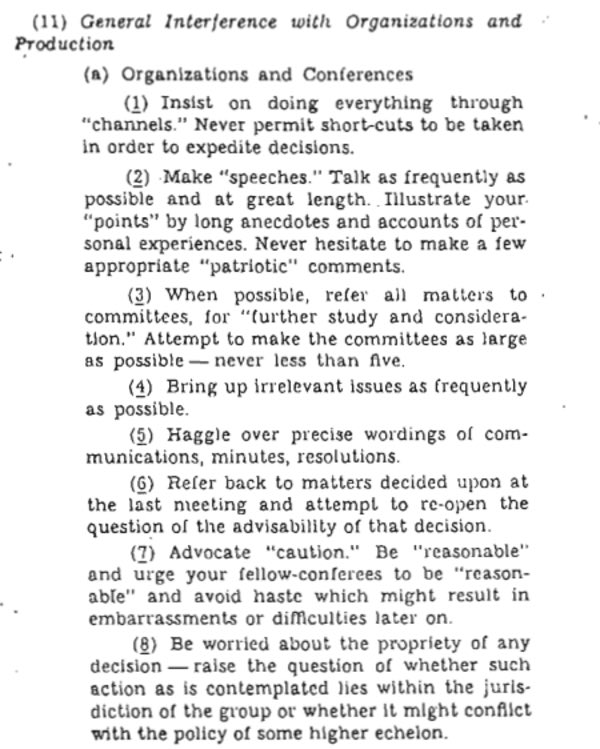
It reminds me of that "CIA manual" that floats around about how to derail conversations and sew doubt when infuriating an organization (can't find link). About doing things like bringing up irrelevant information, highlighting less meaningful things, revisiting already solved problems, etc. I mean what did the GGP do besides say "_I_ knew about this, but you all called me a conspiracy theorist! Who's laughing now?" What good does such a statement do? Clearly they are following the CIA handbook and derailing the conversation! (I'm joking)
But I think it comes down to not wanting to read the entire article _AND_ process the information contained within. I think a lot of people read things for the words written and not for the meaning, and I find this odd.
Most of what's listed as "disinfo agent" tactics there are the general fallacious and bad faith tactics that go on in almost any forum under heated discourse.
But yeah, I fully agree that this is essentially about bad faith tactics. My new strategy to dealing with this is to call these people out on their bad faith rather than engaging in the misdirection that they are creating. At least in my experience it seems to push these conversations down from the top spot (but that may be a selection bias).
>The purpose of this post isn’t to discuss the legality of the NSA's actions or the morality of the leaks, what we are trying to answer is: "Why did we never see it coming?"
They clearly made it the central theme. With enough context what they are saying makes sense, but that phrase is so often used to describe how people predicted something without evidence. I'm sure I've read several articles talking about how some health organization "saw the cornavirus pandemic coming in 200x"
All of the talk of how some people on HN totally for real knew the NSA was hacking people is irrelevant and a total distraction from the far more interesting question of why we needed a leaker to confirm it.
The article then goes on to explain why, even with hundreds of thousands of ppl doing incident response investigations, nobody caught / correctly attributed these attacks.
1. Even if you were right it doesn't matter. Coming to the comments to split semantics while obviously missing the point of the entire article is adding incredible noise. There was more than one sentence in the article and more than enough context to forgive an ambiguous or even incorrect sentence.
2. I don't agree that you're right. You state there's only one interpretation. I could just as easily interpret it as "Why didn't we see the NSA coming for our network?" or "Given all of these NSA attacks, how did no one detect them entering the network?".
So between those things I downvoted it.
I didn't 'come to the comments to split semantics', nor did I say anything at all about the rest of the article. I simply replied to an already existing discussion about the meaning of a phrase.
Describing that one short post as "incredible noise" is frankly beyond absurd, particularly when you have no problem making noisy, unnecessary complaints in two separate posts here.
> I don't agree that you're right. You state there's only one interpretation. I could just as easily interpret it as "Why didn't we see the NSA coming for our network?" or "Given all of these NSA attacks, how did no one detect them entering the network?".
I didn't say there's only one interpretation, I said there's only one meaning, with the point being that if a phrase is used that has one specific meaning then obviously some people are going to assume that is what is meant by it and comment accordingly.
Being right/accurate does matter, precisely to avoid incredible noise like this.
Thank you for replying and explaining.
Yeah, only one person needs to start the semantics-splitting topic and the rest of the lazy uninformative pseudo-discussion just flows from there, with every other guy adding one short harmless post. That’s how we get completely-derailed garbage threads like this. (Did I participate in the thread? Yes. Though in my defense I was trying to impress on people that this kind of thing should not happen.)
“Nor did I say anything at all about the rest of the article” — that should probably have tipped you off in a small way about the value of your addition.
Maybe you should learn how to scroll instead of reveling in the very thing you're complaining about, otherwise people might take you for a hypocrite who is only making matters worse.
> garbage threads like this. Did I participate in the thread? Yes.
And how was your cake?
> “Nor did I say anything at all about the rest of the article” — that should probably have tipped you off in a small way about the value of your addition.
Do you think all comments are required to address every word of an article? Maybe someone should tip you off that not everything posted here is going to be written with your personal satisfaction in mind.
> We were called _Conspiracy Theorists_
Depends who "we" is. If "we" is people on HN, who are tuned in and more closely associated with this stuff, then yeah. _You are not_ just some rando on the internet who follows the mainstream news, you are tech literate and actively participating in a niche technology forum.
But if "we" is more a general term then the premise isn't false and I'd argue is still relatively true today. The general public is only starting to turn away from ideas like "I don't care if Google reads my emails, what are they going to do?" And that's only because ad suggestions have gotten too good, enough that they believe that Facebook is turning on their microphones. Obviously didn't learn from Target[0]. You're clearly aware of this because of your last sentence!
You can sit with your pride telling everyone that you were right all along and not crazy, or you can further the reach to the more generalized "we." The two options are not really inclusive.
[0] https://www.nytimes.com/2012/02/19/magazine/shopping-habits....
It was a theory that there was a conspiracy. The issue is that people dismiss conspiracy theories out of hand - even when the theory is backed by means, motive and incentives.
"This power is being used to influence the political process in the US" is still a conspiracy theory and will likely turn out to be true as well one day - because again the people involved have means, motive and incentives. But incentives based predictions are a bit subjective and most people don't seem to believe that incentives overrule character.
There must be a Luntzian phrase for believing in proven conspiracies.
The whole dialogue is skewed in the favor of those who call others "conspiracy theorists". Once labeled, no more dialogue. This is one of the dialogical moves, and conflicts with the cooperation principle to resolve disputes.
When a few key entities are central points of information distribution it is very simple to monitor everything. End-to-end encryption is helpful, but it isn't enough, becaues no effort is required to know where to find everything. If you really want to lower the probability of state monitoring you need end-to-end encryption and point-to-point communication without a central service provider.
Major information providers and social media have no motivation to solve that problem. Removing them from the communication channel between you and your grandma instantly renders them irrelevant.
>> "Why did we never see it coming?"
You were never taught it in a rote fashion.
Fact is all intelligence services are heavily into their science and control. Its not just computer hacking they are into, they use psychology, medicine and finance to control the population. They have evolved the techniques first used and developed by successive religions since at least as far back as the ancient Sumerians.
Solomon Asch and his conformity experiments https://www.youtube.com/watch?v=TYIh4MkcfJA which continue to evolve to this day, is a useful tool for keeping people out of trouble, otherwise to quote an ancient religious expression "The devil makes work for idle hands to do" and who wants to go backwards in the Maslow's Hierarchy of needs?
So just like some people do not want to believe that God doesnt exist, some people do not want to believe their country's security services are spying on them 24/7 since the day they were born, hence why the hierarchical structure of society, currently called democracy, but included Royal governance and religious governance in the past, is still the leading way to operate in plain sight after more than 10,000 years of society. Maybe I should be called Mustapha Mond ;-)
My parents' friend who had lived in New Zealand for a decade at that point came to the country to bury his father and was over at our house for dinner. He's an electrical engineer and used to work for a telco in New Zealand. He had heard about this ECHELON thing from multiple colleagues and found it plausible enough to talk about. He was told that all internet and phone traffic was being recorded realtime. Mind you, this was pre-9/11, so no 'terrorist threats'. The world ran on shitty computers and expensive storage and voice in any form (even compressed telephony) was considered bulky at the time. And this is 15 years prior to the machine learning boom, voice transcription was really bad, I still doubt it was used at that point, even though he mentioned it.
But he had witnessed an expansion of fiber and datacenter capacity sometime in 1997-99 and it seemed plausible to him (a real serious and professional guy).
Imagine my surprise when it turned out to be true. I mean, the story slowly became less and less far fetched over the following decade, but was still a total surprise when Snowden blew the whistle.
Maybe they mean that most security providers didn't see it coming. Some people would think that the NSA are part of the set of security providers and hence, in a way, it's not that you don't see something coming, it's simply that you don't see them as the aggressor.
If you change from the topic of "computer security" to "nuclear weapons" then perhaps you can see how intelligence gathering, obfuscation and subterfuge is perhaps not an inherently offensive thing. For nuclear weapons, I think the only objective is to prevent nuclear explosions. Some people think the US's role is to stop nuclear war; some people think the US is part of the problem.
My personal take on the topic is that Snowden's main role was to challenge the idea that the NSA is keeping the peace.
The better questions then would be "why didn't people listen? and "why didn't the general public see it coming?" It would be useful to understand these well to prevent future occurrences and even possibly to escape the current situation and future unfolding.
This thread is full of opportunities for me to contribute, but this is the comment that is the most important.
I've spent a long time sifting through conspiracy theories, and I came to a conclusion at one point that the most important thing in the world the oligarchs and TPTB have at their disposal is control and influence of various degrees on the mass media in all it's forms. Therefor, the most important task is to inform people. Problem one is that the propaganda mass conciousness influence has been almost perfected, and it's very numbers based. So for example, lets say I showed you some of the more crazy conspiracies that have been at play in the US. If you are someone who wants an ugly truth over a beautiful lie, you might see the merit to my arguments. I can take the time to do that, but my numbers will never reach the MSM numbers... and so they keep doing what they are doing, because we are far away from the critical mass needed to actually push back against that power with power. The few movements that do start with that intention are quickly infiltrated and taken over, etc. Essentially, as long as the media can fool X percentage of people, it doesn't matter how many people want to fight the system, the fooled masses in their herd mentality will quash any dissent, and the perpetual cycle of abuse continues.
Second, is that I have discovered that most people simple don't want to know the truth, and in particular the ugly truth over the beautiful lie. I've "woken" (sorry it's cliche but appropos) people up who at a later point said "I don't want to know, that's too dark..." etc, but a lot of people really would rather hang on to any lie that makes them feel better than to hear about how borked the US is (and the world).
Combined, these two principles work in tandem to make sure even those who might still have a spark of dissent in their bones tend to be extra dismissive of any "conspiracy theory", either for self-preservation whether concious or not, because of herd mentality, and/or because they've been propagandized too heavily.
Also, there was a definite leap in sockpuppetry tech about ~2010, and I think there are a lot more "digital dissociative disorder people" on the web than anyone is willing to admit. (largely working to create the illusion of that herd mentality which then becomes reality)
The problem I'm running into now isn't yesterdays NSA conspiracy, it's trying to tell people about what TPTB are doing now! So maybe some people were forced to eat their words about NSA (not that many admitted that), but if you bring up the scandal of today or of tomorrow, you go right back to being considered a "wackjob crazy conspiracy nut" or some such nonsense. I don't know how you could possibly break through the control of mass conciousness to change this...
These reasons are also why the oligarchs are after control of the internet. As a withering but still standing bastion of anarchistic freedom of speech, it is their primary threat right now.
Anyway, the bottom line is that the truth, the real world, is chock full of actual conspiracies that are so much stranger than fiction.
You'll notice I kept it meta to avoid digressing into a debate about a particular conspiracy, but the number one issue is that people seem to have completely forgotten what inductive logic is, and how powerful it can be. Of course evidence (deductive logic) is preferred wherever possible, but in the arena of intelligence agencies and billionares who spend a lot of time covering up their tracks (especially by degrees of seperations), you aren't going to get that evidence except in the most rare cases. Even in the cases where the evidence does show up, it is often covered up, destroyed, lost, inadmissable, gag ordered, blackbagged, etc.
"As the Americans learned so painfully in Earth's final century, free flow of information is the only safeguard against tyranny. The once-chained people whose leaders at last lose their grip on information flow will soon burst with freedom and vitality, but the free nation gradually constricting its grip on public discourse has begun its rapid slide into despotism. Beware of he who would deny you access to information, for in his heart he dreams himself your master."
- Commissioner Pravin Lal, Peacekeeping Forces (Alpha Centauri, 1999)
Just a point about this part. That sentence is a nearly universal symptom of helplessness.
Those people are not denying the problem, will not fight you, but are tired of hearing about problems they can't do anything about. That is bad if the helplessness is false (propaganda does make people believe they can't do anything while they can), and you'll get a much better response by fighting the helplessness itself than in trying to push your original message.
Any specifics you are most curious about?
How dire? Where to look? Timeline?
I wish there was a wiki build on a trust network where I could control the weights.
Where to look: I suggest starting with one term, though often overly applied to just terrorsts, and that is "threat finance".
Timeline: Minimum is ~120 years or so.
> Yet another circumstance must be mentioned which proves favorable for the Nazis and their immensely powerful apparatus of oppression: the development of modern technology gives the rulers, as has long been insufficiently understood, an advantage over the ruled. The more effective the weapons become and the less you can protect yourself against them, the more the armed is superior to the unarmed. The Bastille could not be successfully stormed in the age of airplanes and tear gas. Rifles equipped with rifles have no chance against motorized police forces; it makes no sense to build barricades against a government that has tanks. And in the event of a revolution, it is not only weapons development that favors those in power, the state over the individual: modern technical development and the associated sophisticated organization work in the same direction. Traffic has led to the countries becoming small and easy to monitor. How many hiding places there were in a country a hundred years ago! At that time, every power hit natural barriers! Today there is no loophole and no hideout for the rebel anymore. Even the thoughts that are able to penetrate the walls have become "controllable" because they are tied to the mass distribution of news, to radio, film and the press. How long will it take before every house has its own microphone and every private word, like every telephone call today, can be heard? The ant state is at hand. It may not be a coincidence that states like Germany and Russia have elevated technology to the status of a religion. Conversely, this development of modern technology makes the preservation of freedom a human task that is more urgent than ever.
-- Sebastian Haffner "Germany: Jekyll & Hyde (1939 - Deutschland von innen betrachtet)"
The above is my crappy translation because I don't have the English original (!). Apologies to Haffner as author and anyone who enjoys reading good English, but I think the content speaks for itself.
It's not just so-called conspiracy theorists who warned us, but also people in the midst of our society, near the zenith of human achievement. Our best and brightest. And we paid a LOT of lip service to respecting a LOT of people who warned us, while trampling what they held up as most important underfoot. We just wanted their gimmicks, their clever oneliners, the stuff we could kill time with.
> Now the police dreams that one look at the gigantic map on the office wall should suffice at any given moment to establish who is related to whom and in what degree of intimacy; and, theoretically, this dream is not unrealizable although its technical execution is bound to be somewhat difficult. If this map really did exist, not even memory would stand in the way of the totalitarian claim to domination; such a map might make it possible to obliterate people without any traces, as if they had never existed at all.
-- Hannah Arendt, "The Origins of Totalitarianism"
She wasn't the type to get excited and pushy, about anything. And maybe she wasn't aware of how she hit bulls eye when she wrote that. But here we are, and we know she did.
> If both the past and the external world exist only in the mind, and if the mind itself is controllable – what then?
-- George Orwell
What if society became completely digital? What if people completely loose the ability to remember things, and look up their own lifes and history in the data stores? I've seen dozens, countless comments on HN that seem to be longing for something like that, of course while completely ignoring the implications, the destruction of humans and human society that would entail.
> Meanwhile, in the course of this "Terrorist Generation" campaign, for Obama to claim, "you know, I'm really worried about terrorists, so I have to to read -- well, they claim they don't read it -- I have to get information about your email, where you are, who you're talking to, what you have on Facebook; I've gotta put that on my big database"... actually, we're moving into a world which was described, pretty accurately I think, by one of the founders of Google... I don't know if you followed the stories about Google Glass? Well, Google has some new, ridiculous thing, they're marketing glasses which have a small computer on them. So you can be on the internet 24 hours a day, just what you want. It's a way of destroying people, but quite apart from that, this little device has a camera, and presumably, if it doesn't already it will soon have a recorder, which means that everything that's going on around you, goes up on the internet. Some reporter asked Erich Schmidt, didn't he think this was an invasion of privacy, and his answer was exactly right, comes right out of the Obama administration, he said: "If you're doing anything that you don't want to be on the internet, you shouldn't be doing it." This is a dream that Orwell couldn't have concocted. We're moving into it, and it's not the only case. if you read the technical journals, there's more stuff coming along. So, for example, right now there are corporations that are concerned about using computers with components made in China, because it's technically possible to build into the hardware devices which will record what the computer is doing and send it to those bad guys. well, the articles don't point out that if the Chinese can do it, we can do it better, and probably are, so it may end up in Obama's database the next time you hit the computer.
-- Noam Chomsky
That was located at http://grittv.org/?video=noam-chomsky-on-secret-trade-deals-... but that site is dead and directs somewhere else. Don't click. I transcribed it 7 years ago, I can't prove that, but if seriously challenged I would go try looking for another source.
My point is, that's not some old man who doesn't understand technology. He understands it better than the people who are used to make it. And did you catch what he called Google Glass? "a way of destroying people" That's not exaggeration, that's cutting right to the heart of the matter.
Although I will shamefully admit that I was one of the naysayers. I might have even called someone a Conspiracy Nut in a prior conversation, with my perception of the person being obsessed with potential NSA spying / collection.
Oh, how wrong I was.
Side note: I find it interesting that a period of time developed where any type of deep curiosity into government activity was enough to get oneself stamped as a Conspiracy Nut. If I were the person pumping these narratives and troupes out, I'd be very happy with my result, in retrospect.
> "Why did we never see it coming?"
Many people saw it coming. I was warning about the possibility of dragnet surveillance, the existence of ECHELON, the use of the American security apparatus to steal trade secrets, the surveillance of non-American politicians, et al... For many, many years before Snowden. And I'm just some rando on the internet who follows the mainstream news!
We were called _Conspiracy Theorists_; but when the action is _probably_ fact[0][1][2][3], why is it still ridiculed to say it might be happening?
0: https://www.theguardian.com/us-news/2015/jul/08/nsa-tapped-g...
1: https://en.wikipedia.org/wiki/ECHELON
2: https://fas.org/irp/program/process/991101-echelon-mj.htm
3: https://cryptome.org/echelon-cia2.htm