I’m not saying I agree with this. Even if achieved, the amount of future success being priced in today is extraordinary. Combine that with a stock that’s become “cool” to own with retail, and the huge short interest...and well it starts to make sense.
TSLA price action at the moment is really down to a lack of sellers. Shorts have been bent over in a way not seen at this scale since (ironically) VW. Simply put: everyone who has said TSLA is overbought has paid dearly. The bubble will burst, but it’s never shorts that pop bubbles.
What does this mean? ELI5 pls
My understanding is that very likely—whatever green energy technologies win out—energy storage and load shifting will be a major issue.
The entities that can build energy and power storage effectively and at scale will have a new and large market opening before them.
Tesla is in a decent position—by being near the front-edge of battery production and scaling there's real room for Tesla to be a major player in the world energy market.
One (extreme) way of looking at it, is that it's a company that's enabling climate change, at a tiny scale (as they aren't really that big).
Regulatory credits, that are driving their profitability, is selling other car manufactures ability to produce gas-guzzling vehicles.
For Norway, in 2020, for all car sales, Model 3 is in the 6th place, and with 1-4th place occupied by BEV from "legacy" car companies [1]. Model S/X sales are basically gone. Their market share of EV went from over 30%, to well under 10% in just a year [2].
In Netherlands, their sales also plummeted. While model 3 is still best selling EV there [3], lead isn't wide, and they only have 13% of overall EV market, at mere ~2700 cars.
And this is HUGE drop from 2019. In 2019, they sold almost 30k cars [4]. Annualized that's over 80% drop.
[1] https://cleantechnica.com/2020/07/09/69-of-autos-sold-in-nor... [2] https://i.redd.it/amrtc9yhl9851.png [3] https://www.tesmanian.com/blogs/tesmanian-blog/tesla-model-3... [4] https://insideevs.com/news/391681/plugin-car-sales-netherlan...
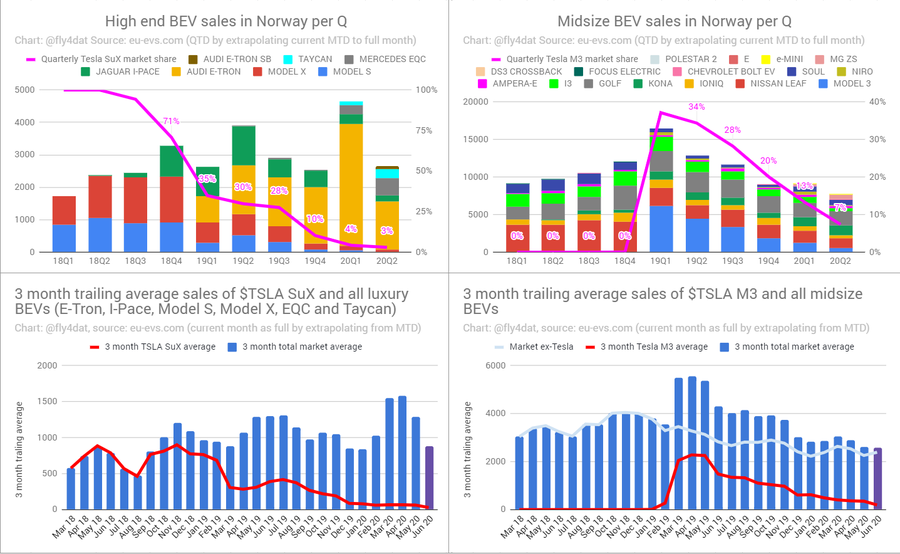
Both the "n% of new cars are Teslas" and the "instant n% drop in Tesla sales" news stories are red herrings. They were both artificially caused by where Tesla allocated their production.
The only signal you can extract from this data is basically that the demand for Teslas well exceeds the company's capability to manufacture them, as whichever country or region they allocate more of their production towards will see a corresponding sales spike. This is mildly positive, but given how long it takes to expand production, I still don't think you can justify the share price on this. Right now, if Tesla had much more cars available, they'd be able to sell them. However, by the time they have ramped up production to match the demand, competitors might have something that matches them.
I fully agree that regulatory credits were big part of that growth and drop, in Netherlands. But the story that sticks to people is wrong one, that Tesla dominates Netherlands and demand for them is huge, and Tesla is posed to dominate all markets in the world. It was demand for free money from government. And while one can argue that other governments will have similar initiatives, that will allow Tesla to play this game for years, competition in EV space is growing, so they’re unlikely to get such a big piece of pie there.
There was no regulatory change in Norway. Tesla brand got pretty badly bruised, with lots of stories in Norway about subpar service. And, most importantly, real competition arrived, while their portfolio is aging (model 3 is 3 years old design, model y is model 3 with a lift kit, and model s/x are way way due for redesign).
But I do see your point, that this all can be attributed to Tesla being production constrained. Except, that Tesla keeps on dropping prices and offering initiatives to push more sales.
Why not push more cars to one of the wealthiest nation on earth (Norway), where EV are ridiculously competitive to ICE cars, due to taxes? Why instead keep on dropping prices, while company is pushing really hard to be profitable?
There are currently ~10 major automakers outside of China and India. In a decade, there will be less than 10. The only one I am confident that will be sticking around is Tesla. The others have a difficult transition to electric ahead of them and possibly a difficult transition to self-driving and will possibly have to deal with strong Chinese competition. Not everyone will successfully transition. Perhaps spending heavy on the electric transition like VW is the right approach. Perhaps letting everybody else take all the risks and swooping in late like Toyota is the right approach. I don't know.
The only manufacturer that I'm confident of being around in 10 years is Tesla. Some of them will transition well and will likely sell more cars than Tesla and have an enterprise value larger than Tesla in 10 years. And some of them will go bankrupt or be swallowed cheap like FCA-PSA.
That being said, I significantly reduced my holdings in Tesla this year. I'm pro-Tesla, but not at current prices.
People think the stock will go up, because it's a hot company with a lot of press, so they buy it. More people buy it, and it becomes a self-fulfilling prophecy: the stock goes up.
Eventually Tesla will either find their groove and be a breakout success, or the stock price will fall. It's just a matter of time, and depends on when people get tired of waiting.
Remember also that VW is, comparatively, a super boring company.
These are all bad reasons for Tesla's stock price, but they are reasons.
Estimates for Q2 2020 are around -3,2 € per share (EPS) for Volkswagen while Tesla posted a profit.
This is what Tesla investors hope for Tesla’s future. That ten years from now, there would be Tesla and all other car manufactures looking to emulate Tesla by producing a couple of electric models that would lack the features or refine of Tesla .
Tesla has a first mover advantage similar to what AWS had for the first 5 or so years.
The Model Y, a compact SUV, starts at $53,000. That is wildly out of bounds for most people. Factor in the low price of gas right now, the unreliability of Teslas, and tax credits that are going away and you really erode away the savings that put a dent into the Tesla's value equation. You're left with a vehicle that competes on value moreso against a smaller luxury compact SUV class.
The big question is if Tesla can continue to see gains from scale that either allows them to address a larger market while still keeping margins at an industry leading level. All that while managing to stay ahead of the influx in competition that will be coming from all the major auto manufacturers as they increase their EV and battery capabilities.
The better answer is that nobody should buy VW either. Their business has zero potential upside and a huge downside risk in the transition to EVs; along with the inevitable rise of China's domestic automakers, which will eat a very large amount of market and sales away from the old giants. VW's position is its weakness, it has everything to lose and nothing to gain from the peak they've reached.
Which also isn't the same as saying that Tesla should be bought at its present absurd valuation.
VW is an EV manufacturer and is investing heavily in the transition to EVs themselves. And they’re already at a much larger scale than Tesla in terms of distribution and manufacturing the rest of the car.
When you buy a tesla, tesla gets 100% of the revenue.
When you buy a VW or a ford, what % cut does the dealership take?
How much does it cost to have 800 cars sitting on a lot, vs order on demand?
Auto industry is ripe for innovation, glad we have someone innovating. I will hopefully never need to talk to a car salesmen or do the dealership thing again.
Tesla's market cap is crazy, but is a reflection of having actual products.
I think that’s a very reasonable argument to make. However, Tesla is not even close to this peak VW might have reached, and is valued (roughly speaking) at 4x that.
VW might lose its peak, Tesla never had it in the first place.
They’re likely to own a big chunk of the market for electricity generation and storage equipment.
Also, people hate dealerships and CO2 so much that I think the general assumption is that Tesla will be one of a very small number of car manufacturers left standing in a decade or so.
Finally, I think people assume Tesla will be like Amazon, and keep doubling down on their bets until they’ve run out of industries to take over.
I'm not saying the valuation makes sense, but to compare them to a car company doesn't make a ton of sense.
The whole argument is that they could use off the shelf materials at scale to attain profitability, since that hasn't happened the goalposts keep being moved by Musk, rumors, and myths.
"Now we’ve learned that Tesla is building a battery cell pilot production line in Fremont"
"Tesla currently buy cells from Panasonic made in Japan for Model S and Model X, as well as cells made by Panasonic at Tesla’s Gigafactory 1 in Nevada for Model 3.
The automaker used those cells, which they help design, to make their own modules and battery packs, but they have never produced their own cells."
It irks me because you clearly do understand they're currently building the factory after years of research (and buying up some startups).
It better. Tesla has a market cap of 4x that of VW, a car maker with €256bn revenue and ~€17bn profit in 2019.
It is beyond me why anyone would buy this stock over VW, let alone pay 4x the price for it. Even if Tesla could put out 900K cars in a quarter instead of the current 90K, they'd still not come even close to the competition is terms of financial success.
Tesla would need to utterly dominate the car market to live up to its current valuation. Dominate as in market share, not relative quarter-to-quarter growth.