As to Oregon, consider this https://en.m.wikipedia.org/wiki/Umpqua_Community_College_sho... in the context of easily available firearms.
The exceptions for the latter category being countries with high external national risk or no standing army.
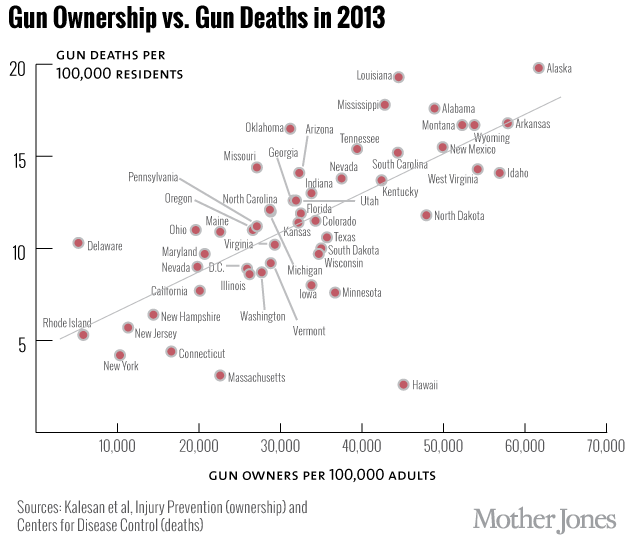
Eye-balling this 2015 chart, there seems like there's a pretty good correlation between per capita ownership and per capita deaths (homicide+suicide):
* https://www.motherjones.com/wp-content/uploads/gun-ownership...
* https://www.motherjones.com/politics/2015/07/gun-owners-stud...
The main outliers appear to be MA and HI, the former of which has some pretty strict rules (very similar to Canada's):
* https://www.vox.com/2018/11/13/17658028/massachusetts-gun-co...
RAND did a (meta-)analysis and found that some policies are more effective than others, specifically: safe storage, waiting periods, background checks, domestic violence history restrictions:
* https://www.rand.org/research/gun-policy.html
Stand-your-ground laws seem to lead to not-good things happening (nothing about castle doctrine though).
Good laws / regulations can counter high numbers though, it appears. Canada has one of the highest per capita ownership rates, and yet has quite low firearm-related death rate (lower than Finland, the Swiss, France, Austria):
* https://en.wikipedia.org/wiki/Estimated_number_of_civilian_g...
* https://en.wikipedia.org/wiki/List_of_countries_by_firearm-r...
Injecting suicide rates into the discussion is a motte-and-bailey tactic. People make their legal case for regulation by invoking the right not to be murdered as outweighing the right go bear arms, but when confronted with the fact that gun control doesn’t appear to reduce homicides within the US, they shift the goalposts by citing numbers that lump in suicides. But the legal and moral justification for regulating guns to reduce suicides is very different than for homicides.
So?
> Injecting suicide rates into the discussion is a motte-and-bailey tactic.
Or it's simply the fact that I don't want people dying unnecessarily, whether at their own hand or another's. Why should we only worry about homicides? What is your intent in removing suicide from the equation?
Unfortunately, with police departments being defunded or restricted, illegal gun ownership and use will only rise over time.
Also, I think I meant to write Baltimore instead of Boston, but I think the point stands regardless.
Well, yeah. Most non-murderers don't murder, too.
As someone else pointed out, you can still buy ammunition in Switzerland. There's plenty of access to guns. The difference is absolutely one of culture, which is what my point was.
You should probably add that most US gun owners are law-abiding gun owners.
Most people abide by the law until they don't:
* https://twitter.com/well_regulated_
And in a lot of jurisdictions in the US all you need to get a gun in the first place is a pulse, which isn't much of a filter in determining whether a person can actually safely handle one. I'd be curious to know the survey results of owners who could recite Jeff Cooper's Four Rules:
* https://en.wikipedia.org/wiki/Jeff_Cooper#Firearms_safety
Personally I like the little mnemonic / acronym that is taught in Canada, A.C.T.S.:
1. Assume every firearm is loaded.
2. Control the muzzle direction at all times.
3. Trigger finger off trigger and out of trigger guard.
4. See that the firearm is unloaded [and P.R.O.V.E. it is safe].
If people followed these or the classic military rules gun accidents would almost be a thing of the past.
Not that I think that will happen:
if people could just stop
- drunk driving,
- speeding
- driving while texting
- etc
that would probably save even more lives, but I don't see that happening either.
Your examples strengthen the point I was trying to make: The numbers on drunk driving over the decades, and auto safety in general, are an example of what government regulation with societal support can achieve. Perhaps some day firearm regulation and licensing will achieve the advances that the automobile has seen.
If only guns were licensed more like automobiles:
* https://www.vox.com/2018/11/13/17658028/massachusetts-gun-co...
But remember: the US is what it is. There is an insane amount of guns floating around already.
My suggestion is the "Norwegian model" from now on and going forward: to get anything except a manually reloaded rifle or a (max 2 cartridge) shotgun you need a clean record with the police + (and here comes the interesting part:) you need a recommendation from a local shooting club. Oh, and before buying any hunting gun at all there's a mandatory 50 hours training.
I'd recommend trying something similar in the US: tell NRA "we want you to help us".
Parts of HN might hate NRA all they want but my understanding is a good chunk of the people in NRA would love to keep weapons out of the hands of crazy people as every criminal shooting hurts peaceful owners as well.
How would tight regulations like that look in a large country already flooded with weapons of all shapes and sizes?
I know multiple pro-gun people who seem to compose a large percentage of their pro-gun belief system around the foundation of the inability to remove them. Ie any bad guy who ever wants a gun will always have it (because there's so many), so give more guns to the good people.
What are your thoughts there? I don't really have a counter.
- Refuse sales of ammunition without proof of gun purchase and registration.
- Refuse gun purchase for specific gun types and if a person already has a certain number of guns.
- Mandate and enforce training before gun purchases, with obligatory re-training every X years. Checked at every purchase of ammo and guns. No training, no sale.
- Mandatory licensing for open carry. Mandatory army-level training for concealed carry. With mandatory re-training.
- Buyback and exchange plans for existing weapons.
- Huge fines (not jail time, fines) for non-compliance. Money is a much bigger deterrent than jail time.
One of the biggest problems is your last point - non-compliance isn’t really enforced. If you ask your friend to buy a gun for you because you’re not eligible, the dealer might stop the transaction, but there is a very low likelihood there will be any police follow up.
The ATF/DOJ loves to make examples out of people even when the case is pretty weak.
Then what? Do you think anyone would be willing to roll back something like this?
One comment regarding the term "Buyback", the government never owned them they can not "buy" them back. It is simply a euphemism for confiscation. Moreover, you can go to pretty much any gun shop or pawnshop to sell a gun you do not want.
Ahahahha what
I couldn't see it mentioned immediately on Wikipedia and it kind of falls outside of the scope of that article too so I'll mention that in addition to people directly preventing crime by pulling a gun IIRC there also seems to be less attempts at crime in areas were there are lots of legal guns.
I think rayiner hints at/mentions that somewhere above.
US gun violence probably would decrease if they adopted the swiss system, but good luck getting people who think a two-day hunting license course infringes their 2A rights to agree to a two-year process involving written, oral, and practical tests.
The NRA agrees that you shouldn’t be able to buy a guy if you have mental problems, drug problems, aren’t in the US legally, criminal history, etc.
The only one restriction that is strongly enforced is the criminal history because it’s easy to do a check. But the system for mental health checks is a patchwork across states.
And to layer on, if someone does violate these laws, there is often no punishment. Straw purchases are a good example - it usually falls on the dealer to stop the transaction, but there is rarely any police follow-up.
But I guess my point would be - if they actually followed up on all straw purchase attempts (even just a call from the ATF saying “yeah, that’s illegal, don’t do that”) you could at least say the law is being enforced.
Right now the most likely outcome is the dealer just refusing the sale. You’re free to tighten up your game and try another dealer.
Despair and poverty without a perspective breeds crime. Switzerland doesn't have much of that.
I would strongly argue against this. Swiss gun law is very different from US, please read my five points above. Do you think US gun violence would decrease if they adopted those points? In my opinion yes.
In my opinion the conservatives, nationalists and the National Rifle Association fight against any tighter regulations that would probably save thousands of lives.