>In the face-off against a Cortex-A55 implementation such as on the Snapdragon 855, the new Thunder cores represent a 2.5-3x performance lead while at the same time using less than half the energy.
https://www.anandtech.com/show/14892/the-apple-iphone-11-pro...
Apple has been hitting it out of the park lately.
The real problem though, is that apple is actually designing a core 100% focused on the target market. Unlike intel, for whatever reason, and AMD which didn't have the funds to run a dedicated design team for laptop/desktops.
So, I would expect the engineering tradeoffs for said laptop/desktop processor to show. AKA, things like hyperthreading are quite a win for servers, but at best are a wash for a desktop use case focused on extremely high single thread perf at the expense of throughput.
Given the extremely impressive performance of the 4800H notebook cpus, I'd assume that might be a thing of the past.
> AKA, things like hyperthreading are quite a win for servers, but at best are a wash for a desktop use case focused on extremely high single thread perf at the expense of throughput.
This might be true for devices like the MacBook Air which are designed for relatively light usage like Office, but I don't see that argument working with their "Pro" lineup, including the iMac Pro and the MacBook Pro. These are devices specifically targeted to a professional audience like graphics designers, 3d artists, software developers or video editors. All of those tasks can be done with decent single-threaded performance, but lots of those tasks also benefit from multithreading. I haven't owned a single MacBook so far and I doubt that'll change anytime soon. Nevertheless, its exciting to see Apple do this move and it'll be interesting how good their CPUs can compare to mobile processors by Intel and AMD.
The TDP on those is, what, 3-4x the A12Z?
So ~2-3x the TDP for 2x the core count and 4x the thread count. Pretty interesting head to head when the Apple dev kits actually show up in people's hands, don't you think?
First of all, TDP is not the same thing as power consumption - it is a specification for the required performance of the heatsink/fan cooling solution.
For example: a Ryzen 3900X is a 105W TDP chip. Running at full speed on all 12 cores it consumes 146W; about 10W per core and the remainder for the rest of the package.
Secondly, it is entirely typical to run a single-threaded workload at a higher clock frequency (because if that's all you have to do, why not?), and chasing higher clock speeds is disproportionately expensive since it requires higher voltages, and dynamic power in a switching system increases with the square of voltage.
Again, taking the Ryzen 3900X: that's a nominal 3.8GHz processor. Running a single-threaded workload, it will typically boost up to 4.45GHz in testing. At that frequency, that single core is drawing nearly 18W - i.e. 80% more than at the nominal frequency achieved when all cores are busy and no boost headroom is available.
From what I've read about the A12/A13, the voltage/clock curves are particularly skewed at maximum clock speeds - something like 1.1V at 2.49GHz on the A12 and well under 0.8V at 2.3GHz - basically half the power to run at 93% of the clock speed.
There are a lot of unknowns here, but I think there are more reasons for optimism than your analysis suggests.

That's either 4-5W per core or the uncore in an A13 is hugely power hungry. I'm rather positive it's not an extremely bad uncore, so the only other option here is a 4-5w per core power figure. Which also lines up with the voltage/frequency curve numbers: https://images.anandtech.com/doci/14892/a12-fvcurve.png
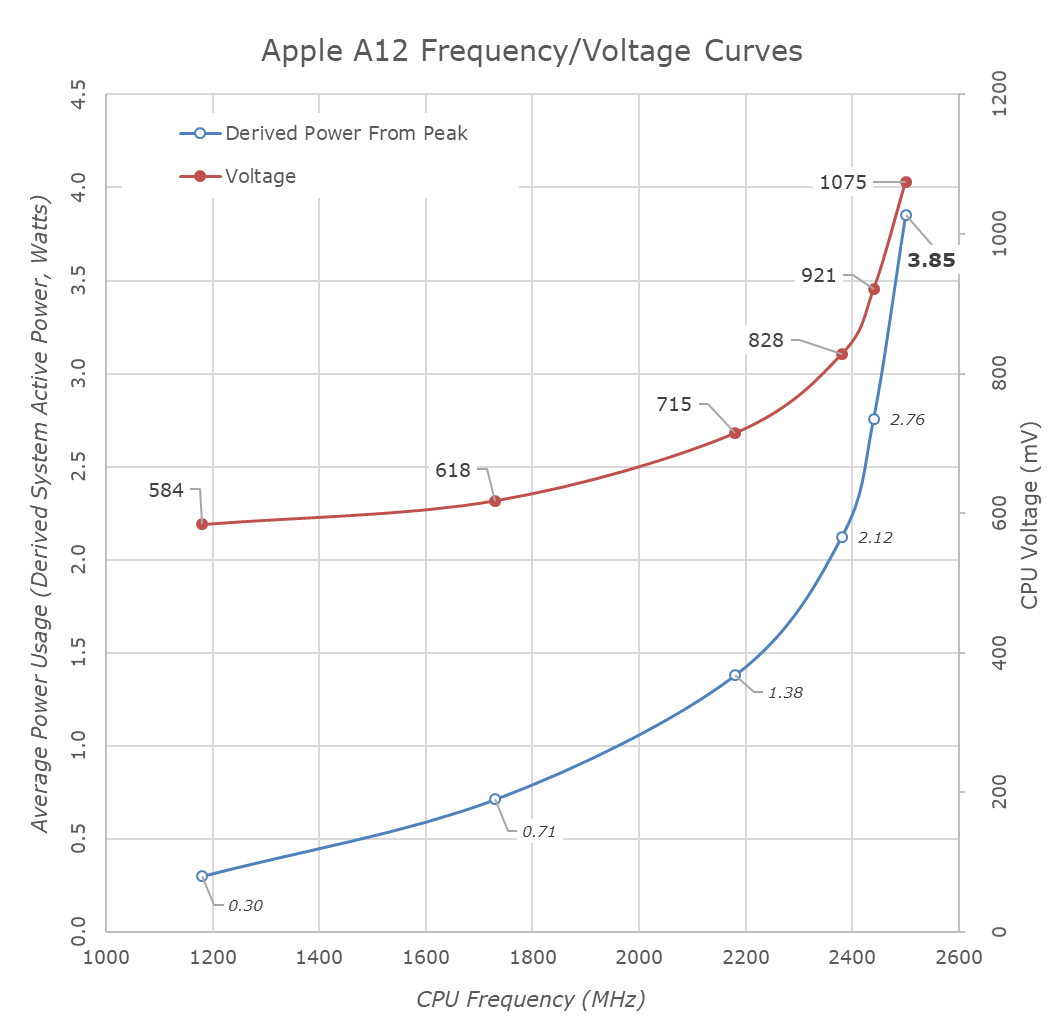
If you have data to support a different number I'm all ears, finding power draw figures in this space is rather difficult, but 4-5W per-core aligns with expectations here. A 1W consumption would be unheard of levels of good.
Intel TDP doesn’t include the power usage of DRAM and other IO, or the screen, or WiFi or modem (which may have been disabled tbf).
Geekbench 5 multi core scores are roughly 7400 vs 3300. Let’s say for example that the Thunder cores are half the perf of the Lightning ones. So that 3300 score might be roughly the perf you could get from 4 x Lightning instead of 2 x Lightning and 4 x Thunder. 4800H has 8 cores. Getting a bit over 2x the performance.
But that’s at a TDP of 45W (let’s call it 40W to be more generous). 5W for A13 (well, A13 entire device) vs 40W 4800H. That’s 8x the power draw for 2x performance. Am I wrong?
Most of those tasks benefit from multiple processors. Multithreading is less clear-cut because you're trading the win for under-optimized code against increased pressure on shared resources (which is one of the reasons why it's opened some windows for security attacks). It's not hard to find pro workloads which perform better without multithreading enabled and considering that Apple will own the entire stack up to some of the most demanding apps they're well positioned to have both solid data on the tradeoffs and architectural changes.
I'm having trouble following the reasoning.
> AMD which didn't have the funds to run a dedicated design team for laptop/desktops.
They have plenty of funds for R&D. Problem is, processor manufacture goes much beyond the processors themselves. You have to design the entire manufacturing chain, and spend billions on new foundries which will get obsolete in a few years.
> AMD’s
> that‘s
What is your method of input where you use three different characters for apostrophes?
The A12 will pull around 4w on a single-core workload to come close to 9900K in performance. That's a good number, but it's not unheard of. The 4800HS is also a 4w per core CPU, and also comes close to the 9900K in performance.
The problem is increasing single-core performance becomes non-linear. It's not just a few more watts to bump from 3ghz to 4ghz. It's a lot of watts.
Simply having 4 big cores on an A12 would push it into 10w actively cooled territory as well, same as the i5 in a macbook air (a CPU that's also 10w). Add a few watts to bump the single core performance while you're at it and suddenly it's a 20w chip. Make it 8-cores to compete with the current macbook pro CPUs and suddenly it's a 40w chip.
The A12X/A12Z already has 4 big cores (and 4 little cores, and 7-8 GPU cores). I imagine the A14X will follow this pattern, but the cores will be 2 generations newer, with 2 generations of performance-per-watt improvements.
Hence it makes much more sense to treat the A series processors as 2 watt chips when looking at multi-core scores. They're targeting efficiently hitting these lower frequencies. You'll get a similar result for the 4800HS; it'll use a lot more than 4 W single-core.
The problem here is a severe lack of quality data. The best we have right now is SPEC2006 which is unfortunately only single core. You're absolutely right that it makes more sense to compare like for like in workloads, but we don't have any good multithreaded cross-platform benchmarks. There's geekbench, but it's somewhere between mediocre and shitty. And then nothing else? There's then no multithreaded benchmarks that also have measured power draw on an A12/A13.
A 4800HS at it's 4w/core all core load is also still clocking higher than an A12X. When Apple has the thermal budget to spend as well they'd almost certainly do the same thing?
> A 4800HS at it's 4w/core all core load is also still clocking higher than an A12X.
This doesn't mean that much, since the range of efficient clock speeds depends on design choices, so they aren't always 1:1 comparable between architectures. Apple might well increase clock speed on their desktop chips, but unless it's only a few percent, it won't be as simple as pumping more power into the same dies; they have to actually redesign the core to operate efficiently at those higher speeds.
This isn't unique to Apple, either. The "big" cores in ARM CPUs have been pulling 2-4W for years and years. That's why thermal throttling is such a major issue in mobile, especially mobile games.
Anandtech would like to disagree with your word choice.
https://www.anandtech.com/show/14892/the-apple-iphone-11-pro...
> In virtually all of the SPECint2006 tests, Apple has gone and increased the peak power draw of the A13 SoC; and so in many cases we’re almost 1W above the A12. Here at peak performance it seems the power increase was greater than the performance increase, and that’s why in almost all workloads the A13 ends up as less efficient than the A12.
> The total power use is quite alarming here, as we’re exceeding 5W for many workloads. In 470.lbm the chip went even higher, averaging 6.27W. If I had not been actively cooling the phone and purposefully attempting it not to throttle, it would be impossible for the chip to maintain this performance for prolonged periods.
In other words, to get those good specint numbers, power was sacrificed to do it. 5W per-core power draw is right in line with a typical x86 laptop CPU, too. 4800HS sits at 35w, or 4.3w per core.
"But the biggest surprises and largest performance increases were to be found in the A13's GPU. Where the new chip really shines and exceeds Apple’s own marketing claims is in the sustained performance and efficiency of the new GPU. Particularly the iPhone 11 Pro models were able to showcase much improved long-term performance results, all while keeping thermals in check. The short version of it is that Apple has been able to knock it out of the park, delivering performance increases that we hadn’t expected in what's essentially a mid-generation refresh on the chip manufacturing side of matters."
One of the key phrases is "...Apple has been able to knock it out of the park..."
The rest of the article is pretty clear - Apple gets it, and beats their competitors pretty soundly.
I think that's only part of the story, which also needs to include the ability to add features and control the entire feature set across chips on all of their devices.
Encryption, ML, graphics, power management, security, etc. are all things that Apple can now add or remove as needed.
The level of optimization they can do is now well beyond just speed and price.
Here's the A12's power/frequency curve: https://images.anandtech.com/doci/14892/a12-fvcurve.png
That's the curve per core (that's how those charts work). 3.85W per core @ 2.5ghz is what a big core A12 is spec'd at.
While similar curves also apply to Intel and AMD, their mobile parts are drawing 10-20 watts per core to acheive the very top results. When you're using all the cores together under a 6W TDP (as apple is doing), Apple is able to achieve a much higher Geekbench result than Intel or AMD parts set to a comparable TDP, or even 3x the TDP. Compare multi-core Geekbench scores of Apple's parts running at a 6W TDP to Intel or AMD's most efficient parts running at a 15W TDP, and you'll see that Apple outperforms them while drawing 1/3 the power. Similar curves apply, but Apple can achieve far morea at 1W per core than any x86 competitors.
> 4x the perf/watt of Intel and AMD competitors in Geekbench
Geekbench only measures perf, not perf/watt. It does not try to achieve maximum perf/watt, nor has Apple tuned to the A12/A13 to achieve maximum perf/watt in Geekbench either. Geekbench's single thread numbers where it "competes with Intel & AMD" are also these ~5W per core power figures.
I'm not sure where you're getting this random 4x better number from anyway?
I'd expect a 2020 A14X or whatever it's called to comfortably beat what they could achieve in 2018, so getting 4-5x the perf/watt of Intel and AMD's best is what I'd expect when operating at similar points in the frequency/power curve. The A12X was around 4-5x the perf/watt of what Intel and AMD had out in late 2018.
https://browser.geekbench.com/v5/cpu/2639065 https://browser.geekbench.com/v5/cpu/2638528
The chip needs around 25W at 2.5GHz and 200W at 4.7GHz. 8x more power for 1.88 times the performance. In other words Intel chips running at 2.5GHz are 4.25 times more efficient than Intel chips running at 4.7Ghz. No magic. Once Apple has chips that go this far they will suffer from the same problems.
Here is a slightly newer chart [1] that demonstrates a 57% increase in power consumption for a 500Mhz frequency gain (12% performance gain).
[0] https://www.extremetech.com/wp-content/uploads/2018/09/Clock...

[1] https://www.extremetech.com/wp-content/uploads/2016/02/power...

For example. Geekbench measures peak performance of all cores at the same time and the power draw may go above 5W.
The 5W TDP may refer to normal day to day use where one or two cores are active at the same time for the duration of the user interaction (play a game for 5 min or something) and once the user stops using the phone it will quickly go back to a lower TDP.
Increase frequency by 30% and the A12 will also be hitting 10 watts per core - the end of that graph is going real vertical real fast.
Since Zen 2 and A12/A13 are all on the same TSMC process this shouldn't be that surprising...
> I expect at least a 50% per core performance increase
Based off of what evidence? That'd be an unheard of improvement. TSMC isn't even claiming anything close to that at a pure transitor switching frequency for 5nm? They are predicting 15% frequency gain (at the same complexity and power) or a 20% power reduction (at the same frequency and complexity) over their 7nm process.
So a A14x+ (15 W+)
30% frequency increase vs A13, because of higher TDP +
10% IPC increase (larger caches, design tweaks) +
15% Frequency increase, due to 5 nm.
A i7-1065G7 costs Apple something like $400. The A13 costs something like $60 to manufacture. Apple is highly motivated.
My intuition is that 50% might be overoptimistic. But going from iPad to Laptop thermal constraints, you'd expect a big increase in frequency just from clocking the thing higher, no?
Presumably that would only apply when the cores are actually running at full-throttle though. For casual use there could still be considerable gains if the processors are better at power management (which they most likely are, as they've had to hyper-optimised for this for phones).
AMD represents about 2/9 in Windows and 3/10 in Linux of processors using Steam month-by-month and raising; In this same survey Windows represents 95% and MacOS 4% of computers.https://store.steampowered.com/hwsurvey/processormfg/
I think they can manage the production to provide for all Apple CPU needs.
And the game consoles show that AMD can put together a secure, x86 chip at high volumes at leading nodes.
Eh? This is a flimsy claim. AMD's performance/watt is extremely impressive right now. Apple is ahead of Intel for sure, but Intel isn't the only other player here.
> So, I’m predicting an MBP 13 - 16 range with an extra three hours of battery life+, and 20-30% faster. Alternately a Macbook Air type with 16 hours plus strong 4k performance.
A slightly more efficient CPU doesn't get you this. You need significant efficiency improvements across a variety of aspects, including those Apple has already been optimizing for years like the display.