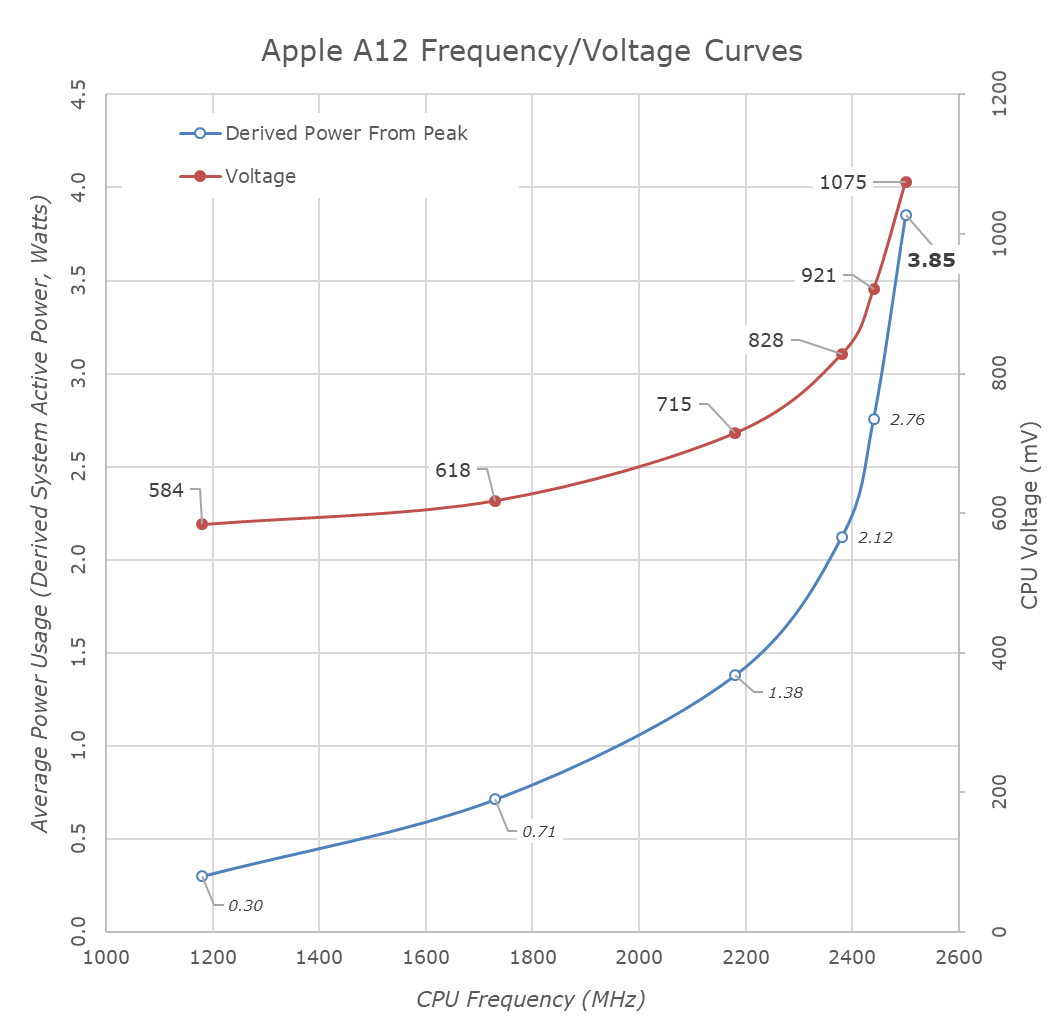
Increase frequency by 30% and the A12 will also be hitting 10 watts per core - the end of that graph is going real vertical real fast.
Since Zen 2 and A12/A13 are all on the same TSMC process this shouldn't be that surprising...
> I expect at least a 50% per core performance increase
Based off of what evidence? That'd be an unheard of improvement. TSMC isn't even claiming anything close to that at a pure transitor switching frequency for 5nm? They are predicting 15% frequency gain (at the same complexity and power) or a 20% power reduction (at the same frequency and complexity) over their 7nm process.
So a A14x+ (15 W+)
30% frequency increase vs A13, because of higher TDP +
10% IPC increase (larger caches, design tweaks) +
15% Frequency increase, due to 5 nm.
A i7-1065G7 costs Apple something like $400. The A13 costs something like $60 to manufacture. Apple is highly motivated.
My intuition is that 50% might be overoptimistic. But going from iPad to Laptop thermal constraints, you'd expect a big increase in frequency just from clocking the thing higher, no?
Presumably that would only apply when the cores are actually running at full-throttle though. For casual use there could still be considerable gains if the processors are better at power management (which they most likely are, as they've had to hyper-optimised for this for phones).