Given the extremely impressive performance of the 4800H notebook cpus, I'd assume that might be a thing of the past.
> AKA, things like hyperthreading are quite a win for servers, but at best are a wash for a desktop use case focused on extremely high single thread perf at the expense of throughput.
This might be true for devices like the MacBook Air which are designed for relatively light usage like Office, but I don't see that argument working with their "Pro" lineup, including the iMac Pro and the MacBook Pro. These are devices specifically targeted to a professional audience like graphics designers, 3d artists, software developers or video editors. All of those tasks can be done with decent single-threaded performance, but lots of those tasks also benefit from multithreading. I haven't owned a single MacBook so far and I doubt that'll change anytime soon. Nevertheless, its exciting to see Apple do this move and it'll be interesting how good their CPUs can compare to mobile processors by Intel and AMD.
The TDP on those is, what, 3-4x the A12Z?
So ~2-3x the TDP for 2x the core count and 4x the thread count. Pretty interesting head to head when the Apple dev kits actually show up in people's hands, don't you think?
First of all, TDP is not the same thing as power consumption - it is a specification for the required performance of the heatsink/fan cooling solution.
For example: a Ryzen 3900X is a 105W TDP chip. Running at full speed on all 12 cores it consumes 146W; about 10W per core and the remainder for the rest of the package.
Secondly, it is entirely typical to run a single-threaded workload at a higher clock frequency (because if that's all you have to do, why not?), and chasing higher clock speeds is disproportionately expensive since it requires higher voltages, and dynamic power in a switching system increases with the square of voltage.
Again, taking the Ryzen 3900X: that's a nominal 3.8GHz processor. Running a single-threaded workload, it will typically boost up to 4.45GHz in testing. At that frequency, that single core is drawing nearly 18W - i.e. 80% more than at the nominal frequency achieved when all cores are busy and no boost headroom is available.
From what I've read about the A12/A13, the voltage/clock curves are particularly skewed at maximum clock speeds - something like 1.1V at 2.49GHz on the A12 and well under 0.8V at 2.3GHz - basically half the power to run at 93% of the clock speed.
There are a lot of unknowns here, but I think there are more reasons for optimism than your analysis suggests.

That's either 4-5W per core or the uncore in an A13 is hugely power hungry. I'm rather positive it's not an extremely bad uncore, so the only other option here is a 4-5w per core power figure. Which also lines up with the voltage/frequency curve numbers: https://images.anandtech.com/doci/14892/a12-fvcurve.png
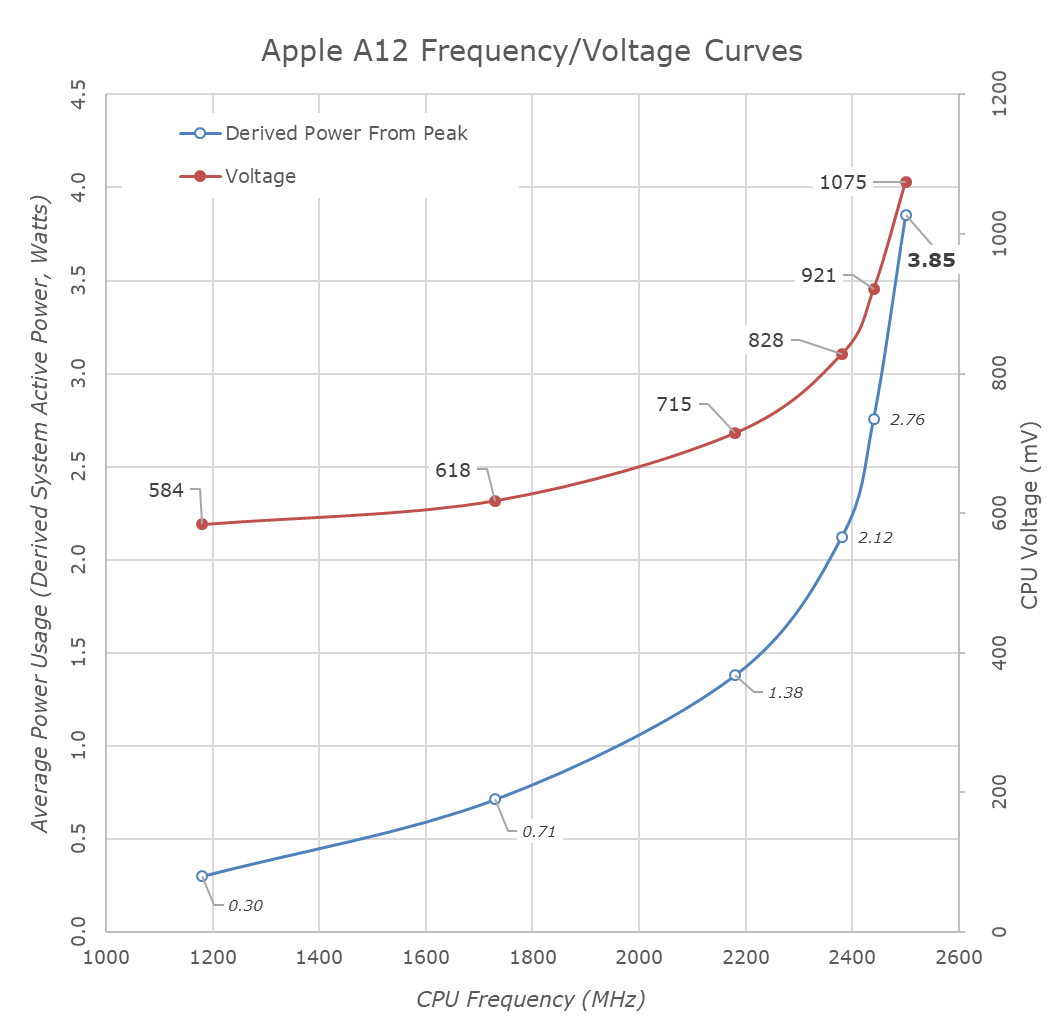
If you have data to support a different number I'm all ears, finding power draw figures in this space is rather difficult, but 4-5W per-core aligns with expectations here. A 1W consumption would be unheard of levels of good.
Intel TDP doesn’t include the power usage of DRAM and other IO, or the screen, or WiFi or modem (which may have been disabled tbf).
Geekbench 5 multi core scores are roughly 7400 vs 3300. Let’s say for example that the Thunder cores are half the perf of the Lightning ones. So that 3300 score might be roughly the perf you could get from 4 x Lightning instead of 2 x Lightning and 4 x Thunder. 4800H has 8 cores. Getting a bit over 2x the performance.
But that’s at a TDP of 45W (let’s call it 40W to be more generous). 5W for A13 (well, A13 entire device) vs 40W 4800H. That’s 8x the power draw for 2x performance. Am I wrong?
Most of those tasks benefit from multiple processors. Multithreading is less clear-cut because you're trading the win for under-optimized code against increased pressure on shared resources (which is one of the reasons why it's opened some windows for security attacks). It's not hard to find pro workloads which perform better without multithreading enabled and considering that Apple will own the entire stack up to some of the most demanding apps they're well positioned to have both solid data on the tradeoffs and architectural changes.
I'm having trouble following the reasoning.
> AMD which didn't have the funds to run a dedicated design team for laptop/desktops.
They have plenty of funds for R&D. Problem is, processor manufacture goes much beyond the processors themselves. You have to design the entire manufacturing chain, and spend billions on new foundries which will get obsolete in a few years.
The real problem though, is that apple is actually designing a core 100% focused on the target market. Unlike intel, for whatever reason, and AMD which didn't have the funds to run a dedicated design team for laptop/desktops.
So, I would expect the engineering tradeoffs for said laptop/desktop processor to show. AKA, things like hyperthreading are quite a win for servers, but at best are a wash for a desktop use case focused on extremely high single thread perf at the expense of throughput.