Of course, in the current setup, this is true, but there are so many boring and hard jobs (worked by people who are yet poor) that we shouldn't mourn once we manage to get rid of them.
I want an economy where we can celebrate automation and distribute the profits evenly.
In such an economy there's no incentive to work on further automation. In particular if there's a part of world where profits aren't distributed evenly - the innovation and manufacturing will move there.
A tiny group might try to live in it, but more would see seasonal jobs as enough. As automation improves in general people would work less over their lifetime. Critically this would likely slow down the economy in the short term, but the constant minor labor shortage would presumably push for ever more automation to offset this.
Unfortunately, it needs to be a pay go system based on a fixed economic percentage to really work. But, assuming it was the general population would suddenly have a huge incentive to promote automation and economic growth.
Read about industrialisation of United States and history of tarrifs. US had plenty of them when the British Empire was the industrial powerhouse.
That said, labor has been cheaper outside the US for decades, yet manufacturing is still 2+ Trillion dollars per year in the US. In part it’s because you can’t simply move farms, oil wells, or forests etc. But, business friendly regulations, educated workers, efficient transportation, etc are also huge contributors.
And no need if the work on further automation is automated.
What's the incentive for millions of people working for free on open source projects?
Kevin Simler (via Dennett) goes as far as modeling this phenomenon on the level of individual neurons [0]: that conditions like depression and grief can be thought of as neurons and their networks becoming suddenly obsolete, and casting about trying to find new ways to be useful.
The employment model is hardly perfect; if anything, it has an uncomfortably feudal flavor in practice, where one is a thrall/vassal for 40(+) hours/week, in exchange for autonomy the other 128(-); and where one has the option to seek a new lord if sufficiently dissatisfied. There are countless other ways to be/feel useful outside that model: entrepreneurship, non-profit/community work, raising children, passion projects.
There are also potential perverse incentives: in particular, to maximize the problem one purports to solve. The most obvious parallels are the military- and prison-industrial complexes; planned obsolescence is another milder example. It's easy for unions to tip from collective bargaining into protectionism of industries that we'd like to become obsolete (prison guards, coal miners), out of a very understandable desire for those individuals to not lose their social bargaining chips.
So I do think we should celebrate the idea of "employment", as such, becoming optional; I strongly favor UBI. But at the same time, we need to be thinking about new institutions and proactive strategies for people to be, and feel, useful. I dare say, in some cases we want to be spending the economic surplus from the efficiency of automation, on intentionally inefficient pro-social economic activity. One example might be a community garden: it's a safe bet that industrial agriculture will always be an order of magnitude more efficient at producing food; but the community garden has other benefits, of connecting humans to nature and to each other (and perhaps a bit of resilience against supply chain disruption).
Bucky Fuller pointed out that we could apply technology to solve our problems efficiently and wind up with a two-year career. You would work for about two years and that pays for the rest of your life, you can retire or do whatever.
(FWIW, this is the context within which I think UBI makes sense, and we are not there just yet.)
Really it's a choice (at least in theory, maybe we are strapped in but I like to think we can affect things at least a little.) We can't un-invent the transistor.
True expertise in fields like medicine, engineering etc. generally takes at least a decade of experience to acquire. Societies need for, and ability to utilize, such highly skilled labor is only increasing as we automate simpler tasks.
People who never aspire to such professions might be spared long working years, but some portion of people will need to put in the long hours and years to keep the lights on.
Oh I agree.
In the absence of a profit motive those fields would be taken up by the most dedicated, eh?
> Societies need for, and ability to utilize, such highly skilled labor is only increasing as we automate simpler tasks.
Again I agree. I think that one obvious benefit of automation is that it frees up humans for important things that only humans can do. Mark Miller has an adage "Moore's law means that humans are becoming exponentially more valuable from the CPU's POV."
We're not talking about forcing people to retire after two years. We're talking about eliminating drudgery and wasteful processes.
> some portion of people will need to put in the long hours and years to keep the lights on.
No, that's the whole point: no one has to put in long hours anymore thanks to the knock-on effects of the invention of the transistor.
Just like farming went from ~90% of the population to ~3%, so will our industrial space-age civilization, if we let it.
If I had to guess, you have a job, so it's fun for you to sit here and make these comments from your high horse.
What you are describing is already a reality for our house pets. I don't find becoming a house pet to some AI/automated machine to be desirable in any way shape or form.
> Got it, thank you for adding to the debate.
How about don't be such a dick?
The point is that the aristocracy did not engage in "work" as many would define it, but seemed to be pretty happy about that.
It worked for them. Why not for others?
Go leave you job in 2020 and see how that goes for you. I understand "the dream" you're trying to describe, but it's 100% fictitious.
Just on the agriculture bit, do you even know where your food comes from or how it's produced? Honest question?
If I had a job I might not want to continue if it was undesirable, if it was desirable I would continue anyway.
If I didn't have a job I would still like my basic needs covered (living in a country with good social security means that that would actually be so), and if nobody else had to pick up my slack I'd want more than the basics.
And then I want that for everyone. Any of the situations given above is true for someone in my surroundings, colleagues, friends, neighbors.
My perspective is coloured by the country I live in of course. Nobody will be on the street, hungry or without healthcare if they lose their job here, there is plenty of annual leave by law. And it's great, I gladly pay taxes for that. But imagine, it could be even better!
Why do you think the question matters?
If everyone were magically able to live without jobs, some would still go off and do things productive out of an innate desire to be productive, but many wouldn't.
Millions have recently lost their jobs so I'm sure its' easy enough to find someone who can tell you how it feels.
Not going to happen under capitalism.
Look at the numbers, they are pretty horrifying.
https://whorulesamerica.ucsc.edu/power/images/wealth/Net_wor...
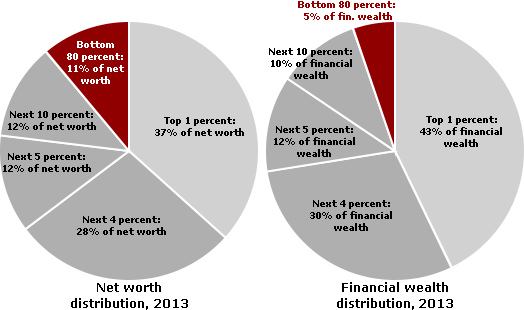
https://sociology.ucsc.edu/whorulesamerica/power/wealth.html
You know this, and we know you know this.
What political system might be capable of meeting these requirements? Is it the political equivalent of unobtanium or vaporware?
Im not trying to be a smartass; I want to know what the answer might look like. It doesn’t have to be a treatise. Just something consistent with a chance at succeeding with non-ideal people.
> What political system might be capable of meeting these requirements?
Capitalism isn't really a political system, even though people seem to elevate it to one.
Different political systems/policies combined with capitalism can produce very different societies and structures. For example, see social democratic systems in many parts of Europe.
“Capitalism” is not a full description of a national political system, but since it is fundamentally a system of legal property relations, it is exactly an aspect of a political system.
> For example, see social democratic systems in many parts of Europe.
Social democratic systems are not, even in the aspect of a political system which “capitalism” describes, purely capitalist but one of many forms of post-capitalist mixed-economy systems which retain elements of capitalist property relations but constrain them in various ways foreign to capitalism in the strict sense.
But then would it also not be fair to consider the US to also be such a mixed system. Not as equally mixed, but still mixed with behaviors that are post-capitalist?
It is you need a giant violent state to create a culture of sophisticated property rights. AKA capitalism requires a state and legal system, it doesn't exist without one. Things like copyright and Intellectual property are pure man made cultural political fictions, they do not exist in the natural animal kingdom.
How is it possible to own large tracts of land the size of small cities or entire provinces without a state/army to enforce it? AKA before populations got big there was plenty of "common" land that wasn't anyones. Property rights are a cultural invention.
That's why you always hear communists and socialists talk about the need for a "revolution". No one ever talks about a capitalist revolution because people don't need to be coerced into voluntarily exchanging goods and services. They do, however, need to be coerced into giving up their wealth to some massive state who's self-appointed role is to decide "what's fair" and who does and does not get to receive wealth produced by others.
They may well be instances where the hard edges of capitalism need to be sanded down a bit with redistributive policies, but make no mistake, between socialism and capitalism, socialism requires a lot more force, state-backed violence, and coercion to make work.
The answer to this is not to double down and give the state even more power to pick winners and losers, thinking that "this time will be different" or "we just need to get the smartest most moral people into power".
No need for a capitalist revolution? Did the monarchy give up power willingly? The french revolution, the american revolution, etc.
The only 'freedom' that exists in the natural world is the law of the jungle. You want freedom but want to live in a society? The idea of police and public prosecution, of justice and judges are all recent inventions. Without them, what stops me from taking whatever is yours and assures your freedom. How do you even come into possesion of land, water or any resource in the natural world?
Apparently some people's idea of freedom means they can wonder around the city spreading deadly disease. I would very much like freedom from them coughing in my vicinity and infecting me.
Some people think they have freedom to shoot me in the face if they feel 'scared', while i value freedom from getting shot.
Some people believ they have freedom to pollute the air with sulphur oxide, while i believe they should have to pay the cost it takes to clean up their pollution.
Any freedom for you is an obligation on me, and vice versa.
That being said, I don't think we're disagreeing here or at least not entirely. I'm saying that the state can't be trusted to manage the economy and distribution of wealth because it is prone to corruption and favoritism leading to bad outcomes. You seem to be arguing a similar point.
It’s not like collectivism or communism or anything else allows interlopers to seize things willy nilly.
Peasants in Cuba or the Soviet Union couldn’t just squat on land and do as they pleased. The kulaks are a good testament to what happens in those circumstances.
Common land used to be a thing, you could graze your animals there, etc. https://www.gov.uk/common-land-village-greens
Today, air and seawater are common resources that are being taken willi nilly and polluted
It's actually funny to listen to political debates of the 60s and 70s because people were planning that if automation were properly handled we'd be working like 2 days a week while keeping our standards of life and retiring at 40. What happened is that the rich got richer and the poor have to work shittier and shittier jobs, work longer, retire later, &c.
By the way, you might want to reassess your way of starting conversations, you're definitely trying to be a smartass. There are answers all over the place if you're willing to search/read a bit, it's not like these societal issues are new, there are literally hundreds of books about this very topic.
And the Welfare State was created to avoid Socialism:
https://en.wikipedia.org/wiki/Otto_von_Bismarck
> A master of complex politics at home, Bismarck created the first welfare state in the modern world, with the goal of gaining working class support that might otherwise go to his Socialist enemies.
The person you are replying to was making the obvious point that noone knows a better system than the current one. Adding a bit more wealth distribution just means tweaking the system, rather than creating a new one, which is what the parent poster implied was needed.
Maybe you should try reading some of those hundreds of books, because you clearly haven't if you think "What happened is that the rich got richer and the poor have to work shittier and shittier jobs, work longer, retire later, &c."
It is, but it's also very heavily influenced by socialism. You, and many other people, seem to believe it's and "either or" question when it really isn't and it never has been...
> The person you are replying to was making the obvious point that noone knows a better system than the current one
What does that even mean ? the current "one" ? Since when there is only one ? Just compare the US and French or German systems they're extremely different, especially for the average workers.
> rather than creating a new one
Come on, we're not talking JS frameworks here, what kind of rhetoric is that. Nobody is talking about tearing down the whole thing and starting from scratch.
> Maybe you should try reading some of those hundreds of books, because you clearly haven't if you think "What happened is that the rich got richer and the poor have to work shittier and shittier jobs, work longer, retire later, &c."
https://www.pewresearch.org/fact-tank/2018/08/07/for-most-us...
https://www.theguardian.com/business/2018/apr/07/global-ineq...
https://www.schroders.com/en/insights/economics/world-pensio...
Everything I can find talks about rising retirement age, lowering of pensions, and stagnation of purchasing power. If automation really brought what it was supposed to bring we would see much deeper _positive_ changes when comparing 1970s and 2020s. People got kicked out of factories and pushed into the tertiary sector but for all intent and purpose it's the same shitty working conditions, wages and social statuses. The guy who built cars for ford in the 50s is now driving a uber and has to pay his own insurances and pension, talk about the automation revolution ...
Capitalism existed for thousands of years (first company if the world was registered like yr. 700) and only supported miserable living standards. Most of these systems appears during / after the Renaissance, and deserve more credit for the society we have today than capitalism does
As long as we all get to do less of the undesirable work, our needs are covered and the profits and power of automation are not concentrated in the hands of a few I'd say we reached the goal. 'Evenish' distribution might be sufficient too.
There is a lot of literature on ideas and theories about it. The systems used so far had a lot of debugging time already, and I'd expect unexpected effects to turn up when implementing anything new, and thus it is hard to advocate for any specific one. Working with our problematic traits (such as laziness, selfishness and hunger for power) instead of against them (or worse, ignoring them) seems advisable though.
> our needs are covered
Human desires and human needs don't work the way you're probably thinking. I'd suggest to take into account Maslow's theory of human motivation. http://psychclassics.yorku.ca/Maslow/motivation.htm
is what I meant but did not specify. Is that more in line with what you mean?
How do you define desirability in the society where "needs are covered" (already)?
What would comprise the desirability if the profit of every action is alienated from the acting person?
I would say a desirable job is one with
- mostly pleasant tasks,
- good working conditions (not hard on the body (heavy lifting and bad positions, no natural light, noisy, bad air quality, ..) and mind (bad stress, bad social fit, ..),
- good relationships with the people around you, (and the ability to leave if they don't work for you)
- a good amount of agency (where 'good' might differ from person to person),
- achievable and worthwhile goals that do not feel like 'bullshit work', with a good feedback loop,
- and probably more I cannot think of off the top of my head right now.
(Respect and reward of other people is definitively a big plus, but if you yourself think your job is worthwhile it's probably enough to count as desirable.)
Most of these are not material rewards (though not having them can increase profit). If the only reason somebody does a specific job at all is money, the above conditions are not met/the person is not actively happy about doing it, and it can be done by a machine just as easily, I say we shouldn't have a need for this person to do it. Still, current society demands people have a job, any job, or even several, as a value in itself.
How the profit from work done is distributed is whole other (but connected) story. (Concerning your last question, I would argue that this disconnect to profit is already the case for many many people.)
Sorry for not writing clearly, this topic would probably warrant a seminar with lots of beer and reading at least.
The comment "...distribute the profits evenly.Not going to happen under capitalism." strongly implies a communist or socialist solution to this very real issue around automation.
It's trendy to bring up socialist solutions and then re-label them or put the ever-cleansing phrase "democratic" in front. But it's important to note when talking about redistribution as a solve, that for every Sweden or Denmark, there's a Cuba or North Korea.
I guess the question would be, if given a chance to choose would people living in those regimes keep the economic system and reform government or would they vote for a different kind of system altogether?
Whether the dictators where honestly trying to create communism, or they were using it to fool the populace much the same as monarchs used religion, is debatable.
A country where wealth is primarily controlled and distributed by state cannot, by definition, ever be free, even if the people doing the redistribution got elected at one point. That's simply mob rule with no respect or regard for the individual. Socialism or social democracy, or whatever you want to call it requires constant state coercion of individuals to work at all. This type of coercion may happen in capitalism systems like those in dictatorships, but it's not a built in requirement of the system itself.
So where is this magical line, once we cross it, the system suddently becomes oppressive?
Or, as the socialists would call it, when they take control of "the means of production".
Which is just another way of saying that private businesses are illegal.
Collectively funding some services has nothing to do with socialism.
I can't find a single country (maybe North Korea?) still in existence, that has outlawed private business. We aren't just talking social democracy, even Cuba and Venesuela allow private business.
From my original comment: "the majority".
The examples you have given, have indeed outlawed many private businesses, in the past. Although, I agree that those countries have become significantly more capitalistic over the years.
You also skipped the most famous example of socialism, which was the Soviet Union. The Soviet Union absolutely banned almost all forms of private enterprise.
But sure, socialism has significantly decreased in relevancy over the last few decades, to the point where basically all old socialist countries are becoming more and more capitalistic. Socialism is dying, all throughout the world.
Before Stalin forced the kulaks out of their farms Lenin allowed private farming as a means to an end. Stalin lost patience and forced it.
> Which is just another way of saying that private businesses are illegal.
No, it's not. Private businesses executed through private labor applied to public capital which the business rents from the state are perfectly compatible with socialism in which private ownership of the means of production is prohibited.
It's true that there are “socialist” states and parties that have banned or sought to ban private business, but that's not essential to socialism.
Also, all of those collectively funded services listed upthread tend to feature public capital ownership of the means of delivering the service as well as public operating funds, and often exclude private ownership of some of the means of delivering those services and/or use of privately owned capital to provide the same service, resulting in a domain in which private capital ownership is restricted.
This is a borderline semantic argument.
There is very little difference between banning almost all private businesses, and banning all owenership of private capital.
Everything that everyone does, relates to capital. If I write code, I just produced capital. And now the socialists are saying that I won't own that.
Yes, code is capital. The value of almost all software companies, is not in the server racks, it is in the code that they produced.
As far as I am concerned, banning all private ownership of capital, is only very slightly different than banning private enterprise, given that the main function of many private enterprises is to create capital, and now that capital would be illegal for them to own, even if they produced it.
Dude, the cold war is over, the communists are gone, noone is coming for your code. Every half-sensible discussion of modern socialism is not about taking away all of your stuff. I am really tired of this bait and switch social democracy for communism.
Einstein, Heinzenberg and many other scientists have advanced the whole human race, but you can't have IP on ideas and on laws of nature, and on scientific theories. So have they produced capital?
The discussion of IP is very nuanced, and raises question for why code is covered by overlapping patents and copyright, how long it should last, what rights does end user have and how right to repair is affected, etc.
Anyway, this thread has been massively derailed. It started with a bizzare slippery slope argument of "for every Finland there is a North Korea" as if social democracies are in danger of turning totalitarian any day.
Correct, that is kind of my point. Socialists and communists are becoming more and more irrelevant in the modern era. That does not change the definition of what "The means of production" are though.
I am not too worried about socialists taking over. They lost, and aren't going to take back the means of production from anyone.
> is not about taking away all of your stuff
Well yeah. That is because they are no longer relevant, because of how significantly they lost, and because of how much capitalism has become the defacto government system, all around the world, even in many places that used to call themselves socialist.
If socialists want to redefine socialism to be actually be just capitalism, but with a slightly more expansive social safety net, with more free healthcare and government programs, I guess that is fine by me.
But I am not going to call that socialism.
Leninists and their descendants might be; socialists aren't any more than capitalists are, as pretty much every advanced economy is some hybrid of the two. Because of the Cold War (by which point that was already largely true), it's become fashionable to call those mixed economies “capitalist”, that is not particularly accurate (though it comports well with Leninist propaganda.)
But I am not going to call that socialism.
That's just capitalism, with a slightly larger safety net.
You said that a reasonable definition of socialism was the following: "means you can't own those goods while renting labor"
This situation, is so far removed, so far out there, so far significantly different than the current state of the world, that it makes no sense at all to call the current state of the world "socialist".
The situation you gave, is far, far outside the norm of how the world currently works, and is borderline unimaginable as to how such a society would even look like.
But my situation, of "Capitalism countries put more money into existing social safety net programs" is easily immaginable. It require no restructuring of society. It merely requires a bit more money, being put into existing programs.
Or in other words, not much would change.
Wheras making it so "you can't own those goods while renting labor" would mean that basically every major company in the world would have to be shutdown or restructured. It is such a massive change, that I cannot even begin to guess as to what such a world would look like.
If you want to make up a new word, or something, that describes giving a bit more money to existing social safety net programs, go ahead.
But whatever you decide to call it, please do not pretend that it is any way similar to if people "can't own those goods while renting labor". The situations are so extremely different, that it makes no sense to describe them using the same word.
There's no borderline, once the issue was raised of, to paraphrase “what does the term ‘socialism’ encompass”, the discussion was inherently one of semantics.
But that hardly invalidates a response once the term of the discussion are set.
> There is very little difference between banning almost all private businesses, and banning all owenership of private capital.
There's a very big difference, especially in the way socialists (who established the term) define “capital” (the definition is used in finance within capitalist societies is broader, expanding the original by metaphor, and useful for its purpose within capitalist societies, but it's not what socialists seek to abolisg. The socialist use is strictly limited to the physical, non-financial means of production.)
> Everything that everyone does, relates to capital. If I write code, I just produced capital.
No, you didn't, as socialists define the term (whether or not private ownership of IP is recognized—on which socialist preferences may vary—IP is not capital in the socialist sense, being decidedly non-physical.)
> As far as I am concerned, banning all private ownership of capital, is only very slightly different than banning private enterprise, given that the main function of many private enterprises is to create capital.
Again, no, what in capitalists societies are called “capital goods” are not capital in the socialist sense until and except as they are used as means of production. Socialism doesn't mean you can't own capital goods, it means you can't own those goods while renting labor to apply to them in the course of production (and many schools of socialism have a principled carve out for means of production to which the owners own labor exclusively is applied, the prohibition is most centrally about the separated relationship between labor and capital, which does not exist in that case.)
And this is all strict-sense socialism, which much modern developed-world socialism is decidedly not, being largely instead mixed economy ideology with a preference for more restraints on the power of capital owners over others in society than the dominant status quo in modern mixed economies. Your precious code and capital goods are even more safe there.
And this is only slightly different than banning all private enterprises.
I do not consider "you can own some capital, but only if you are a single person, and you can't purchase labor from others for your business" to be significantly different than the slightly more extreme situation of banning all private enterprises.
I don't know the answers here but they don't look like free market capitalism or redistributive socialist utopia, and actually I think this axis or spectrum is an actively harmful frame for constructing a society with fulfilling lives and less inequality. Neither more government nor more free enterprise is quite right.
People want to live productive lives where they are valued and make a difference. How do you do that in a society which has such enormous returns on capital which alienates people from their work product?
The most meaning in life comes from doing things for other people - not necessarily for money, but for other people.
I'd love if we could try and figure out a social, institutional, structural technology which doesn't require taxes (and thus politics and government) for this. Government slowly but surely gets captured by people with the biggest pockets, until populists take over and everything falls apart with simple wrong answers, or worse, kleptocracy.
Exactly. So we should set up a system that provides everyone with enough to meet their basic needs.
That way they can spend their time and effort to find the way they can most effectively do things for other people rather than finding the local maxima "job I can tolerate that keeps me alive"
That means capitalism.
The downsides are lack of agency in large efficient orgs and unearned profits from capital.
I don't know the answer, but I don't think UBI + charity++ is it.
>College education becoming increasingly expensive proves this false, I believe.
Or is college education becoming more expensive because government has allowed for loans that can't be discharged to be given to people who have been given a false sense of the value college provides. This in turn means there is more demand (including the ability to actually purchase the desired product) for a product that isn't always worth it, increasing price?
One last consideration. Being the most efficient doesn't mean it is as efficient as one could theorize, only that it is more efficient than any alternative that can be put into practice.
That means markets, not capitalism.
If there's a real social fear that I hold, it's that we'd suddenly have supply problems in certain segments of the labor market. I know I, for one, would never have taken that 2nd shift job working in the kitchen of an all night diner if I hadn't needed the money to buy food. I'd have spent that time working on some of the ideas I had for software projects instead.
EDIT: Not sure if this was understood, this was meant on a commentary on how capitalism and class can find its why back into such a system
In broad strokes, I'm more capitalist than communist, so I don't really disagree with the whole "greed is good" thing. Where I part ways is the unstated - often, I suspect, un-recognized - premise that it's the only good. Money's only useful for what it can buy, and its value has been artificially inflated by a social structure that makes it something that you just can't live without.
That's a good point. And makes me think of videogames analogy, particularly MMORPG.
In a typical MMO, you need to labor to earn money (known as "grinding") to buy all the stuff you'll need to make progress easier (and/or possible). But at any time, you can just stop, take time off, go explore the places you've been to (i.e. not containing enemies stronger than you can beat), or even just log out and leave your character be for a week. You lose nothing except time and perhaps your rank in some completely optional competition with other players. But your character won't go hungry, won't starve or freeze to death, won't be evicted for not paying taxes.
That illustrates the difference between money being useful, versus being necessary. And even if it's only useful and not necessary, that doesn't mean you won't be motivated to earn it - you will want more money if the things you can buy with it are interesting enough.
There are other kinds of value, too.
This seems like an easy explanation striped of nuance that really needs some data backing it. How is it different from resentment from people who earned it by working? Why is it unfulfilling - is it only because of comparison to others, or is it common even for UBI? Is it specific to feelings about income, but balanced out by easier life, or is it a significant decrease in satisfaction overall?
There are so many things people could be doing which are not compensated by the market and corporations. “Leaning in and earning $1 instead of 70c” is a meme that corporations use to get more humans to trade quality time with parents and kids for them. [1] Why don’t we ask about “Leaning out and spending more time with our families?” [2]
Open source
Science
Philosophy
Family
Personal development
Volunteering in community
You’ve been CONDITIONED to think that large corporations are better ways to allocate your time and organize us all. That’s why many in NYC lamented when Amazon was not given tax breaks to come to our city. It’s almost as if we need Bezos’ company to organize ourselves an our time so we can get paid the money.
Society spends tons on fossil fuels and commuting and for what? To sit in a chair 30 miles away?
I haven't been conditioned, thanks.
Large corporations enable efficiencies of scale which in turn enables modern living. We can't live at our current standards with artisan search engines, hand-crafted phones and home-made cars. But the same scale which enables modern living alienates workers from their labour. In most companies, all but a select few at the top have very little agency. They mostly get told what to do and they often don't even see the customer that benefits from the value they create. And the people with agency at the top get the vast majority of the profits.
The result is a society with a lot of inequality and poverty, and a mass of alienated consumers trying to purchase those things which are missing in their lives: narrative, stories which connect their consumption with humanity. Hand-made this, small batch that, experiences you can share with other people., the personal touches which weave a life into a broader more meaningful tapestry.
And raising children, of course. But that's somewhat bitter-sweet, knowing the world they're going out into, unless you have some assurance they're going to be among those with agency.
> > You’ve been CONDITIONED to think that large corporations are better ways to allocate your time and organize us all.
Emphasis added.
> Large corporations enable efficiencies of scale which in turn enables modern living. ...
I want to point out in this connection that advertising (commercial propaganda) is ubiquitous in most modern societies, and IMO counts as "conditioning".
It does not follow that I think that's the way things ought to be. That's how I interpret the "better" in EGreg's comment, because this conversation is about how we can live a better lives, not how to maximize efficiency. But we can only talk about oughts in the context of what can be.
What I'd like - as I've mentioned in another comment here - is some kind of organizational technology which enables the same efficiencies as large orgs, but without the alienation of labour.
I was interested (from a distance) in "Holacracy" but it's hard to find information about how well it works in practice.
https://en.wikipedia.org/wiki/Holacracy
Also, FWIW, I'm hoping that automation frees up enough time to be able to support "consensus driven" governance, which is I suspect is theoretically optimal, but it's really expensive:
Have the labor classes of the U.S. seen any advancement in the last few decades? Are the advances the labor classes of other (US/India) even worthwhile given the lack of political bargaining power?
You economically depress local workers, and sell them on their freedoms and in then in the next breath you're politically oppressing foreign labor classes while selling them on their economic advances. Both are true, but you take the larger margin from both.
LiveJournal vs Wordpress
AOL vs The Web
Britannica vs Wikipedia
I could go on and on. Science, Open Source, Creative Commons allows collaboration instead of a top-down approach, and has been wildly successful.
In the past, we needed centralized manufacturing, centralized telephone operators etc. No longerz
Google “Distributism”
AOL -> Web -> Google AMP etc.
Wikipedia has its editors and its petty squabbles, and worse, its ever increasing budgets (for what, exactly?) funded by guilt-based extortion from the masses, a bunch of parasites feeding on public contributions.
Once a hill has appeared from the bottom up, climbers crawl out of their holes, clamber up and try and steer from the top. And they usually succeed.
In the end, the number of actual jobs available is very limited, and it's not so illogical to call the act of making such money/labor exchange possible as "job creation".
Probably because the origin of the term is very political in nature.
Hm there was a certain German economist which had that sort of idea.
Distribution of profits evenly: This is called "company stocks".
Equal distribution is called taxes and social programs.
However, even before Covid, McDonald's was rolling out touchscreen kiosk and app ordering. So, there has definitely been automation in that sector.
The paper is ... kinda odd ... because its methodology considers machine operators (injection molding machine operators, lathe and machining center operators, etc.) to be some of the most automatable. That's a pretty laughable idea to anyone who has tried to run one of those machines.
Yeah, 20 hours of training got me to the point I can run a CNC mill. However, I wouldn't say I'm good at it. I touch off incorrectly probably 1 in 20 times--which likely blows a part and breaks an end mill. I sometimes don't leave enough clearance to the vice jaws--which certainly breaks a mill and possible damages the machine itself.
I think it was NYC CNC on YouTube that had a whole video of the various fails he's had with CNC milling machines over time. Anyone who has used a CNC cringes at that video because we have all done exactly the same things.
That’s not laughable in the slightest to anyone who knows history of machining. There are fewer and fewer machine shops, and at the same time the machining centers are becoming more and more sophisticated. Sure, operating CNC mills requires significant expertise, but so did manual machining. We used to have hundreds of thousands of machinists in this country, making various parts for cars, household appliances etc. Now it’s all factory made. Just because some existing process requires expertise, doesn’t mean that we cannot come up with a new process that will not need that skilled operator as a step.
However, completely wiping out a process (replacing sheet metal fabrication with plastics) is not particularly "automation" of said process. You've just changed where the expertise is rather than automated it away.
Replacing injection molding machine operators with 3D printing machine operators is automation because it makes some people go away/requires less expertise.
The customers replaced shipping disk drives (or, in DoD's case, boxes of analog videotapes!) with transferring files over fiber and satellite links. NYT switched from reading stories aloud over bad phone connections to transferring files via satphone.
This displaced fedex package handlers and mailroom personnel, and stenographers.
In DoD's case, a physical library of surveillance drone videotapes, and everybody schlepping tape cartridges, was replaced with a remote-accessible video library. Nowadays digital video is streamed to Nevada and Utah in real time, and copied off there.
Similar stories apply for numerous other customer industries. These were all permanent changes. Aspera grew to a hundred-some employees in 2014, but must have displaced thousands.
Does this count as automation?
My current employer had a curiously very successful corona-quarter and building a solid backorder because we cannot have everyone in production right now.
We automate everything we can and still employ more and more people. We often think manufacturing when speaking about automation, but I think administration will be affected most (you won't automate anything if you fired your internal IT department).
We also build a fairly sci-fi robot to populate circuit boards for parts that cannot be fitted by reflow soldering. Great device to show off but the soldering women are just plainly faster and less error prone. And we have quite a high wage level.
But sales planning, accounting, reporting will be mostly automated at some point. Our own in-house production is steadily growing even with additional support by machines.
Of course it is bad if people out of job have no alternative. I think there should be state support for such cases instead of artificially keeping an industry alive.
All of these jobs were replaced by a spreadsheet decades ago.
This sounds like the centre of the distribution catching up to the frontier moreso than the frontier advancing.
I think the OP's comment is very relevant.
Post 2001, there was a huge shift to offshore models, ticketing-workflow models, and a shift to a blossoming open source environment.
Post 2008, there was another huge shift to more flexible infrastructure models, and to automation.
Companies are often reluctant to restructure workforces, even when there are potential efficiencies available. Economic crises provide an "opportunity" for them to right-size.