When I visited China, I felt like I was in the future. We have fallen behind, and we literarily have shipped the "Arsenal of Democracy" to China. Their airports are bigger and better, the high speed rail was amazing, and the subway system was simple to navigate.
China has innovated in important ways - they have beat us to 5G, and they have weapons systems that could take out our best aircraft carriers and satellites.
And what kind of visit was this where you were inspecting their weapon systems, and ascertained that they could take out the best of what the American military has, based on some knowledge of military technology you magically have?
Thats called reading. https://www.rand.org/blog/2019/10/how-the-united-states-coul...
https://www.amazon.com/Destined-War-America-Escape-Thucydide...
Infrastructure is a sign of a healthy economy and capability to build a war machine.
China's exports are not as much of an influence on it's GDP as you would think. The difference between China and the US is less than 10% of GDP.
China's middle class has grown very wealthy which has undoubtedly reduced China's reliance on exports and stabilized its economy against outside interference.
"Endogenous growth theory holds that investment in human capital, innovation, and knowledge are significant contributors to economic growth."
https://en.wikipedia.org/wiki/Endogenous_growth_theory
> Technology in China is still by and large imported / copied.
For many important technologies, it is either on par, a bit behind, or sometimes a bit ahead (5G, quantum communications) of the west. A few key areas where China still lacks are semiconductors, aviation, and global reaches of internet platforms. These are important but account for far less than half of its GDP.
China's numbers of patents and scientific publications have reached world's no.1 in recent years:
https://en.wikipedia.org/wiki/World_Intellectual_Property_In...
https://en.wikipedia.org/wiki/List_of_countries_by_number_of...
One can argue about the quality of those, but one should not assume that China is substantially behind the west as was the case even a couple decades ago.
China's number of STEM graduates, many of whom are sources of the progress above, is the highest in the world: 4.7m in 2016. The only country that comes close is India.
https://www.statista.com/chart/7913/the-countries-with-the-m...
> ...while Western demand (mostly US, really) and its technology are not.
US population: ~330 million; EU, ~450 million => Total: 780 million. China's population: ~1400 million. Domestic demand is clearly not China's disadvantage.
Population size doesn't paint a full picture. China's GDP per capita is still less than a third of the US. A lot of those 1.4 billion have absolutely appalling living standards.
If a country is economically well-governed and still developing, the quality of life for most everyone will improve over time.
Most people who have studied or traveled to one of the Asian tigers before and after its rapid phase of development can see how different 2-3 decades can make.
A 5% annual compound growth results in 3.4 times the previous GDP within 25 years.
2020 projection of GDP per capita (PPP) of China is ~$21000 according to the IMF. It's a middle-income country. If they continue to adopt and invent technologies extensively, there is no reason they cannot grow further.
https://en.wikipedia.org/wiki/List_of_countries_by_GDP_(PPP)...
Quality of life is not a zero-sum game. In fact, when a country is richer, their trading partners are often better off too.
I suspect that China will hit similar limits soon, if they haven't already. We do see signs of environmental and geopolitical strain there.
Antibiotics by itself improves the quality of life a great deal and does not take much resources to produce.
If a country moves toward an innovation-driven economy, its growth can be less constrained by physical resources.
You have to admit that the possibility of a global hegemony is more likely today than ever in modern history. An unlikely event, however, is still unlikely, no matter the rate at which it increases in likelihood. Our prerogative now is to carefully monitor this increasing rate, lest it somehow escape our attention while becoming unavoidable.
https://www.indexmundi.com/graphs/population-pyramids/china-...
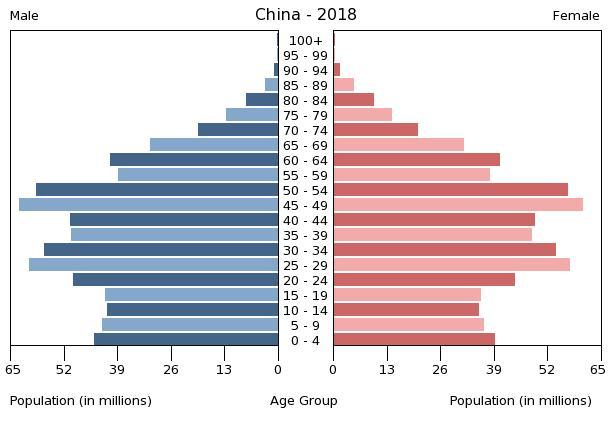
Personally I see China replacing a superpower, but the superpower being replaced is Russia. Russia is by nearly every metric declining and much faster than the USA.
The question is whether the USA will remain the dominant superpower or whether China will be a serious challenger by mid century. To really challenge the USA China would have to export more than just goods and services but also ideas and culture. I see a little bit of ideas being exported but very little cultural export happening.
US after Cold War and before 2008 will be remembered as a very special country by history. China or the post great recession US can only imagine that power and influence, they can't match it.
I think the 21st century will have China and the US as the two superpowers and the rivalry will be mostly economic and technological rather than military (via build up and proxy wars) and propagandistic.
I don't think it was the Great Recession that cut America down to size. I think it was the Iraq war. We "won" but it was a classic Pyrrhic victory that cost us both a ton of capital (I wonder if it caused the Great Recession) and our reputation on the world stage. We basically burned our Cold War victory on that. Bush II was the worst president of the last 100 years, in my opinion worse than Nixon and worse than Trump has been so far in terms of actual damage done. I don't think there would be a President Trump either were it not for that damage.
IMO, Russia will bide her time. They have a lot of intelligent, entrepreneurial people. Just need the government to loosen up a bit.
Or perhaps, most of the economy doesn't need GDP.
Their government needs to do more than just loosen up.
china has 4x our population and growing like a weed. it’s naive to think they haven’t/won’t/can’t eclipse the US economy. it’s another reason we should overhaul immigration policy to attract the world’s best minds while we still have the prestige to do so.
That's exactly what China and the United States are trying to do: To Africa.
China is no longer an export dependent economy, and moving manufacturing away from it, is hard.
The belief that manufacturing is about labor is simply false.
Dalio is pretty smart to smell the trend, maybe just because he is less idealogical driven but data-driven.
The much more critical thing for China is domestic consumption, which is where they focus the most and struggle the most. And a big thing there that has made other developed countries mad is that China's net imports haven't nearly kept up with their consumption growth. China has been meeting consumption domestically, which changes their mix, and makes everyone else understandably frustrated.
The US technically can, but then how many Americans would be able to buy the $2999 iPhone (for example) to keep Apple's current valuation?
It was accelerating before the pandemic.
https://www.scmp.com/economy/china-economy/article/3045141/c...
Steve Jobs told Obama manufacturing is never coming home, but it only partly had to do with cost. Impossibility of scaling like China was the major blocker.
Instead, I can see the world gradually shifting manufacturing to the next cheapest labor pool until there is none left, and then the ensuing equilibrium would have diversified supply chains, with any concentration largely being a function of 1) access to natural resources, and 2) access to expertise.
If it's that easy, it should have happened by now.
Why? It's not convenient. I'm just saying it could be done if necessary.
It isn't convenient because China also offers infrastructure, a rich supply-chain of similarly off-shored labor / parts and it's "the devil you know" vs. e.g. Vietnam
No it can't. An empire is the complexity*robustness of its supply chains, and supply chains are much less modular on the ground than they appear to be from the air.
The import of intellectual property could take decades or lifetimes to truly play out. If a country could take everything we know, without the debt, it would be a stellar starting point, but wouldnt instantly make them us.
This is a pretty bold claim, at least for now. People have been claiming this is the case for decades, but I still don't see it.
Western (US / EU) demand is what drives China's growth.
Technology in China is still by and large imported / copied.
The West can move manufacturing back home (or anywhere else with cheap labor) and China's economic prowess will be severely undermined.
China doesn't have a whole lot of leverage – it's cheap and convenient, but its cheap labor is easily replaceable, while Western demand (mostly US, really) and its technology are not.
EDIT: Additionally, the balance of power used to change much more frequently back when we didn't have nuclear weapons. From the introduction, it seems this analysis is entirely economic when it ought to also factor in politics (domestic and international), strategy and military power.