Let me however disagree strongly with your claims that this concerns 99.99999% of cases, and that the other commenter was talking about "what ifs" and "hypotheticals". That last claim seems to me to just be untrue: we know in fact that local laws, for example several american states, contradict WHO. Their point is valid. This could be a problem.
Now you have done well to state your belief of proportion clearly: only 1 in a million of the cases that will be removed should not have been removed, the rest are indisputably worth of banning.
I think you now need to go a step further: Why do you think that all but one out of a million cases will be justified? And do you really think that a discussion about edge cases is so unnecessary? Given YouTube's history with copyright trigger happiness, I wouldn't be so sure of these proportions, myself.
And I think that it is actually very healthy that the introduction of (increased) censoring should go hand in hand with public scrutiny and discussion, in fact I'd be very worried if we'd all just accept all of it uncritically.
Your point is, in general, well taken. I think you're right to point out commentators can blow fringe issues out of proportions. I am however unconvinced in this particular case.
Let me put it this way. If you're not just pointing to the mask example as a tentative, academic exercise, and sincerely believe that they constitute some non-trivial percentage of videos that will really get taken down, you should come out and say so. And if you don't want to commit to that, I have a hard time understanding what, other than frivolous internet contrarianism, motivates you to emphasize those examples.
>do you really think that a discussion about edge cases is so unnecessary?
Yes.
If this were the case, they could simply announce that their policy is to ban videos that blame coronavirus on 5G.
In practice, they will probably be banning a lot more videos than simply ones which blame coronavirus on 5G.
There's nothing in any of my comments that suggests the policy would only address the specific case of 5g.
>The 99.99999% case scenario concerns videos that are saying '5g caused coronavirus', and meanwhile you're trying to tie up everybodies attention with special cases that don't represent the majority of cases. People get disoriented with special cases and trick questions.
Why not actually defend your arguments and attack mine instead of circling about the issue with "this actual real life example is a what if hypothetical" and hastily drawn up dichotomies?
(Particularly this hammering that these are contrived examples is bordering on the ridiculous: we know this is true!)
You've lost your benefit of the doubt with this comment.
I'm just going to note you agree that these examples are contrived yet nevertheless want to debate them, apparently to performatively exhibit your appreciation for the values open-mindedness and free speech.
That's a not a constructive use of anybody's time. It's a frivolous distraction. Youtube is doing what they can to save lives by stopping misinformation in the face of a global pandemic. If you're more interested in turning this into a navel gazing exercise, I'd say you're suffering from a serious lack of perspective.
I'm shocked that anyone would believe that this is an honest framing of YouTube's motivation.
How about political pressure?
Your argument seems to rely on the fact that we know the WHOs recommendation on masks is wrong.
Exactly. There's absolutely no reason to trust Google about anything. This is a totally CYA move. That is, Google's only concern is avoiding controversy, whether it's about copyrights and trademarks, non-mainstream politics, non-traditional medicine, or whatever.
Even so, it's their platform, and they have the right to do whatever they like with it. I avoid it, and I recommend that others avoid it, but we're all free to choose.
These are not mere edge cases. We have structured our public organizations in a way that gives credentialed "experts" enormous amounts of power, but without making sure they are _actually good at what they do_. This move by youtube further enshrines credentials on top of the grave of competence. This is how you end up with the FDA banning covid tests for more than a month, how you end up with a completely ineffective CDC, or (to return to the topic at hand) the WHO spreading nonsense.
The fact of the matter is that the twitter shitposters I follow were far ahead of all the major health organizations on this topic, but if they mention covid in a tweet they'll get their account suspended now. This censorship is not about censoring bad info, it's about censoring any "non-official" info regardless of its veracity.
[0]: https://pbs.twimg.com/media/EUN7LIXUMAY_2DI.jpg
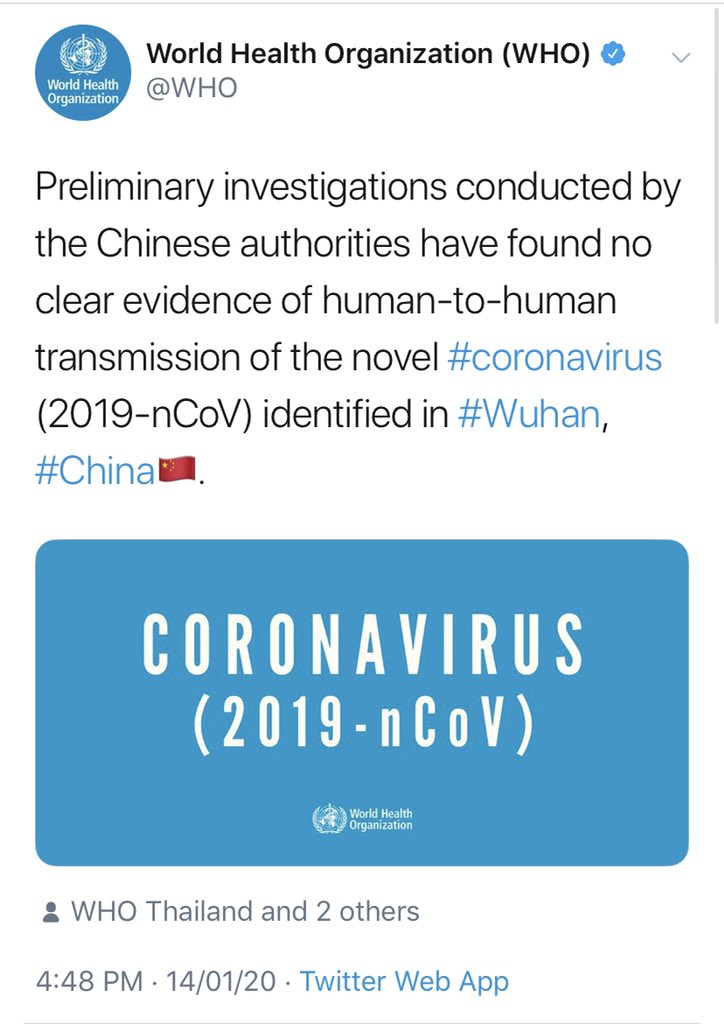
[1]: https://pbs.twimg.com/media/EVCIDfoWAAc-mq0.jpg

[2]: https://www.who.int/images/default-source/health-topics/coro...

Meanwhile Youtube is going to take down videos claiming 5g caused the coronavirus, which are obviously wrong and obviously causing harm. And instead of looking at cases of obvious misinformation the policy targets, you would rather we go down a rabbit hole of idiosyncratic disputes about the the meaning of WHO statements, all while keeping up blatantly inaccurate misinformation.
Tying ourselves up in that frivolous debate would let misinformation flourish.
[3] https://www.vox.com/2020/1/23/21078325/wuhan-china-coronavir...
Geeks, more than most, should be savvy about scientific progress.
Coronavirus is still very new. We're learning new things every day. eg Today it's risks from blood clots.
I'd only be worried if the experts (WHO, CDC) failed to update their position over time.
Aside: Retric's comment earlier about AIDS killing 770k every year reminded me how long it took to understand anything about HIV, much less cope. And all the senseless unnecessary misinformation and backlash which thwarted progress.
> People are stupid -- especially people who think they're smart contrarians.
Speak for yourself.
You might be in earnest, but you're behaving like a contrarian who thinks they know more than they do. "You have become the very thing you sought to destroy."
It's still misinformation, and it's specifically misinformation that makes the WHO complicit in 187,420 deaths and counting. There had been plenty of indications by that point that - even if human-to-human transmission had not yet been confirmed - it was still evidently spreading beyond people at ground zero.
That is, I ain't sure how you're able to read it as anything but a blanket declaration. The WHO outright said that there's no evidence of human-to-human transmission; this is an outright lie, given that the sheer number of people by that point who were hospitalized with the virus without ever having visited the Huanan Seafood Wholesale Market would be, I would argue, evidence.
> When read [2] it's clear that it is not a blanket declaration not to wear masks.
No, but it's advice that - if followed - would make any asymptomatic carrier dangerous. The point of wearing masks is not to prevent yourself from being infected (no mask is sufficient for that), but rather to minimize the risk of you spreading SARS-CoV-2 to other people by breathing on them.
The WHO seems to have a chronic pattern of being one or more weeks behind the curve on its assessment of COVID-19 and the mitigation thereof. Needless to say, I trust them about as far as I can throw them (which is 0 meters, given the impossibility of throwing an entire organization), and that YouTube is putting them on any kind of authoritative pedestal despite these blatant missteps is ignorant of that behavioral pattern.
Apparently yes, given that it's a bit of a smoking gun. Namely because:
> the Huanan Seafood Market was suspected as a source of the virus but it could have come from somewhere else too.
It was (to my knowledge) the only suspected source for quite a while (up until the later discovery that the currently-known "patient zero" had no connection to it, and even then it's still considered ground zero for the outbreak). If there was any indication that "it could have come from somewhere else", and that "somewhere else" is evidently a place where even fewer patients in common visited ("evidently" because if it was a common factor it would've been mentioned instead of or alongside the seafood market, and yet... no such location was mentioned), then that serves as even stronger evidence that it's somehow spreading between humans, even if the mechanism is unknown.
If even a "random programmer" on Hacker News can point this out, then I strongly suspect there were a number of doctors and nurses and other personnel on the front lines who could have and did point this out, too.
Plus, China knew as early as 31 December that the "novel coronavirus" was related to SARS (leaking that info is what got Dr. Li Wenliang in trouble), which was already known to spread human-to-human. Seems like "it looks like SARS and probably has similar spreading mechanisms" would be a reasonable assumption when information is limited: better safe than sorry (and in this case, 180,000+ deaths later, "sorry" indeed). I obviously don't blame the WHO for the entirety of that (or even necessarily China; my government dragged its feet, too, like most governments), but the WHO is certainly not blameless, either, and that it continues to spread misinformation like how not everyone should be wearing masks doesn't leave a whole lot of room for me to give them the benefit of the doubt.
Yes, but the only suspect does not mean conclusive evidence.
>Plus, China knew as early as 31 December that the "novel coronavirus" was related to SARS (leaking that info is what got Dr. Li Wenliang in trouble),
This is untrue, Li Wenliang said it was SARS, and it's actually another virus. He did not know it was related to SARS but assumed it was SARS due to the symptoms.
edit: secondly he did not leak the information, he send it in a private chat to friends, one of whom leaked it.
That's... exactly my point. The evidence pointed in favor of human-to-human transmission specifically because there was no definitive common source.
> Li Wenliang said it was SARS
SARS-CoV-2 is literally a different strain of the virus that caused the original SARS (SARS-CoV; now called SARS-CoV-1). "It's SARS" is reasonably accurate (especially given the information available at the time), even if not quite specific; it's like calling Ebola, well, "Ebola" without knowing if it's specifically Zaire ebolavirus or Sudan ebolavirus or Reston ebolavirus or what have you. Regardless, if the public and Chinese authorities had treated it like how said authorities should've treated SARS two decades ago, the world would very likely be in a much better position than it is now. And likewise, if foreign governments (including my own) believed it to be SARS instead of just some weird flu, they might very well have restricted travel earlier and imposed stronger quarantines early instead of waiting until it was too late to be effective.
GP comment is a bit too categorical but it's not even a contested fact that WHO initially downplayed the epidemic, put out recommendations to keep borders open, and still continues to spread disinformation e.g. about not needing to wear masks.
I won't even say anything about the string of corruption allegations and ties to China.
And then the fact that WHO basically pretended Taiwan doesn't exist[1] and is clearly aligned with Chinese political interests over even its primary mission.
Giving absolute authority over 'truth' to an entity with such a shitty track record is insane.
[1]: https://twitter.com/studioincendo/status/1243909358133473285
The WHO has a list of medical guidance. I've yet to see anyone in this thread complain about any of the medical guidance the WHO has provided. The most relevant is likely this page: https://www.who.int/emergencies/diseases/novel-coronavirus-2.... None of this is controversial.
> put out recommendations to keep borders open
This is incorrect. The WHO recommended against banning travel from certain parts of the world. Completely closing you borders (to non-citizens) was not covered. You can read the WHO's actual statement[1], and it's well reasoned. The value of unrestricted travel for emergency equipment and personnel outweighs the value of restricted travel from certain areas. But short term restrictions are alright if necessary to build up infrastructure (iow, to flatten the curve temporarily).
> about not needing to wear masks.
They recommend against random everyday people using medical masks. Given the PPE shortage, this is not unreasonable advice. They defer to local authorities for more stringent recommendations.
> And then the fact that WHO basically pretended Taiwan doesn't exist
Does this impact their medical advice?
[1]: https://www.who.int/news-room/articles-detail/updated-who-re...
Go back and actually read the full set of WHO statements in mid-January. They have a bunch of statements saying that nations should get prepared, one saying that specific studies haven’t yet found hard evidence for person-to-person transmission (because at that point most of the cases they’d managed to find were tied to the market). The WHO never, ever said that it can’t be transmitted, and they absolutely never said that people should do nothing about COVID-19. They were urging nations to act for months before they actually did.
If this virus had come in some African country, they would have no problem in closing everything out - as anyone that understands tail risks would. But because it's China, then the recommendations for actions come after the evidence can not be hidden anymore. It is immoral.
That's a very strong and very stupid claim.
The fact that WHO made the same claim and the fact that it's disputed by most actual experts around the world, hence ongoing travel restrictions, is a pretty good example of why there can't ever be one arbiter of 'truth' in a free society.
South Korea never banned travel.
Alright, show us some peer reviewed studies, preferably a meta-analysis, that shows it's stupid.
edit:sp
If they had started with the strong restrictions and then loosened it up after more information/debate/evidence of safety, then things would be better. But instead they let it go and claimed that "absence of evidence" is the same as "evidence of absence". Completely irresponsible. This is why the WHO's response to it is so infuriating.
No. There is no call for a "global travel ban". Are you deliberately misunderstanding what I am saying?
The call is (or better, it was, now is too late) for a restriction of mobility in the place of an outbreak, until they either "fizzle out" or are controlled/understood/resolved by development of treatment and/or vaccine.
If an outbreak is likely to "fizzle out", then the restriction will be for a short time and localized to the source and chances of spreading around the globe is reduced. And in case the outbreak is highly contagious like this one, an early and swift restriction would prevent the pandemic in the first place, or at the very least slow down things as much as possible to avoid exponential explosion of cases.
THAT IS THE KEY POINT! The WHO should be asking for an early local lockdown so that we wouldn't have to act later in a global one.
Hard to find a counterexample when n=0.
My "being rude" is due to the fact that the WHO's actions and directions have been mostly politics washed up in science instead of properly looking for guidance for the well-being of people. It has cost hundreds of thousands of lives.
They should've asked for restrictions. They should tell people "wearing a mask may not help you, but not wearing is certainly worse, so go ahead and get masks." All we get instead is CYA and bureaucratic responses. They need to be held responsible for their part in this mess.
If this virus had come in some African country, they would have no problem in closing everything out - as anyone that understands tail risks would. But because it's China, then the recommendations for actions come after the evidence can not be hidden anymore. It is immoral.
Now I agree the coronavirus situation is without precedent, but if you're going to make assertions that they would have done X here while only doing Y there, you need to back it up with some evidence for your claims about X.
Ok, fine. Never mind the fact that this is also a mistake of conflating absence of evidence for evidence of absence. Your objection does not invalidate what I am saying regarding the biggest problem with the WHO: their failure in defending early action and in showing themselves to be a political-bureaucratic organization more preoccupied with its own existence than in achieving the goals it was supposed to.
That's how you interpret 'no clear evidence from preliminary investigations' is it?
Why bother attempting to twist the WHO's words? What does it get you?
The relevant timeline: Li Wenliang (a doctor in Wuhan) blew the whistle on Dec 30. 4 days later he was harassed by the Chinese police for "spreading rumors". On Jan 8 Li Wenliang was infected. On Jan 12 he was put in the ICU. On Jan 14 WHO denied human-to-human transmission.
Li unfortunately passed away in early February.
And by the way, there were warnings from Taiwan about human-to-human transmission very early on, which the WHO ignored: https://www.ft.com/content/2a70a02a-644a-11ea-a6cd-df28cc3c6...
December 25: Wuhan Municipal Health Committee posted on social media, “An Urgent Notice on the Treatment of Pneumonia of Unknown Cause.”
December 31: China contacts WHO and informs them of “cases of pneumonia of unknown etymology detected in Wuhan.”
January 1: Huanan Seafood Market is closed.
January 3: China informs US CDC and other countries
January 10: The gene sequencing data of COVID-19 is posted online and shared with other researchers.
January 23: China goes into lockdown.
Taiwan, themselves, had a press conference where they showed the email they sent the WHO and it did not say human-to-human transmission.
> As there were no confirmed cases in Taiwan at the time, the [Taiwan] CDC could not definitively state that there had been human-to-human transmission of the disease, he added.
> “We would really be giving a misleading message if we firmly stated that there was human-to-human transmission, so we clearly alerted the IHR about the information we received,” he said.
https://www.taipeitimes.com/News/front/archives/2020/04/12/2...
This has been proven to not be true. They had no more information than anyone, and the WHO also did not exclude the possibility of H2H at any point.
If the WHO had a more nuanced stance, they should've made that clear - e.g. "We don't have evidence yet that the #coronavirus spreads human-to-human, but it's possible".
A Jan 1st interim guidance: https://www.who.int/docs/default-source/coronaviruse/surveil...
The first thing they recommend:
"The primary objectives of surveillance are to: 1. Detect confirmed cases/clusters of nCoV infection and any evidence of amplified or sustained human-to-human transmission;"
Then on Jan 10th:
https://apps.who.int/iris/bitstream/handle/10665/330374/WHO-... "As information about the etiology, clinical manifestations and transmission of disease in the cluster of respiratory disease patients identified in Wuhan is limited, WHO continues to monitor developments and will revise these recommendations as necessary."
Also, those documents seem to be focused entirely on laboratory testing and surveillance, not on, you know, treatment or prevention (beyond one section on preventing infection among medical/laboratory personnel, whence I pulled that quote) or risk assessment.
If these are the documents used for policymaking, then it seems their lack of communication skills extends even here. They'd benefit from a more bottom-line-up-front approach and making these suspicions more explicit; the documents as they stand read as a wishy-washy "well we don't quite know how this spreads and don't want to jump to any conclusions...", and it should be entirely unsurprising that policymakers interpreted that as "aight, WHO hasn't said it spreads between humans so nothing to worry about".
If that is true, then you are just categorically not competent to be making interpretations of scientific statements. In a separate comment you cited a handful of sources that, on my reading you had clearly not interpreted accurately, and now you're advancing an argument that depends on a fallacy so obvious that would be dispensed with by a JV debate team.
There's evidence that human to human transmission was documented on January 14? That would be the first time I hear about it. Do you have a source?
Dr. Li made social media posts about the virus which Chinese authorities forced him to take down and sign a written confession and promise not to do it again.
Now the question is do you have a source that shows the exact steps, if any, the WHO took to verify the “preliminary investigation” as reported by the Chinese authorities? Because from the sound of it, Chinese authorities reported these claims to WHO and WHO turned around and published the Chinese claims without performing any independent investigation (they certainly didn’t know about Dr. Li at the time).
But I will respond to your goalpost shift as well in defense of Li Wenliang who's a celebrated individual in China but turned into a cartoon meme in the west.
Li, an ophthalmologist, has no first hand knowledge of the virus nor was he trying to "whistleblow". He received a private group message within the hospital from ER department director and he simply re-shared the message to other private groups with his classmates.
The ER director, Ai Fen, was the source of the hypothesis that some patients in the hospital had, incorrectly, SARS and she was the right channel to escalate in the first place. And her escalation was successful when 1 nurse was observed to have been infected on January 11th.
The only piece of new information Li brought to the world was on January 30th when he tested positive.
-why did Chinese police get involved and force Dr. Li to remove social media posts about the virus and sick patients?
-who were the Chinese Authorities, by name, who represented their “preliminary investigation”
-what steps did WHO take to independently verify what they were told by Chinese Authorities about person to person transmission before posting this information to the public on Twitter?
Edit:
No offense but you seem like one of China’s paid trolls, throughout this thread you are accusing everyone who mentions facts of “moving the goal posts” and otherwise attacking “the West”. The West didn’t give the WHO knowingly false information and use their political power to have the WHO tweet the falsehoods to the public with #TheWest
Now while I agree that WHO is a poor yardstick of scientific truth, that is a long way from saying it's useless. With all its faults I prefer to the disinformation and quackery that are flying about, and indeed pouring out of the White House.
Everyone understands the difference.
>The WHO opted for an excess of scientific caution
No scientific caution would have been independently verifying China’s representations and throughly reviewing their claims before retweeting it to the public.
Not accurate. The commenter that spawned this entire sub-thread claimed that 'no clear evidence' equated to 'does not spread.'
So even assuming the commenter worded it properly “no clear evidence” WHO tweet is still misinformation to the public because they Tweeted on 01/14/20 but as early as 12/30/19 China had evidence the virus was was being transmitted person to person in the Wuhan hospital, and on 01/08/20 the a Dr. had contracted it.
You can't dispute that, so you want to shift to a broader question. I think xster already answered the claims that you are repeating now, and your reply to xster was to expand the conversation even further with even more non-sequiturs and to suggest they were a paid troll.
This is the pattern that keeps repeating itself. Someone confidently declares the WHO is spreading misinformation for reasons that turn out to be inaccurate, but take lots of time to refute. And those efforts to focus on previously made statements are met with meandering replies constantly seeking to 'broaden' the conversation.
You claim they claimed it does not spread from human to human, but the tweet talks about preliminary research. If you don't understand how science works, don't make such rash opinions on it.
For example some in the Chinese government think coronavirus was released by the US Army while some in the US intelligence community think coronavirus leaked from a Chinese government lab in Wuhan. Another example, some US government officials think chloroquine is a COVID cure, while others disagree or remain undecided.
Google should instead have a list of allowed sources (e.g. WHO, CDC, NHS, etc) and explicitly disallowed sources (states owned media organizations, politicians and intelligence agencies).
That's an excellent point.
> Google should instead have a list of allowed sources (e.g. WHO, CDC, NHS, etc) and explicitly disallowed sources (states owned media organizations, politicians and intelligence agencies).
Well, isn't the BBC at least government affiliated? And yes, I'm aware that it's supposedly entirely independent.
And about intelligence agencies, the NSA has contributed hugely to computer security. It's true that they're arguably the world's greatest hackers, but that actually increases their credibility. Except for the backdoors that they hide ;)
If the intelligence agencies are any good then they do not release information under their own name.
They'll have some lazily built ML algorithm that flags the whole channel with a video that mention 'corona' and demonitize them so they can collect money and benefit from the videos but not have to do any payout.
> so they can collect money and benefit from the videos but not have to do any payout.
No ads show on demonetized videos.
If it is obvious, why does it need banning?
The bigger problem is that many people haven't learned how to process information properly. It's frivolous to just demand banning. Banning should only be a first step among many to spread media competence. How can google ban corona misinformation but just recently has made ads and links almost indistinguishable on its result page?
>Now we need to go and look in families to find those people who may be sick and remove them and isolate them in a safe and dignified manner so that's what I was saying previously; the transition from movement restrictions and shut-downs
I believe unlawfully removing people from their homes and restricting their movement is against the constitutions of several countries, mine for sure. According to this transcript directly from the WHO, this is what they advocate and recommend. Speaking out against this falls under directly contradicting the WHO.
Anyone who doesn't like YouTube's policies are welcome to post their content on Facebook to share with their friends, on Twitter, stream it live on Twitch, or, host it themselves on their own servers.
YouTube is part of a gigantic, public company with more power than many world governments. In a very real sense, Alphabet is more powerful than a hypothetical Standard Oil that also owned one of the most popular two newspapers in every single city in the US.
Their ability to shape markets, public opinion and even elections in 100+ countries is unprecedented and very easy to use with plausible deniability. Facebook is a similar sort of entity. In aggregate, the two control more personal communications than the postal service.
The notion that only a government can be a threat to free speech is outdated and naive.
Your snarky condescending tone is not helpful.
Just because a person reaches a different conclusion than you doesn't mean that they lack information like this.
I think it's dangerous to society to give corporations that have as much power as YouTube a pass simply because they are not government entities.
...criticize them on HackerNews.
You mean the Facebook that just banned WhatsApp message forwarding, despite their service supposedly being end-to-end encrypted? It didn't take long for that little sham to collapse did it? Sure, go self publish and watch as the self appointed guardians of the galaxy do everything in their power to stop you speaking.
We're not debating Google here. Not really. We're debating the whole ethos of Silicon Valley liberals which has become, "we're smarter than you and will ensure you think what we want you to think". Except they're not smarter. Having worked there for years I can confidently say that whilst there might have been some merit to that argument a long time ago within the scope of computer science, but years of endless hiring has now made them distinctly average groups of people with no edge over the rest of the world. Yet they continue to believe merely being a part of a particular organisation allows them to instantaneously decide the correctness of any argument.
I always thought that their job was to get involved in arguments over public health.
2. Both Taiwan and China claim to be China, so that statement wasn't even factually wrong.
Taiwan nowadays is kinda forced by China to claim to be China actually.
After all, it is crystal-clear to all right-thinking people that if the world were just, he would currently be in jail. Referring to him as a president is explicitly taking a political position on the subject...
Staying on topic, you grossly misrepresented the situation by characterizing WHO's implicit endorsement of Taiwan's non-existance as a state as a matter of mere "argument over borders".
Why do you think I feel that way? Why do you not feel that way about the example I outlined? Is it because one topic (Trump's criminality) is controversial in the Western world, while the other one (Taiwan's independence) is not?
No, they don't tell you what to do, it is your government that does that, or in this case a private entity.
But anybody with a brain would go for the scientific consensus.
(Even though, just to be clear, I don't agree with what YouTube is doing here)
Not one of these statements reflects any stated positions of the parent. All are hyperbolic mis-characterizations.
> without a whole lot of correctly collected data (emphasis on the correctly collected because data are worthless unless correctly collected, i've personally had to throw out hours of work because of sampling errors)to back anything up.
"Deaths: 191,081" would beg to differ with their conclusion that there isn't a whole lot of correctly collected data. Further, we have incredibly good evidence that social distancing works. We could see it on a state by state and week by week basis in the US, as well as in other nations when they implemented similar policies. There's a whole lot of data backing up lockdowns.
There's also literally hundreds of academic papers on the subject would also disagree. I'm not sure what they expect, but you don't generally get to run longitudinal double blind studies in the midst of a pandemic (although now we're finally getting to the point that you can, with, for example, evidence that things like cloroquine don't improve outcomes).
I'm also not sure what home invasions and human rights violations they're talking about, I haven't heard of any, so I'm curious to see if that's substantiated. I doubt it is.
If you're anti-consensus, you're anti-science.
And yes, it's OK to be skeptical, all good scientists are skeptics, but skeptics don't reject consensus, only denialists do.
Examples like these are frivolous. There's a heartland of obvious, flagrant misinformation that is indisputably worth banning and for which a moral case exists to ban immediately: '5g caused corona, this home remedy will cure it!' etc.
The go-to move of internet commenters craving debates is to look past the 99.9999% of cases that will get taken down and to tie everyone up in debates about hypotheticals.
Instead of telling me about your special what-if edge case, tell me whether you think the example you are bringing forward represents the heartland of content that is being targeted by this policy. Be clear about what percentage of cases you think are represented by your special example.