News for hackers. Stuff that matters.
Re:OsFree project: OS/2 Replacement by Yoric on Monday April 20, 2020 @12:47PM (#22925640)
Well, the Windows NT family (which includes Windows 2000, Windows XP, Windows 7, Windows 10) is a descendant of OS/2. In fact, Windows NT 3.1 was basically a reskinned OS/2.

I remember fond days of playing several MSDOS games at once under OS/2 (Elite: Frontier and Colonization, iirc) while Windows 95 failed to play any of them :)

Re:OsFree project: OS/2 Replacement by hvs on Monday April 20, 2020 @01:07PM (#22925862)
This isn't quite true. Microsoft and IBM were working on OS/2 together and Microsoft got fed up with the development delays and decided to build their own system. So NT was designed from the ground up. It originally had multiple subsystems (Win16, Win32, Posix) one of which included an OS/2 1.0 subsystem.

https://www.itprotoday.com/compute-engines/windows-nt-and-vm...

Re:OsFree project: OS/2 Replacement by WorldMaker on Monday April 20, 2020 @02:46PM (#22926973)
With WSL bringing back the spirit of a POSIX-flavored subsystem, it might be fun to see some other retro-computing subsystems such as a modern OS/2 subsystem, though I can't think of a good reason to do that other than fun.

Maybe if someone can think of a good reason to need OS/2 running on Azure it could happen. Maybe there's a bank somewhere with the OS/2 apps investment and enough money to throw at Microsoft (and IBM) somewhere to make it happen.

Re:OsFree project: OS/2 Replacement by rrdharan on Tuesday April 21, 2020 @10:29PM (#22941434)
> Maybe if someone can think of a good reason to need OS/2 running on Azure it could happen.

FYI you can do this today with VMware either on your own hardware, or within AWS, running ArcaOS 5 (the successor to eComStation, i.e. the maintained/supported flavor of OS/2 that lives on). Though I would be shocked if anyone has actually tried it:

https://aws.amazon.com/vmware/faqs/

https://www.arcanoae.com/wiki/arcaos/technical-specification...

Re:OsFree project: OS/2 Replacement by rrdharan on Monday April 20, 2020 @05:20PM (#22928703)
Also Microsoft already gave up on WSL1's subsystem approach and just made the VM-based WSL2, focused on fixing the UX issues with VMs.
Re:OsFree project: OS/2 Replacement by WorldMaker on Tuesday April 21, 2020 @12:18PM (#22936327)
WSL2 is certainly doing fewer kernel interactions as a subsystem than WSL1, but my impression is that it is still classified as a subsystem in the way that it launches and manages its more VM-like approach.

The comparison/analogy I've heard, and I'm not sure it is apocryphal but it certainly makes sense to me, is to the Xbox One's game subsystems, which while rarely described in great detail from an NT Kernel engineering standpoint, when they are briefly described as such they are often described as subsystems and that they are "VM-like" in operation.

Re:OsFree project: OS/2 Replacement by rrdharan on Tuesday April 21, 2020 @04:24PM (#22938976)
The point is in WSL2 rather than emulating the Linux kernel, they just run it:

https://en.m.wikipedia.org/wiki/Windows_Subsystem_for_Linux

https://github.com/microsoft/WSL2-Linux-Kernel

The Xbox One also uses a hypervisor to run multiple OSes, one of which was Windows 8:

https://en.m.wikipedia.org/wiki/Xbox_One_system_software

https://wccftech.com/xbox-one-architecture-explained-runs-wi...

They started doing that with the Xbox 360.

Re:OsFree project: OS/2 Replacement by WorldMaker on Tuesday April 21, 2020 @05:25PM (#22939498)
Yes, I mentioned all of that. All I was saying is that WSL2 is still technically a subsystem by name, even if it is "just running the Linux kernel". NT Subsystems have always varied in nature of how they operate. Yes, it's disappointing that WSL2 is "less cool" or "less proper" a subsystem, but they still call it a "subsystem for Linux", not a "Windows VM Host for Linux" or anything like that. (It might be less confusing between WSL1 and WSL2 if they had had chosen a name like "Windows VM Host for Linux" for WSL2.) To the NT Kernel naming perspective these "micro-VM hosts" still appear to be called "subsystem", even if they are doing so much directly less Kernel work than a "proper" subsystem in the Win16/Win32/Classic POSIX/OS/2 1.x or even WSL1 sense.

Though this is getting into semantic weeds and drifting away from the original point that more subsystems, especially retro-computing inspired ones would be fun to see, even if they are more just "micro VM hosts" than full NT Kernel "flavors".

(ETA: Also, it's a small stretch that Microsoft "gave up" on the WSL1 approach. They will still be supporting WSL1 side-by-side WSL2. The numbered name approach makes it seem that it is a strict "upgrade", but it's more a side-by-side trade-off option than the numbers imply.)

Re:OsFree project: OS/2 Replacement by rrdharan on Tuesday April 21, 2020 @10:19PM (#22941378)
Yes, they kept the name.

"NT Subsystems have always varied in nature of how they operate."

Not sure what you mean here. There were classically three environment subsystems and they all fit in to the architecture in a consistent manner: https://upload.wikimedia.org/wikipedia/commons/5/5d/Windows_...
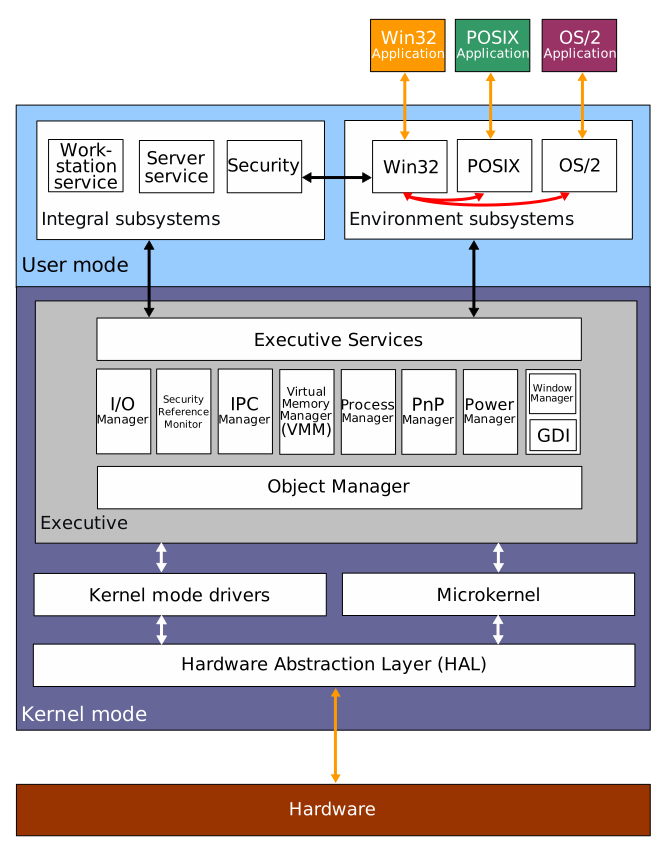
The fact that if you look at the full callstack and address space of a regular Linux process running in WSL2 you won't see the "classic" NT Kernel anywhere feels like a pretty big difference to me.

Yes they are still supporting WSL1. Microsoft's support policies are generally excellent. But it seems very unlikely there will be an interest in providing OS emulation or compatibility at the userspace/OS kernel boundary using the classic subsystem architecture, as a technical direction for the Windows team to invest in going forward. It's an architectural dead-end.

Re:OsFree project: OS/2 Replacement by Stranger43 on Monday April 20, 2020 @06:23PM (#22929440)
There is always an 100 different stores when corporations break up.

The reality seems to be that MS kind of wanted something more lightweight that could be sold to existing pc owners, where as IBM was happy to just push the requirements to the point where OS/2 would require an fairly high end system(preferably an PS/2 from IBM to run).

For some markets where the expensive PS/2 systems were not considered too expensive as in the case of banks and the like OS/2 sold well enough for IBM to profit off it. But the wider market went with the less hardware hungry and at least initially less capable windows.

If i recall correctly NT was slow to mature into an mainstream OS and did not really start replacing OS/2 until the late 90ies and only really took of for consumers when XP were released.

Re:OsFree project: OS/2 Replacement by cestith on Tuesday April 21, 2020 @06:34AM (#22933654)
I see a lot of people forgetting Microsoft's illegal "white box tax" as the years go on. Anticompetitive practices meant many small businesses and home users were seldom going to use anything that cost them money on top of the DOS or Windows they already had to pay for just to own a computer.
Re:OsFree project: OS/2 Replacement by rlkf on Monday April 20, 2020 @01:39PM (#22926255)
Kernel-wise, there isn't much common code between OS/2 and NT. Windows NT 3.1 is more like VMS with the Windows graphical subsystem ported on top of it.

But yes, running OS/2 was fun days, much better than Windows 3.11 (if you had memory enough).

Re:OsFree project: OS/2 Replacement by guessbest on Monday April 20, 2020 @02:05PM (#22926566)
Sorry to be pedantic, but Windows NT 3.5 was the VMS version of windows to compete with OS/2, and Windows 3.0 and 3.1 was the mass market version built on top of DOS. If you bought through a small shop, they would add a batch file to autorun the windows executable that launched the GUI from an ini file. Nobody had the Windows 3.11 version if I remember correctly
Re:OsFree project: OS/2 Replacement by caspper69 on Monday April 20, 2020 @02:41PM (#22926934)
This is just not true.

Windows NT has ALWAYS been based on Dave Cutler's code, which shares a lot with VMS, because he architected that as well.

Windows 3.0 and 3.1, the non-NT flavors, ran on DOS.

Windows 3.11 added networking to Windows 3.1, and was wildly successful. Google Windows for Workgroups.

Re:OsFree project: OS/2 Replacement by guessbest on Monday April 20, 2020 @04:00PM (#22927852)
I don't think you read my comment. I know that Windows 3.x were not based on NT. They were DOS shell extensions essential that could run DOS, but not as well as OS/2. Windows 3.11 didn't sell hardly at all, but everyone mentions it like it did. It is a common mistake. Windows NT 3.1 was just something I forgot about. Windows 3.51 was the popular version. All this was before the internet as we knew it took off. People only had access to what was available in the book store or computer store, and online updates was usually for enterprise subscribers only.
Re:OsFree project: OS/2 Replacement by Aloha on Monday April 20, 2020 @01:02PM (#22925814)
NT 3.1 was not just a reskinned OS/2, it was a new kernel, and new internal architecture.
Re:OsFree project: OS/2 Replacement by jmspring on Monday April 20, 2020 @12:51PM (#22925686)
Yep, the schism between IBM and Microsoft let to the two products. I preferred OS/2 and workplace shell at the time. Heck, I was using OS2 up until 2000ish. Then got sucked into the land of BSD.

I still have a vm floating around of OS/2 Warp so I could play the original Galactic Civilizations from Stardock

Re:OsFree project: OS/2 Replacement by pjmlp on Monday April 20, 2020 @01:25PM (#22926071)
One of the few things I missed was not getting SOM instead of COM, but we have UWP now, and the DCOP / AIDL / gRPC variants.

And the UI had more powerful concepts, but I guess too advanced for most users.

Re:OsFree project: OS/2 Replacement by llarsson on Monday April 20, 2020 @01:44PM (#22926324)
Please write about some of these UI features, I would love to hear about it! I never got to play with it, because it demanded a much better computer than I had.
Re:OsFree project: OS/2 Replacement by pjmlp on Monday April 20, 2020 @02:36PM (#22926878)
I also did not own it, but got to play with it at conferences and read quite some literature back then.

Here is some information that does better justice than I would be able to do,

https://en.wikipedia.org/wiki/Workplace_Shell

http://www.edm2.com/index.php/Extending_the_Workplace_Shell_...

https://books.google.de/books?id=GL59pngdbfQC&pg=PA542&lpg=P...

https://books.google.de/books?id=yurvRCerf_UC&pg=RA1-PA515&l...

Re:OsFree project: OS/2 Replacement by guessbest on Monday April 20, 2020 @02:12PM (#22926645)
I think the GP was referring to features that were advanced for the day, but these days we take for granted, like a system control panel controlled entirely through a GUI rather than any text files like Autoexec.bat and config.sys
Re:OsFree project: OS/2 Replacement by ptx on Monday April 20, 2020 @06:47PM (#22929675)
Also features that we should be able to take for granted but are broken or missing in current systems, such as spatial file managers.

In OS/2 and classic Mac OS, folders you opened would remember their window position and other properties (including custom background image in OS/2) so that you could find things in a very human way by remembering e.g. "the small blue window in upper left".

Windows 95 copied this in a slightly broken way – you could open the same folder in multiple windows at the same time and give them conflicting properties, which breaks the model. Windows 98 (and the IE 4 upgrade to Windows 95) merged the whole thing with the web browser which broke it even more.

Mac OS X also had a half-broken implementation of this, since the file manager tried to combine the Mac OS Finder with the NeXTSTEP file manager which was completely different. John Siracusa has written extensively on this topic: https://arstechnica.com/gadgets/2003/04/finder/

Re:OsFree project: OS/2 Replacement by ptx on Monday April 20, 2020 @06:34PM (#22929555)
What were the advantages of SOM compared to COM?
Re:OsFree project: OS/2 Replacement by pjmlp on Tuesday April 21, 2020 @02:23AM (#22932515)
I really liked that it had support for metaclasses.

Here you can find a comparison, naturally biased towards SOM.

http://www.edm2.com/index.php/The_System_Object_Model_%28SOM...

Here is some SOM documentation, https://ecsoft2.org/ibm-somobjects-developers-toolkit-os2

However, UWP now makes COM quite nice to use, this was what VB 6 and C++ should have turned into, instead of racing after Java, and taking 20 years to do a full circle.