Maybe if someone can think of a good reason to need OS/2 running on Azure it could happen. Maybe there's a bank somewhere with the OS/2 apps investment and enough money to throw at Microsoft (and IBM) somewhere to make it happen.
FYI you can do this today with VMware either on your own hardware, or within AWS, running ArcaOS 5 (the successor to eComStation, i.e. the maintained/supported flavor of OS/2 that lives on). Though I would be shocked if anyone has actually tried it:
https://aws.amazon.com/vmware/faqs/
https://www.arcanoae.com/wiki/arcaos/technical-specification...
The comparison/analogy I've heard, and I'm not sure it is apocryphal but it certainly makes sense to me, is to the Xbox One's game subsystems, which while rarely described in great detail from an NT Kernel engineering standpoint, when they are briefly described as such they are often described as subsystems and that they are "VM-like" in operation.
https://en.m.wikipedia.org/wiki/Windows_Subsystem_for_Linux
https://github.com/microsoft/WSL2-Linux-Kernel
The Xbox One also uses a hypervisor to run multiple OSes, one of which was Windows 8:
https://en.m.wikipedia.org/wiki/Xbox_One_system_software
https://wccftech.com/xbox-one-architecture-explained-runs-wi...
They started doing that with the Xbox 360.
Though this is getting into semantic weeds and drifting away from the original point that more subsystems, especially retro-computing inspired ones would be fun to see, even if they are more just "micro VM hosts" than full NT Kernel "flavors".
(ETA: Also, it's a small stretch that Microsoft "gave up" on the WSL1 approach. They will still be supporting WSL1 side-by-side WSL2. The numbered name approach makes it seem that it is a strict "upgrade", but it's more a side-by-side trade-off option than the numbers imply.)
"NT Subsystems have always varied in nature of how they operate."
Not sure what you mean here. There were classically three environment subsystems and they all fit in to the architecture in a consistent manner: https://upload.wikimedia.org/wikipedia/commons/5/5d/Windows_...
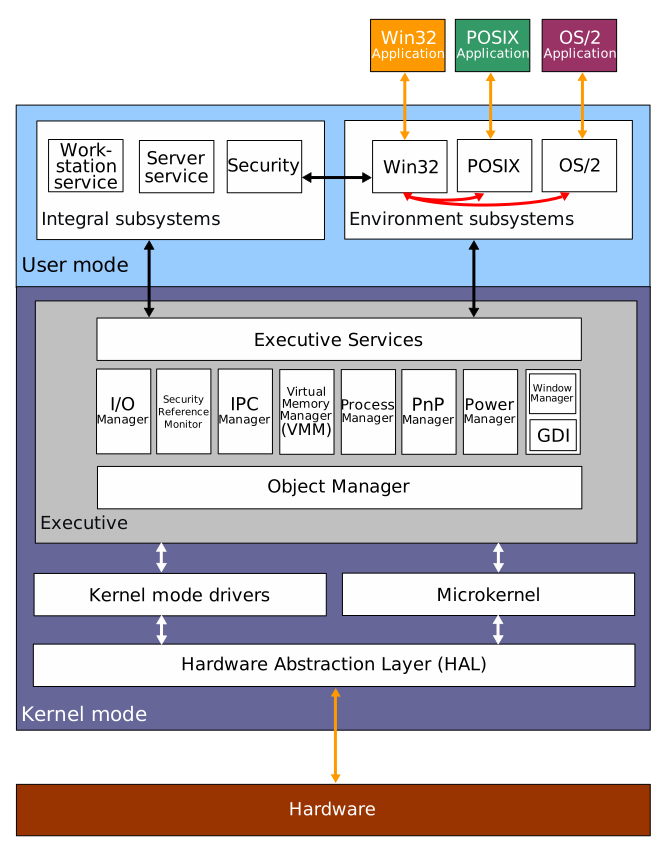
The fact that if you look at the full callstack and address space of a regular Linux process running in WSL2 you won't see the "classic" NT Kernel anywhere feels like a pretty big difference to me.
Yes they are still supporting WSL1. Microsoft's support policies are generally excellent. But it seems very unlikely there will be an interest in providing OS emulation or compatibility at the userspace/OS kernel boundary using the classic subsystem architecture, as a technical direction for the Windows team to invest in going forward. It's an architectural dead-end.
The reality seems to be that MS kind of wanted something more lightweight that could be sold to existing pc owners, where as IBM was happy to just push the requirements to the point where OS/2 would require an fairly high end system(preferably an PS/2 from IBM to run).
For some markets where the expensive PS/2 systems were not considered too expensive as in the case of banks and the like OS/2 sold well enough for IBM to profit off it. But the wider market went with the less hardware hungry and at least initially less capable windows.
If i recall correctly NT was slow to mature into an mainstream OS and did not really start replacing OS/2 until the late 90ies and only really took of for consumers when XP were released.
https://www.itprotoday.com/compute-engines/windows-nt-and-vm...