News for hackers. Stuff that matters.
Re:We've Built Cities We Can't Afford by brenden2 on Saturday April 18, 2020 @12:48PM (#22908953)
The entire economy is based on the idea of never ending growth, infinite leverage, and assets that always inflate without increasing utility (homes for example). It works, until it doesn't.

I don't know how long it will keep going, but I do think we need a real correction in order to redistribute some of the wealth.

Re:We've Built Cities We Can't Afford by airstrike on Saturday April 18, 2020 @01:08PM (#22909143)
> The entire economy is based on the idea of never ending growth

Yes, because total factor productivity[0] always grows.

> infinite leverage

None of us can raise an infinite bank loan, so this isn't really true. There are many, many, many limits to leverage.

> and assets that always inflate without increasing utility (homes for example).

Also not true... if the value of living in SF increases, it makes perfect sense that land in SF is also more valuable

> It works, until it doesn't.

That's not really a falsifiable assertion.

> I don't know how long it will keep going, but I do think we need a real correction in order to redistribute some of the wealth.

Notwithstanding all the faults in the arguments above, how does distributing wealth arbitrarily at a single point in time ("real correction") solve any of the issues you present?

__________

https://en.wikipedia.org/wiki/Total_factor_productivity

Re:We've Built Cities We Can't Afford by kaizendc on Saturday April 18, 2020 @01:42PM (#22909473)
Your "rebuttals" are a prime example of normalcy bias.

Not surprising though, pretty much everyone born in the past 60 years has become accustomed to a ridiculous "normal" that has been built on a fossil fuel house of cards.

https://en.wikipedia.org/wiki/Normalcy_bias

Re:We've Built Cities We Can't Afford by fastball on Saturday April 18, 2020 @02:19PM (#22909826)
They're not though.

GC mentioned "total factor productivity", which is not just an assumption that things will stay the same. It's a measure that value (productivity) actually is increasing, all the time.

And the other rebuttals were pointing out flaws with GGC's arguments, none of which relied on "the status quo works".

Re:We've Built Cities We Can't Afford by rsync on Saturday April 18, 2020 @01:41PM (#22909459)
"None of us can raise an infinite bank loan, so this isn't really true. There are many, many, many limits to leverage."

Yes, of course that is true, but there appears to be no general limit on notional value of derivatives of debt - and when there are limits, they are local to some very particular asset class.

I encourage you to re-watch "The Big Short", or at least the scene where one of the protagonists discovers the 10x or 20x notional value of total housing credit derivatives (and derivatives of derivatives ...).

Although that particular asset class is no longer encumbered in that way, I predict that there is some asset class hiding somewhere that has been levered up in creative ways, just waiting to collapse ...

Re:We've Built Cities We Can't Afford by covidacct on Saturday April 18, 2020 @02:02PM (#22909667)
Corporate debt
Re:We've Built Cities We Can't Afford by ahnick on Saturday April 18, 2020 @01:28PM (#22909317)
Why does TFP always grow? Is the fundamental reasoning that new technologies and efficiency improvements in existing technologies will always occur over time and therefore guarantees this growth?
Re:We've Built Cities We Can't Afford by dodobirdlord on Saturday April 18, 2020 @01:40PM (#22909452)
Essentially yes. Technology improvements (for a very, very broad definition of technology that includes things like Rights) are the only way that wealth is actually created. Everything else is just assets moving along a value curve in time.
Re:We've Built Cities We Can't Afford by nerfhammer on Saturday April 18, 2020 @01:32PM (#22909365)
people are smart and slowly inevitably figure out ways to do things more efficiently
Re:We've Built Cities We Can't Afford by stouset on Saturday April 18, 2020 @01:42PM (#22909470)
And this does not and cannot continue indefinitely.
Re:We've Built Cities We Can't Afford by edanm on Saturday April 18, 2020 @04:00PM (#22910621)
Yes, but we don't know if the limit will be reached in 10 years or 10 billion years.

And while there might certainly be material problems in the future, in terms of "coming up with new ideas", I think we're nowhere near the limit.

Re:We've Built Cities We Can't Afford by airstrike on Saturday April 18, 2020 @04:50PM (#22911007)
"Indefinitely for all given purposes" is better than "technically indefinitely till the end of times"
Re:We've Built Cities We Can't Afford by nerfhammer on Saturday April 18, 2020 @02:19PM (#22909823)
what do you mean, do you think over time people are going to stop being clever?
Re:We've Built Cities We Can't Afford by sudosysgen on Saturday April 18, 2020 @03:20PM (#22910328)
Eventually, all the clever innovations will either have smaller and smaller impacts, or will be impossible to implement due to material restrictions. Exponential, infinite growth can not be sustainable.
Re:We've Built Cities We Can't Afford by jimbokun on Saturday April 18, 2020 @03:58PM (#22910608)
I mean, once you have a Dyson sphere, sure.

We have a ways to go before then.

Re:We've Built Cities We Can't Afford by sudosysgen on Saturday April 18, 2020 @04:23PM (#22910799)
Sure, but even beforethen growth will slow down very very significantly, and might go to zero for some for significant periods. Just building a Dyson sphere would probably take a few millenia.
Re:We've Built Cities We Can't Afford by fastball on Saturday April 18, 2020 @07:11PM (#22911903)
You're assuming we don't make any fundamental discoveries in various fields that allow for an exponential number of new technologies based on those discoveries.

This seems short-sighted, as we've been doing that for most of human history, and honestly I don't think we're very close to unveiling all the mysteries of the universe.

We could start building a Dyson sphere right now. It would just take a long, long, long time given our current understanding of physics and technology. Imagine all the things we might be able to achieve with our understanding of physics in 300 years. Imagine the thing we will discover that will have their own Dyson-sphere equivalents. i.e. things we discover that we know (hypothetically) how do do, they are just not quite in our grasp.

Re:We've Built Cities We Can't Afford by sudosysgen on Saturday April 18, 2020 @08:44PM (#22912422)
No, I'm projecting it would take millenia even if we start multiple hundreds of years in the future. We absolutely could not even start building a Dyson sphere today, the material constraints are far beyond anything we are capable of.

The reason why I'm saying it would take in the thousands of years, is because of this tautology: If we want to build a Dyson sphere, it means that we are still limited to the energy we can get from Earth. Given the issues that come with extracting a large percentage of the energy received by the Earth, even if we used fusion (due to thermodynamic constraints), the limit of energy used can be placed around 5-10% of the energy Earth receives from the Sun (And that would require extensive geo-engineering). With that sort of energy output, the energy alone required in order to move the material needed for a Dyson sphere from Earth orbit to Sun orbit would take literally millenia, and that's with a combined effort from all of Mankind, which politically completely impossible for the next centuries unless China or some other superpower was able to magically establish true utopic statless communism and win away the rest of the world to establish a world cooperation of sunshine and rainbows magically.

A Dyson sphere would weight around the mass of the Earth. The Hohmann transfer from Earth to Mercury (fly-bys cannot work due the sheer mass knocking out other planets from their orbits, this is actually the magnitude of energy we're talking about). If we could magically make the material necessary appear from Earth gradually, d/v from earth surface to LEO then from LEO to Mercury's orbit or thereabouts via a Hohmann transfer is of around 15 000 m/s. If you take the good old kinetic energy formula, 1/2mv^2, you find that this would require a staggering amount of energy that would take millenia to amass.

Re:We've Built Cities We Can't Afford by fastball on Saturday April 18, 2020 @09:42PM (#22912753)
So the actual logistics of starting work on a Dyson sphere wasn't really the point of my comment. My only point was that we could make a start, because we grasp the principles – surround the sun with a structure that can capture most of its energy output.

Contrast with the plentitude of natural things we presumably don't understand / know about (unlike the sun) and there is a lot of potential for the future.

That being said, for the construction of a sphere you would presumably not be shipping matter from earth. You'd be towing in matter from asteroid belts and such.

Re:We've Built Cities We Can't Afford by sudosysgen on Sunday April 19, 2020 @12:46PM (#22917051)
Towing materials from asteroid belts would require almost as much energy, and you would need some sort of megastructure for processing.

What I'm telling you is that there are hard limits that mean that our growth must slow down. There is a hard limit to how much energy we can harness from the earth, and a hard limit for how fast we can avoid this. Progress will have to slow down, a society based on endless exponential growth at short-term significant rates is untenable.

Re:We've Built Cities We Can't Afford by klibertp on Saturday April 18, 2020 @03:56PM (#22910593)
They might run out of things to be clever about, for example (that's assuming your belief in the people actually being clever holds - I have my doubts here.)
Re:We've Built Cities We Can't Afford by brenden2 on Saturday April 18, 2020 @01:19PM (#22909242)
When I said "infinite leverage", what I meant was that there is no upper limit to the amount of leverage (debt, or credit) that any one entity can have. There's also no limit on the total amount globally. The US government, for example, can print infinite money and create infinite debt.
Re:We've Built Cities We Can't Afford by arbitrary_name on Saturday April 18, 2020 @01:26PM (#22909302)
Theoretically yes, practically no. So what?
Re:We've Built Cities We Can't Afford by nordsieck on Saturday April 18, 2020 @01:22PM (#22909281)
> Yes, because total factor productivity[0] always grows.

Is that true? Has that been true for Zimbabwe née Rhodesia?

What about Britain following the fall of the Roman Empire?

Re:We've Built Cities We Can't Afford by fastball on Saturday April 18, 2020 @02:21PM (#22909852)
I think the point is that you are developing, it all works. If you are not improving, it clearly doesn't, but that is true regardless of "what the economy is geared for".

If you have a complete meltdown, that's not the growth economy's fault.

Re:We've Built Cities We Can't Afford by hitekker on Saturday April 18, 2020 @03:16PM (#22910302)
I think you’ve chosen the wrong thing to worship.
Re:We've Built Cities We Can't Afford by fastball on Saturday April 18, 2020 @03:42PM (#22910497)
Not sure I follow.
Re:We've Built Cities We Can't Afford by ouid on Saturday April 18, 2020 @01:20PM (#22909263)
The distribution of wealth creates a distribution of incentives that behave dynamically. "fixing it at a single point in time" does more than you're saying.

Also, there are a number of asymptotic features of "total factor productivity" that are not favorable. The more oil you burn, the more expensive it is to burn oil.

Re:We've Built Cities We Can't Afford by alexashka on Saturday April 18, 2020 @01:23PM (#22909282)
The most 'always' things I know, are axioms we've agreed upon, such as 1 + 1 = 2 in arithmetic. They are only 'always' so because we've agreed on it, for now.

What incredible discovery enables you to make 'always' claims about the world we're living in?

Re:We've Built Cities We Can't Afford by airstrike on Saturday April 18, 2020 @05:09PM (#22911116)
Fine, change it to "has always" if that makes you feel better. I don't think we've reached the apex of our technological prowess so I assume our productivity will continue to improve, but if you want to make a different assumption feel free to do so
Re:We've Built Cities We Can't Afford by jdc on Saturday April 18, 2020 @01:17PM (#22909218)
That may well be, but is fair to displace people because their productivity isn't increasing quickly enough?
Re:We've Built Cities We Can't Afford by yingw787 on Saturday April 18, 2020 @01:36PM (#22909409)
It really bothers me to hear this, because the truth is people have unlimited wants, and there will always be rich and poor, whether by context or by deed. Growth is the only way I see where we can hope to lift all boats. An anti-growth mentality kicks the ladder from underneath those who might benefit from increased material wealth.

In this context, I'm really proud of my ancestral homeland (mainland China), who in 40 years lifted a billion people from abject poverty through economic growth. Yes, there's significant problems magnified by that, but to paraphrase a popular saying, a full person has a million problems and a starving person has one.

Sure, growth with negative externalities have negative side effects and we definitely should talk about that, but that's a separate discussion and focus than "don't grow".

I totally agree with your leverage aspect and aligning value to utility, and I think that's a very positive avenue of discussion. Let's talk about that instead.

Re:We've Built Cities We Can't Afford by stouset on Saturday April 18, 2020 @01:50PM (#22909551)
Exponential growth literally cannot continue indefinitely on a planet with finite land, finite energy reserves, and finite resources. This should be uncontroversial.

We can disagree about where, when, and how to stop growth. We cannot disagree that it must stop at some point, and that the tyranny of exponential growth means that you will hit this moment frighteningly fast even when you appeared to have plenty of legroom. With a growth rate of even 1.5%, you can be using less than 10% of the resources available to you, and yet you will hit a hard wall at a minimum within 200 years. And even this is a fantasy, as resources, land, and energy are always utilized in decreasing order of ease of access.

Re:We've Built Cities We Can't Afford by crazygringo on Saturday April 18, 2020 @04:16PM (#22910745)
You're misdefining growth. Growth in no way has to be dependent on physical resources, and in fact isn't.

Growth is just as much about increasing efficiency. If you continue to chop down the same amount of sustainable wood year after year, but figure out how to do it at half the price (e.g. because robots), that's 100% growth.

Indeed, look at the huge growth in the services industry over the past several decades. That's not using up extra land, energy, etc.

Now growth can involve using up more resources, or it can not, or it can be a mix. But the problem you seem to have is with resource consumption, not with economic growth generally.

Re:We've Built Cities We Can't Afford by stouset on Saturday April 18, 2020 @10:39PM (#22913026)
I am emphatically not doing that. Efficiency gains and “services” simply cannot fuel unlimited exponential economic growth, end of story. You can chop your tree for half the energy use tomorrow, but not the next day and the next and the next and the next. And unfortunately, we’re way closer to optimal efficiency for the tasks that we want to accomplish than you may want to believe. There simply aren’t many more 100% efficiency gains to be had anywhere economically meaningful.

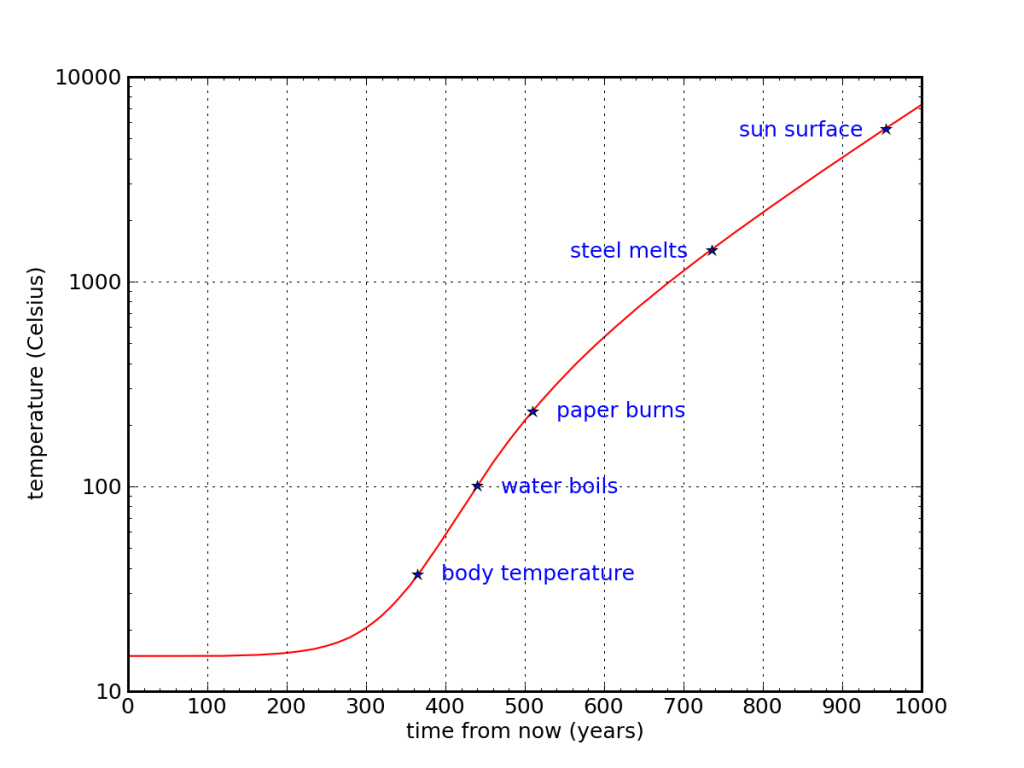
At the end of the day, our access to energy is finite. And not simply from a perspective of resources. We are literally a few hundred years shy[1] of heating the Earth to uninhabitable levels from a pure thermodynamics perspective (e.g., entirely ignoring global warming from greenhouse gases, and considering Earth as a simple blackbody radiator).

If you somehow believe that we can have unlimited economic output from finite energy and finite resources on this planet I’m not sure there’s any point in me continuing to debate an argument rooted in magical thinking.

[1] https://dothemath.ucsd.edu/2011/07/galactic-scale-energy/

Re:We've Built Cities We Can't Afford by crazygringo on Sunday April 19, 2020 @12:51PM (#22917072)
> You can chop your tree for half the energy use tomorrow, but not the next day and the next and the next and the next.

Why not? If we're talking decades rather than days, a combination of AI and solar power will eventually get us to the point where virtually no human effort is required at all.

Economic efficiency has nothing to do with energy efficiency, it's entirely about the efficiency of human inputs.

In fact, a significant amount of economic growth comes from learning how to accomplish the same tasks with less energy -- more fuel-efficient cars, lightbulbs, and so on.

Energy and thermodynamics have absolutely nothing to do with it.

There's no magical thinking here. You're just confused that you think economic growth requires greater energy usage. It doesn't. And I don't know where you've gotten the idea that it does.

And your link is misleading -- just because energy production has accompanied economic growth doesn't mean it always will, or that it does in every sector. It just means it's been the pattern so far, because energy is cheap. As soon as energy becomes more expensive, growth consists in using it even more efficiently and renewably.

Re:We've Built Cities We Can't Afford by stouset on Thursday April 23, 2020 @03:57PM (#22960442)
> Why not?

Basic thermodynamics?

> If we're talking decades rather than days, a combination of AI and solar power will eventually get us to the point where virtually no human effort is required at all.

I'm not talking about human effort. Price is related to energy input. And there's only so efficient you can get at chopping down that tree.

> And your link is misleading -- just because energy production has accompanied economic growth doesn't mean it always will, or that it does in every sector. It just means it's been the pattern so far, because energy is cheap. As soon as energy becomes more expensive, growth consists in using it even more efficiently and renewably.

It is not misleading, you simply misunderstand the impact. Again, there's only so efficient you can become in any system. And we're already shockingly close to optimum in many of our systems. Getting closer and closer to those optimums is obviously possible, but it's ever-diminishing returns.

Re:We've Built Cities We Can't Afford by yingw787 on Saturday April 18, 2020 @02:48PM (#22910101)
It is controversial, because the assumption of exponential growth is flawed. For one, your model underfits population growth, it's a logistic curve and not a purely exponential one. Wealthier countries on average produce less children than poorer countries, and assuming no global shakeup occurs, most will end up in the crisis like the one Japan is beginning to see with a lot of older people and not enough younger people to support them. We can talk about what happens after that cliff, but how can you have exponential usage in natural resources when the population _doesn't even exist_?

Not to mention human ingenuity when people get desperate. WWI / WWII saw Germany produce coffee from acorns, oil from coal, and Fanta from vegetable scraps, ensuring a rise in industrial production during 1944 under arduous circumstances. We don't operate at 100% efficiency and we can most definitely increase that number by double digit, maybe even triple digit percentages. Take meat, a horrible source of energy inefficiency. Lab grown meats, meat substitutes grown from vertical farms, even eating different kinds of meats (cricket powder protein bars aren't bad and have a more or less 1:1 energy input:output ratio) result in increased efficiency savings. This is a matter of economics.

Anti-growth simply isn't feasible from a domestic or foreign policy standpoint. There is no way you will convince any significant politician, and by extension his/her voting bloc, that there must be an end to growth. You can't religion or dictator your way out of this either, since it goes against the very essence of human nature.

Re:We've Built Cities We Can't Afford by stouset on Saturday April 18, 2020 @10:53PM (#22913097)
Nothing I said is rooted in a belief that population growth will continue unabated. You yourself asserted that people’s wants are unlimited. That may be true, but people’s wants are never going to override the cold reality of finite supply.

Finite supply exists even if population growth declines. Finite supply exists even if population declines. Finite supply exists even if it’s untenable from a policy perspective. The expectation of continued unending exponential growth baked into our economic system will run up against the actual limits of what the Earth is capable of providing.

Again, this should not be controversial. Playing games about population growth is simply dodging the fact that even given a population of two humans, any greater-than-one exponent on economic activity will end. The logistic curve exists precisely because of this fact.

Re:We've Built Cities We Can't Afford by twblalock on Saturday April 18, 2020 @03:54PM (#22910580)
The carrying capacity of the Earth is not fixed.
Re:We've Built Cities We Can't Afford by stouset on Saturday April 18, 2020 @10:54PM (#22913099)
And? “Not fixed” and “literally infinite” are completely different ballparks.
Re:We've Built Cities We Can't Afford by KhoomeiK on Saturday April 18, 2020 @04:01PM (#22910629)
There's a whole universe out there. Europe had "finite land" until it got to the point where the demand for new territorial acquisitions became so high that governments financed colonization of 2 whole new continents. Why wouldn't this be the case with space exploration?
Re:We've Built Cities We Can't Afford by stouset on Saturday April 18, 2020 @11:12PM (#22913199)
It’s hard to come up with a succinct reply to highlight how utterly absurd this argument is. From virtually any physics-based perspective, any kind of space travel or space-faring economy outside of very, very near Earth is unavoidably an net-negative venture[1]. Shipping energy from anywhere outside of Earth’s gravity well costs more energy, even at theoretical optimum efficiency, than it has any chance of gaining.

It’s not just that it’s difficult, from any meaningful angle it requires us to have completely misunderstood the relevant physics. If your argument relies on us discovering that all of known physics isn’t just off a bit or needing of refinement, but is completely misguided… well, that’s your prerogative I suppose.

Even if you hypothesize a space-colonizing human race, that does nothing for the people who are still stuck on Earth with Earth’s finite resources.

[1] https://dothemath.ucsd.edu/2011/10/stranded-resources/

Re:We've Built Cities We Can't Afford by brenden2 on Saturday April 18, 2020 @04:57PM (#22911057)
Some people have unlimited wants. I just want to do interesting work, work with interesting people, and take walks with my dog. I'm pretty basic, I don't enjoy or have any interest in fancy automobiles, big houses, vacations, air travel, etc.
Re:We've Built Cities We Can't Afford by twblalock on Saturday April 18, 2020 @05:57PM (#22911456)
> I just want to do interesting work, work with interesting people, and take walks with my dog.

You've fulfilled all of your material needs and now you're in the self-actualization phase of the hierarchy of needs. It took decades of economic growth driven by other people to get your society to the point where people like you care more about fulfillment in their profession rather than food security.

Some people are still subsistence farmers and they need a lot of economic growth to get to the point where they can worry about fulfillment in their professions and taking their pets for a recreational walk.

Why should you get to benefit from the economic growth in your own society while telling others they don't get to have that?

Re:We've Built Cities We Can't Afford by Ericson2314 on Saturday April 18, 2020 @01:50PM (#22909558)
No serious antigrowth argument is saying China ought to stay at it's 20th low point.

The problem is there is growth that solely exists to feed the capitalist Leviathan vs growth that is actually giving people what they want, and they are hard to disentangle under capitalism. You could the first is trying to disguse itself.

Re:We've Built Cities We Can't Afford by twblalock on Saturday April 18, 2020 @03:53PM (#22910573)
> No serious antigrowth argument is saying China ought to stay at it's 20th low point.

Nobody says that outright, but that is what would have happened if their arguments had been translated into policy in the 1970s. And it is what would happen to poor countries today, if anti-growth arguments were adopted today.

Re:We've Built Cities We Can't Afford by stouset on Thursday April 23, 2020 @04:08PM (#22960616)
And yet... growth will end. It will end because we choose for it to end, or because we've over-mortgaged the resources we have available to us and experience a collapse.

Bacteria in a sealed jar will continue to multiply until they've consumed all the available nutrients, at which point their population collapses. If you constantly add a trickle of nutrients to the jar, this behavior still happens, just with violent yo-yo'ing between collapse and growth until an eventual steady-state is reached.

We can argue whether or not we've exceeded the replenishment rate We can argue how far it's reasonable to go past this point if effects won't be felt for thousands of years. But there is simply no argument to be made that we can continue growing endlessly and exponentially past the replenishment rate of the ecosystem we live in.

Personally, I think we're well past the replenishment rate. Our ecological impact is causing systemic collapse in multiple areas: our climate is warming past dangerous thresholds, our oceans are acidifying and being depleted at an alarming rate, our oceans are rising at an accelerating rate, and we're experiencing unprecedented rates of of extinction of both animal and plant life. We're running out of sand (to make concrete with) for fuck's sake.

On top of this, at current rates of energy growth, we'll literally cook the Earth within two or three hundred years[1]. And I'm not talking about greenhouse gases: just from a raw thermodynamics perspective. Put enough energy capacity on Earth and it will eventually take the form of waste heat. Even in the complete absence of carbon dioxide, the only way for that heat to escape Earth is by being radiated into space. And there's only so fast a perfect blackbody with the surface area of the Earth can get rid of that heat. Even if the Earth were a perfect radiator (it isn't), this[2] is what our future looks like.

[1] https://dothemath.ucsd.edu/2011/07/galactic-scale-energy/

[2] https://dothemath.ucsd.edu/wp-content/uploads/2011/07/tmp-10...
Re:We've Built Cities We Can't Afford by katmannthree on Saturday April 18, 2020 @12:58PM (#22909049)
I posed that question of the reality of that infinite growth to my econ professor back in the day, and their response was that technological advancements have allowed it in the past and likely will through the future. The plan appears to be to throw money at problems as they come up and coast into the sunset on the current economic system without a serious long-term plan for when things break down.

Unfortunately as most people here are probably aware, throwing money at a problem doesn't always result in a viable solution. As more and more of the low hanging fruit of technological advancement gets picked we may be in for some interesting times.

Re:We've Built Cities We Can't Afford by meroes on Saturday April 18, 2020 @01:05PM (#22909108)
I think technology is only one way of expanding markets indefinitely, albeit one of the most beneficial when it happens.

Unfortunately capitalism's need for infinite growth is nigh unstoppable and it always finds a path. If there aren't enough startups, technological advances, or similar we see things like private militaries, Banana Wars, buying elections, private prisons, over leveraging, etc. Capitalism has to have an outlet and we are at its mercy in that sense.

Re:We've Built Cities We Can't Afford by sudosysgen on Saturday April 18, 2020 @03:22PM (#22910344)
Or, eventually, capitalism has to end.
Re:We've Built Cities We Can't Afford by onlyrealcuzzo on Saturday April 18, 2020 @12:58PM (#22909055)
It keeps going until people are unwilling or unable to put themselves into more debt for the same thing.

The government seems dead set on making sure the "unable" part never happens. And people are dead set on always willing.

If the government would stop trying to manipulate every market, this maybe wouldn't happen. The Islamic empire was insanely successful for a longer period of time than the US empire has been around, and the Islamic Empire had truly free markets.

For anyone interested, Debt: The First 5000 Years is a fascinating examination of this topic.

Re:We've Built Cities We Can't Afford by ntsplnkv2 on Saturday April 18, 2020 @01:40PM (#22909444)
If the government doesn't manipulate the market then corporations will swoop in and manipulate it themselves. Which they have. Which is why government stepped in.
Re:We've Built Cities We Can't Afford by onlyrealcuzzo on Saturday April 18, 2020 @04:41PM (#22910923)
I /think/ it's possible to regulate without egregious manipulation.

I do agree that some regulation is necessary, which is a form of manipulation.

If you're referring to monopolies, for example, the government could regulate anti-trust without -- say -- artificially setting treasury yields (interest rates) and corporate bond yields.

Re:We've Built Cities We Can't Afford by sudosysgen on Saturday April 18, 2020 @03:23PM (#22910357)
Islamic empires did not have a truly free market. Islam imposes quite a few financial and economical restrictions (I'd say, rightfully in many instances)
Re:We've Built Cities We Can't Afford by onlyrealcuzzo on Saturday April 18, 2020 @04:43PM (#22910944)
I do not in anyway claim to be an expert on the Islamic Empire. But Islam (today or even in the past) does not equal the early Islamic Empire.

The religion seems to have evolved considerably from the early Islamic Empire. Which is common. Every major religion seems to have undergone several major metamorphoses.

Re:We've Built Cities We Can't Afford by sudosysgen on Saturday April 18, 2020 @08:10PM (#22912245)
Not really, no. The Coranic prescriptions have been relatively unchanged since a thousand years. Given the combination of textual and oral traditions, and the low divergence of historic Qurans over a wide area, we can conclude that the Quran did not significantly change.

The Coranic prescriptions about usury and other economic activities are incredibly clearly written.

The only conclusion is that there is no reason to believe that it was in any way different to today, and a lot of reasons to believe the restrictions on free trade are even higher than in the modern Islamic world.

Re:We've Built Cities We Can't Afford by cheez on Saturday April 18, 2020 @01:13PM (#22909194)
First time I've seen this discussion of Islamic empire in a favorable light here.

What makes you say the Islamic empire had free markets? From the book?

Re:We've Built Cities We Can't Afford by onlyrealcuzzo on Saturday April 18, 2020 @04:36PM (#22910886)
The book says that the original Islamic Empire was highly favorable of merchants.

One of the main ideas (of the Empire, not necessarily the religion) was that gold coinage came from God so that people could easily trade. Instead of everyone acquiring all the skills necessary for sustenance (farming, tool building, carpentry, etc) -- they could become masters of a few skills and trade the fruits of their skills in the open market. The idea was that doing so, humans could advance much faster. This was sort of God's secret sauce. So interfering with the market was like interfering with God. It was a no no.

One could argue that they manipulated the market by banning usury (interest bearing loans). However, before the Islamic Empire, interest was usually VERY high -- 60%+ per year was common. Debt was so cost prohibitive that the constant need for debt Jubilees was its own problem.

It's unclear how the Islamic Empire financed all these merchants without interest bearing loans. I'd love to learn more about how that worked.

Re:We've Built Cities We Can't Afford by drstewart on Saturday April 18, 2020 @12:55PM (#22909023)
How does redistributing wealth fix a problem based on never ending growth? I don't see how your two statements follow from one another.

In Japan, house prices commonly depreciate. I don't see any evidence their economy is unaffected by that fact.

Re:We've Built Cities We Can't Afford by jdc on Saturday April 18, 2020 @01:14PM (#22909197)
In Japan, house prices commonly depreciate.

Maybe that's why their homelessness per capita is almost 57 times lower than the States'.

Re:We've Built Cities We Can't Afford by wutbrodo on Saturday April 18, 2020 @01:52PM (#22909573)
Only if you don't understand anything about economics...

> Homelessness grew noticeably more widespread in Japanese society since the collapse of the Japanese asset price bubble across the 1990s, and the resulting "Lost Decade" of economic stagnation. This has resulted in higher unemployment, a contributing factor towards potential homelessness.[1]

National economies are complicated, and the connection between high (or continually-appreciating) housing prices and homelessness doesn't always run the direction that a naive model assumes it does.

[1] https://en.wikipedia.org/wiki/Homelessness_in_Japan

Re:We've Built Cities We Can't Afford by renewiltord on Saturday April 18, 2020 @02:04PM (#22909682)
Wait, the latest stats read that there are fewer homeless people in Japan than all of San Francisco (and definitely all of LA). That can't be right. It has to be a definition difference or they're doing something remarkably right.
Re:We've Built Cities We Can't Afford by jdc on Saturday April 18, 2020 @02:18PM (#22909821)
It's because GP cherry-picked a paragraph from the History section of that article and ignored the actual present per-capita homelessness rates.
Re:We've Built Cities We Can't Afford by wutbrodo on Saturday April 18, 2020 @02:35PM (#22909986)
No, you just misunderstood my comment. I'm not disputing that Japan has a far lower homeless rate than we do, there's likely things we can learn from them (and things we can't easily transplant), and I've always been pretty radical when it comes to land economics (the notion of owning land as an asset is absurd to me, vs having a stable claim over it but no entitlement to its increase in value). I was narrowly disputing your comment's claim that depreciating housing prices is a significant driver of low homelessness rates, using an example of a big drop in housing prices causing a spike in homelessness. The example isn't perfect, since steady-state low prices have different effects from a large shock, but my point was that the connection obviously isn't this straightforward.
Re:We've Built Cities We Can't Afford by jdc on Saturday April 18, 2020 @02:52PM (#22910134)
Oh I see. Thanks for the elaboration. I definitely agree that large shocks are best avoided, but I do think that ceteris paribus, bringing housing prices down relative to wages would decrease homelessness.

On the other hand, there's a lot of Americans on their nth mortgage, though so any policy aimed at driving housing prices down would have to factor that in.

Re:We've Built Cities We Can't Afford by rriepe on Saturday April 18, 2020 @01:46PM (#22909516)
Opposite the "never-ending growth" crowd is the "everything is zero-sum" crowd. There are plenty of ways to be wrong about the economy.
Re:We've Built Cities We Can't Afford by twic on Saturday April 18, 2020 @12:54PM (#22909021)
> The entire economy is based on the idea of never ending growth

I hear this a lot. As far as i know it's not actually true. Is there anything specific in orthodox economic theory that requires never-ending growth?

Re:We've Built Cities We Can't Afford by nordsieck on Saturday April 18, 2020 @12:58PM (#22909051)
> > The entire economy is based on the idea of never ending growth

> I hear this a lot. As far as i know it's not actually true. Is there anything specific in orthodox economic theory that requires never-ending growth?

I think a charitable interpretation of this claim is: people's planning (which is usually limited to the short term, when it happens at all) typically assumes the optimistic case.

This is certainly true for everyone who lives paycheck to paycheck.

It's also true for companies who survive on a revolving line of credit to fund longterm operations.

Re:We've Built Cities We Can't Afford by fullshark on Saturday April 18, 2020 @12:57PM (#22909038)
There are many macroeconomic models with the assumption that populations will keep growing and worker productivity will not shrink. That alone should yield never-ending growth.
Re:We've Built Cities We Can't Afford by sudosysgen on Saturday April 18, 2020 @03:27PM (#22910382)
Yes. Without viable debt being possible, barriers to entry to all markets skyrocket. When barriers to entry increase, competition breaks down. Thus, viable debt must be possible. For viable debt must be possible, there must be an opportunity for the lender to realize real interests. In order for the lender to be able to expect real interest on average, there must be growth.

Thus, growth must always exist for the current system to continue.

Re:We've Built Cities We Can't Afford by twic on Saturday April 18, 2020 @06:53PM (#22911789)
> In order for the lender to be able to expect real interest on average, there must be growth.

Why?

This doesn't sound obviously true to me. Imagine an economy in perpetual long-term stasis, with zero inflation. There's a company which has a factory which turns a profit, because it makes useful stuff. Every ten years, they need to replace the factory. So they take out a loan, and pay it off, with interest, over ten years. The lender earns interest with positive real value from this. Is there anything in this story which is impossible? Is there a theoretical reason a world like that couldn't exist?

Re:We've Built Cities We Can't Afford by sudosysgen on Saturday April 18, 2020 @08:05PM (#22912211)
On average, if there is no growth in the economy, then the average debtor can not expect a positive return on investment (obviously). As a collateral, on average, a bank can not expect that the debtor will be able to pay interest on the loan. So selling loans honestly becomes impossible. This is not a theoretical concept, this is the reason why in pre-industrial times lending with interest was all but forbidden.

Let's expand on the example of your factory. Say that you have a factory, that needs to be replaced in ten years. Why would you take out a loan over ten years with substantial interest, when you can simply save up over ten years to buy another factory? Since there is zero inflation, this is incredibly better for you. And so, there is no reason for you to take a loan; and you won't take out a loan. For an economic transaction to happen, it needs to be in the interest of both party, and in a no-growth economy taking out a loan is either in the interest of the lender or the debtor, but never both, on average, for a given lending policy. This is not the case when there is growth, which is why we have banks, whereas we didn't really have any kind of lending infrastructure in times were growth was of or near zero.

The only people that might want a loan are people that don't have enough capital to get started, but in a zero-growth economy you cannot expect that they will be able to repay you, so you won't lend to them, and if you do lend to them expecting that they will not pay you back that will be at astronomical interest rates and will essentially be usury.

Re:We've Built Cities We Can't Afford by sarbaz on Saturday April 18, 2020 @03:13PM (#22910277)
It's a relatively natural consequence of the fact that doing work creates value. One of the things you can work towards is creating more workers (by creating more humans, or better efficiency, or robots). Because these processes are basically exponential, you expect to see constant neverending growth.

The only real physical limit to productivity is our energy input. When we create things, we use energy and time to turn raw materials into useful stuff. Today most of our energy comes from the plants we eat (ie the sun) and from the ground. But we are not close to using even a small fraction of the energy that the sun gives us, so there is still lots of room to grow.

Re:We've Built Cities We Can't Afford by twic on Saturday April 18, 2020 @06:54PM (#22911794)
There may well be reasons to expect growth to continue forever. But i am asking if there are reasons to require it to continue forever.
Re:We've Built Cities We Can't Afford by vsareto on Saturday April 18, 2020 @02:32PM (#22909950)
I always hear that there's inflation targets, and deflation and stagflation are both worse than inflation. In this sense, the price of things always goes up, but so should wages. I don't know if economists plan on purchasing power always going up.
Re:We've Built Cities We Can't Afford by wutbrodo on Saturday April 18, 2020 @02:38PM (#22910012)
I don't think this is relevant. Prices and wages going up aren't growth. In fact, inflation represents a _devaluation_ of a unit of held currency. There's a reason everything is measured in real prices instead of nominal.
Re:We've Built Cities We Can't Afford by bsanr2 on Saturday April 18, 2020 @12:58PM (#22909053)
The existence of debt and interest coupled with lack of practical planning for the eventuality of economic decline or stagnation.
Re:We've Built Cities We Can't Afford by cagenut on Saturday April 18, 2020 @12:57PM (#22909045)
I mean, you clearly know the answer, you just want to label it "unorthodox" and dismiss it.
Re:We've Built Cities We Can't Afford by coldcode on Saturday April 18, 2020 @12:51PM (#22908991)
The problem is the wealth in concentrated in the few, who do not want to give it up, and needed by the many, who do not have (or know) the leverage needed. Of course this has always been the case since cities were first invented. All civilizations come to some kind of end, and new ones arise.
Re:We've Built Cities We Can't Afford by throw_this_one on Saturday April 18, 2020 @01:17PM (#22909231)
Yup, precisely this. Obviously this is super hard/impossible to calculate, but everybody should be paying in a certain fraction of what they are getting out of the system.

ex. The entrepreneur that gets access to the road system, educated workforce, police/legal system protection... if they didn't have that then they couldn't profit from their widget. So pay something significant back to the system, or you can't participate in the system.

Re:We've Built Cities We Can't Afford by weirdstuff on Saturday April 18, 2020 @12:55PM (#22909025)
City populations are some of the most unequal in all society. Extremes in close proximity. I've read research on this in the past, although I don't have any links at the moment.
Re:We've Built Cities We Can't Afford by WWLink on Saturday April 18, 2020 @02:05PM (#22909694)
That can lead to better mobility though, can't it? Instead of living in a town full of poor people who you can't sell anything to. lol.
Re:We've Built Cities We Can't Afford by Retric on Saturday April 18, 2020 @01:04PM (#22909103)
Total wealth is not important as long as everyone is paying for shared infrastructure based reasonably closely to the value they derive from it. That’s the social contract that’s being broken as for example developers depend on good local schools but they pay nothing for them. Building a new house is inherently different from selling an existing one, but zoning changes are handed out for free.
Re:We've Built Cities We Can't Afford by airstrike on Saturday April 18, 2020 @01:10PM (#22909169)
> concentrated in the few, who do not want to give it up

This bit is true, but we should remember that no one wants to give up anything, rich or poor. That's human nature.

Re:We've Built Cities We Can't Afford by aspenmayer on Saturday April 18, 2020 @01:54PM (#22909584)
You don’t speak for me. I would rather pay my taxes than have the money if I know every one else is in the same situation as me in being obligated to pay taxes. That is not the current status quo. Tax shelters and tax minimization strategies generally are tools that are not beneficial to market participants equally. It’s simply not worth the trouble unless you are offsetting a substantial tax liabilities. It’s not always the case that tax liabilities increase as wealth increases. Taxes don’t always go up with your income either. The fact that these variations and exclusions and deductions exist show intent to tax fairly and a desire to not double tax if not a reality. Yet the clear evidence that in real world examples, very high net worth individuals pay less than those in the upper middle class. Taxing proportional ability to pay seems fairer than the current system. That this is not the natural order of the tax system is itself curious. The governments of the world already deficit spend in excess of tax revenues. The tax system isn’t any more about fairness than it is about the money. If the government was able to choose to forgive your tax liability due to an exclusion or deduction, it could choose to do so for the entire tax base. It is not necessary to tax system to exist in its current state. It is the way it is because it benefits those who have money and power for it to be this way. Maybe this is why Fukuyama foresaw the end of history. We just ran out of ideas so this is the closest thing we got to a steady state society.
Re:We've Built Cities We Can't Afford by joefourier on Saturday April 18, 2020 @01:11PM (#22909171)
If real estate were a depreciating asset rather than an appreciating one, this would not be a problem. Imagine if we had a surplus of housing in major cities (certainly possible with modern technology if you put politics aside) and homes had to compete in the manner of consumer goods such as automobiles.
[dead]
Re:We've Built Cities We Can't Afford by sfkdjf9j3j on Saturday April 18, 2020 @01:12PM (#22909177)
https://news.ycombinator.com/newsguidelines.html

When disagreeing, please reply to the argument instead of calling names. "That is idiotic; 1 + 1 is 2, not 3" can be shortened to "1 + 1 is 2, not 3."

Re:We've Built Cities We Can't Afford by claudiawerner on Saturday April 18, 2020 @01:16PM (#22909214)
> This is stupid. You have this marxist idea that conflates wealth and value.

I just want to point out that to philosophers and economists interested in Marx, that's not a solid point. Marx rarely uses the term 'wealth' and his definition of 'value' is very specific. Marx's point was that wealth always takes a specific form, there is no 'wealth' in abstract just as there is no 'production' or 'population' or even 'value' in the transhistorical always-the-case sense.

>In reality, there is no real problem with wealth inequality as long as people don't all work for one person, which never happens because of dynamics of demand and offer for labor.

This seems to be deriving an 'ought' from an 'is'. You may find no problem with wealth inequality, but a wide variety of esteemed economists, sociologists and philosophers do. You need to consider the question of to whom wealth inequality isn't an issue, on the basis of which facts, and which model of wealth and value.

Re:We've Built Cities We Can't Afford by sudosysgen on Saturday April 18, 2020 @03:32PM (#22910408)
You should read Marx. In general, he explicitly separates accumulated capital (wealth) and value.
Re:We've Built Cities We Can't Afford by Ididntdothis on Saturday April 18, 2020 @12:57PM (#22909036)
“assets that always inflate without increasing utility (homes for example)”

I think that’s the real problem. Work should be rewarded and not just owning things.

Re:We've Built Cities We Can't Afford by abnry on Saturday April 18, 2020 @01:14PM (#22909202)
Work in cities is highly rewarded which means owning a home in a city is highly rewarded. It's a second order effect.
Re:We've Built Cities We Can't Afford by wutbrodo on Saturday April 18, 2020 @02:14PM (#22909779)
It's beyond me how you can think this makes even an ounce of sense. Contrary to your assertion, owning a home in a city isn't the same thing as working in one (I can't believe I have to say that), as should be made obvious by the fact that there are tons of employed renters and retired homeowners in cities. There are plenty of situations where the dynamic runs precisely counter to your claim: the obvious example being assetholders of real estate in a booming city extracting rents from the newly-arriving people whose work is "highly rewarded".

Work in cities is "highly rewarded" through high salaries (obviously). High house prices is (part of) how work in cities is _taxed_, which is pretty much the exact opposite of rewarding.

Re:We've Built Cities We Can't Afford by njharman on Saturday April 18, 2020 @01:02PM (#22909083)
Really? Work should be disincentivized. Automation and innovation rewarded.

The goal of human existence is not and should not be "gainful employment".

Re:We've Built Cities We Can't Afford by Pfhreak on Saturday April 18, 2020 @01:09PM (#22909162)
I think the parent is objecting more to the fact that today's economy allows those with wealth to earn income from that wealth. (E.g. they own the property, they can earn income from rent. They own the factory, they can extract excess value from the labor. etc.)

Automation vs working is a different axis than rewarding capital vs working. They are both good discussions to have, though.

Re:We've Built Cities We Can't Afford by Ididntdothis on Saturday April 18, 2020 @03:40PM (#22910481)
Ideally we wouldn’t have to work but we are very far away from that.

In the meantime it seems society is getting skewed towards benefiting owners over people who work. The news celebrates rising stock markets and rising housing prices. We celebrate “job creators”. The Fed responds when the stock market goes down but just shrugs when real wages for most people are stagnating or even going down . Investment income is taxed favorably over income from work.

Companies claim they are run solely for the owners (shareholders). Why not make workers also stakeholders that need to considered?

Re:We've Built Cities We Can't Afford by leetcrew on Saturday April 18, 2020 @01:08PM (#22909145)
clearly the rewards from owning things vs actual work is a bit out of whack in our current society. but owning things is itself the reward for surplus work.
Re:We've Built Cities We Can't Afford by alacombe on Saturday April 18, 2020 @04:42PM (#22910933)
Make me long for the day we were all serf, could barely have enough to eat and the local Lord had jus primae noctis rights.
Re:We've Built Cities We Can't Afford by leptoniscool on Saturday April 18, 2020 @12:58PM (#22909054)
Inventions and new technologies increases wealth, think about the digital revolution in the past few decades. In order to keep growing, society must invest in research and innovation.

'Redistribution' is inherently unfair, and in a global world it will only cause capital flight.

Re:We've Built Cities We Can't Afford by notduncansmith on Saturday April 18, 2020 @01:42PM (#22909469)
> Inventions and new technologies increases wealth

Increases wealth for a few. Studies have shown that technology is not actually making us more productive in the past 10+ years.

> In order to keep growing

Who says we need to keep growing? We have enough mouths to feed on this planet already.

> 'Redistribution' is inherently unfair

There is no such thing as “inherently” fair or unfair. Did anyone “earn” a wealthy upbringing? Did anyone “earn” their genetic advantages? Outcomes are a result of one’s nature and nurture, neither of which are under one’s control. Anything you have is a gift from the universe, and you will either share your gifts or not.

“If I had to support my family growing up instead of having time to code, if I didn’t know I’d be fine if Facebook didn’t work out, I wouldn’t be standing here today” - Mark Zuckerberg

“I think about the amount of human potential that is being wasted by people that are not doing what they want to do. I think about how great it would be to undo that. And that’s really powerful to me.” - Sam Altman

“People who fall by the wayside, through no fault of their own, as the goose lays more golden eggs, should still get a chance to participate in that prosperity.” - Warren Buffett

> and in a global world it will only cause capital flight

“Only” would imply that everyone with capital has the same opinion as you, but it doesn’t sound like you understand how people with capital actually think.

Re:We've Built Cities We Can't Afford by leptoniscool on Saturday April 18, 2020 @02:05PM (#22909684)
Re:We've Built Cities We Can't Afford by Pfhreak on Saturday April 18, 2020 @01:04PM (#22909105)
> 'Redistribution' is inherently unfair

This is a peculiar, and unsubstantiated assertion. I certainly wouldn't consider this an axiom in any discussion about economic policy. Can you explain a little more?

Or are you just saying that you believe that redistribution is unfair?

Re:We've Built Cities We Can't Afford by StephenCanis on Saturday April 18, 2020 @01:15PM (#22909207)
The world is inherently unfair - people can’t control what family they are born into. It’s unfair that some of those families may have be subject to generations of marginalization.

So if redistribution is “unfair” it’s only to counteract the inherent unfairness of the current system.

Re:We've Built Cities We Can't Afford by pvorb on Saturday April 18, 2020 @01:22PM (#22909274)
Increasing legacy taxes (a lot) would help to make the world fairer in the long run.
Re:We've Built Cities We Can't Afford by seibelj on Saturday April 18, 2020 @01:37PM (#22909426)
And this is why I’ve been saying for years that all children should be taken at birth and put into centrally managed government daycares where all babies can be raised in equal environments. It’s completely absurd and unfair that a rich baby gets so much more than a poor baby. Until we stop letting parents raise their own children and let society do it, there will always be inequality at birth which cannot be overcome.
Re:We've Built Cities We Can't Afford by DangitBobby on Saturday April 18, 2020 @02:33PM (#22909968)
It's much too difficult a problem to solve completely, so we should give up immediately. Your strawman has shown me the light.
Re:We've Built Cities We Can't Afford by smaddox on Saturday April 18, 2020 @01:27PM (#22909310)
Frankly, fairness is irrelevant. There's nothing fair about the distribution of wealth. There is a natural tendancy for the wealthy to grow more wealthy, and the poor to grow more poor. Hence the power-law distribution of wealth observed in every society throughout the history of man, not to mention in the other natural systems.
Re:We've Built Cities We Can't Afford by meroes on Saturday April 18, 2020 @01:09PM (#22909161)
I disagree that Redistribution is unfair when the playing field isn't level from the get go.
Re:We've Built Cities We Can't Afford by dsr_ on Saturday April 18, 2020 @01:17PM (#22909226)
The playing field was last level (for humans) about 15,000 years ago.

(It probably wasn't, but no records from that long ago exist so we can pretend.)

Re:We've Built Cities We Can't Afford by simonh on Saturday April 18, 2020 @02:03PM (#22909672)
All forms of redistribution, of any kind or at any level?

Here in the UK we have a bit of a different history on this that has pushed British conservatism in a more centrist direction. The first and second world wars were existential crises for us that stretched our economies and society to near breaking point. Millions of Britons were called up, worked in munitions factories, or volunteered in public services and the Land Army. It was a concerted effort across all levels of society. A major problem in the first war was so many draftees were unfit for service due to poor health and nutrition, this created a consensus that a coordinated system of social support and health care was essential for national security if nothing else.

So over here, it’s not really about redistribution. Sure there are plenty of socialists over here who are committed redistributionists, sure. Socialism is entrenched in Europe in a way it really isn’t in the US. But even among the majority of conservatives over here, history has shown us the its in the national interest to have a population that is well nourished, healthy and has a basic education that makes them fit to work, and serve if it comes to that.

Re:We've Built Cities We Can't Afford by onlyrealcuzzo on Saturday April 18, 2020 @01:05PM (#22909112)
Fair is inherently subjective.
Re:We've Built Cities We Can't Afford by leptoniscool on Saturday April 18, 2020 @02:00PM (#22909644)
Indeed there's many different interpretations of fairness: https://plato.stanford.edu/entries/social-procedures/#Fai
Re:We've Built Cities We Can't Afford by pvorb on Saturday April 18, 2020 @01:25PM (#22909294)
Sure, but you can objectively tell if something is unfair. Defining fairness is more difficult.
Re:We've Built Cities We Can't Afford by matz1 on Saturday April 18, 2020 @01:44PM (#22909487)
How ? The definition of fairness itself subjective.
Re:We've Built Cities We Can't Afford by gowld on Saturday April 18, 2020 @01:44PM (#22909494)
What's the objective definition of unfair?
Re:We've Built Cities We Can't Afford by pvorb on Monday April 20, 2020 @03:48AM (#22921976)
I'm not talking about a definition. Just that, for example, if one child gets born in a rich country to a rich family and one child to a poor family in a third world country, their starting conditions are unfair. This doesn't help much with a definition of unfair, but I think it's still objective.
Re:We've Built Cities We Can't Afford by refurb on Saturday April 18, 2020 @01:13PM (#22909188)
“Never ending growth” is what drives improvements in the standard of living. And by standard of living I don’t mean a bigger TV or faster computer but better healthcare, improved education, fewer living in poverty and clean energy.

Seems like a noble goal, no?

Re:We've Built Cities We Can't Afford by AnthonyMouse on Saturday April 18, 2020 @01:14PM (#22909200)
> The entire economy is based on the idea of never ending growth, infinite leverage, and assets that always inflate without increasing utility (homes for example). It works, until it doesn't.

Humans want better lives. More living space, more free time, faster cars, whatever. Humans will not stop wanting this for as long as there are humans. There are two ways to get it.

One is creating more stuff. This is growth.

The other is taking somebody else's stuff. This is war.

Growth is better.

But zoning restrictions that inflate housing prices? That's not growth, it constrains growth, which implies...

Re:We've Built Cities We Can't Afford by rsync on Saturday April 18, 2020 @01:50PM (#22909557)
I hope you will consider - both from a biological perspective and an economic one - that catabolism is also possible.

Which is to say, depending on your environment, you can create a "better life" (by your definitions) by catabolizing existing resources.

You can't catabolize forever, of course, but it's an immediate and obvious refutation to your claim that "better lives" can only be pursued through growth or war.

Re:We've Built Cities We Can't Afford by AnthonyMouse on Saturday April 18, 2020 @02:37PM (#22910006)
There isn't a separate thing called catabolism which can increase available value by neither creating nor transferring it.

Converting one resource to another at an overall net gain is growth. Converting one resource to another when the original resource was equally or more valuable net doesn't improve lives, it's either completely neutral or net harmful.

Note that there are a lot of growth metrics out there that inappropriately fail to account for this, e.g. they measure sale price but not consumer or producer surplus (which are harder to measure because there is no market pricing information available). If someone invents a cheap way to turn farm waste into motor fuel and then suddenly gas is $1/gallon, that's growth -- there is a surplus being created -- even if there is a net reduction in GDP because oil companies are making less money while most of the surplus goes to the consumer. (Though in most cases the reduction in GDP doesn't happen anyway because then consumers have more money in their pockets and spend it on something else.)

Re:We've Built Cities We Can't Afford by mindslight on Saturday April 18, 2020 @03:29PM (#22910396)
> Humans want better lives. More living space, more free time, faster cars, whatever

More free time implies translating productivity gains into less time working, rather than the current economic policy of pushing everyone into working full time such that productivity gains just create more waste.

Re:We've Built Cities We Can't Afford by AnthonyMouse on Saturday April 18, 2020 @07:11PM (#22911904)
I'm not sure "pushing everyone into working full time" is an existing economic policy goal so much as what happens as a result of artificial scarcity.

If Alice and Bob want to buy the same house as Carol and Dave and nobody works full time but Alice and Bob currently have more money, Alice and Bob get the house. But Carol and Dave can get the house by each taking a full time job. Until Alice and Bob do the same thing, and then you're back to square one except that now everybody has to work full time.

The solution is obviously to build a second house so they can each have one instead of being locked into a bidding war that requires everybody to run faster just to stay where they were. Which is growth. Elimination of artificial scarcity enables growth. Artificial scarcity is a method of war/theft and its prevalence is the source of the trouble.

Re:We've Built Cities We Can't Afford by mindslight on Saturday April 18, 2020 @08:19PM (#22912294)
Your thought experiment assumes cheap credit. Imagine with no credit - Carol and Dave could still start working more to close the gap in their funding, and Alice and Bob could still follow suit to stay ahead. But as soon as the houses were sold, the competition would end and all of them could stop working extra. Only with cheap credit are the four put into the situation of bidding away their futures. Moderate interest rates are on the continuum between the two extremes wherein parties would be disincentivized from bidding far beyond their current means, by a significant down payment and resulting compound interest.
Re:We've Built Cities We Can't Afford by AnthonyMouse on Saturday April 18, 2020 @10:23PM (#22912939)
Cheap credit matters more as to how much of the money goes to the bank vs. the original property owner. When interest rates are higher more of the money goes to the bank, because the monthly mortgage payment each household can afford is the same but now more of it is interest.

Even eliminating banks entirely wouldn't fix it, because if Carol and Dave could pay the equivalent of the higher mortgage payment in rent every month by taking full time jobs, a rich landlord would pay the higher price for the house and then rent it to them, which means they would still get to live in the house by both working full time, until Alice and Bob do the same.

The only real way out of it is to have two houses for two households so they don't both have to bid on the same one.

Re:We've Built Cities We Can't Afford by mindslight on Sunday April 19, 2020 @02:56PM (#22917954)
That's the main difference for fixed monthly payments. But higher interest rates cause lower asset valuations, which increases the marginal utility of paying more than the minimum payment each month. Paying off a mortgage ahead of time used to be a common goal. Now you hear people talk about how it's smart to pay the bare minimum and gamble their surplus in a brokerage account.

And sure any individual loan done by a bank can also be done by a well capitalized landlord, but the difference is in the quantity of money being newly created and funneled into housing. You can't take out a securitized loan to buy groceries, but everything that can be financialized shoots up. Even non-scarce manufactured goods like cars.

I agree that increasing the supply of housing is a good thing. But you're never going to get rid of positional goods - few want to live in a tiny apartment their entire life. So our solutions aren't a matter of either/or.

Re:We've Built Cities We Can't Afford by AnthonyMouse on Sunday April 19, 2020 @08:09PM (#22919908)
> But higher interest rates cause lower asset valuations, which increases the marginal utility of paying more than the minimum payment each month.

That requires having enough income to pay more than the minimum payment each month, which isn't really compatible with working less. And to the extent that this is helpful in allowing people to work less after the house is paid off, it would just tend to increase housing prices by a corresponding amount as long as there are still constraints on increasing the housing supply, because people would just bid them up by the amount that it's worth it to be able to do that.

> You can't take out a securitized loan to buy groceries, but everything that can be financialized shoots up. Even non-scarce manufactured goods like cars.

That's not necessarily the same thing though.

Suppose you can afford a $300 car payment and interest rates are such that a $300 payment translates to a $20,000 car. Then interest rates go down such that you can get the same car for a lower payment or a $30,000 car for the same payment.

Some people are going to choose the better car over the lower payment. That kind of looks like the same cars getting more expensive even if it's really people buying better, more expensive cars. Especially confusing when they're the same vehicle models but the later model years had a bunch of premium features added to them because the manufacturers noticed hardly anybody was buying the ones without them.

> I agree that increasing the supply of housing is a good thing. But you're never going to get rid of positional goods - few want to live in a tiny apartment their entire life.

You can't get rid of positional goods but you can move them up-market so they aren't necessities anymore.

Living in a tiny apartment with a long commute is terrible. People will be willing to work full time for many years to avoid it. But if you build a large number of normal sized houses or condos a reasonable distance from where people work, so that they cost the same as tiny far away apartments currently do, would people be so willing to give up years of their lives just to avoid living there instead of the giant mansion you could then get with two full time salaries?

Affluent people would then live in the giant mansions because they can afford it, and it would still be a positional good in that respect, but that doesn't detract from the dramatic improvement it would be over the status quo.

By contrast, it really doesn't matter what you to do interest rates, if building new housing is prohibited then the number of people who get to live in satisfactory housing is dictated by the amount of such housing that currently exists. Which makes everybody a lot more inclined to do whatever it takes not to be the ones stuck in the crappy housing.

Re:We've Built Cities We Can't Afford by gowld on Saturday April 18, 2020 @01:34PM (#22909391)
There's a third way: Living better, not bigger. Engaging in social, intellectual, and aesthetic activities, not ever-increasing consumerism.
Re:We've Built Cities We Can't Afford by AnthonyMouse on Saturday April 18, 2020 @02:16PM (#22909789)
This is what people say when their basic needs are met and they have enough free time to engage in "social, intellectual, and aesthetic activities."

Tell the people who don't that growth isn't necessary and see if they're happy for you to have that but not them.

Re:We've Built Cities We Can't Afford by megavolcano on Saturday April 18, 2020 @01:09PM (#22909152)
> we need a real correction in order to redistribute some of the wealth.

There will be no redistribution, that's a fairy tale. There will only be evaporation.

Re:We've Built Cities We Can't Afford by dsr_ on Saturday April 18, 2020 @01:18PM (#22909234)
Taxes are a redistribution mechanism.
Re:We've Built Cities We Can't Afford by megavolcano on Saturday April 18, 2020 @08:48PM (#22912450)
And what do you think would happen if we decide to hike taxes on the uber wealthy once this is all over? The same thing they always do - go stash it in some tax haven, never to be seen again. For all intents and purposes, it has evaporated.
Re:We've Built Cities We Can't Afford by ckdarby on Saturday April 18, 2020 @01:06PM (#22909129)
> I don't know how long it will keep going

It ends in the next 8-14 years. First time event where retiring class > working class. Population growth assumed to be equal or higher for every subsequent generation back 50 years ago.

Wait until those surplus programs stop becoming surplus. If you look now and think inequality is bad now, wait, it gets a lot worst.

Re:We've Built Cities We Can't Afford by arbitrary_name on Saturday April 18, 2020 @01:28PM (#22909324)
Do you have good demographic data to share? Would love to dive deeper.
Re:We've Built Cities We Can't Afford by ckdarby on Tuesday April 21, 2020 @04:27PM (#22939002)
This book does better justice than I could ever: Sleeping on a Volcano: The Worldwide Demographic Decline and the Economic and Geopolitical Implications
Re:We've Built Cities We Can't Afford by twblalock on Saturday April 18, 2020 @03:57PM (#22910605)
> I don't know how long it will keep going, but I do think we need a real correction in order to redistribute some of the wealth.

How would a correction lead to redistribution?

Corrections hurt the poor more than the rich. For the rich, a correction is a great time to invest. For the poor, it is a time of unemployment and despair.

Re:We've Built Cities We Can't Afford by _curious_ on Saturday April 18, 2020 @01:03PM (#22909098)
The correction you describe has been perpetually postponed in the form of bailouts - whether that's to wall street or main street. A true reset would be quite painful and catastrophic - but only then can we rebuild a foundation on a different set of values and orientation.
Re:We've Built Cities We Can't Afford by airstrike on Saturday April 18, 2020 @01:09PM (#22909155)
> but only then can we rebuild a foundation on a different set of values and orientation.

[Citation needed]. That's a pipe dream. Human nature remains constant.

Re:We've Built Cities We Can't Afford by ModernMech on Saturday April 18, 2020 @01:29PM (#22909330)
Aspects of human nature are not evenly distributed throughout the population. For example, psychopaths have a very different value system compared to other people. Societies with psychopaths in charge of things reflect the values of the psychopath (a pathocracy). We can put people in charge who have a more even distribution of human emotions.