News for hackers. Stuff that matters.
Re:Boeing 777X: World’s largest twin-engine jet completes fi... by cstross on Sunday January 26, 2020 @06:33AM (#22151597)
The 777X is a program, covering two (or more) models: the 777-8 and 777-9. The one that flew yesterday was the first 777-9 -- a replacement for the 777-300ER, with significantly increased range, a stretched fuselage (it's slightly longer than the 747-8), and up to 426 seats. Increased use of lightweight materials and those whizzy folding winglets mean it's no heavier than its predecessor.

Maximum cargo capacity is roughly three-quarters that of a 747-8 by weight.

There's also a possible 777-10X model that will seat up to 450 passengers and is being pitched as a rival to the A-380 superjumbo.

The real miracle here is that the big four-engine jumbos are being replaced by a twin-jet. (This says something profound about advances in engine technology since 1970. Or even 1990.)

Re:Boeing 777X: World’s largest twin-engine jet completes fi... by inferiorhuman on Sunday January 26, 2020 @06:41AM (#22151612)
I always thought the real miracle was grandfathering that thing on the 777 type certificate.
Re:Boeing 777X: World’s largest twin-engine jet completes fi... by neuronic on Sunday January 26, 2020 @06:51AM (#22151634)
Will pilots need new training if they are already 777-certified?

Complete noob here, so I am trying to improve my understanding.

Re:Boeing 777X: World’s largest twin-engine jet completes fi... by nottorp on Sunday January 26, 2020 @07:12AM (#22151700)
You want Boeing's opinion or the pilots' opinion? :)
Re:Boeing 777X: World’s largest twin-engine jet completes fi... by wolfgke on Sunday January 26, 2020 @01:18PM (#22153642)
A lawyer's opinion. ;-)
Re:Boeing 777X: World’s largest twin-engine jet completes fi... by coding123 on Sunday January 26, 2020 @02:20PM (#22154068)
I'd like the aftermath opinion (before the "math" happens).
Re:Boeing 777X: World’s largest twin-engine jet completes fi... by samstave on Sunday January 26, 2020 @05:55PM (#22155427)
I'd prefer the NTSB's take-off on this...
Re:Boeing 777X: World’s largest twin-engine jet completes fi... by masklinn on Sunday January 26, 2020 @07:45AM (#22151813)
> Will pilots need new training if they are already 777-certified?

Well that depends what you mean by "need" specifically. The point of being the same type is that regulations-wise they don't.

Re:Boeing 777X: World’s largest twin-engine jet completes fi... by iso947 on Sunday January 26, 2020 @10:18AM (#22152421)
That worked so well before
Re:Boeing 777X: World’s largest twin-engine jet completes fi... by neuronic on Monday January 27, 2020 @07:31AM (#22158697)
Yes, this was my question, thank you!
Re:Boeing 777X: World’s largest twin-engine jet completes fi... by raverbashing on Sunday January 26, 2020 @07:39AM (#22151788)
Doesn't look too complicated (I mean, given what "complicated" means in aviation), the 777 is a relatively modern project.
Re:Boeing 777X: World’s largest twin-engine jet completes fi... by kijin on Sunday January 26, 2020 @07:53AM (#22151840)
Yeah, Boeing gets (and rightfully deserves) a lot of flak these days but updating the 20-year-old 777 is very different from updating the 50-year-old 737.

More specifically, the 737 design had so little ground clearance that the bigger, more efficient engines used in the Max had to be mounted in a different position than before. This change resulted in different maneuvering characteristics that Boeing tried to patch with crappy software. The 777, on the other hand, is a much bigger plane with plenty of clearance and the new engines are only marginally larger than the old ones. I don't see Boeing messing with the engine positioning needlessly here, especially in the wake of the 737 Max fiasco.

Re:Boeing 777X: World’s largest twin-engine jet completes fi... by masklinn on Sunday January 26, 2020 @09:23AM (#22152180)
> More specifically, the 737 design had so little ground clearance that the bigger, more efficient engines used in the Max had to be mounted in a different position than before.

And this issue was already stark on the NG, which had to use these weird flattened turbofan nacelles in order to get enough ground clearance despite its much larger engines:

* 737-NG https://upload.wikimedia.org/wikipedia/commons/c/ce/CFM_56_L...
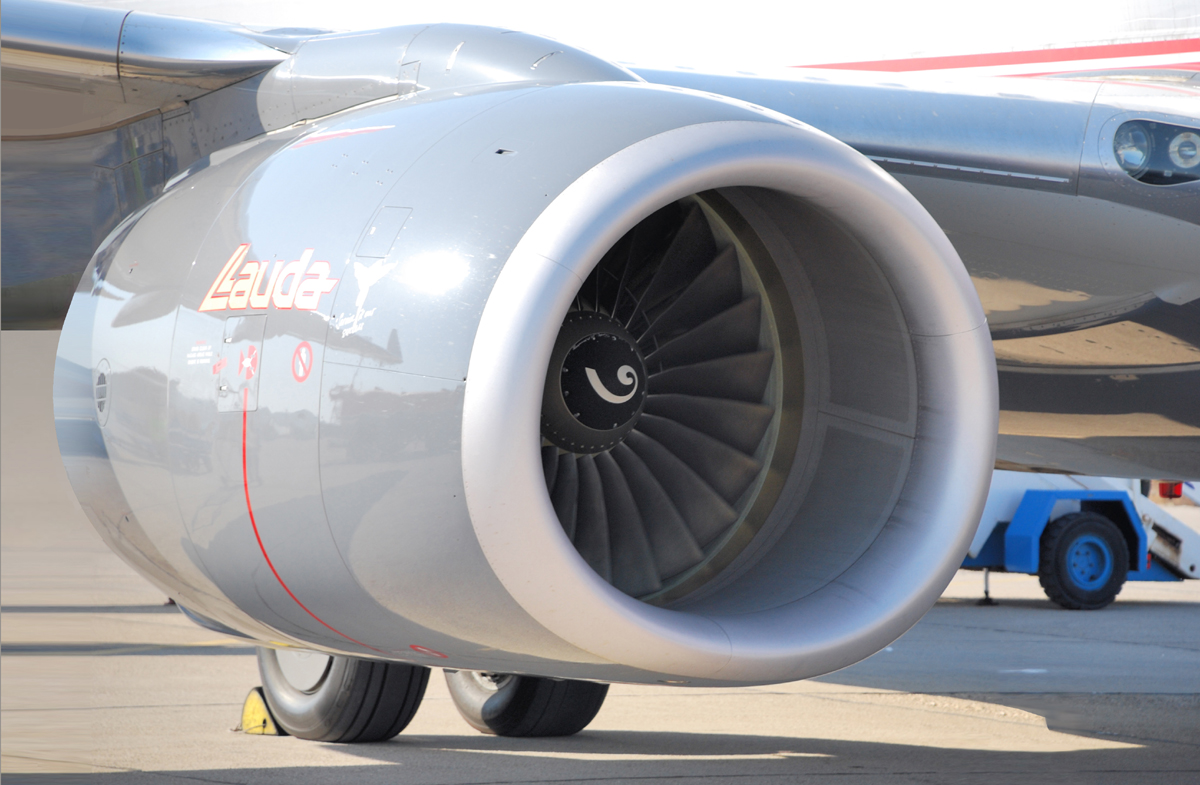
* 787 https://upload.wikimedia.org/wikipedia/commons/7/70/787_-_Fl...

And even with that they also had to mount the engines way ahead of the wing, clear off of it: https://en.wikipedia.org/wiki/File:N707SA_Southwest_Airlines...

Now this looks a lot like an A320 where the engine is also ahead of the wing[0] but notice how the engine "strut" goes downwards on the 320 but has to "wave up" on the 737NG.

It's very clear on the side-view drawings:

* A30x https://upload.wikimedia.org/wikipedia/commons/9/92/A32XFAMI...

* 737 https://upload.wikimedia.org/wikipedia/commons/b/bc/B737Fami...

where you can also see the side-structure of the original 737 and its low-bypass turbofan (0.96:1 compared to 5:1 to 6:1 for the NG's engine).

[0] https://en.wikipedia.org/wiki/Airbus_A320_family#/media/File...

Re:Boeing 777X: World’s largest twin-engine jet completes fi... by Reason077 on Sunday January 26, 2020 @12:23PM (#22153275)
"the NG, which had to use these weird flattened turbofan nacelles in order to get enough ground clearance"

I believe your picture actually shows the 737-300 (Classic), which had a very obvious flat-spot in it's nacelles. The NGs do also have a slight "flat spot", but it's much less obvious.

Re:Boeing 777X: World’s largest twin-engine jet completes fi... by gfree on Sunday January 26, 2020 @12:32PM (#22153344)
There is a similar example for the 777X though. The new folding wingtips to fit into the existing gate sizes seems like a potential new failure mode like moving the 737Max engines forward. No evidence it won’t work fine but it feels like a hack.
Re:Boeing 777X: World’s largest twin-engine jet completes fi... by donarb on Sunday January 26, 2020 @01:54PM (#22153888)
Here's a link to the FAA certification for the folding wingtips. It's pretty comprehensive.

https://www.federalregister.gov/documents/2018/05/18/2018-10...

Boeing was required to prove the load-bearing of the hinges on the wings and what types of alerts that the crews receive should a wingtip fail to lock prior to takeoff. More than one means must be available to alert the flight crew that the wingtips are not properly positioned and secured prior to takeoff. If the wingtip is not locked prior to takeoff, the plane is prevented from taking off.

They even required that the electric circuit that unlocks the wingtips be automatically isolated from the circuit that folds and locks the wingtips and that that circuit cannot be re-powered during flight.

Re:Boeing 777X: World’s largest twin-engine jet completes fi... by dx034 on Monday January 27, 2020 @01:29AM (#22157239)
Did they show simulations about what would happen if they fold during flight? Is it just rougher flight with less lift or would they severely impact the pilot's ability to steer the plane?
Re:Boeing 777X: World’s largest twin-engine jet completes fi... by matt123456789 on Sunday January 26, 2020 @01:39PM (#22153765)
That’s closer to the type of iterative change one might expect from a new model of the same type. As long as they’re structurally sound, the folding wingtips present more of a maintenance risk than a safety risk.
Re:Boeing 777X: World’s largest twin-engine jet completes fi... by trhway on Sunday January 26, 2020 @07:29PM (#22155911)
why don't Boeing leave wingtips vertical like on A350 or 737? A feet of vertical winglet replaces 3 feet of horizonal wingtip. So with 3 feet high winglets Boeing cold have just avoided the need for folding.
Re:Boeing 777X: World’s largest twin-engine jet completes fi... by zz0rr on Monday January 27, 2020 @02:24AM (#22157459)
vertical winglets are ways to get more lift:drag out of a wing that's constrained by some width limit (airport gate spacing) or an existing wing design that you don't want to redo. they don't generate lift. for a clean sheet design you can do better with a "scimitar" wingtip that actually provides some lift and might weigh the same as a winglet. see 787. also the navy p8 which has the most efficient wing of any existing 737, and doesn't have vertical winglets (because it doesn't typically park at a gate they could go wider with these little triangular extensions)
Re:Boeing 777X: World’s largest twin-engine jet completes fi... by tonyedgecombe on Sunday January 26, 2020 @12:28PM (#22153312)
If the cultural problems at Boeing led to the issues with the 737 then perhaps they would also manifest themselves on this plane, just in some other part of the aircraft.
Re:Boeing 777X: World’s largest twin-engine jet completes fi... by chipsa on Monday January 27, 2020 @02:23AM (#22157453)
The 777 is also FBW. They wouldn't have needed the patch. It'd just be a change in how the stick forces are mapped.
Re:Boeing 777X: World’s largest twin-engine jet completes fi... by londons_explore on Sunday January 26, 2020 @08:12AM (#22151912)
Technology dramatically changes in 20 years. Would you be happy to drive around in a 20 year old car design? I for sure would feel a little uneasy about the rather basic airbags, and the lack of proper FEA modelling of the crumple zone.

Same applies for planes.

Now remember these planes will probably be produced for 30 years, and then maybe in service for a further 20 years. Will you be happy to know that safety critical design decisions were made to standards of 90 years ago?

Re:Boeing 777X: World’s largest twin-engine jet completes fi... by maxerickson on Sunday January 26, 2020 @08:22AM (#22151934)
I crashed a gen 2 Ford Explorer (first production year 1995) head on at about 35-40 MPH and wouldn't be scared to drive one around today. The other driver crossed the centerline directly in front of me and I crashed into the rear of their gen 2 Ford Explorer (so a medium-large vehicle striking a medium-large vehicle).

It didn't have airbags, I was wearing the seat belt, I had a slightly sore neck for a couple months (not like bothersome sore, I noticed it when doing higher impact things).

Which isn't to say I'm opposed to updated safety features, rather that 20 years ago wasn't that bad, even without air bags.

Re:Boeing 777X: World’s largest twin-engine jet completes fi... by apta on Sunday January 26, 2020 @03:11PM (#22154422)
A head on crash is very different from an offset crash, which are supposedly much more common, and much more likely to cause injuries compared to a full head on crash where forces are (relatively) easier to be dissipated. When the IIHS started testing small-overlap crashes, many vehicles failed, receiving a score of "marginal" or "poor", including cars such as the c-class.

Later models of those cars were improved. But then a similar story happened when the IIHS started testing small overlap for passenger-side crashes, until again newer models were reinforced.

[1] https://www.cars.com/articles/mercedes-lexus-and-audi-fail-l...

[2] https://jalopnik.com/the-toughest-car-crash-test-is-about-to...

Re:Boeing 777X: World’s largest twin-engine jet completes fi... by maxerickson on Sunday January 26, 2020 @08:26PM (#22156162)
It was somewhat offset: https://imgur.com/a/I8YxrAt

I'm not sure why I didn't take pictures of the drivers side, but the front panel wasn't nearly as damaged.

Re:Boeing 777X: World’s largest twin-engine jet completes fi... by apta on Monday January 27, 2020 @10:25AM (#22160103)
Glad you're safe, but look up the IIHS medium and small overlap tests to see what those overlap tests look like.
Re:Boeing 777X: World’s largest twin-engine jet completes fi... by forgetfulusr on Sunday January 26, 2020 @09:26AM (#22152193)
OT: I would also prefer a 20 yr old car design then a modern 'smart screens everywhere let the car drive for you because it is safer'. Cars were just finoshed back then, but in comes the age of 'Everything as a service'. Cars today are crap. Maybe in another 20 when they fix the batteries.
Re:Boeing 777X: World’s largest twin-engine jet completes fi... by ken on Sunday January 26, 2020 @11:43AM (#22152985)
I drive a 23-year-old car design and have zero qualms about it.

Commercial aviation is one of the safest modes of transportation there is. That’s due to the safety procedures practiced by the operators, not faster FEA modeling. It’s far safer than even the latest cars, when driven by amateurs on public roads.

Is there some specific “safety critical design decision“ you think was lacking in the 777 era?

Re:Boeing 777X: World’s largest twin-engine jet completes fi... by apta on Sunday January 26, 2020 @03:36PM (#22154598)
Newer cars are provably much safer compared to older models. They have both active safety systems, such as pre-collision braking, lane tracking, etc. as well as passive systems such as airbags and superior crumple zones. Not to mention they're much more efficient when it comes to fuel consumption.

I don't know what your financial situation is, but I recommend that you research the issue. You can buy a good, safe, and reliable second hand car from a manufacturer like Toyota, Honda, etc.

Re:Boeing 777X: World’s largest twin-engine jet completes fi... by allovernow on Sunday January 26, 2020 @12:12PM (#22153187)
My 25 and 30 year old cars don't fall out of the sky if the engine stops working, and even if I do wreck I'm not looking at guaranteed death like that in a typical plane accident.

One of them doesn't even have airbags!

Live a little.

Re:Boeing 777X: World’s largest twin-engine jet completes fi... by heelix on Sunday January 26, 2020 @12:45PM (#22153428)
Good lord... I realize my plane is 64 years old now. I was able to solo with about 8 hours of training (a few takeoff and landings by my lonesome).

Most of getting licensed is learning how to deal with bad situations. Engine out, getting lost, that sort of thing. Every biennial flight review, at some point, the engine will 'fail'. The plane may or may not belong to the insurance company after in a real event but most engine out scenarios should be survivable. I can't think I've even seen an aircraft that is without 4 point shoulder straps.

Even big stuff can do that sort of landing. (Your call on if you consider that gliding, or just falling with style) https://en.wikipedia.org/wiki/Gimli_Glider https://en.wikipedia.org/wiki/US_Airways_Flight_1549

Re:Boeing 777X: World’s largest twin-engine jet completes fi... by allovernow on Monday January 27, 2020 @01:43AM (#22157292)
Sure, I was being hyperbolic. But all of those are emergencies that require technical training and a cool head to evade - and not everyone is capable of flying a plane. Contrast that to a car where the worst that can happen is you roll to a stop. Hell, during near misses, you can panic brake and lock the steering wheel and that's it, your ride is safely over. No need to hit a runway with just enough glide left within a speed range with some special configuration of control surfaces.

Sounds like a cool plane though, clearly I appreciate old mechanical technology!

Re:Boeing 777X: World’s largest twin-engine jet completes fi... by WalterBright on Sunday January 26, 2020 @01:29PM (#22153708)
> I'm not looking at guaranteed death like that in a typical plane accident.

I don't have the numbers handy, but most plane accidents are survivable. In fact, there are many crashes where everyone survived (like the Gimli Glider).

Re:Boeing 777X: World’s largest twin-engine jet completes fi... by chrisseaton on Sunday January 26, 2020 @12:03PM (#22153134)
> Would you be happy to drive around in a 20 year old car design?

Er yes I’d be fine with it.

My current car is from 2009, looks and works almost the same as the same model from 1999, and I’m not planning to change it.

Re:Boeing 777X: World’s largest twin-engine jet completes fi... by apta on Sunday January 26, 2020 @03:37PM (#22154607)
Just because it looks the same, does not mean that it's the same under the hood. Designs are constantly improved and re-worked for safety. Look up what happened when the IIHS introduced the small overlap test. Several manufacturers (including luxury brands like Mercedes-Benz) failed the test before re-enforcing the same design to make it pass. Not to mention active safety systems such as pre-collision braking and the like, which don't exist on older models.
Re:Boeing 777X: World’s largest twin-engine jet completes fi... by chrisseaton on Sunday January 26, 2020 @04:02PM (#22154771)
> re-worked for safety

Lol I don’t think my 2009 Defender was - doesn’t even have airbags. Pretty sure it has zero crumble zone either. And no adaptive anything.

But I wouldn’t swap it for anything - it’s a timeless heritage piece and represents something about who I am.

Re:Boeing 777X: World’s largest twin-engine jet completes fi... by opsunit on Sunday January 26, 2020 @06:39PM (#22155671)
I've a Defender, a '66 VW Beetle, a Fiat 500 and a Volvo XC40 with adaptive and predictive everything and I'll only take my kids out in the latter. Heritage vehicles have their place but they're harmful to the occupants and harmful to the other party in an accident. I wouldn't use one as a daily for that reason.

One interesting thing about the Beetle is that despite retaining the same basic shape and construction over the entire run a lot changed to significantly improve relative safety: collapsible steering columns, the change to Macpherson strut suspension, door handles with the opening mechanism shielded in a roll-over and so-on.

Re:Boeing 777X: World’s largest twin-engine jet completes fi... by the_mitsuhiko on Sunday January 26, 2020 @07:05AM (#22151683)
Which tricks did they have to pull here?
Re:Boeing 777X: World’s largest twin-engine jet completes fi... by wolfgke on Sunday January 26, 2020 @01:15PM (#22153617)
$$$
Re:Boeing 777X: World’s largest twin-engine jet completes fi... by vasilakisfil on Sunday January 26, 2020 @11:07AM (#22152716)
Doesn't that make a plane less engine-fault tolerant? Completely noob here, but I would feel better if I flew in a 4-engine plane than 2-engine. In a 4-engine plane, even if 2 engines faults (like, bird strike), the other 2 will still make the plain airbone.
Re:Boeing 777X: World’s largest twin-engine jet completes fi... by dehrmann on Sunday January 26, 2020 @12:45PM (#22153426)
You don't necessarily lose engines instantly to bird strikes, they're most likely to happen at takeoff and landing, and it hasn't been an issue for the massive fleet of twin-engine short-haul jets.

The real concern is trans-oceanic long-haul. Supposedly modern engine failure rates have improved to the point that you're less likely to have problematic engine failures than a four-engine 70s-era 747.

Re:Boeing 777X: World’s largest twin-engine jet completes fi... by dx034 on Monday January 27, 2020 @01:32AM (#22157246)
Which is shown by statistics. There are thousands of daily flights over Atlantic & Pacific. Engine failures over the ocean are incredibly rare (I couldn't find any recent ones). Most reasons why airliners choose to divert at this stage are medical issues nowadays. And for the plane to crash not one but both engines would have to fail.
Re:Boeing 777X: World’s largest twin-engine jet completes fi... by dehrmann on Monday January 27, 2020 @11:34AM (#22160871)
> for the plane to crash not one but both engines would have to fail

I recently rode in a 2-person jet. The pilot said the only reason we might bail out is an engine fire. If the engine fails, the plane's an excellent glider, and we'll glide to an airport/airstrip. Now, this was somewhere with airports all over, not an ocean.

https://en.wikipedia.org/wiki/ETOPS is a good read.

Re:Boeing 777X: World’s largest twin-engine jet completes fi... by dehrmann on Monday January 27, 2020 @11:42AM (#22160980)
> medical issues

Good to know that the squishy contents of the aluminum can are the least reliable part of the system.

I guess that also limits the size for planes, but probably to 10,000+, so it's not something we're likely to hit.

Re:Boeing 777X: World’s largest twin-engine jet completes fi... by foryourpleasure on Sunday January 26, 2020 @12:10PM (#22153179)
Robust testing should make the dual engine failure scenario quite unlikely. That’s why the miracle on the Hudson was so remarkable.

ETOPS is the general set of rules for how far a plane with two engines can be from an airport. https://en.m.wikipedia.org/wiki/ETOPS

Re:Boeing 777X: World’s largest twin-engine jet completes fi... by marcinzm on Sunday January 26, 2020 @12:14PM (#22153201)
A bird strike (keep in mind birds fly in flocks) I'm guessing would either take out 1 engine (which is fine on a new 2 engine plane even during takeoff) so no benefit or take out all engines (or all engines on one side which again means just 1 engine on a 2 engine plane). A flock big enough to take out both engines on a 2 engine would be big enough I presume to take out all 4 on a 4 engine.

Four engines just means there's 4 things that can catastrophically fail and potentially damage the plane rather than 2.

Re:Boeing 777X: World’s largest twin-engine jet completes fi... by ryder9 on Sunday January 26, 2020 @05:38PM (#22155330)
A very good video on this subject matter of 4 Engines vs 2 Engines

https://www.youtube.com/watch?v=HSxSgbNQi-g

Re:Boeing 777X: World’s largest twin-engine jet completes fi... by WalterBright on Sunday January 26, 2020 @01:32PM (#22153725)
Statistically, 2 engines are safer than 4. 4 engines will have twice the failure rate, and when engines fail the risk is collateral damage.
Re:Boeing 777X: World’s largest twin-engine jet completes fi... by jfim on Sunday January 26, 2020 @03:17PM (#22154453)
That really depends on the minimal number of engines needed for safe operation.

Say that you need 50% of the engines on the plane to be able to fly safely, then having more engines is actually safer. For example, supposing that engine failures occur 1% of the time, with four engines there are 3.97 three and four engine failures per million flights. For a two engine plane, there are 100 two engine failures per million flights.

Re:Boeing 777X: World’s largest twin-engine jet completes fi... by WalterBright on Sunday January 26, 2020 @05:35PM (#22155313)
Engine failure can be more than just quitting. It can catch fire and burn the wing, it can throw turbine blades around, it can shake itself violently. These can cause other damage to the airplane. It can even tear itself off, surge forward, fall back and hit the wing. These things have all happened. I remember a DC-10 that crashed losing everyone in it when one engine came off and took out the flight controls with it. Then there's the Sioux City crash where the compressor disintegrated and took out all three hydraulic systems.

That's what I meant by "collateral damage".

Doubling the number of engines doubles that risk.

On the other hand, a failure that would take out both engines on a twin jet is likely to take out 4 engines. Failures such as running out of fuel, ingesting a flock of geese, and ingesting hail.

Re:Boeing 777X: World’s largest twin-engine jet completes fi... by apta on Sunday January 26, 2020 @03:43PM (#22154652)
There's correlation involved with other factors however. If I'm not mistaken, things like maintenance are relatively easier (and cheaper) on a 2 engine aircraft compared to a 4 engine aircraft. So we cannot consider failure rates as an abstract measure.
Re:Boeing 777X: World’s largest twin-engine jet completes fi... by jfim on Sunday January 26, 2020 @04:08PM (#22154810)
I agree, and it's also very unlikely that engine failures are independent, since they're the same model, coming from the same manufacturer, and the same maintenance procedures.

There's probably less drag from two engines than four as well.

Re:Boeing 777X: World’s largest twin-engine jet completes fi... by WalterBright on Sunday January 26, 2020 @05:47PM (#22155385)
Even if two engines have the same defect, it's highly unlikely they'd both fail on the same flight.
Re:Boeing 777X: World’s largest twin-engine jet completes fi... by K0SM0S on Sunday January 26, 2020 @06:27PM (#22155607)
The associated concept in regulation is a certification (by plane model, e.g. for all Airbus A321) called ETOPS¹ (Extended Operations). The cert applies to twin engines and basically tells you that a plane can fly up to XXX minutes on 1 functional engine only (e.g. ETOPS = 60, then you have ETOPS 120, ETOPS 180 and currently ETOPS 240 is permitted on a case-by-base basis). Note that "ETOPS-180 and ETOPS-207 cover about 95% of the Earth" (how much you can reach while staying 180-207 minutes from an airport at normal altitude/speed).

The rational justification is not merely technical but rather empirical, proven by real-world data. Certifications usually because companies can demonstrate e.g. "N years of trouble-free XXX-minutes ETOPS experience". In other words, we've been doing it for this long and it works so there's statistically ever-less reasons to believe the certification is flawed.

So, despite all the stats you may collect about birds, and physical + ethological models to estimate how much chance there is it will happen twice to a twin engine plane on both reactors before it can land, it would only prove reality: it just doesn't happen. Or not in ways that more engines would solve. (Birds are a bigger problem for cockpit windows, though.)

Now, another additional bit of safety: all jetliner planes have a "fixed-wing" design, allowing "deadstick landing"². From wiki:

> All fixed-wing aircraft have some capability to glide with no engine power; that is, they do not sink straight down like a stone, but rather continue to glide moving horizontally while descending. For example, with a glide ratio of 15:1, a Boeing 747-200 can glide for 150 kilometres (93 mi) from a cruising altitude of 10,000 metres (33,000 ft).

More recent planes are usually ever better (the OG 747 is from 1969!) At the very least it allows the pilot to 'land' on sea and wait for evacuation in zodiacs. So even in the extremely unprobable event that ETOPS failed (the statistical outlier where a plane loses both engines), you'd probably just glide to the ground 100-200km away at most to reach some landing spot.

There are reasons why air travel is so safe, the safest of all, and most of those are empirical, real, tested then validated. That's why it was such a shame what Boeing did to the 737 MAX; and I hope the 777X program yields the safest planes we've ever seen from them, that they actually innovate in that respect.

Safe travels!

[1]: https://en.wikipedia.org/wiki/ETOPS

[2]: https://en.wikipedia.org/wiki/Deadstick_landing

Re:Boeing 777X: World’s largest twin-engine jet completes fi... by dx034 on Monday January 27, 2020 @01:34AM (#22157258)
> More recent planes are usually ever better (the OG 747 is from 1969!) At the very least it allows the pilot to 'land' on sea and wait for evacuation in zodiacs. So even in the extremely unprobable event that ETOPS failed (the statistical outlier where a plane loses both engines), you'd probably just glide to the ground 100-200km away at most to reach some landing spot.

While I agree with the rest, landing on sea is a terrible idea. That can work on rivers where you have no waves. But gliding onto an ocean with waves will likely be fatal. Luckily, there is no recent case of a double engine failure where landing on sea was necessary (apart from maybe MH370 but we don't know that).

Re:Boeing 777X: World’s largest twin-engine jet completes fi... by K0SM0S on Monday January 27, 2020 @01:55AM (#22157331)
Oh I totally agree. Thanks for clarifying this point! I honestly didn't mean to say that you would choose to land of sea if you had any alternative... just that if you must, it's a last resort.

The main argument was really about not dying from engine failure (i.e. from falling) since planes glide — knowing this totally changed my impression of "safety" wrt riding planes, for the better: “planes can't fall!”.