The parent's statement is not false, it's just that one must be precise about naming, because casual use leads to incorrect assumptions by others.
Other than that, yes, you are correct.
* [1] https://www.animatedknots.com/overhand-knot * [2] https://www.animatedknots.com/flat-overhand-bend-knot
While double-overhand and half-hitches are very useful, the "vanilla" overhand knot is among the weakest of knots and should be avoided in almost all circumstances. I can't say that I've ever found a good use of the "vanilla" overhand knot.
I'm not a climber. I just happen to have some twine on my often for daily use.
Rappel only exerts a force equivalent to your weight, plus a little extra because of bouncing that naturally occurs during descent. 1kN = 224lbs force, so if you weigh 200lbs you can expect to exert about 1kN of force on a static rope. About the weakest static rope people frequently rappel on is a 7mm line, and a typical one[1] is rated to 12.4kN. So abrasion, knots coming undone, losing control of the brake strand, etc. are much larger concerns than static rope breaking due to knots.
Static ropes are ideal for rappelling, but climbers will often use the same rope they lead climb on to rappel on, and for lead climbing applications your rope must be dynamic. The weakest ropes you would usually lead on would be something like 7.5mm half ropes. A typical example[2] doesn't list a maximum breaking strength, because this statistic isn't relevant for dynamic rope. The purpose of a dynamic rope is absorb force during a fall: if you take a lead fall on a static rope, it's unlikely that the static rope will break, but hitting the end of a static rope is just as bad as hitting the ground with the same force. When you hit the end of a dynamic rope, it stretches to absorb this force, giving you a gentle fall. The maximum force on the rope listed is 9.9kN, which is from a UIAA-standard test fall: these falls are far more violent than anything you are likely to experience in actual usage. Ostensibly the rope can handle more force than that, but 9.9kN of force would probably kill you anyway. Luckily the rope stretch means it's unlikely you'd get anywhere near that level of force: a typical lead fall is in the range of 2kN. So again with dynamic rope, margins of error are very high, and abrasion, knots coming undone, losing control of the brake strand, etc. are much larger concerns than static rope breaking due to knots.
This is all fine and good on paper and in a lab, but does it work in the real world? The answer is yes: real world accident statistics[3] indicate that the most common accidents on rappel are simply rappelling off the ends of your rope. I wasn't able to find a single accident caused by rope breaking due to knots. Ropes do break, but this is typically attributed to abrasion over sharp surfaces, or long-term wear, and even these accidents are rare.
[1] https://sterlingrope.com/store/climb/cordage/tag-lines/7mm-t...
[2] https://www.mammut.com/us/en/p/2010-02762-11190/75-twilight-...
[3] http://publications.americanalpineclub.org/about_accidents
EDIT: Just to be clear, although there is a correlation between thickness and strength, the thinnest ropes aren't necessarily the weakest. The examples I give are examples of some of the weakest ropes I have used. This also shouldn't be perceived as a criticism of these ropes: as I said, these are more than strong enough. Thin ropes are certainly more susceptible to abrasion and aren't as durable, but this is a tradeoff for having a very light rope for moving fast. I used these ropes because they are the best ropes for the situations I planned for.
I'm not a climber, what I usually use is cotton, jute, or sisal twine in a day-to-day basis for various tasks. Cotton twine is very easy to keep in your pocket and very clean, but its the weakest by far. Sisal and Jute are scratchy and messy, but they have superior strength.
Lets say you've got a 40lb cotton twine in your pocket. You can either use an overhand knot and drop the strength to ~20lbs, or you can use a figure-eight knot and instead have ~32lbs of strength.
Both the overhand knot and figure eight knot weakened the twine. But overhand knot is among the weakest of knots, with a 50% drop in performance. Having only a 20% drop from figure-eight makes a huge, noticeable difference in strength.
1. Change in strength is dependent on the cord material and weave. Stiffer cord will lose more strength when tied, while more supple cord will maintain its strength better. The tradeoff is that supple cord is more susceptible to tangling. Citing one number as a strength loss for different knots is sure to be false. I would guess, for example, that your cotton twine sees less percentage loss in strength in both knots than your jute.
2. The change in strength is also dependent on the sharpness of the folds in the material. A sharper turn is weaker than a rounder one. If you tie a knot around something, that decreases the sharpness of the turns, which is going to increase the strength of the knots. We aren't typically just tying an overhand or figure 8 midline in a knot and pulling on the ends--I can't think of ANY place where that's useful. The closest thing I can think of is a stopper knot, and neither of these knots is ideal for that application. I'd expect to see a higher loss of strength with flat overhand/flat figure 8, than with a ring bend/flemish bend (which correspond to the overhand and figure 8). This is because the weakest points in the flat knots is the turn entering the knot, whereas the retraced bend versions of these knots, the cord enters the knot in a straight line.
3. Breaking is often not the largest source of failure. A flat figure 8 will roll and come untied long before the cord breaks in most materials, while the flat usually binds within 1-3 rolls. The breaking load of a flat overhand is much, much higher than the rolling load of a flat figure 8 in climbing ropes I've tried it with.
I'll admit that I've mostly used this "useless knot" test methodology you're criticizing here. But in its defense, it is an easy to do micro-benchmark with consistent results.
I guess I could setup a more cohesive test to measure the strength in more "realistic" scenarios. That's really all it comes down to: the strength of the rope in whatever specific situation you're doing.
I'll note that 40lb-strength rated cotton twine is just strong enough to be useful, and just weak enough that a bad knot or two will cause the twine to snap under moderate usage. (Ex: Package Tie to support a box containing 20lb).
That's fair, and it does prove that different knots affect strength differently. That's a base principle that is useful to know even if it doesn't get you far on its own.
With regards to your application: while it lacks the "finesse" of tying knots that give you just enough strength, simply getting stronger twine would solve this problem without the complexity.
In general, there's a whole lot of ways knots can fail. If you can solve the problem by just using stronger cord, that frees up mental cycles for dressing, avoiding slippage, effective communication, ease of untying, etc. If you're just tying up boxes do whatever you feel like doing. But for climbing, I'd rather have the rope be more than strong enough to do its job, and have those brain cycles for focusing on preventing other system failures.
That's why I asked.
Zip ties are more prone to overtightening, but as long as you are aware of the overtightening problem, there's probably no real reason to avoid them.
The main advantage of knowing cable lacing is that it generalizes. There are many long-objects that benefit from the cable-lacing knot. For example, a rope can secure a bunch of 2x4 together using the cable-lacing technique. Any "long lengthwise bundle" of objects can benefit from cable lacing.
Cable lacing on the Curiosity rover: https://news.ycombinator.com/item?id=4472312
The Lost Art of Lacing Cable (2018): https://news.ycombinator.com/item?id=20582844
https://www.101knots.com/wp-content/uploads/2016/11/How-to-T...
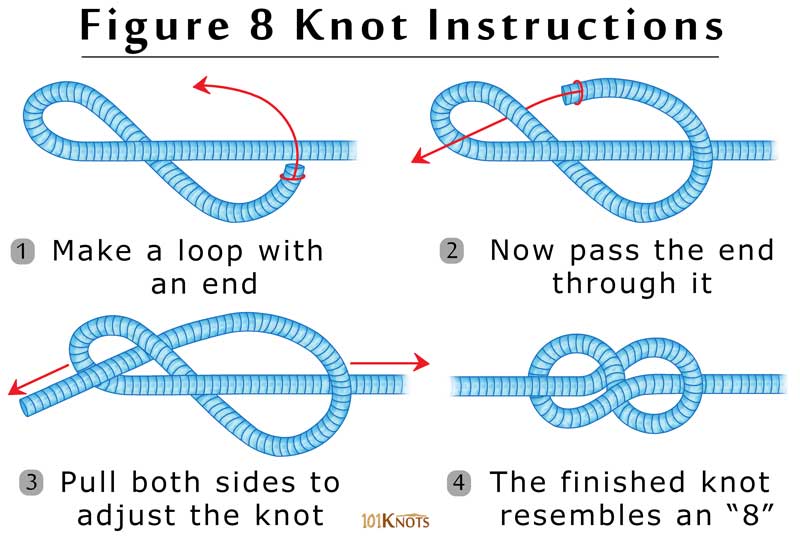
In fact, I've practiced the figure 8 knot so much, that it takes more effort for me to do an overhand knot these days. Figure 8 is really easy.
Just as the "Granny Knot" is a mistaken square knot / reef knot... the "Overhand Knot" is basically a mistaken figure-8 knot. Just turn the other way, and the knot will be far, far stronger.
So, an overhand knot is likely easier for most people, where a figure-eight would be better for those who practice.
I think the difference in speed would be measured in milliseconds. You'd need a slow-motion camera to spot see any difference at all.
1. Square Knot / Reef Knot -- This is the shoelace tie, and its one of the simplest knots. Learn this knot backwards and forwards you'll use it a lot. Avoid the granny knot (a mistaken reef knot). Beginners will often tie the granny knot instead of the square knot. If you can do a square knot, the "Surgeon Knot" is a useful variant which is more secure.
2. Figure Eight -- Superior to the overhand knot in almost every way imaginable. Never use an overhand knot, always use figure eight instead.
3. Bowline Loop / Sheet Bend -- When a loop must be sturdy and unmoving, the bowline is one of the best. The Sheet Bend is nearly the same, except you tie two different ropes together. I keep a bowline loop on any "pocket twine" because making a bowline loop is the start of many advanced knots. Such as...
4. Package Tie -- Presents obviously look nicer with a ribbon in package tie form, but any large, box-ish object can be secured with the package tie. Really good for lunchboxes / bags in daily usage. Add another Bowline loop on the end for a convenient handle. https://www.animatedknots.com/package-tying-knot
5. Cable Lacing -- When working with wires and electronics, the cable-lacing knots are great for organizing wires. Its quick to tie and organize, and looks great. https://www.flight-mechanic.com/lacing-tying-and-cutting-wir...
6. Poacher's Noose -- When a loop needs to "collapse" to bind objects together, various nooses come in handy. Poacher's noose is my favorite, ties easily and fewer people recognize it compared to the hangman's noose. Both nooses have political implications however so be wary of who is watching you when you tie a noose.
7. Butterfly coil -- When storing most paracord, twine, or ropes... butterfly coil is fast and effective storage.
8. Over-under coil -- Wrapping up thicker wires / cables (especially electronic cables / wires, but also garden hoses) is best with over-under coil instead of butterfly coil.
9. Half-hitch -- Its the knot you've been using all the time, and you probably don't even realize it. Its called a "half-hitch", because you need two of them to actually make it secure. Two-half hitches solves many problems.