News for hackers. Stuff that matters.
Re:Incident: Wizz Air and Air Europa Planes in Near Collisio... by yladiz on Tuesday December 31, 2019 @07:44AM (#21920649)
Short summary: the two planes were very close, “200 feet vertical and 0.2nm horizontal,” and according to the article the main reason the incident happened is due to miscommunication and oversaturated communication channels.

Initially the Wizz Air plane was supposed to descend to FL300, but missed the first instruction, and the second one was incorrectly given and confirmed (read back by the crew means confirmed?) as FL200. The Air Europa flight was at FL290, and the Wizz Air plane got to FL292 (200 feet from FL290) before being instructed to ascend. The cause of the miscommunication was that the frequency used to communicate from the air traffic control to the planes was saturated and many communications collided, meaning multiple communications happened at the same time and were impossible to differentiate, necessitating repeating.

Edit: wasn’t misheard, instruction was incorrectly given.

Re:Incident: Wizz Air and Air Europa Planes in Near Collisio... by bkor on Tuesday December 31, 2019 @08:00AM (#21920715)
> read back by the crew means confirmed

Read back does not mean confirmed, it's basically a double check. What pilots do when they get an instruction they'll respond with the same instruction (but abbreviated).

Example:

ATC: Descend and maintain FL300

Pilot: Cleared for FL 300, XZ 123

Whereby XZ 123 indicates the flight. By reading back the instructions ATC should notice if the pilot heard everything correctly.

That's entirely different than "confirmed". With confirmed there's no double check. Further, unless there's an emergency AFAIK the pilot must follow ATC so no need to "confirm".

Re:Incident: Wizz Air and Air Europa Planes in Near Collisio... by tombh on Tuesday December 31, 2019 @07:47AM (#21920667)
'nm' is 'nautical mile', for anyone wondering
Re:Incident: Wizz Air and Air Europa Planes in Near Collisio... by acvny on Tuesday December 31, 2019 @07:54AM (#21920693)
Clearly a mistake. Abbreviations for nautical mile are M NM or nmi. I guess the author has not heard about nanometer
Re:Incident: Wizz Air and Air Europa Planes in Near Collisio... by backspace_ on Tuesday December 31, 2019 @08:23AM (#21920809)
I guess you could take the context of the article. There would be no way to measure in nanometers in that situation. So if someone does not know that nautical miles was implied, it should be easy to infer that nm was not nanometer.
Re:Incident: Wizz Air and Air Europa Planes in Near Collisio... by StavrosK on Tuesday December 31, 2019 @08:29AM (#21920850)
I did infer that, but was extremely confused because I didn't know what else it could be.
Re:Incident: Wizz Air and Air Europa Planes in Near Collisio... by ogre_codes on Tuesday December 31, 2019 @12:44PM (#21922846)
The source isn't really intended for general consumption. It's a briefing intended for pilots and others in the industry. The goal of these kind of documents is to help pilots and air traffic controllers to learn from their mistakes.
Re:Incident: Wizz Air and Air Europa Planes in Near Collisio... by mirimir on Tuesday December 31, 2019 @02:30PM (#21923869)
Sure, but that didn't stop me from thinking "nanometer" whenever I saw it. Initially, I was wondering what font screwup could turn "km" into "nm".
Re:Incident: Wizz Air and Air Europa Planes in Near Collisio... by HeWhoLurksLate on Tuesday December 31, 2019 @06:48PM (#21925621)
Same! I was wondering A) how in the world they managed to get that closr and B) how they managed to measure it.
Re:Incident: Wizz Air and Air Europa Planes in Near Collisio... by _-___________-_ on Tuesday December 31, 2019 @08:23AM (#21920812)
In an aviation context, `nm` is almost universally used for (and understood to mean) nautical mile.
Re:Incident: Wizz Air and Air Europa Planes in Near Collisio... by gdxhyrd on Tuesday December 31, 2019 @03:08PM (#21924283)
NM or nmi, but not nm.

Confusion in units is never a good thing.

Re:Incident: Wizz Air and Air Europa Planes in Near Collisio... by nwallin on Tuesday December 31, 2019 @04:27PM (#21924867)
I don't think I've ever seen someone use M, NM, or nmi for nautical mile. I've only ever seen nm. I used nautical miles a lot in a previous career, in the context of aircraft mission planning.

Telling people in the industry to use nmi or NM seems a lot like telling computer people to use MiB or GiB instead of MB or GB, or to pronounce gif "jiff". They're just not going to change.

Re:Incident: Wizz Air and Air Europa Planes in Near Collisio... by gdxhyrd on Tuesday December 31, 2019 @09:39PM (#21926302)
It is going to change. I use MiB and GiB. I also use the ISO standard for dates, etc. Precisely because they are now standard.

Saying it is not going to change is what makes things harder.

Re:Incident: Wizz Air and Air Europa Planes in Near Collisio... by nradov on Tuesday December 31, 2019 @04:18PM (#21924809)
The FAA uses "NM" (capitalized) in federal regulations.
Re:Incident: Wizz Air and Air Europa Planes in Near Collisio... by rovolo on Tuesday December 31, 2019 @02:55PM (#21924169)
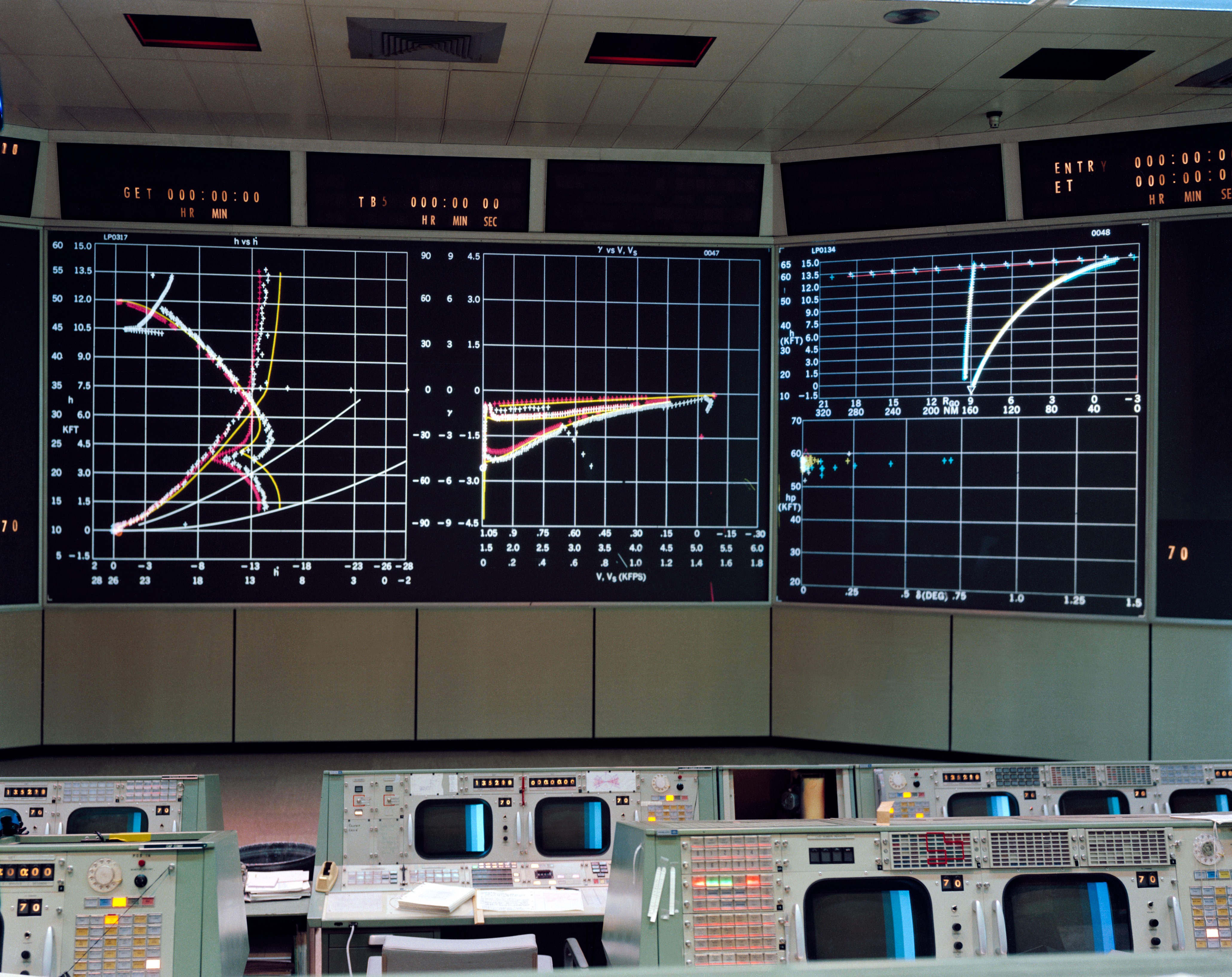
The Apollo flights used NM on their screens for nautical mile.

[pic (right-most screen)] https://cdn.arstechnica.net/wp-content/uploads/2012/10/liebe... [article] https://arstechnica.com/science/2019/12/apollo-flight-contro...
Re:Incident: Wizz Air and Air Europa Planes in Near Collisio... by semi-extrinsic on Tuesday December 31, 2019 @04:22PM (#21924830)
Also "KFPS", presumably for "thousands of feet per second"
Re:Incident: Wizz Air and Air Europa Planes in Near Collisio... by burke on Tuesday December 31, 2019 @11:44AM (#21922350)
The aviation industry: not exactly sticklers for metric usage.
Re:Incident: Wizz Air and Air Europa Planes in Near Collisio... by syncsynchalt on Tuesday December 31, 2019 @11:12AM (#21922020)
Nautical miles are a fun unit. They are one minute of arc of the earth's surface (idealized), so it makes sense why they took hold in the two forms of travel that regularly travel great circle routes.
Re:Incident: Wizz Air and Air Europa Planes in Near Collisio... by fanf2 on Tuesday December 31, 2019 @01:11PM (#21923069)
There is a similar relationship between gradians (metric angles) and kilometres https://en.wikipedia.org/wiki/Gradian
Re:Incident: Wizz Air and Air Europa Planes in Near Collisio... by ims on Tuesday December 31, 2019 @03:35PM (#21924505)
One minute of latitude for those wondering how this works.
Re:Incident: Wizz Air and Air Europa Planes in Near Collisio... by iso947 on Wednesday January 01, 2020 @06:19AM (#21927617)
1nm is about 1/60th of a degree of any great circle on the earths surface

(Earth isn’t a sphere so it’s not exact, but it’s pretty close)

Re:Incident: Wizz Air and Air Europa Planes in Near Collisio... by ddalex on Tuesday December 31, 2019 @05:09PM (#21925123)
Thank you! I was wondering how these work around the poles!
Re:Incident: Wizz Air and Air Europa Planes in Near Collisio... by SirHound on Tuesday December 31, 2019 @07:48AM (#21920675)
Yeah I did a double take. Close but surely not that close.
Re:Incident: Wizz Air and Air Europa Planes in Near Collisio... by rzzzt on Tuesday December 31, 2019 @08:45AM (#21920929)
missed by a whisker -> 90,000 nanometers apart
Re:Incident: Wizz Air and Air Europa Planes in Near Collisio... by solarkraft on Tuesday December 31, 2019 @09:36AM (#21921224)
Thanks. 2 nanometers of distance would indeed be a bit low.
Re:Incident: Wizz Air and Air Europa Planes in Near Collisio... by analog31 on Tuesday December 31, 2019 @01:27PM (#21923178)
It's only a problem if the planes are both fermions.
Re:Incident: Wizz Air and Air Europa Planes in Near Collisio... by anymane on Tuesday December 31, 2019 @11:35AM (#21922256)
Not nano meter :)
Re:Incident: Wizz Air and Air Europa Planes in Near Collisio... by SomeHacker44 on Tuesday December 31, 2019 @10:25AM (#21921567)
1nm is just over 6000 feet, so that is about 1200 feet horizontally. 1nm is also about 15% more than an sm (statute mile), the thing we usually call a mile outside of aviation or nautical circles.
Re:Incident: Wizz Air and Air Europa Planes in Near Collisio... by benhurmarcel on Tuesday December 31, 2019 @08:28AM (#21920844)
> 200 feet vertical and 0.2nm horizontal

So that's 375m (1230ft) total for anyone wondering.

Re:Incident: Wizz Air and Air Europa Planes in Near Collisio... by mlyle on Tuesday December 31, 2019 @12:18PM (#21922627)
Planes aren't spherical and don't change directions in all ways as easily... so taking the straight line distance isn't as helpful as you'd think.
Re:Incident: Wizz Air and Air Europa Planes in Near Collisio... by marcosdumay on Tuesday December 31, 2019 @10:32AM (#21921611)
You can't really compare horizontal and vertical distances.
Re:Incident: Wizz Air and Air Europa Planes in Near Collisio... by mannykannot on Tuesday December 31, 2019 @11:15AM (#21922064)
This is correct, and it is implicitly recognized in the vertical separation intervals being less than the horizontal ones. What matters even more than distance, however, is time, and in this case, fortunately, the aircraft were travelling in the same direction and so had a low closing speed (it was actually negative, I believe.)
Re:Incident: Wizz Air and Air Europa Planes in Near Collisio... by hnarn on Tuesday December 31, 2019 @10:27AM (#21921584)
What do you mean by 375 meters "total"? They were 0.2 nautical miles apart vertically, which is 370.4 meters, and additionally they were separated horizontally by 200 feet, which is ~61 meters.
Re:Incident: Wizz Air and Air Europa Planes in Near Collisio... by phonon on Tuesday December 31, 2019 @10:42AM (#21921709)
Re:Incident: Wizz Air and Air Europa Planes in Near Collisio... by saagarjha on Tuesday December 31, 2019 @10:43AM (#21921711)
Presumably they plugged it into the Pythagorean theorem.
Re:Incident: Wizz Air and Air Europa Planes in Near Collisio... by GordonS on Tuesday December 31, 2019 @08:44AM (#21920923)
Wow, usually when there are reports of "near misses" the planes are relatively far apart (still potentially dangerously close, of course) - I don't think I've seen a report with the planes this close to each other before.
Re:Incident: Wizz Air and Air Europa Planes in Near Collisio... by dragontamer on Tuesday December 31, 2019 @10:18AM (#21921511)
Planes don't actually have to strike each other to cause issues.

The turbulence from the engines is enough to cause issues for the next plane. Enough so, that turbulence alone can cause a crash, even if the airplanes never actually touch.

https://en.wikipedia.org/wiki/Wake_turbulence

Re:Incident: Wizz Air and Air Europa Planes in Near Collisio... by rkochman on Tuesday December 31, 2019 @01:07PM (#21923032)
FWIW, the dangerous part of wake turbulence is from the wing vortices, not the engines.
Re:Incident: Wizz Air and Air Europa Planes in Near Collisio... by dsfyu404ed on Tuesday December 31, 2019 @10:38AM (#21921667)
This is only really an issue for planes of highly disparate sizes and I've never heard of it causing issues (a crash or near miss) with a commercial airliner (edit: in good mechanical condition where the pilot does not make things worse from the get-go) sized craft being on the receiving end.
Re:Incident: Wizz Air and Air Europa Planes in Near Collisio... by cjbprime on Tuesday December 31, 2019 @11:01AM (#21921918)
Wake turbulence was the cause of the second deadliest air crash in US history:

https://en.wikipedia.org/wiki/American_Airlines_Flight_587

And involved in this one, though the situation is harder to assess:

https://en.wikipedia.org/wiki/USAir_Flight_427

Re:Incident: Wizz Air and Air Europa Planes in Near Collisio... by dsfyu404ed on Tuesday December 31, 2019 @11:13AM (#21922030)
>Wake turbulence was the cause of the second deadliest air crash in US history:

>https://en.wikipedia.org/wiki/American_Airlines_Flight_587

Funny you mention 587. That was actually the first thing I thought of. That was the one where the pilot slammed the pedals lock to lock in response to turbulence and ripped the vertical stabilizer off. Aircraft of similar size take off similar distances behind 747s all the time. The pilot really reacted badly in the case of 587 though his training was partly at fault. From wikipedia:

"The first officer repeatedly moved the rudder from fully left to fully right... The resulting hazardous sideslip angle led to extremely high aerodynamic loads that separated the vertical stabilizer. If the first officer had stopped moving the rudder at any time before the vertical stabilizer failed, the airplane would have leveled out on its own, and the accident would have been avoided"

>And involved in this one, though the situation is harder to assess:

>https://en.wikipedia.org/wiki/USAir_Flight_427

427 was a hydraulic failure and any source of turbulence (e.g. weather) requiring rudder movements could have raised that issue. IT was part of a larger issue.

https://en.wikipedia.org/wiki/Boeing_737_rudder_issues#Secon...

I originally said "Thank you from changing the wording from "implicated" to "cited" because they mean very different things." but you since edited your comment to say "cause" and "involved" which IMO is as accurate on average as "implicated" but with greater standard deviation.

Re:Incident: Wizz Air and Air Europa Planes in Near Collisio... by cjbprime on Tuesday December 31, 2019 @11:21AM (#21922114)
I don't think it's reasonable to say that wake turbulence has never caused an issue for an airliner, when many hundreds of people died because pilots misapplied rudder in direct response to wake turbulence.

The correct systemic response is to note that wake turbulence is very dangerous for airliners because it may cause pilots to catastrophically misapply rudder.

(Sorry for my many edits to the parent, I didn't realize you'd already replied.)

Re:Incident: Wizz Air and Air Europa Planes in Near Collisio... by dsfyu404ed on Tuesday December 31, 2019 @11:32AM (#21922225)
I don't think it's reasonable to say that N=1 warrants a systemic change when the N in question was a human (as opposed to a mechanical failure which is as repeatable as the components and the failure conditions are).

I don't know but I suspect United did change their training after that. The fact that the pilot reacted the way he did is as much their fault as the pilots. IMO it is a training/human factors issue, not some fundamental issue with turbulence and current following distances.

Re:Incident: Wizz Air and Air Europa Planes in Near Collisio... by mannykannot on Tuesday December 31, 2019 @12:35PM (#21922760)
American Airlines' training division had taught its pilots to react vigorously to wake turbulence, and among pilots generally, there was a widespread mistaken belief that, below the maximum maneuvering speed, it was impossible to do structural damage through the primary flight controls. Now that these misunderstandings have been corrected, we can hope this particular problem will not occur again.

On the other hand, I would guess that there is still a risk of people-thrown-around-the-cabin type incidents from abnormally close encounters with wake turbulence, and I do not know if the possibility of structural damage can be ruled out, especially if this were to happen at cruising speeds. I think it is probably safe to say that any structural-risk incident would have been within a whisker of being a collision anyway, in which case the measures to avoid the latter cover the former as well.

Re:Incident: Wizz Air and Air Europa Planes in Near Collisio... by cjbprime on Tuesday December 31, 2019 @11:46AM (#21922366)
But the point of systemic thinking is to see when you've hit an area that's vulnerable to human and training factors and try to do the best you can to reasonably remove the risk. There are surely hazards that have caused less loss of life that we still consider dangerous at N=0.

Do you know whether ATC large plane same-size spacing guidelines around airports have changed much over the years? I don't know whether airliner spacing would have generally increased or decreased, but I'd be surprised if it hasn't changed at all.

Edit: I read more about these flights and I think I agree with you that I'm overstating the risk to airliners from wake turbulence. I was expecting to find increases in separation distances in response to the American flight and instead it looks like the only change made was a training change for rudder control.

Re:Incident: Wizz Air and Air Europa Planes in Near Collisio... by mikeyouse on Tuesday December 31, 2019 @05:00PM (#21925081)
The Air Canada near miss in San Francisco is another one.. but the other planes were on the ground. Apparently they missed by ~20 feet and it would have likely been the most deadly accident in aviation history as 4 planes were in the path with something like 1,000 passengers in total.

Video: https://www.youtube.com/watch?v=aGQlQFn0euI

Wiki article with the story: https://en.wikipedia.org/wiki/Air_Canada_Flight_759

Re:Incident: Wizz Air and Air Europa Planes in Near Collisio... by raverbashing on Tuesday December 31, 2019 @07:54AM (#21920691)
It was not misheard, the controller got confused and said FL200 instead of FL300
Re:Incident: Wizz Air and Air Europa Planes in Near Collisio... by phkahler on Tuesday December 31, 2019 @10:20AM (#21921529)
Dont they have ADSB in on the commercial flights? They could have known another plane was so close?
Re:Incident: Wizz Air and Air Europa Planes in Near Collisio... by flyinglizard on Tuesday December 31, 2019 @01:53PM (#21923427)
I believe that’s how TCAS (Traffic Collision Avoidance System) works; ADS-B broadcasts aircraft data which is received by other aircraft, and an “advisory” is issued to the crew if a potential for collision is detected. This system operated in this case, for the lower aircraft of the two.
Re:Incident: Wizz Air and Air Europa Planes in Near Collisio... by cjbprime on Tuesday December 31, 2019 @05:04PM (#21925102)
I think the parent commenter is pointing out that the descending aircraft could (and arguably should) have refused the descent clearance on noticing that it would lower them into FL290 traffic that they could see via ADS-B display in the cockpit, long before TCAS fired.
Re:Incident: Wizz Air and Air Europa Planes in Near Collisio... by cjbprime on Tuesday December 31, 2019 @11:12AM (#21922022)
Yes.
Re:Incident: Wizz Air and Air Europa Planes in Near Collisio... by yladiz on Tuesday December 31, 2019 @07:57AM (#21920704)
Thanks, I updated my comment.
Re:Incident: Wizz Air and Air Europa Planes in Near Collisio... by desertrider12 on Tuesday December 31, 2019 @04:24PM (#21924843)
So that means the planes were intended to be at levels 300 and 290. Is it normal to have only 1000 feet of vertical separation? It seems like the higher plane could easily lose 1000 feet in a few seconds before ATC could tell the lower plane to move away.
Re:Incident: Wizz Air and Air Europa Planes in Near Collisio... by _s on Tuesday December 31, 2019 @06:14PM (#21925460)
Yup; https://en.m.wikipedia.org/wiki/Reduced_vertical_separation_...

A plane can ascend/descend fast, but generally stick to either 500 or 1000ft/min.

Re:Incident: Wizz Air and Air Europa Planes in Near Collisio... by CapacitorSet on Tuesday December 31, 2019 @08:22AM (#21920800)
Fractions of nanometers close? That's some insane precision.
Re:Incident: Wizz Air and Air Europa Planes in Near Collisio... by maxaf on Tuesday December 31, 2019 @08:23AM (#21920818)
In aviation “nm” stands for nautical miles.
Re:Incident: Wizz Air and Air Europa Planes in Near Collisio... by chmars on Tuesday December 31, 2019 @08:50AM (#21920958)
It’s usually written NM.
Re:Incident: Wizz Air and Air Europa Planes in Near Collisio... by rkochman on Tuesday December 31, 2019 @01:05PM (#21923019)
Regardless of what’s technically correct, I see “nm” way more often than “NM” in aviation contexts.