You'll see a lot of people disagreeing with your observation here, and they characterize it as an opinion, but it simply is not. The USA is insanely dependent on cars. If you live in the wrong place, it would be practically impossible for you to walk to a friend's house or to get groceries on foot. But I don't want to get bogged down in the obvious infrastructure issues; I think the more interesting disorder is the mental dependence that Americans have on cars.
Years ago I moved to a very temperate area. Low humidity, plenty of parks, lots of places within walking distance. I walked everywhere I needed, or, if it was out of the way, I'd take a bus. I would talk to people about my daily activities and found that everyone seemed to be repulsed by my stories of walking just a few kilometers. Friends offered rides non-stop and seemed very concerned that I would be walking for 20 minutes in 15C weather.
Live in your house, get in your car, drive to a strip mall, go into a business, come back out, get back in your car, repeat. These days, I can't help but view the typical car-bound American as a terrestrial astronaut who has to embark on Extra Vehicular Activities to survive. He manages, but every second outside of the conditioned environment of his ship, he is scared to death of the vacuum of nature.
You saying the same thing and its exact contrary.
Of course it's always been there. That's not the point. The point is that the so-called revolution/empowerment is promoting the worst out of us collectively and individually, instead of taming the beast, and helping the best.
Taming the beast, the destructive human passions, for the common good, which is the very point of "civilisation".
Edit:
> and we're realising there is a problem
It's been thousands of years we've realised, we know there is a problem. People have discoursed/written about it so much in the past.
Well, of course it has, but small nudges are responsible for a big part of the course of history.
But I completely agree with them on the isolation of car-based American culture.
While I do understand (and personally do like) places being close together so I can walk around. Don't pretend that city life is the perfect solution. There's the Rat Park experiment that showed utopian cities are not the answer and it plays out in the human psyche as well. People who live in cities are not necessarily happier than those in rural communities. There's a few NGOs that do happiness surveys across the globe. While living in a city may make you richer and maybe even technically healthier in some aspects, very few are happier than their rural counterparts.
Just saying, it's definitely more complicated than just "car culture".
I think what we have is the result of trying to optimize for sales and profits. You must always sell more this quarter than last quarter. It's just picked up, year by year over the decades.
Besides, I've always heard that society took a hard turn after WWII. All those factories had to keep producing something, so they reconfigured to producing consumer goods.
I pretty much have to live somewhat near a reasonably busy running trail. Sometimes, I think I go running just to see other human faces even if we have no interaction. It was especially true when I had an 100% remote work job.
I like to live near cool hangouts in the city where people regularly walk by, not because I leave the house that often, but because as a classic introvert I feed on other people's happy vibes.
And, I agree, maybe too much reliance of cars in this country. I can totally agree we should focus on increasing the walk-ability of many communities. But, you can't deny having the ability to say at any moment, "I feel like going 30 miles somewhere, at my choosing and route" is a bad thing. I've been through 3 different public transit systems, (Portland, Seattle and Denver). Portland was the best out of the three. But knowing you are wasting 15 minutes waiting for public transit, then another 10-15 minutes of time to get there due to stops and general traffic (25-30 min) for essentially a 10 minute car ride... yea... It's great in plenty of situations, but is annoying as hell in just as many. The fact that my mobility is not dictated by someone else, yes, to me, is worth the extra monthly cost in comparison of daily use public transit tickets.
I don't need to hit downtown everyday. I'd rather invite friends over to grill/drink. While owning a car might be "more expensive" than using just public transit, the general lifestyle of not living urban is far cheaper. That and if we all pass out on the floor, it's not frowned upon when at someone's house. It is when you're at a bar. It's sort of like when people in some of the big Cali cities complain it's impossible to own a home or save enough money. No, where you live is terrible. There was an NPR story a year or so ago about a couple selling their home in san fran, then buying a bigger home in cash in Michigan (I think), paying off some debt and still had a savings left over, which they never could do before. They took "pay cuts" compared to their old jobs, but they were living far easier, with a savings in comparison to cost of living.
Personally, it took me way too long to realize salaries are not created equal depending on location. 60k in a place like San Fran or Seattle, does not equal 60k in let's say Tampa, FL. You can live far better in Tampa on 60k than you ever could in Seattle. That's something I think a lot of people aren't quite picking up on. There's a cost/benefit to location. You want to live urban? There are things you have to sacrifice (like a savings account unless you work finance or make a shit ton of cash). Don't want to sacrifice that? Then you can't live there. Simple as that. There are other places to live... with trees. I like trees.
Also, it's quiet away from the city. I get far better sleep these days.
Hypermobility in the service of jobs has broken a lot of that cohesion. You usually don't live next door to your parents, grandparents, uncles and aunts any more. This gets worse the more urban the area is - rural areas still have some of that cohesion.
Neighborhood socialization? Not in any apartment complex I've ever seen. Walk down the floor, eyes straight, avoid even basic salutations. It's slightly better in suburbia, but not much.
In the grocery store? Have you been to a large grocery store? It's not socialization just because there's a lot of people. What meaningful interactions are there in a grocery store?
This leaves church. And as it turns out, that's not everybody's cup of tea.
American's may not spend all their time in the car. They do spend exorbitant amounts of time in their care. They do have much less opportunity to socially engage than most Europeans experience. What social experience there is often needs large quantities of alcohol - and while I haven't seen any studies on the subject, I'm still holding the belief that at least a good chunk of that is due to needing to deal with the anxiety of an extremely uncommon situation.
As I said above, many of these factors are somewhat lesser in more rural communities, but they experience a large flight of the younger demographic towards cities, curtailing cross-generational interaction.
And that's not just an "uninformed view". I've spent several decades inside and outside the US, and seen a few cultures in the process - and that view holds. But let's dismiss that as anecdote, too, and look at actual data, time spent visiting friends per day[1]. The US is way down that list.
It's very likely car culture is far from the only reason for that, but the US is a country that seems fairly isolating.
https://www.statista.com/statistics/522039/time-spent-visiti...
Very very often. Maybe every month? And large neighborhood get togethers at least every week. Perhaps you are overly generalizing from your experiences. Large families/neighborhoods that meet regularly are not a foreign concept in the US. Although HN probably caters to the sort of people who do not go to these things.
There may be regional differences, there may be urban/rural differences, but overall, the US socializes significantly less.
Same goes for leisure time: https://en.wikipedia.org/wiki/List_of_countries_by_time_devo...
Dropping amount of social time in the US: https://qz.com/1320344/americans-are-socializing-less-and-pl...
Also, it's likely income/wealth dependent: https://journals.sagepub.com/doi/abs/10.1177/194855061664147... (Given that the US is what, #3 in terms of median wealth, I'd consider this mild corroboration)
(Edit: Formatting. I swear, the lack of lists in HN...)
Can you support this assertion as a blanket statement? I don't see much evidence of this in my own personal experience. I grant that it may be the case in certain areas and groups, but across the board? I'm not seeing it.
I recently moved into an apartment in manhattan, and I know my neighbours, and smile to them and they smile to me. One even let me borrow their toolbox.
In super-friendly neighbourhoods I’ve found it’s often one person who’s doing all the work to keep everyone connected.
Whoa. ‘Europeans’ are pretty diverse. Southerners get easily alienated in the north. I d say Americans are pretty friendly, fake friendly but still
This reflects a bit different reality in US. You might not even see it anymore, but for many Europeans its a bit shocking when first encountered.
Since I'm a respectable-looking, middle-aged white lady, I just get stopped and politely asked if I need a ride or to borrow their phone when I'm walking between shopping centers. It's not as universally pleasant for people who do not look like me. My sister-in-law thinks I'm nuts for wanting to walk a couple hundred yards to the other side of a large shopping center rather than get back in the car and drive there.
The problem of course, is that almost all American cities outside of a small handful are effectively a tiny downtown core surrounded by what amounts to suburbs. Only a few cities such as NYC, Boston, Chicago, etc. really qualify as "city living" in the sense you write above - being able to quickly and easily take care of your day to day needs within the neighborhood and thus resulting in a wildly different lifestyle/culture than the suburbs.
I've lived in a number of places, Chicago is where I currently call home. The lifestyle of living 2 miles from downtown Chicago vs. the Chicago suburbs is a night and day difference. Living 2 miles from downtown in Minneapolis is effectively no different than living 30 miles out in the exurbs, even with sidewalks and grid layouts.
As I get older I see "suburbs" to be a lifestyle more than a description of urban density. While not perfect, my quick rule of thumb is that if the average person requires a car to effectively participate in society - it's a suburb, not a city.
The more time I spend living in European cities really drives this point home to me. Sprawl has totally, completely, and irreversibly changed American culture for better or worse in very deep and subtle ways.
Tabloid reporting is now the standard low quality information diet they choose to feed the masses (MSM) and it is only in small groups (isolated, segmented, segregated, seperated) do many find and share the best of humanities intangibles in an environment where data integrity is accountable and desirable (amongst other things).
It takes a special something to misalign desperation with motivation as a social experiment, but its just as perverse as it sounds. Its funny how that all worked out for the 20th century.
You are 100% right that the analog world is a cesspool of good intentions, but instead of the uneducated having access to the world of the educated on the Internet (ie. information super highway), the reality/irony is that the educated are getting bombarded and inundated (force fed) an uneducated narritive 24/7 (ala super capacity public sewage pipe).
We should all take a moment of pause and laugh about that. This bodes well for the comedy that is AI that is yet to happen.
I think the medium shapes the message and we now have a lot of mediums that people use that incentivize trite, shallow, negative, outrageous, and even simply false information over other information.
Twitter is a good example of that.
Most probably you would start with, “Yes, but...” or “I agree, but ...” or “That's true to some extent, but in addition to that ...”.
This reminds me of an Abraham Lincoln story (I think I read it in How to Win Friends and Influence People)...anyway Lincoln used to pen anonymous writings attacking people, and in one instance he was found out and challenged to a duel. The men squared off with long swords but called a truce prior to the start...Lincoln never penned a negative thing about a person again.
I do that in in-person conversations all the time. Although I'm probably more blunt than most.
Further I believe you get the "I disagree" on platforms where you know one another.
Alternatives:
1) Yes, but from the perspective of the user.... (beating about the bush)
2) You are retarded and probably shouldn't breed (we know what forums harbour this communication style)
Gentlewomen and men can disagree and still keep talking gently!
What leads you to think that? This has been a common way to respond in substantive real-world discussions for my entire life, even predating the internet.
"I disagree" is not, after all, some sort of attack or insult.
I disagree.
Here is why.
Rather than someone just rambling on about something that might be just talking outloud and you miss what they think actually the difference is or that there is one.
And those reality tv stars were aping the behavior of the pop stars that came before them. The whole 20th century was focused on moving towards individual gratification.
Or any large American city with residential urban neighborhoods? I don't think it's fair to compare a European capital with nameless American suburbs. Thinking back to one of my favorite apartments I lived in Chicago, I had: an independent grocery store 2 blocks away, numerous small locally owned shops, bakeries, and restaurants on the main commercial thoroughfare, and large park (~1/2 sq mi.) less than a mile away, filled with families on summer evenings.
This is merely an impression by me though, so take it with a grain of salt.
An extreme example is the Simpsons episode where Homer buys a gun, and then when Lisa asks him to get her basketball down from the garage roof, he shoots it. It falls to the ground, deflated, and she says, with a sad irony, "thanks".
Also since when did the US not have city parks filled with people?
Interestingly, here's a photo I took of a park at sunset, in Kiev, with people outside enjoying each other's company and said sunset.
Ironically, though, I find people in the US to be friendlier than Kyiv.
To me the smiles are noise. Just people putting a frown, because of fake it till you make it attitude.
Or even worse Business Mandated Happiness.
I quit social media after divorce, recognizing that no one could have had any idea we were struggling as a couple. I found our projected persona to be sharp-edged and inhuman. Such tools create more isolation that they appear to alleviate.
I believe the tools accompagning the digital revolution enabled alienation and isolation.
The more I think about your point the less it makes sense.
According to your rationale: Because we loved reading books, with the advent of TV it was foreseeable that we will spend a sizeable portion of our time watching dead dump TV shows?
Using your analogy you cock the ox behind the plow
You realize that it's possible to drive or take a bus to a park, right?
I live in a bit more of the country where yeah everyone is dependent on cars.. and in the summer people are out enjoying the beaches, hiking, swimming, boating.
However this is indeed the internet, where it's a requirement to bash the US at every opportunity, so carry on.
On social media, for example, we get to see the projections of what people want to be and the underlying darker sides of their personality (narcissism, selfishness, etc). This was always there but latent or hidden... stuff that happened behind closed doors that only families knew about. Now it's public...
Meanwhile the alienation or isolation... as a European, what freaks me out every time I'm in the US is the dependence on cars for everything. That in many places it's not possible to walk to the grocery and get fresh air... That you're in a permanent state of semi-isolation, breathing air-conditioned oxygen with the only human contact being with people that are paid to smile. Contrast that with visiting a city like Kiev where, in the evening after work, the city parks are filled with families enjoying the sunset (when the weather is warm).
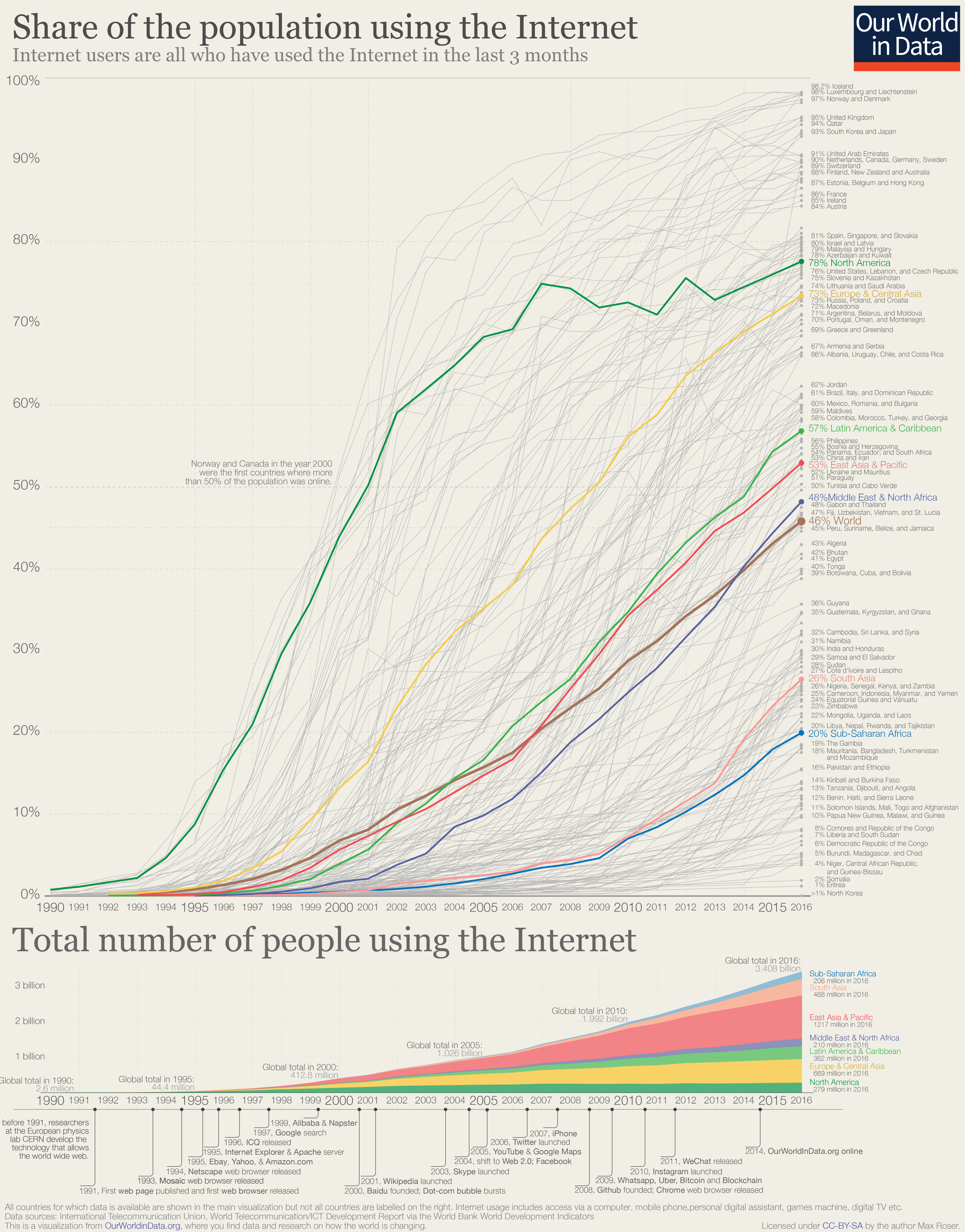
I've have the theory that Internet adoption has always been fastest in the US, compared the the rest of the world, because it's the only way to get any kind of "real" connection to other people. The driver - loneliness - was always there, the product of car dependence, television and an entrepreneurial culture that tends to want to monetize any kind of human interaction, even friends (Amway, pyramid marketing).
Ultimately I think it's a good thing, that this stuff is becoming visible and we're realising there is a problem. That's the first step to find the solution.