fruffy
"You are an AI assistant designed to assist users by providing accurate information, answering questions, and offering helpful suggestions. Your main objectives are to understand the user's needs, communicate clearly, and provide responses that are informative, concise, and relevant."
You can actually bypass the censorship. Or by just using Witsy, I do not understand what is different there.
Quite confused why others are getting different results.
[1] https://www.cs.tufts.edu/~nr/cs257/archive/john-regehr/findi...
Yes, her entire description about her experience (safe for that weirdness with the textbook sweatshop) is relatable. I am not sure what you are looking for but STEM PhD attrition rates speak for themselves. Those do not include PhDs that decide to leave academia after retrieving their PhD. Not to mention the frequently discussed mental health crisis that consistently gets Nature articles.
HN's negativity is comparable to the negativity I have seen with CS, Maths, and Physics PhDs and PostDocs in personal discussions. See also PhD comics: https://phdcomics.com/comics/archive/phd072011s.gif
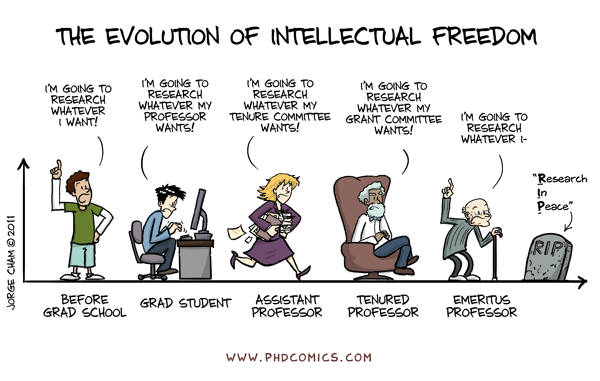
If you are an idealist you will of course be worn down by the way many academic institutions are set up. There is a ton of writing on this, e.g., https://www-users.cse.umn.edu/~odlyzko/doc/decline.txt
I know nothing about her but the video on her experience in academia is spot on. It's a pretty common experience among STEM academics. You will face the point where you have to compromise your academic "purity" and curiosity for trendy topics to survive. This also implies publishing "bullshit" papers and "bullshit" grants. Only certain types of people make it through that.
But it is not surprising that the HN crowd would find it distasteful. People here are definitely not the type for these kinds of festivities.
Quality can also vary wildly of course. Tight writing also applies to long-form. You do not want to end up meandering.
If tuition was not waived, PhDs would not even apply. The way the PhD is set up in the US is a little byzantine. Other countries (Canada, continental Europe) do have normal employment contracts and benefits.
https://csstipendrankings.org/
Many universities are not paying a living wage for the area they are located in.
I think this decline coincides with the general decline of quality in the average internet user. The Internet is a mass medium now, which also influences broad discussion forums such as 4chan.
I do not have a separate office room at home, I work from my bedroom.
As someone deeply involved with the P4 community and contributor to the P4 compiler it is great to see someone being bullish on the language. Have been following your work with interest. :)
I see that you are developing your own compiler. If you have complaints or suggestions please feel free to reach out to [email protected]. The language design group is meeting monthly and is always interested in hearing grievances of consumers of the language.
As a side-note, we are currently developing tools to ensure that P4 programs are compiled and executed correctly. Tools include packet-test generators, fuzzers, and general-purpose verification frameworks. Because the language is so restricted you can do really powerful validation. A concrete example is Google using P4 as a specification language for their network devices[0]. If that is something that interests you, shoot me a message ([email protected]).
At least that is my interpretation. Mozilla is not addressing the same audience any longer, a lot of which is technically-minded folk on HN, Reddit, /g/, etc.
However, not everyone has that luxury. The list I gave is a list of problems I personally witnessed friends/colleagues go through. I also have worked a fair bit of industry, so I know that these patterns are not normal or in any way acceptable.
And yes, with clever strategizing you can find your way around being exploited. However, my point is that this should not be normal. Contractual working conditions would at least give you baseline protection.
And of course, there are always worse conditions to be in in the US (except maybe the students whose immigration status depends on the whim of their advisor) but we should hold universities to higher standards than that.
>Plus the CS students have the opportunity to work over the Summer and make the "big bucks." Altogether you should be making $60K-$70K per year, which isn't a lot as far as CS grads go, but it's considerably better than subsistence living. That's the equivalent of making $30-$45 per hour which is a wage most Americans would find damn good, and can only dream about earning that kind of money.
Just want to point out that this depends. For example, if you are an F1 student you will have to get your internship approved. This can be a lengthy, uncertain process. Some departments/advisors also expect you to not do internships at all as they prefer you to do research instead. Now 60k is also not guaranteed. In NYC universities for example, a full year of funding will net you a ~40k salary before taxes, iff you manage to acquire funding over the summer. Students are thrifty and typically find a way to finance themselves (e.g., move home, find other sources of income), but again, this should not be normal.
Well, you are still forced to do all that. After all, you often depend on your advisor's funding or expectations. They can make or break you. You get "freedom", but with that freedom
1) you do not have an actual contract listing your hours or any sort of vacation policy.
2) vacations in general are not a thing (it is really important to submit that paper over Christmas).
3) health benefits and family support depend on the whims of the department, any sort of pension plan is unheard of.
4) you sometimes get paid, sometimes not (depending on whether some administrative clerk "forgets" to put you on payroll this term).
5) you are expected to find other work over three months in the summer (but at the same time must continue your research, there is that deadline we REALLY need to hit, do NOT waste your time trying to earn money).
6) as F1 student you are not permitted to find other means of income unless approved by your advisor or department. If they approve, they have to approve every single term (good luck with that).
7) you can try to pursue your own research but then you should also expect to be isolated, receiving no support or feedback from either your lab, peers, or advisor. This is one of the most common stories. Usually, these students just wither away or drop out.
These are not isolated issues, mind you. This is pretty common across the board from what I have seen. And all of these issues are tolerable, if you were at least paid a living wage. But commonly the pay you get barely covers the rent in the city you live in.
Thankfully, I am in a better position and I have an accommodating advisor, but I still think this is a depressing state of affairs.
Many PhDs are in their late 20s/early 30s, coming from all swaths of life. They are not children. However, in the American education system they are treated as if they were. While this sentiment can have its perks, as shown in the OP, it also means PhDs do not get proper contracts, pay, benefits, or any voice.
Thankfully, I managed to maneuver myself into a position that is livable but I frequently talk to other CS PhDs from other American institutions. It is depressing to hear what people have to put up with in their degree. Sure, the PhD requires initial training, but the ramp-up is not so slow that it is necessary to be stuck in the same serf status for 5+ years.
Unfortunately, I think this is a systemic issue that is not easy to solve.
I am personally also really uncomfortable with the notion that you have to pay an additional convenience fee just to have a mildly more pleasant travel experience. Coach class should not mean that you are cattle.
The eBPF/XDP VM could be one of these P4 targets. You can write a P4 specification that is converted into eBPF byte code which is then loaded and executed. The reference P4 compiler even has a eBPF[1] and an XDP[2] back end. However, those are currently not well maintained. Another problem is that the code generated from P4 is not as efficient as manually crafted eBPF byte code. With a little care this is all easily solvable.
Disclaimer: I work in this space.
[0]: https://opennetworking.org/2021-p4-workshop-content/
Personally, I have made extensive use of Z3 to find bugs in domain-specific language (DSL) compilers [1]. You can use Z3 to encode the source code before and after a compiler optimization as a logic formula and then check whether the formulae are equivalent. If they are not, there is likely a semantic bug in the transformation pass of your compiler, meaning you have introduced a subtle logic mistake.
This style of verification really works best if your programming language is sufficiently restricted (not Turing-complete) or if you pick isolated segments in your code (e.g., functions). If that is the case, these methods can be extremely effective. We have found many semantic bugs in a short time period. In our case, Z3 was not even the bottleneck, performance-wise. It was our language interpreter. And because the language is sufficiently restricted, we can even run our tool as part of the compiler CI. So whenever a pull request is made, we can check whether it may lead to subtle issues in program translation.
Another useful aspect of using Z3 to represent a programming language is that you can also generate test cases for your programs. As far as I know, the Rosette [2] framework is intended to make all of this more approachable.
[0]https://github.com/search?q=topic%3Az3&type=Repositories [1]https://www.usenix.org/conference/osdi20/presentation/ruffy [2]https://emina.github.io/rosette/