News for hackers. Stuff that matters.
Re:Shibboleths that get you past the initial script stage by netcan on Sunday December 01, 2019 @05:22AM (#21674813)
This is (hopefully not) obnoxiously off-topic...

As a Hebrew speaker, I wish the "shibboleth" idiom (which is a good one) was translated, rather than transliterated. laoned idioms are inherently exotic, and this one is worth demystifying

It means any choice of word (or pronunciation, in the literal example) that clearly identifies the speaker's group affiliations.

A good modern example is "LondonDerry/Derry. This'd be my my choice for an English translation of shibboleth.

These tweets are about hacking shibboleths, which is advanced mode. Basic mode would be just noticing shibboleths, and also why and how they so clearly identify speakers.

Shiboleths can have serious weight, can be used to disarm/arm. They're probably interesting to text analysis as a classifier. You can use them to reliably imply things about you, like patio does

One hack among many possibles. I'm looking forward to Mackenzie's modern Machiavelli YouTube series using Derries.

Re:Shibboleths that get you past the initial script stage by aasasd on Sunday December 01, 2019 @06:53AM (#21675046)
> I wish the "shibboleth" idiom (which is a good one) was translated, rather than transliterated. [...] A good modern example is "LondonDerry/Derry. This'd be my choice for an English translation of shibboleth.

Well, the thing is, I'm not an Englishman so have no idea what's the deal with ‘Derry’ is, but I know what a shibboleth is. It has become an English term—and btw not an idiom in English since it has no other meaning in that language.

Re:Shibboleths that get you past the initial script stage by ValentineC on Sunday December 01, 2019 @06:56AM (#21675056)
> I'm not an Englishman so have no idea what's the deal with ‘Derry’ is

I had to look it up too: https://en.wikipedia.org/wiki/Derry/Londonderry_name_dispute

Re:Shibboleths that get you past the initial script stage by gnufx on Sunday December 01, 2019 @10:14AM (#21675817)
Actually, being English might not help.
Re:Shibboleths that get you past the initial script stage by netcan on Sunday December 01, 2019 @07:40AM (#21675199)
I agree. Terms become terms and we can't change it.

I just meant that idioms tend to be richer when the source is material.

Point taken on finding an example that everyone understands.

Any political context creates shibboleths by the dozen. The UK is good for making ones that stick around. "Nationist" and "National" political movements, for example, are apposite (and opposing).

Re:Shibboleths that get you past the initial script stage by aasasd on Sunday December 01, 2019 @08:41AM (#21675434)
Yeah no, don't do that. After reading about the Derry thing, I realized I better forget all about it and never mention it in the presence of an Irishman, a Northern-Irishman or anyone else from GB, and especially not botch my reference to any one side. ‘Shibboleth’ has the nice quality that no Ephraimites recently had, or are likely to soon have, misfortunes because of the phenomenon, and the whole affair was three thousand years ago.

Where I'm from, some people, having nothing better to do, occasionally raise noise saying that ‘to each his own’ is offensive because it happened to be written by Nazis on a concentration camp. I don't think I need any more unnecessarily politically aroused stubborn people around than there already are.

Re:Shibboleths that get you past the initial script stage by purple_ducks on Sunday December 01, 2019 @10:29AM (#21675891)
> never mention it in the presence of an Irishman, a Northern-Irishman or anyone else from GB, and especially not botch my reference to any one side

It's really only an issue in written form.

In spoken form, the London part is silent so they're both just pronounced Derry..

Signed,

An Irish person.

Re:Shibboleths that get you past the initial script stage by fhars on Sunday December 01, 2019 @02:34PM (#21677344)
Well, that is sort of the point of a shibboleth: those who say it wrong get killed.
Re:Shibboleths that get you past the initial script stage by coldtea on Sunday December 01, 2019 @09:31AM (#21675614)
>As a Hebrew speaker, I wish the "shibboleth" idiom (which is a good one) was translated, rather than transliterated. laoned idioms are inherently exotic, and this one is worth demystifying

Well, it was neither translated, nor transliterated. It was adopted as an english word, with its own dictionary definition and everything.

The definition happens to coincide with the Hebrew, but it could just as well not (there are loaners that have changed definition).

As far as an English speaking person hears the term, whether they know the meaning or not, it's just any other English word -- they can ask people for its meaning, look it up in the dictionary, etc.

The Hebrew origins don't come into play at all, except when one specifically looks for the history/etymology of the term. But it can totally be used as a black box word too.

Re:Shibboleths that get you past the initial script stage by freehunter on Sunday December 01, 2019 @10:40AM (#21675940)
That's (for better or worse) an almost defining characteristic of the English language. We take words from other languages and adopt them as English words. It doesn't matter if the word in English means the same thing as the original word, it doesn't matter what language it came from, it doesn't matter if we're combining two words from different languages to make a new word (television is the Greek word 'tele' combined with the Latin word 'visio').

English is an incredibly dynamic language with very loose rules. If a loanword sounds exotic, well that's half the fun.

Re:Shibboleths that get you past the initial script stage by paradoja on Sunday December 01, 2019 @11:12AM (#21676088)
Well, that's not a defining characteristic of English but of most (all?) living, dynamic languages. I have seen it with the languages I speak or have tried to learn (Spanish, German, Portuguese, Chinese...).
Re:Shibboleths that get you past the initial script stage by coldtea on Sunday December 01, 2019 @11:38AM (#21676226)
Most of those languages though change the original words to suit the language (e.g. with gendered nouns, certain suffixes, changing the spelling, etc).

English tends to just copy, at least from other latin-script languages...

Re:Shibboleths that get you past the initial script stage by FabHK on Sunday December 01, 2019 @01:08PM (#21676827)
Many languages adopt words, but English does so to an unusual degree. As a consequence, it is the language that has most words today, by far.
Re:Shibboleths that get you past the initial script stage by laretluval on Sunday December 01, 2019 @05:37PM (#21678283)
Is there a citation for that?
Re:Shibboleths that get you past the initial script stage by rgossiaux on Sunday December 01, 2019 @07:01PM (#21678701)
No, because it's not scientific. There's no agreed upon definition of what counts as a unique word. Do you count every inflected form, like "dog" and "dogs"? Derivations from other words? Homonyms? Compound words? How do you deal with archaic or obsolete words? And so on...
Re:Shibboleths that get you past the initial script stage by FabHK on Monday December 02, 2019 @05:42AM (#21681347)
Yes, it is not trivial to define what a word is (I am well aware of that), but the fact that it is difficult does not make it impossible to make quantitative comparative statements about the number of words a language has. It is also difficult to exactly define and measure GDP, yet nobody raises that facile methodological objection when we say that Singapore has a higher GDP per capita than Swaziland.

Now, one can basically create an infinite number of words in some languages with compound words (eg German) and agglutination (eg Turkic or Uralic languages); it makes sense to exclude those (to avoid counting infinities).

Here's a source (from a collaboration between Dictionary.com and Oxford University Press) that basically concurs that English is the language with most words (excluding the results of agglutination):

https://www.lexico.com/en/explore/does-english-have-most-wor...

EDIT to add language (family) examples and this:

Here is The Economist with the cop-out answer that it's difficult to count:

https://www.economist.com/johnson/2010/06/23/the-biggest-voc...

Re:Shibboleths that get you past the initial script stage by fortran77 on Sunday December 01, 2019 @11:20AM (#21676134)
The "definition" of the word doesn't coincide with the Hebrew meaning at all. In Hebrew the word refers to grain (and in modern Hebrew Oat grain.)

The definition comes from a story in the Tanach where the word is used. I believe Christians have appropriated this book of the Tanach, too. And this appropriation is what's reflected in English

https://www.sefaria.org/Judges.12.6?lang=bi

Re:Shibboleths that get you past the initial script stage by leipert on Sunday December 01, 2019 @05:31AM (#21674837)
Yes. I am a native German speaker, and apart from grammar (people usually have a bit of trouble with cases, articles and particles) there are a few nice words to trip people up:

- Streichholzschächtelchen (match box – diminutive): https://commons.wikimedia.org/wiki/File:De-Streichholzsch%C3...

- Austrians use a lot of different words, my favorite being Jänner and not Januar for the month January

- Swiss German: Chuchichäschtli (small kitchen cup board) which is hard to pronounce, apparently Arab, Dutch and Hebrew speakers are at an advantage here.: https://commons.wikimedia.org/wiki/File:Chuchichaeschtli.ogg

- Another fun thing, different words for bread rolls depending where you are from: http://www.atlas-alltagssprache.de/wp-content/uploads/2012/1...
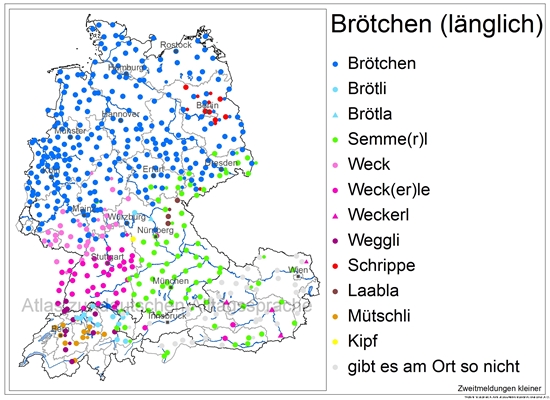
Re:Shibboleths that get you past the initial script stage by netcan on Sunday December 01, 2019 @05:38AM (#21674848)
Funny on the the swiss example. I was just thinking: that's not hard to say!

Hebrew is well adapted to dealing with words made mostly made from subtle variations of s, sh & t sounds... Which brings us full circle to shibboleth/שיבולת

Re:Shibboleths that get you past the initial script stage by fortran77 on Sunday December 01, 2019 @11:21AM (#21676139)
It's שבלת when referring to the biblical use. You got the modern spelling of the word for "oatmeal" from google translate.

See https://www.sefaria.org/Judges.12.6?lang=bi for the source.

Re:Shibboleths that get you past the initial script stage by hermanKM on Sunday December 01, 2019 @11:56AM (#21676331)
Both spellings are correct ( שיבולת and שבלת ).

Netcan is using the standardized Rules for Spelling without vowel pointers (Niqqud) enacted by the Academy of the Hebrew Language, which is rejected by some Hebrew language purists.

The rules: https://en.wikipedia.org/wiki/Ktiv_hasar_niqqud

Re:Shibboleths that get you past the initial script stage by trollied on Sunday December 01, 2019 @06:17AM (#21674935)
> different words for bread rolls depending where you are from

This is also a British thing: https://yougov.co.uk/topics/food/articles-reports/2018/07/19...

Re:Shibboleths that get you past the initial script stage by FabHK on Sunday December 01, 2019 @07:27AM (#21675159)
Allegedly, during the invasion of the Netherlands by Nazi forces commencing on May 10th, 1940, the Dutch used "Scheveningen" or "beschuit" as a shibboleth to distinguish German speakers from Dutch. I don't quite understand that, as most Germans don't speak Dutch, full stop, and it would be trivial to distinguish them thereby, while presumably if you have gone to the trouble of learning Dutch, you'd know how to pronounce "Scheveningen".

At any rate, that story is often cited, eg in this insightful article that has many more examples:

Mcnamara, T. "21st Century Shibboleth: Language Tests, Identity and Intergroup Conflict " Lang Policy (2005) 4: 351. https://doi.org/10.1007/s10993-005-2886-0

Re:Shibboleths that get you past the initial script stage by hprotagonist on Sunday December 01, 2019 @07:50AM (#21675232)
> while presumably if you have gone to the trouble of learning Dutch, you'd know how to pronounce "Scheveningen".

It’s actually hard to do. This is a good choice of shibboleth.

I’d propose “squirrel” as an english word to find german speakers.

Famously, pacific theater allied forces occasionally used “lollapalooza” as a shibboleth, also for fairly obvious reasons.

Re:Shibboleths that get you past the initial script stage by leipert on Sunday December 01, 2019 @10:33AM (#21675908)
Ha. That is nice, because Eichhörnchen (squirrel) is also a hard one in German.
Re:Shibboleths that get you past the initial script stage by mhink on Sunday December 01, 2019 @01:01PM (#21676788)
The same issue exists in French, as well! "Écureuil" (squirrel) is somewhat difficult for English speakers to pronounce, and "squirrel" (écureuil) is somewhat difficult for French speakers to pronounce.
Re:Shibboleths that get you past the initial script stage by hprotagonist on Sunday December 01, 2019 @12:26PM (#21676571)
Re:Shibboleths that get you past the initial script stage by CalChris on Sunday December 01, 2019 @12:00PM (#21676359)
Scheveningen is one of the districts of The Hague. It's also a variation of the Sicilian chess opening (1.e4 c5 2.Nf3 d6 3.d4 cxd4 4.Nxd4 Nf6) which is how I learned that story.

Anyways, someone who is Dutch (I'm not) would know how to pronounce it. Someone purporting to be Dutch highly likely would botch it miserably.

A modern example of this sort of shibboleth is:

https://twitter.com/richardfausset/status/861297977813590019

Re:Shibboleths that get you past the initial script stage by indocomsoft on Sunday December 01, 2019 @08:10AM (#21675305)
I think it’s because in German, sch is one consonant (like sh in English), while in Dutch, sch is a consonant cluster of s-ch, ch as in Loch Ness.
Re:Shibboleths that get you past the initial script stage by 80386 on Sunday December 01, 2019 @10:00AM (#21675748)
Also, in many dialects of Dutch, including the standard, the long e in the first syllable of Scheveningen is pronounced closer to the English long a than the German long e, and the final -n is silent. So a typical Dutch pronunciation would be (something like) [sxeɪ̯vənɪŋə], vs. German [ʃe̝ːvənɪŋən].
Re:Shibboleths that get you past the initial script stage by FabHK on Sunday December 01, 2019 @09:29AM (#21675610)
Yes, but presumably you’d learn that when you learn Dutch. I maintain that it is easier for a German speaker to learn the pronunciation of “Scheveningen” than to learn the entire Dutch language, and that L1 German speakers that learned Dutch as a foreign language will pronounce “Scheveningen” correctly, or, at any rate, not make the trivial mistake of analysing “sch” as the trigraph "sch," pronounced [ʃ], rather than as the letter "s" and the digraph "ch", producing the consonant cluster [sx].
Re:Shibboleths that get you past the initial script stage by coldtea on Sunday December 01, 2019 @09:35AM (#21675626)
>Yes, but presumably you’d learn that when you learn Dutch.

Learning it theoretically (and adapting to it somewhat) and being able to fluidly pronounce it as a native are two different things...

>and that L1 German speakers that learned Dutch as a foreign language will pronounce “Scheveningen” correctly

Technically correctly. Not natively correctly. There would still be differences...

Re:Shibboleths that get you past the initial script stage by coldtea on Sunday December 01, 2019 @09:34AM (#21675621)
>while presumably if you have gone to the trouble of learning Dutch, you'd know how to pronounce "Scheveningen"

The idea behind that scheme was not about people "knowing" how to pronounce or not.

The idea was that native speakers would pronounce it differently than people who merely learned the language as foreigners -- which could then be identified even if it was subtle.

Re:Shibboleths that get you past the initial script stage by sukilot on Sunday December 01, 2019 @08:32AM (#21675396)
I'm not Irish, so Derry is just as exotic as shibboleth.

English is made of Greek and Latin and German and more; it's weird to say that one of those languages is exotic, but weirder still to level that complaint against the oldest known word whose meaning hinges on it being intentionally exotic.

Finally, Londonderry/Derry is a disagreement, not a shibboleth. Shibboleth is about having the ability to pass as a native, not the preference to do so. In modern IT terms, It's something you are, not something you know.

Re:Shibboleths that get you past the initial script stage by netcan on Sunday December 01, 2019 @10:18AM (#21675831)
It's also a disagreement.

In practice and common language though, the choice of words gives you information about the speaker.

Re:Shibboleths that get you past the initial script stage by peteretep on Sunday December 01, 2019 @11:22AM (#21676145)
But it can be faked, in a way that a Shibboleth can’t
Re:Shibboleths that get you past the initial script stage by 80386 on Sunday December 01, 2019 @09:57AM (#21675729)
> As a Hebrew speaker, I wish the "shibboleth" idiom (which is a good one) was translated, rather than transliterated. laoned idioms are inherently exotic, and this one is worth demystifying

Until a few decades ago, it was assumed in educated Protestant society that everyone was familiar with the Bible. So a lot of biblical idioms are still present.

Re:Shibboleths that get you past the initial script stage by netcan on Sunday December 01, 2019 @05:07PM (#21678123)
Hmm.

I now just realized that the biblical translators must have chosen to transliterate the word, not translate it.

It's probably because in context its about how the word is pronounced, not meaning. In any case, I guess the idiom would have never taken off with the word "corn."

Re:Shibboleths that get you past the initial script stage by acqq on Sunday December 01, 2019 @06:08PM (#21678441)
You can compare the different translations, even through the centuries, here:

Vulgate, cc 4th century CE:

https://www.biblegateway.com/passage/?search=Judges+12%3A5-6...

Luther, 1545:

https://www.biblegateway.com/passage/?search=Judges+12%3A6&v...

King James Bible (1611):

https://www.biblegateway.com/passage/?search=Judges+12%3A6&v...

Septuagint (the Greek translation, older than all above, around 3rd century BCE) didn't keep that word as is:

https://forum.wordreference.com/threads/shibboleth-in-the-se...

"the LXX scholars had difficulties translating the Hebrew word שבלת Shibboleth into Greek, for the simple reason, Greek lacks the phoneme [ʃ]"

Re:Shibboleths that get you past the initial script stage by sudosteph on Sunday December 01, 2019 @01:28PM (#21676949)
A good one in the Southern U.S. is the pronunciation of the word "Appalachian". I'm from NC and whenever I hear someone say "Appa-lay-shin" I immediately know they aren't local and I start acting a little different accordingly. Not in a mean way, but I know I can't open up completely to those people because from experience I know they might judge me according to stereotypes about that region.
Re:Shibboleths that get you past the initial script stage by saagarjha on Sunday December 01, 2019 @01:33PM (#21676990)
How would you pronounce it? Appa-lah-chi-an?
Re:Shibboleths that get you past the initial script stage by cjslep on Sunday December 01, 2019 @02:41PM (#21677386)
I'm originally from NC but the piedmont region (Charlotte), not the mountains, and would say "Appa-LA-chin". ("La" rhymes with the "a" in "matt") Making the long-a sound ("la"->"lay"), or both long-a and "ch"->"sh", is common from northerners who have (or still are) moving to the city from elsewhere.
Re:Shibboleths that get you past the initial script stage by sudosteph on Sunday December 01, 2019 @04:51PM (#21678035)
Yep, and that's the same pronunciation used in Western NC too (ie, how locals say "Appalachian State" in Boone).
Re:Shibboleths that get you past the initial script stage by sudosteph on Sunday December 01, 2019 @02:39PM (#21677375)
App-uh-LATCH-in
Re:Shibboleths that get you past the initial script stage by fortran77 on Sunday December 01, 2019 @11:17AM (#21676122)
And for those wondering where it comes from (us Hebrew speakers know, unless we don't pay attention during Haftorah...) here's in the Tanach where the word שבלת is used:

https://www.sefaria.org/Judges.12.6?lang=bi

In Modern Hebrew the term with the modern spelling "שיבולת שועל" is used to mean "Oatmeal"

Re:Shibboleths that get you past the initial script stage by CharlesColeman on Monday December 02, 2019 @11:16AM (#21683769)
> These tweets are about hacking shibboleths, which is advanced mode. Basic mode would be just noticing shibboleths, and also why and how they so clearly identify speakers.

Yeah. Also using the word "shibboleth" for "advance mode" make some sense, but seems like an uncommon usage. To me, has strong connotations of the "basic mode," i.e. a word use that indirectly gives away someones identity.

Re:Shibboleths that get you past the initial script stage by dmitryminkovsky on Sunday December 01, 2019 @08:33AM (#21675398)
> Shiboleths can have serious weight

Yeah "shibboleth" carries a really serious (life/death) connotation for me as well. Was confused to see it here like this.

Re:Shibboleths that get you past the initial script stage by ljm on Sunday December 01, 2019 @09:45AM (#21675670)
I think Inglorious Basterds captures this quite well, in the underground bar scene where the use of three fingers to gesture ‘three’, as opposed to a thumb and two fingers. That blew the Brits’ cover and resulted in their deaths.
Re:Shibboleths that get you past the initial script stage by antonvs on Monday December 02, 2019 @05:44AM (#21681358)
I don't understand what you're saying about Derry. It's an example of a shibboleth, but it wouldn't be a translation of the word. It's also pretty obscure for most people outside of Ireland.
Re:Shibboleths that get you past the initial script stage by m4r35n357 on Sunday December 01, 2019 @06:01AM (#21674901)
Some good ones for US/UK: fanny, fag or if you are polite: pants
Re:Shibboleths that get you past the initial script stage by chillydawg on Sunday December 01, 2019 @06:00AM (#21674900)
Is using the word shibboleth a shibboleth? I never really understood it until now and have never and probably wouldn't use it.
Re:Shibboleths that get you past the initial script stage by EliRivers on Sunday December 01, 2019 @06:40AM (#21675007)
The word itself was the original shibboleth; used to identify fleeing Ephraimites. It did not go well for those Ephraimites thus identifed.
Re:Shibboleths that get you past the initial script stage by FabHK on Sunday December 01, 2019 @07:18AM (#21675129)
Specifically, Judges 12:4-6:

4 Jephthah then called together the men of Gilead and fought against Ephraim. The Gileadites struck them down because the Ephraimites had said, “You Gileadites are renegades from Ephraim and Manasseh.” 5 The Gileadites captured the fords of the Jordan leading to Ephraim, and whenever a survivor of Ephraim said, “Let me cross over,” the men of Gilead asked him, “Are you an Ephraimite?” If he replied, “No,” 6 they said, “All right, say ‘Shibboleth.’” If he said, “Sibboleth,” because he could not pronounce the word correctly, they seized him and killed him at the fords of the Jordan. Forty-two thousand Ephraimites were killed at that time.

Re:Shibboleths that get you past the initial script stage by afarrell on Sunday December 01, 2019 @06:52AM (#21675039)
The word "lollapalooza" was used similarly in night-fighting against the Japanese in WWII.
Re:Shibboleths that get you past the initial script stage by ptaipale on Sunday December 01, 2019 @02:31PM (#21677328)
My father was a veteran of WWII, in the Finnish army fighting the Soviets.

In (I think) 1972, I was a 6-year-old kid, and we went to the town 60 km away (we did not go there very often).

Suddenly, my father exclaimed "Hei yks!" (Finnish for "hello one!") to a man on the street. Then they greeted and spoke quietly for quite a while. I didn't understand it at all.

Only much later I realized that the other man was a brother-in-arms of my father, and "Hei yks!" was the shibboleth of their unit; it had been devised for a night-time attack in very extreme conditions in February 1942, and the men in the brigade then used it throughout the war to identify each other whenever there was no mission-specific one defined. Russians cannot very well pronounce the y in "yks" the way Finns do. (This was of course no strong guarantee because the Soviet army had some native Finnish-speakers, but most were not.)

Re:Shibboleths that get you past the initial script stage by partyboat1586 on Sunday December 01, 2019 @08:07AM (#21675287)
Using the word makes you sound like a smartass. As if other people don't know what a shibboleth is. Everyone knows it without needing a word for it.
Re:Shibboleths that get you past the initial script stage by forgotmypwd123 on Monday December 02, 2019 @08:06AM (#21681996)
I feel obligated to say, I THINK YOU'LL FIND THAT'S DERRY/LONDONDERRY, SON.
Re:Shibboleths that get you past the initial script stage by netcan on Monday December 02, 2019 @01:21PM (#21685124)
Is it? I don't think anyone but the city council and BBC use the hyphen.
Re:Shibboleths that get you past the initial script stage by forgotmypwd123 on Tuesday December 03, 2019 @06:13AM (#21691466)
Or the civil service. I'm sure there's plenty of dickheads would still want derry put first even when using both, though
Re:Shibboleths that get you past the initial script stage by GuB-42 on Sunday December 01, 2019 @11:21AM (#21676140)
Maybe you can partly blame xkcd for the transliteration. https://xkcd.com/806/
Re:Shibboleths that get you past the initial script stage by tempguy9999 on Sunday December 01, 2019 @07:08AM (#21675102)
"patio"? I assumed you meant Patois, but I'm not sure now.
Re:Shibboleths that get you past the initial script stage by vermilingua on Sunday December 01, 2019 @07:11AM (#21675109)
patio as in @patio11, as in the author of that thread.
Re:Shibboleths that get you past the initial script stage by netcan on Sunday December 01, 2019 @07:43AM (#21675212)
yup, thanks.